One Bone Reveals a Giant in Kalasin
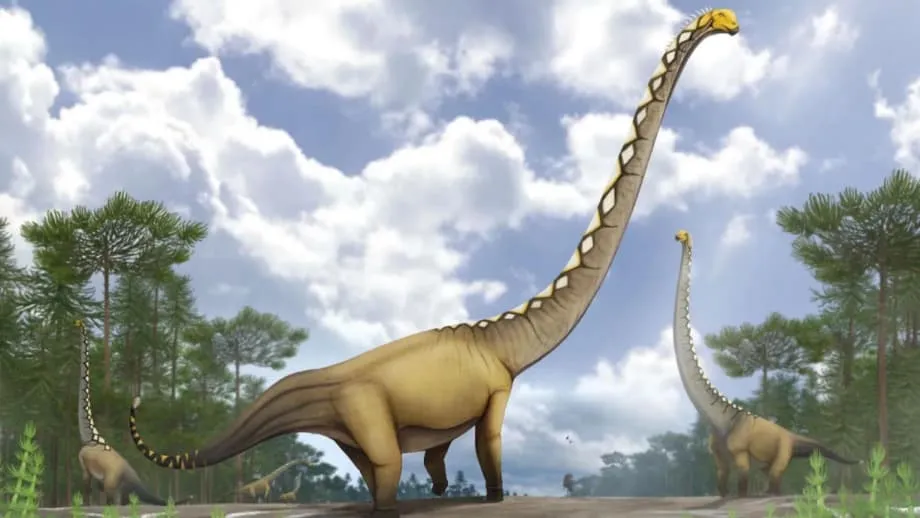
A single fossil backbone has led scientists in Thailand to identify Uragasaurus kalasinensis, a dinosaur that ate plants, reached up to 20 metres in length and lived roughly 150 million years ago. Found in what is now Kalasin Province, the animal was about 66 feet long, nearly the length of a cricket pitch.
Contents
- One Bone Reveals a Giant in Kalasin
- A Local Discovery Opened a Rich Fossil Site
- How Scientists Recognised a New Species
- Air Chambers Helped Make Giant Bodies Possible
- Why a Giraffe Cannot Match a Sauropod
- A Wider Map for Mamenchisaurids
- Filling a Gap Between Two Dinosaur Eras
- Two Thai Giants From Different Family Branches
- More Fossils Could Complete the Picture
- The Bottom Line
The newly described dinosaur belongs to Mamenchisauridae, a family of sauropods famous for extraordinarily long necks. Its identification makes it the first formally named member of that family from Thailand, extending the group's known presence into mainland Southeast Asia.
Scientists identified the species from an anterior dorsal vertebra, a bone from the upper or middle back, just behind the neck. Its unusual combination of external ridges and internal air cavities gave researchers the anatomical evidence needed to distinguish it from known dinosaurs.
Uragasaurus walked on four sturdy legs resembling pillars and fed on vegetation in ancient forests. Its elongated neck would have allowed it to reach leaves at different heights without repeatedly moving its enormous body.
The name connects the animal's appearance with its home. Uraga is a Sanskrit word for snake or serpent, reflecting the dinosaur's serpentine neck, while kalasinensis refers to Kalasin Province, where the fossil was found.
The discovery, described in Scientific Reports, a journal from the Nature Publishing Group, has drawn attention from paleontologists around the world. Alongside another giant dinosaur identified in Thailand in May, it adds to a year of striking discoveries about the country's ancient animals.
A Local Discovery Opened a Rich Fossil Site
The story began in 2008, when a resident of Kalasin Province noticed fragments resembling serpent scales. That chance observation brought researchers to Phu Noi, which has since become one of Thailand's richest fossil localities.
Excavations at Phu Noi have produced a large collection of remains from the Late Jurassic period. More than 90 percent of the material recovered belongs to dinosaurs, making the site particularly valuable for reconstructing the animals that lived in the region.
Survey teams found teeth, bones and other fragments in sediments of the Phu Kradung Formation. Ancient rivers deposited those sediments, preserving traces of the creatures that inhabited the surrounding landscape.
Among the discoveries was the carefully preserved vertebra that would become the basis for naming Uragasaurus. At first glance, the bone resembled a typical sauropod vertebra. Detailed examination revealed features that set it apart.
The main stages of the discovery and the other major Thai dinosaur announcement were:
- 2008: A local resident found fragments resembling serpent scales in Kalasin Province, leading researchers to Phu Noi.
- Subsequent excavations: Teams recovered dinosaur teeth, bones and other remains, including the vertebra later assigned to Uragasaurus.
- May 2026: Scientists announced Nagatitan, a different giant dinosaur found in Chaiyaphum Province.
- July 2026: Two months after the Nagatitan announcement, Uragasaurus added another named giant to Thailand's dinosaur record.
How Scientists Recognised a New Species
Dr. Apirut Nilpanapan, a paleontologist at Mahasarakham University and the study's lead author, identified a distinctive arrangement of bony ridges on the vertebra. These ridges, called laminae, formed a Y shape.
CT scanning revealed another crucial feature inside the fossil: an unusual arrangement of air cavities. The technology let the researchers examine the bone's interior without damaging it, exposing details that traditional preparation methods would have left hidden.
Nilpanapan explained that the internal anatomy helped distinguish the fossil from other known dinosaurs:
The features, in particular a unique air cavity structure, were unlike any other dinosaur in the world. That is what sets it apart.
Paleontologists frequently work with incomplete skeletons. A single bone can be enough to identify a new species when it preserves a distinctive combination of anatomical features. For Uragasaurus, the researchers found that combination in the vertebra's external ridges and internal structure.
The formal description includes a diagnosis, an explanation of the specific traits that separate the species from every other known animal, living or extinct. In this case, one vertebra carried the identifying details that a much larger skeleton might otherwise provide.
Nilpanapan later described an intense reaction to confirming the discovery. He said he smashed his computer in excitement and felt both exhilarated and relieved at recognising a species new to science.
Air Chambers Helped Make Giant Bodies Possible
Uragasaurus belonged to a family whose members developed some of the longest necks in the history of life. In some mamenchisaurids, the neck alone could stretch beyond 15 metres.
Mamenchisaurids were not closely related to neosauropods such as Brachiosaurus and Diplodocus. Those groups independently developed a similar way of reaching vegetation: a long neck carried by a large body supported on four legs.
Such proportions required a skeleton that combined strength with relatively low weight. Sauropods had a pneumatic internal structure in their vertebrae, meaning that air spaces occupied parts of the bones.
Like modern birds, these dinosaurs had respiratory air sacs that extended into their skeletons. The resulting chambers reduced bone weight without sacrificing strength, helping support enormous necks and bodies while the animals walked and fed.
The CT scan of the Uragasaurus vertebra showed a camellate internal pneumatic structure. In simpler terms, the bone contained a network of small air chambers resembling a honeycomb. The Y arrangement of laminae on its exterior provided additional support.
These features illustrate the strong but light skeletal construction that helped sauropods carry their elongated necks. A neck with that reach could sweep across a broad arc of vegetation, allowing the animal to feed over a large area while moving its body relatively little.
Why a Giraffe Cannot Match a Sauropod
Modern giraffes have exceptionally long necks for mammals, yet their proportions fall far short of those reached by sauropods. The difference involves the way their bodies and skeletons are built.
Giraffes lack the air sac system and pneumatic vertebrae that helped these dinosaurs reduce skeletal weight. Without those adaptations, a neck on the scale of the longest sauropod necks would have imposed enormous weight and mechanical stress.
The air chambers therefore help explain more than the appearance of a single fossil bone. They were part of the anatomy that allowed sauropods to reach body sizes beyond those of any land mammal.
For Uragasaurus, the same internal spaces also supplied evidence for identification. The researchers could study both how the bone was constructed and how its particular arrangement differed from that of other dinosaurs.
A Wider Map for Mamenchisaurids
China has supplied most known mamenchisaurid fossils, particularly from the Sichuan Basin. The Shaximiao Formation there has yielded many well known species, contributing to the earlier view that the family was largely restricted to East Asia.
Discoveries elsewhere have broadened that picture. Vertebrae from Tanzania, originally assigned to another sauropod, were later recognised as belonging to mamenchisaurids. That reassessment showed that members of the family also lived in Africa.
Uragasaurus now confirms the presence of these dinosaurs in mainland Southeast Asia. Together, the Thai and African evidence points to a wider geographic range than scientists once appreciated and to animals capable of spreading across substantial areas of ancient land.
During the Jurassic, much of what is now Southeast Asia was connected with other parts of Asia by landmasses that allowed animals to move between regions. Similarities between some Chinese and Thai fossils provide clues to those connections.
The precise routes and timing of those movements remain uncertain because the fossil record is limited. Additional specimens could help researchers establish whether Uragasaurus had close relatives elsewhere in Southeast Asia or belonged to a local lineage that evolved in isolation.
Filling a Gap Between Two Dinosaur Eras
The Thai discovery also helps fill a gap in the fossil record around the transition from the Late Jurassic to the Early Cretaceous, roughly 150 million to 143 million years ago.
Dinosaur communities changed during that interval. Some groups declined while others became more prominent, making fossils from this period useful for tracing how different kinds of dinosaurs replaced or lived alongside one another.
Uragasaurus represents an early diverging mamenchisaurid, a branch that separated relatively early in the family's evolutionary history. Its presence in Thailand points to Southeast Asia as an active centre of sauropod diversity during this interval, rather than simply a destination for animals arriving from China.
The discovery brings together two kinds of evidence: the anatomy that identifies a new species and the location that places it on the ancient map. Both matter when scientists try to reconstruct where these animals evolved and how far their relatives travelled.
Two Thai Giants From Different Family Branches
Uragasaurus follows another major discovery announced two months earlier. In May, scientists identified Nagatitan, a dinosaur with an elongated neck found in Chaiyaphum Province.
Nagatitan measured about 27 metres and weighed an estimated 27 tonnes, making it the largest dinosaur ever found in Southeast Asia. Its estimated weight was roughly equivalent to nine adult Asian elephants.
The figures put Nagatitan about seven metres longer than the upper length estimate for Uragasaurus: 27 metres compared with 20 metres. Both were giant herbivores, but they belonged to different branches of the sauropod family tree.
Nagatitan was a titanosauriform. Members of that lineage would go on to dominate the Cretaceous period and include the largest land animals of all time. Uragasaurus belonged to Mamenchisauridae.
The two dinosaurs lived at different times. Their discoveries show that Thailand supported a varied succession of giant animals that ate plants during the Jurassic and Cretaceous periods.
Uragasaurus was smaller than Nagatitan, yet its scientific value lies in expanding the known diversity and geographic distribution of its family. Together, the discoveries raise the international profile of Thai paleontology and can attract collaborations and funding that may speed further research.
More Fossils Could Complete the Picture
Phu Noi and the wider Phu Kradung Formation remain promising places for further excavation. Compared with China's extensively explored fossil basins, Southeast Asia has received relatively limited paleontological attention, and many deposits have been only partly studied.
Researchers expect continued work in Thailand to produce more fossils, potentially including further mamenchisaurid specimens. Additional bones could provide a fuller picture of Uragasaurus and its relatives.
Future discoveries could also help explain how these dinosaurs moved across ancient continents, how their extreme necks evolved and how they interacted with other species in their ecosystems. Finding related animals elsewhere would help test whether the Thai species belonged to a wider regional group.
For Nilpanapan, identifying Uragasaurus also fulfilled a fascination that began in childhood. His grandfather read to him from a dinosaur book every night, an experience that helped set him on the path toward studying prehistoric life.
The discovery connects that childhood interest with a resident's observation of unusual fragments in Kalasin. One led to a scientific career; the other led researchers to a fossil site where a single vertebra preserved enough detail to name a new dinosaur.
The Bottom Line
- Uragasaurus kalasinensis was identified from a single vertebra found in Kalasin Province, Thailand.
- The dinosaur ate plants, lived about 150 million years ago and reached up to 20 metres, or about 66 feet, in length.
- Y shaped bony ridges and a distinctive internal air cavity structure helped researchers distinguish the species.
- The study, published in Scientific Reports, formally names Thailand's first mamenchisaurid dinosaur.
- The discovery expands the family's known presence into mainland Southeast Asia and helps fill a gap around the Jurassic to Cretaceous transition.
- It follows the May identification of Nagatitan, a dinosaur about 27 metres long and weighing an estimated 27 tonnes, from Chaiyaphum Province.
- Further work at Phu Noi and across the Phu Kradung Formation could reveal more about sauropod evolution, movement and diversity.