Two Mong Kok Bookshops Raided as Pressure Grows
Five people arrested in raids on two independent Hong Kong bookstores on July 15, 2026, were released on bail on July 17, pending further investigation. The operation against Have A Nice Stay and Greenfield Book Store in Mong Kok, Kowloon, was the third targeting independent booksellers in four months.
Contents
- Two Mong Kok Bookshops Raided as Pressure Grows
- A Closure Announced Before the Police Arrived
- Three Operations in Four Months
- How the Security Laws Reach Publishing
- Chris Tang Rejects a List of Banned Books
- Amnesty Warns of Fear and Self Censorship
- Taiwan's Response and the Book Fair
- The Shadow of the Causeway Bay Disappearances
- What Readers, Writers and Shops Are Losing
- The Bottom Line
National security police arrested two men aged 37 and 57 and three women aged between 30 and 59 on suspicion of "acting with seditious intent" under Hong Kong's 2024 national security legislation. Authorities alleged that publications displayed and sold at the shops incited hatred against the government, judiciary and law enforcement agencies. A conviction could carry up to seven years in prison.
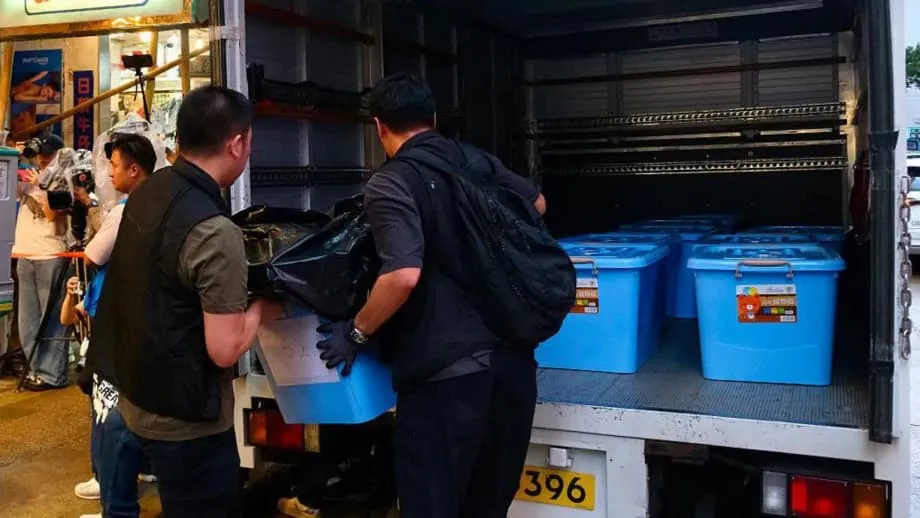
The investigation began after customs officials found allegedly seditious books in an overseas shipment bound for Hong Kong and referred the matter to the National Security Department. Officers subsequently searched both stores and removed boxes of materials.
Reporters from Agence France-Presse witnessed officers escorting a handcuffed woman from Have A Nice Stay into a van. Video from online outlet The Collective showed similar scenes at nearby Greenfield Book Store, with officers wearing vests marked "Police" carrying boxes from the premises.
Police did not officially name either bookstore or disclose the titles involved. The shops were identified through reporting and witness accounts. The five people remained under investigation after their release, with legal proceedings continuing.
The arrests came one day after Have A Nice Stay announced that it would close permanently on August 30. They also preceded the opening of the Hong Kong Book Fair on July 16, an event that neither raided shop was participating in. Together, those dates show how commercial difficulties, uncertainty about permissible books and police enforcement have converged for the city's independent booksellers.
A Closure Announced Before the Police Arrived
Have A Nice Stay opened in 2022, founded by former journalists including veteran reporter Sum Wan-wah. Several founders had worked for Stand News, the independent online publication that police shut down in 2021.
The bookstore stocked literature about democracy, authoritarianism and media literacy. Its founders sought to preserve a space where readers could examine politics, understand how information is produced and encounter different ideas amid growing restrictions on public expression.
On July 14, the store announced its planned August 30 closure on social media. It cited financial difficulties and what it called an "elusive 'red line'" separating acceptable material from books that might attract official action.
The shop explained that its staff could not read every book in its inventory and lacked the ability to judge which titles might cross that boundary. For a small bookseller, this meant having to make decisions about a large collection without knowing precisely which publications authorities considered unlawful.
The raid effectively accelerated a closure the owners had already decided upon. Its timing also brought the shop's stated concern into immediate focus: uncertainty about stock was followed, within a day, by a police search and arrests.
Greenfield Book Store had a broader and more established presence in the community. Its Facebook page described a collection drawn from Hong Kong and Taiwan, covering literature, history, philosophy, art, sociology and personal development. The two targeted shops therefore served readers with overlapping but different interests.
The specific publications remained officially undisclosed. Sources cited by the South China Morning Post identified books by the late opposition lawmaker Bottle Shiu Ka-chun and "Stay," a memoir by former Democratic Party legislator Emily Lau Wai-hing, as titles suspected of promoting sentiment against the government. Booksellers were left without an official list identifying the material at the centre of the investigation.
Three Operations in Four Months
The July arrests followed police action against Book Punch in March and Hunter Bookstore in June. Across those three operations, the arrest figures were four, two and five respectively, a total of 11 people.
Four Book Punch workers were arrested in March on suspicion of selling seditious publications. The books included a biography of jailed media tycoon Jimmy Lai, a supporter of democracy who was sentenced to 20 years in prison in his national security case.
Two Hunter Bookstore employees were arrested on similar grounds in June. Owner Letitia Wong and her husband were additionally accused of receiving funds from foreign political organisations, bringing an allegation about overseas funding into the pressure facing that business.
The sequence continued through July, when a closure announcement, bookstore raids and the opening of a major publishing event occurred within three days:
- March 2026: Four workers at Book Punch were arrested over suspected seditious publications.
- June 2026: Two employees at Hunter Bookstore were arrested on similar grounds, with additional allegations involving foreign political funding against Letitia Wong and her husband.
- July 14, 2026: Have A Nice Stay announced that it would close on August 30.
- July 15, 2026: Police raided Have A Nice Stay and Greenfield Book Store and arrested five people.
- July 16, 2026: The Hong Kong Book Fair opened, and Security Secretary Chris Tang defended the enforcement action.
- July 17, 2026: The five people arrested in the latest raids were released on bail pending further investigation.
Independent bookstores once flourished as places where ideas could circulate freely in Hong Kong. The city had a reputation across Asia for freedom of publication and expression, attracting mainland Chinese visitors who crossed the border to buy books considered too politically sensitive for their home market.
How the Security Laws Reach Publishing
Hong Kong's present legal framework followed the large protests against the government in 2019. Beijing imposed a national security law in 2020, creating offences involving secession, subversion, terrorism and collusion with foreign forces.
Hong Kong then adopted the Safeguarding National Security Ordinance in 2024, commonly called Article 23. That legislation built on the 2020 law, adding detail and expanding official powers in ways that affect speech, publishing and cultural expression.
The allegation of "seditious intention" draws on offences originating in laws from the colonial period. Those provisions were rarely used in modern Hong Kong before their revival under the newer security framework.
Sedition, in this context, reaches beyond calls for violence or the overthrow of the government. It can include expression that "stirs up hatred" against authorities or institutions. The July allegations concern hostility towards the government, courts and law enforcement agencies, with a maximum prison term of seven years.
Prosecutors have wide discretion in deciding which publications fall within that standard. A bookseller therefore faces a legal question about the content and meaning of a publication, rather than simply whether the business has followed ordinary rules for importing and selling goods.
Customs inspections add another point at which books can enter the security system. In the July case, officials flagged an overseas shipment before referring it for investigation. Imported publications can therefore attract scrutiny before reaching a shop's shelves, extending content controls beyond local writers and publishers to the international movement of books.
The two security laws have brought areas of expression previously protected in Hong Kong into the reach of national security enforcement. For publishers and readers, the consequences extend from what can be written locally to what can be brought into the city from elsewhere.
Chris Tang Rejects a List of Banned Books
Secretary for Security Chris Tang addressed the raids at a press conference on July 16. He said booksellers were responsible for ensuring that their merchandise did not threaten national security and compared that duty to the responsibilities of a business selling food.
If you are a bookseller, you have a responsibility to make sure the books you sell won't endanger national security," he stated. "It's equal to, for example, when you are selling food, you need to ensure the food won't cause a stomach ache and is not either poison or illegal.
Tang's analogy drew criticism because evaluating political writing involves interpreting ideas, while food safety concerns whether a product is safe to consume. Have A Nice Stay's closure message had already described the practical difficulty of assessing every title in a bookstore.
Tang rejected suggestions that authorities publish a list of banned books. He called such a list "pointless" and "not conducive to effective law enforcement," arguing that people could avoid detection by changing wording or titles.
The security secretary maintained that the law itself provided sufficient guidance:
"The law is very clear. If you break the law, you have crossed the red line," he declared.
Tang also said authorities did not target particular sectors. He gave a broader warning about enforcement against businesses and individuals:
if any shops or individuals engage in any activity that endangers national security, we will take enforcement action
The recent operations have nevertheless repeatedly focused on independent bookstores. Tang's position leaves sellers responsible for compliance while denying them a title by title guide to what authorities consider prohibited.
Legal scholars and human rights advocates describe this uncertainty as a means of deterring expression. Small shops must either attempt to review every book in detail or avoid potentially objectionable material in advance. Such self censorship can remove whole categories of political, historical and social commentary, rather than just the publications involved in particular cases.
Legal systems ordinarily aim to give people clear notice of prohibited conduct. Under the approach described by critics, booksellers instead discover boundaries through enforcement and prosecution. Those critics call this "rule by law" rather than "rule of law": the law becomes an instrument of control while people struggle to identify the limits governing their conduct.
Amnesty Warns of Fear and Self Censorship
Amnesty International condemned the raids. Sarah Brooks, its deputy regional director, said the repeated action against bookstores showed how far restrictions on expression had spread into everyday cultural life.
This year's escalating attacks on Hong Kong's independent bookstores hammer home the chilling reality of what the city has become: a place where you can be criminalized simply for what's on your bookshelf.
Brooks said booksellers should never face arrest for carrying out their professional work of selling, publishing or distributing books. She described the use of sedition offences as evidence that Hong Kong's national security framework was being "weaponized to silence dissenting voices and eradicate spaces for free thought and debate."
Amnesty argued that uncertainty over the authorities' boundaries was deliberate, feeding fear and self censorship with devastating consequences for freedom of expression. It called for an immediate end to using national security and sedition laws to criminalise the peaceful exercise of rights.
Taiwan's Response and the Book Fair
Taiwan President Lai Ching-te expressed support for the booksellers in a Facebook post. Taiwan is a democracy that governs itself, while China claims the island as its territory. Beijing considers Lai a "separatist."
Lai described independent bookstores as places that protect the ability to think freely:
every independent bookstore is vital in guarding free thought.
The president also expressed concern and respect for "all bookstores and cultural workers who continue to stand their ground in difficult circumstances." He linked their work to freedom from political pressure:
thought and writing should not be imprisoned because of political pressure.
Liang Wen-chieh, deputy minister of Taiwan's Mainland Affairs Council, said some Taiwanese publishers were already censoring their own selections when participating in the Hong Kong Book Fair. His comments showed that the pressure was affecting cultural exchange between Taiwan and Hong Kong, as well as local bookselling.
The fair opened on July 16 without Have A Nice Stay or Greenfield Book Store. Their absence, alongside publishers' decisions to restrict their selections, made the event a measure of the changing conditions in the city's literary market.
Taiwanese publishers adjusting their stock can reduce Hong Kong readers' access to controversial perspectives from outside the city. Major publishers' self censorship also pushes sensitive subjects towards informal or underground channels, rather than the open commercial spaces through which they once circulated.
The Shadow of the Causeway Bay Disappearances
Five booksellers associated with Causeway Bay Books vanished in late 2015. The store specialised in books containing gossip and criticism about Chinese Communist Party leaders. Their disappearances became an earlier marker of pressure on Hong Kong's publishing world.
Lam Wing-kee, one of the five, later said Chinese authorities had kidnapped him, held him in solitary confinement for months and forced him to confess on television before releasing him.
Lam fled to Taiwan in 2019. He died there in early July 2026, aged 70, shortly before the latest raids. His death in exile brought renewed attention to a history of pressure on booksellers extending well before the current series of police operations.
Hong Kong's former role as a destination for politically sensitive books depended on readers and sellers being able to exchange material openly. The Causeway Bay disappearances, the security legislation and the recent bookstore arrests trace successive changes in the conditions under which that trade takes place.
What Readers, Writers and Shops Are Losing
Independent bookstores already operated with narrow financial margins amid competition from digital reading and online retailers. The possibility of arrest adds a threat to their continued existence, making the decision to remain open a calculation about legal exposure as well as income.
Have A Nice Stay's closure brings those pressures together. The business cited money problems and uncertainty about permissible stock before police arrived. The raid then accelerated the loss of a physical space devoted to literature, democratic debate and media literacy.
Writers examining Hong Kong politics, the 2019 protests, Taiwanese independence or Chinese Communist Party governance face uncertainty about how their work will be treated. Some creators have moved abroad, joining Hong Kong communities in Britain, Taiwan, Canada and elsewhere. Those remaining face a choice between restricting their expression and accepting the risk of crossing boundaries that authorities have left undefined.
Hong Kong's public libraries have also been affected. In 2022, the government refused to tell a legislator which books had been removed under the national security law. That decision established an earlier practice of withholding information about the titles affected by censorship.
Readers seeking certain perspectives now depend on private collections, digital tools used to get around controls, or a shrinking number of physical shops prepared to stock challenging material. Political and commercial pressures together narrow both the range of books on sale and the places where readers can find them.
The city's literary marketplace increasingly resembles the more restricted environment across the mainland border. Politically sensitive writing moves through informal networks, sometimes described as samizdat, meaning material shared outside approved publishing channels. As of July 17, the five people arrested in the latest operation were on bail, while booksellers continued to face responsibility for their stock without an official list of prohibited titles.
The Bottom Line
- Police arrested five people at Have A Nice Stay and Greenfield Book Store in Mong Kok on July 15, 2026.
- The five were released on bail on July 17 pending further investigation into alleged seditious intent.
- The offence can carry a prison sentence of up to seven years.
- The operation followed arrests at Book Punch in March and Hunter Bookstore in June.
- Have A Nice Stay announced an August 30 closure before the raid, citing financial difficulties and uncertainty about permissible books.
- Security Secretary Chris Tang defended enforcement and rejected a list of banned publications.
- Amnesty International condemned the arrests, while Taiwan President Lai Ching-te expressed support for independent bookstores.
- Taiwanese publishers were already restricting their selections for the Hong Kong Book Fair, according to Mainland Affairs Council deputy minister Liang Wen-chieh.
- Lam Wing-kee, a bookseller caught up in the 2015 Causeway Bay Books disappearances, died in Taiwan in early July 2026, aged 70.