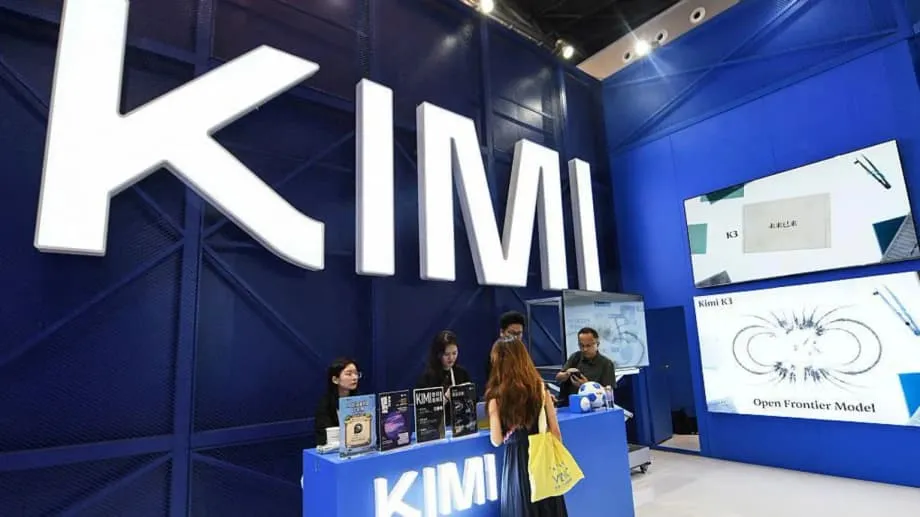
A 2.8 Trillion Parameter Challenge
China's Moonshot AI announced Kimi K3 on July 17, 2026, introducing a model with 2.8 trillion parameters that it says rivals leading American systems. Full model weights are scheduled for release on July 27, giving developers access to the numerical values that determine how the system processes information and generates answers.
Contents
- A 2.8 Trillion Parameter Challenge
- Where K3 Leads, and Where It Trails
- How Moonshot Reduces the Computing Burden
- A Chip Design and an Astrophysics Calculation
- Technology Shares Fall After the Announcement
- Open Models Become a Political Choice
- Washington Debates Regulation and Talent
- What K3 Costs, and Why Prices Matter
- Moonshot's Rise, Setback and Return
- Researchers Find Reasons for Caution
- What Businesses Can Build With Open Weights
- A More Competitive Model Market
- Key Points
Moonshot calls K3 its "most capable flagship model to date," built for coding, knowledge work and complex reasoning over extended tasks with minimal human supervision. Its announcement unsettled technology markets and sharpened competition with OpenAI and Anthropic, whose leading systems remain proprietary.
K3 is the largest open model announced, approaching three trillion parameters. Its scale exceeds DeepSeek's V4 Pro, with 1.6 trillion parameters, and Zhipu AI's GLM-5.2, with 744 billion. Parameters function roughly like connections in a neural network: they help encode learned patterns and knowledge. More parameters generally offer greater capacity for complex tasks, although the design and training of a model also shape its performance.
Moonshot is also offering a context window of one million tokens. Tokens are pieces of text, often words or parts of words; the context window is the amount a model can work with at once. One million tokens corresponds to roughly 750,000 words, described as about three novels, allowing K3 to handle large collections of documents or code in a single interaction.
The promised release would let developers download, modify and deploy the model rather than access it only through Moonshot's service. Businesses seeking greater control over their AI systems would gain another option, while American laboratories face a Chinese competitor combining near frontier performance with lower advertised prices.
Where K3 Leads, and Where It Trails
Kimi K3 took first place on Arena.ai's Frontend Code Arena with 1,679 points, ahead of Anthropic's Claude Fable 5 and OpenAI's GPT-5.6 Sol. The platform compares coding outputs through human preferences. Frontend coding concerns the parts of websites and applications that users see and interact with.
K3 ranked first in six of seven evaluated domains, including brand and marketing, design based on references, and data analytics. Artificial Analysis placed it third on its Intelligence Index, behind Claude Fable 5 and GPT-5.6 Sol, but ahead of Claude Opus 4.8 and GPT-5.5.
BrowseComp, an evaluation of difficult information searches requiring extended work, gave K3 a score of 91.2 out of 100. The result was described as a new leading score, achieved using the full context window of one million tokens without compressing the context.
Moonshot's own evaluations showed K3 outperforming Claude Opus 4.8 and GPT-5.5 on coding and agentic tasks, including Program Bench and SWE Marathon. An agentic task involves a model taking successive steps, often using tools, to complete a broader assignment. Moonshot acknowledged that K3 still trails the highest performance represented by Claude Fable 5 and GPT-5.6 Sol.
Alex Liu and fellow Bank of America analysts connected the results to China's continuing limits on hardware and computing capacity. Their research note stated:
Despite persistent hardware and compute capacity constraints in China, K3 demonstrates that pre-training scaling, paired with architectural innovation, can still deliver step-change gains for flagship Chinese models.
How Moonshot Reduces the Computing Burden
Moonshot attributes K3's efficiency to two architectural innovations previously published as open research. Kimi Delta Attention uses a hybrid linear attention mechanism to reduce the computing cost of processing long sequences. Attention is the process through which a model weighs relevant information when producing an answer.
Attention Residuals replaces conventional residual connections between layers of the neural network. Those connections help information move through a deep model. Moonshot says its replacement delivers "consistent scaling gains" as models grow.
K3 also uses a mixture of experts architecture. Rather than engage every specialist component for every piece of text, it activates 16 of 896 expert subnetworks per token, about 1.8% of the expert pool. Selective activation reduces the computing needed to generate responses while retaining the capabilities of a much larger model.
Moonshot employed quantization aware training with MXFP4 weights and MXFP8 activations. Quantization represents numerical values using fewer bits, reducing memory and computing demands. The company chose these precision formats for compatibility with hardware from different chip manufacturers.
Training used Nvidia H200 processors alongside a device Moonshot described only as a "GPGPU from an alternative vendor," widely understood to refer to Huawei's Ascend chips. Its kernel optimization benchmark ran on Nvidia's L20, a reduced capability processor designed for sale into China under American export rules. Kernel optimization means improving the low level computations that make software run efficiently on a processor.
A Chip Design and an Astrophysics Calculation
Moonshot demonstrated K3 working autonomously for 48 hours to design a physical chip that could run a miniature version of itself. The model used only open electronic design automation tools and the Nangate 45nm library, a collection of components used in chip design.
K3 completed the design pipeline from architecture through optimization and verification. The resulting design covered four square millimeters, achieved timing convergence at 100 MHz, and decoded more than 8,700 tokens per second in simulation. Timing convergence means the design met the timing requirements needed for its intended operating speed.
The chip exercise brought together several stages that normally require coordinated engineering work. K3 had to create a design, improve it and check whether it met the specified requirements, illustrating Moonshot's focus on assignments that continue across many steps.
Another case study involved reproducing the universal I-Love-Q relation in computational astrophysics. K3 reportedly completed the complex calculation in approximately two hours while reading and cross validating more than 20 academic papers. The task was described as work that would typically take a senior researcher one to two weeks.
These demonstrations sit alongside the coding and search evaluations as examples of the longer assignments Moonshot wants K3 to handle. They also place greater attention on whether a model can maintain useful reasoning throughout an entire project, rather than simply produce a strong answer to one prompt.
Technology Shares Fall After the Announcement
Hong Kong shares in Moonshot's domestic rivals fell sharply: Zhipu AI, also known as Z.ai, dropped 27% to 28%, while MiniMax declined 16%. Taiwan Semiconductor Manufacturing Company fell 7% despite reporting a 77% increase in quarterly operating profit. SoftBank, often treated as a proxy for investment in OpenAI, dropped 9.0%.
The selling extended to American markets. The Nasdaq 100 declined 1.0%, Nvidia fell 1.2% and briefly lost its position as the world's most valuable company to Apple, and Meta dropped more than 2.4%. The reaction recalled January 2025, when DeepSeek's release of a capable model at low cost unsettled investors.
Patrick Moorhead, CEO and chief analyst at Moor Insights and Strategy, described the response in a social media analysis:
an over-reaction shockingly similar to the DeepSeek panic.
Moorhead acknowledged technological progress while stating, "We are far away from super-intelligence." He argued that models such as K3 would "accelerate and grow the inference market faster than without." Inference is the process of running a trained model to answer requests.
Investor Gavin Baker called the release an "inflection point" and predicted it would be "bad news for closed AI startups like OpenAI and Anthropic, but a net positive for just about every other company in the world." He explained his view of competition at the model layer:
anything that lowers margins and increases competition at the model layer is good for every other AI layer: power, semiconductors, hyperscalers, neoclouds and yes even software.
Baker's argument separates model providers from businesses supplying electricity, chips, cloud infrastructure and applications. Lower model prices put pressure on the first group while potentially encouraging more AI use across the others.
Open Models Become a Political Choice
The US government had forced Anthropic to temporarily withdraw its Fable and Mythos models just weeks earlier because of cybersecurity concerns. Washington subsequently lifted the restrictions, but the intervention reflected an approach that treats advanced AI as critical national infrastructure requiring close control.
Chinese President Xi Jinping presented a different position at the 2026 World Artificial Intelligence Conference in Shanghai, calling for open development and cooperation:
We must seize this rare historic opportunity, encourage open source, openness, cooperation, and sharing.
Xi also criticized the expansion of national security arguments into AI policy:
We should jointly oppose the practice of overstretching the concept of national security in the field of AI or placing one country's own security above the security of others.
Open releases serve several Chinese objectives: demonstrating technical strength, attracting international developers and building standards that can resist American efforts to restrict technological progress. Wider developer communities also give Chinese companies influence beyond their domestic market.
Dean Ball, a former Trump administration official now heading strategic futures at OpenAI, expressed surprise at the Chinese state's willingness to permit such releases. He wrote on social media:
I am personally surprised the Chinese state continues to allow the open sourcing of models this good, given potential risks.
Ball offered a political interpretation of a world dominated by openly available model weights:
one probable outcome of an open-weight-model-dominant world is full AI communism, which is precisely what China proposes: rather than a market product, AI is a 'public good' which will ultimately be provided by the state as a kind of 'digital public infrastructure.'
Washington Debates Regulation and Talent
David Sacks, President Trump's initial AI and crypto czar who later became cochair of the President's Council of Advisors on Science and Technology, called K3's release "concerning." His response focused on American policy choices that he believes weaken the country's competitive position.
Sacks pointed to obstacles to new data centers, expanding state regulation and proposals for federal agencies to approve frontier models before release. He argued that "permissionless innovation" helped America dominate the internet era and remains the viable approach for AI.
Sacks warned in a widely circulated social media post:
This is how you lose the AI race. The rest of the world won't play by America's rules if it bogs itself down.
Vinod Khosla, founder of Khosla Ventures, agreed with Sacks while identifying "an even bigger issue": immigration restrictions. Khosla believes those restrictions repel talented technical workers from other countries, weakening the pool of people needed to develop advanced AI.
American lawmakers are also considering measures to limit domestic adoption of Chinese models. Open distribution complicates that task because models spread through international developer networks, while improving technical performance gives businesses more reasons to consider them.
What K3 Costs, and Why Prices Matter
Moonshot charges $15 per million output tokens for K3, compared with $50 for Claude Fable 5. The difference is $35 per million tokens, making K3's advertised output price 70% lower. Output tokens are the text generated by the model.
Input costs $3 per million tokens, falling to $0.30 for cached inputs. Caching allows previously processed material to be reused rather than handled from scratch. K3 costs more than some earlier Chinese models, placing it in a middle price tier with performance close to the leading systems.
Chinese electricity prices are substantially lower than those in many American regions, reflecting large state investments in power generation and transmission. Chinese data centers also face less political resistance to expansion. In the United States, communities increasingly object to facilities because of pressure on electricity grids and water supplies.
Chinese AI companies have pursued market share and developer adoption at the expense of immediate profitability. American export restrictions have also pushed laboratories to obtain more performance from less capable hardware through algorithmic improvements.
Grace Shao, an AI analyst and author of the AI Proem newsletter, described the resource pressures on Chinese laboratories:
are so compute-constrained, capital-constrained, and talent-constrained that a lot of them are being cautious in how they use their resources.
George Chen, a partner at the Asia Group, pointed to the price difference between imported and domestic processors:
for the money [a Chinese AI company would] spend on an Nvidia chip, they can buy ten local chips from Huawei or other local chipmakers.
The combination of lower operating costs, aggressive pricing and technical efficiency explains why Chinese models are attracting Western developers. It also helps explain investors' concern that premium prices for proprietary models may become harder to sustain.
Moonshot's Rise, Setback and Return
Yang Zhilin founded Moonshot AI in 2023 after graduating from Tsinghua University and conducting research at Google and Meta. The company's Chinese name comes from Pink Floyd's album "The Dark Side of the Moon," reportedly his favorite record.
Kimi initially gained attention through analysis of long texts and AI search, attracting investment from Alibaba, Tencent and Meituan. By early 2026, Moonshot had raised approximately $1.5 billion across several rounds, with its valuation rising from $2.5 billion to $4.3 billion.
DeepSeek's R1 release in January 2025 disrupted China's AI market, and Moonshot was among the companies hardest hit. Kimi fell from third to seventh place in monthly active users within China. Moonshot responded by turning toward open models, seeking renewed relevance through technical contributions rather than its consumer market position alone.
The company's recent development followed this sequence:
- 2023: Yang Zhilin founded Moonshot AI.
- January 2025: DeepSeek R1 disrupted the market, followed by Kimi's decline in the user rankings.
- July 2025: Moonshot released Kimi K2 as part of its shift toward open models.
- January 2026: Kimi K2.5 extended that strategy.
- June 2026: Moonshot was reportedly seeking $2 billion at a valuation of approximately $30 billion ahead of a potential Hong Kong IPO.
- July 17, 2026: Moonshot announced Kimi K3.
- July 27, 2026: Full K3 weights are scheduled for release.
Training a model with 2.8 trillion parameters requires months of preparation and substantial computing resources, placing major architectural decisions well before the announcement. K3 also arrives as Moonshot seeks fresh financing, potentially strengthening its position in those negotiations.
Researchers Find Reasons for Caution
Ethan Mollick, a Wharton professor studying AI's effects on work, offered "a note of caution" after testing K3 on a complex statistical audit of his earlier academic research. He reported that it "messed up in a bunch of ways," including applying statistical methods incorrectly.
Mollick shared a detailed assessment generated by OpenAI's GPT-5.6 Pro that identified fundamental errors in K3's analytical approach. He said he agreed with that assessment, adding a concrete example of difficulties outside the model's headline benchmark results.
Simon Koser, chief product officer at AI startup Tzafon, called K3 "legitimately impressive" in areas such as coding, while warning that performance can vary between testing and everyday deployment:
Certain AI models may react differently when put in production versus when they are tested, and there's no true jack-of-all-trades AI model that's superior to everything else on the market.
Koser also questioned how extensive immediate switching would be:
It's going to seem like a lot of people are changing. But in practice, I'm not sure if the shift is that huge.
Aravind Srinivas, CEO of Perplexity, argued that "the model alone is no longer the product." He placed greater weight on "the harness, the orchestration system that puts the model inside a very capable harness and pairs the model with a lot of tools." Such a system coordinates the model's tools and successive actions to complete useful work.
Lu Zhang, founder of Fusion Fund, said most developers using open models come from "the startup ecosystem, less from the large corporate side." Those users often change models when better or cheaper options appear, treating AI capability as something they can substitute rather than a permanent commitment.
What Businesses Can Build With Open Weights
July 27 is the next key date for businesses considering K3. Access to its weights would allow them to fine tune it, host it themselves and build proprietary systems with greater control over data location and use. Broader community testing is also expected after the release.
Hosting the model directly can remove recurring fees paid to a model vendor, but it brings substantial infrastructure demands. Running 2.8 trillion parameters requires GPU clusters that few organizations maintain internally, making hardware and operations central to the decision.
Moonshot's Mooncake project addresses part of the serving challenge. It won the Best Paper award at FAST 2025 for KV cache centric disaggregated serving. A KV cache stores information about earlier context; Mooncake separates this memory intensive caching from the computation of new responses to make inference more practical and economical.
Moonshot's lineup now includes K3 as its flagship, K2.7 Code for programming and K2.6 for general use. All support context windows of at least 256,000 tokens, with K3 reaching one million. Automatic context caching requires no explicit management by developers.
The company also updated Kimi Code, its open coding tool competing with Anthropic's Claude Code. Kimi Code has more than 3,100 GitHub stars and integrates with VSCode, Cursor and Zed. New features include expanded subagent tools, management of background tasks and nested agents, allowing multiple layers of automated coding work.
A More Competitive Model Market
K3 brings open models closer to proprietary competitors after three years in which a substantial performance gap commonly separated them. Its results suggest that the gap may now be measured in weeks rather than months, subject to broader testing after July 27.
OpenAI and Anthropic face pressure on premium pricing when developers can obtain similar capabilities through cheaper services or downloadable models. American hardware export controls also face a practical challenge as Chinese laboratories use architectural efficiency to get more from restricted computing resources.
Chinese companies occupy all five leading positions on OpenRouter's weekly usage leaderboard: Tencent, Xiaomi, DeepSeek, MiniMax and Zhipu AI. That adoption gives K3 a competitive setting in which several Chinese suppliers are already drawing developer demand.
DoorDash has reportedly moved "lower-level work" to Kimi models. Its chief technology officer, Andy Fang, described the result as "better quality, cheaper cost." That example connects the pricing debate to an American business already choosing Chinese AI for some tasks.
Moonshot's announcement brings together three pressures: improving open model performance, lower advertised prices and easier access for developers. The July 27 release will extend the competition from hosted services and published evaluations to developers running and adapting K3 themselves.
Key Points
- Moonshot AI announced Kimi K3 on July 17, 2026, with 2.8 trillion parameters and full weights scheduled for July 27.
- K3 supports one million tokens of context and placed first in Frontend Code Arena with 1,679 points.
- Artificial Analysis ranked K3 third, behind Claude Fable 5 and GPT-5.6 Sol.
- Output costs $15 per million tokens, 70% below Claude Fable 5's $50 rate.
- Zhipu AI shares fell 27% to 28%, MiniMax fell 16%, and major global technology stocks also declined.
- Moonshot demonstrated autonomous chip design over 48 hours and an astrophysics calculation completed in approximately two hours.
- Training used Nvidia H200 processors and an unnamed alternative vendor's GPU; an optimization benchmark used Nvidia L20.
- Xi Jinping supported open AI development, while David Sacks and Vinod Khosla warned about American regulatory and immigration policies.
- Open weights offer greater deployment control, but K3 requires substantial computing infrastructure and has shown errors in statistical work.