
A Wedding Ring Shows the Appeal of Shopping in Seoul
A Chaumet wedding ring bought for about 37,000 yuan in Seoul saved Wu, a 28-year-old Chinese office worker preparing for marriage, roughly 11,000 yuan compared with buying it in China. She purchased it at Lotte Duty Free in Myeong-dong after comparing prices across several channels. Discounts, tax refunds and a favorable exchange rate all contributed to the saving.
Contents
- A Wedding Ring Shows the Appeal of Shopping in Seoul
- How the Exchange Rate Makes Purchases Cheaper
- Chinese Visitors Drive Record Card Spending
- Beauty Clinics and Hair Salons Join the Itinerary
- Why Korean Beauty Has Become a Travel Attraction
- Retailers Prepare for a Trillion Won in Foreign Sales
- A Broader Mix of Overseas Customers
- Japan Faces Stronger Competition for Chinese Travelers
- The Dates Behind the Tourism Shift
- Why a Retail Boom Has Limits for the Economy
- A Weak Won Creates Winners and Losers
- Public Concerns, Diplomacy and Travel Planning
- Key Points
Wu described her purchase simply:
"It was really quite a good deal," Wu said.
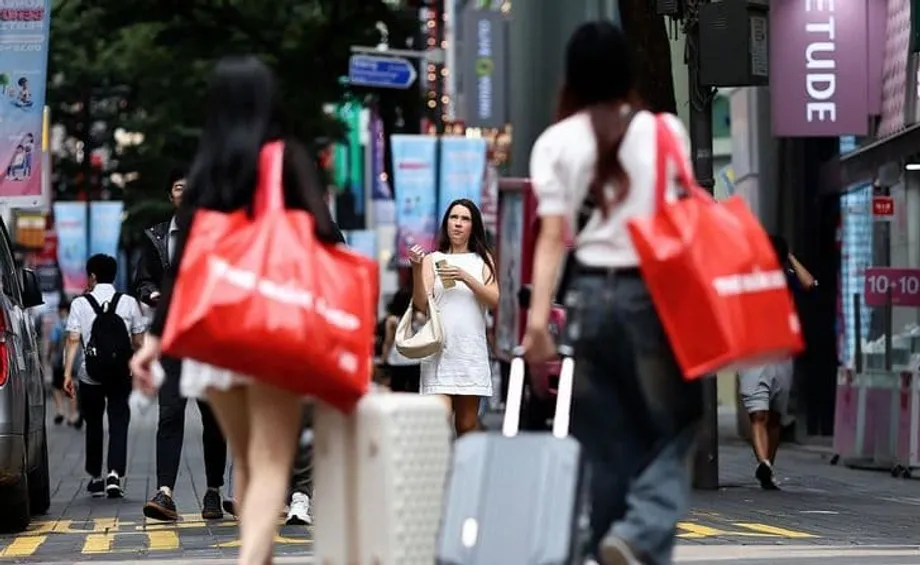
Her friend Chelsea Wang arrived in Seoul with two friends in late April with a carefully researched shopping list and no plans to visit ancient palaces or climb scenic mountains. Their stay of three and a half days centered on duty-free shopping, beauty treatments, hair salons and cosmetics stores. Wang expected a backpack to cost at least 500 yuan ($70) less than in China, with a similar saving on a bottle of perfume.
By July 17, 2026, experiences like theirs illustrated a broader change in Chinese travel to South Korea. Shopping and beauty services were becoming the reason for a trip, rather than activities fitted around sightseeing. A weak Korean won, the popularity of Korean beauty products and Korean pop culture, more flights and easier entry for Chinese tour groups were helping drive that change.
The spending figures were striking. South Korea welcomed approximately 1.95 million international tourists in May, including 563,000 from China, according to the Korea Tourism Organization (KTO). Chinese arrivals had stood at 484,390 in May a year earlier. Foreign visitors spent a record 2.12 trillion won ($1.45 billion) on credit cards that month, crossing 2 trillion won for the first time.
How the Exchange Rate Makes Purchases Cheaper
One Chinese yuan bought an average of about 226 won in June, compared with approximately 209 won in January. That meant the same amount of Chinese currency bought about 8.1 percent more won. For a visitor exchanging 1,000 yuan, the difference was approximately 17,000 won before exchange fees.
A weaker won makes purchases priced in Korean currency cheaper for someone paying with yuan, provided the Korean price stays the same. Discounts and tax refunds can increase the saving, as Wu found when buying her wedding ring. Her reported figures put the comparable Chinese price at about 48,000 yuan, making the saving roughly 23 percent.
The won had remained weak against major currencies over the preceding year. The Korea Culture and Tourism Institute, a government funded research body, said in its June tourism outlook that this had improved South Korea's price competitiveness and increased overseas visitors' purchasing power.
The institute also pointed to expanded flight capacity and the continuing worldwide popularity of Korean cultural content. Together, those factors had created unusually favorable conditions for inbound tourism, meaning travel into South Korea from other countries.
Chinese Visitors Drive Record Card Spending
Foreign visitors' credit card spending rose 67.1 percent from a year earlier to reach May's record 2.12 trillion won. Chinese visitors' spending increased much faster, climbing 214 percent and continuing an upward trend through 2026. An increase of 214 percent means spending was more than three times its level a year earlier.
The KTO identified Chinese tourists as the leading buyers in shopping for exceptionally expensive goods. Watches, jewelry and luxury accessories reached unprecedented sales levels. The ring purchase in Myeong-dong helps explain how that demand works: a large saving on a single expensive item can become a major attraction of a short overseas trip.
Chinese arrivals rose by about 16.2 percent between May 2025 and May 2026, using the KTO's figures of 484,390 and 563,000. Their much faster increase in card spending shows that the retail surge involved both more visitors and greater spending, rather than visitor growth alone.
Beauty Clinics and Hair Salons Join the Itinerary
The KTO has identified a shift from traditional duty-free shopping toward what it calls "lifestyle consumption." Visitors are spending on activities that resemble everyday life in Korea: dermatology appointments, beauty treatments, pharmacy purchases of Korean skincare products, local fashion shops and hair salons.
Gangnam, the affluent district in southern Seoul, has become part of this experience. For many Chinese tourists, visiting its clinics and shops is a main purpose of travel rather than an optional extra.
Grace Gu, a 32-year-old media professional based in Shanghai, visited Seoul with her sister in late May. They had initially planned a family holiday in Japan before choosing South Korea. Gu explained how the exchange rate changed her thinking:
The exchange rate was one factor," Gu explained. "Once you realize the won is cheap, you naturally start searching for products and comparing prices. Then you realize the value for money is really high and you naturally want to buy more.
During five days in Seoul, Gu devoted one day entirely to shopping and another to cosmetic treatments in Gangnam, along with a haircut at a Korean salon. Her spending exceeded 10,000 yuan, including flights, hotels, food, purchases and beauty services.
At Olive Young's flagship Myeong-dong store, Gu saw shoppers queuing to pay shortly before closing, many carrying large bags filled with skincare products and cosmetics. She described the atmosphere and how naturally those activities fitted into her holiday:
You could really feel this consumption carnival," Gu recalled. "In Korea, getting a haircut, visiting beauty clinics and shopping for cosmetics all felt like activities that naturally belonged to the trip.
Why Korean Beauty Has Become a Travel Attraction
South Korea's beauty industry has moved from following trends to developing products and treatments with a worldwide following. Its approach places weight on prevention and maintenance, supported by routines involving several steps and products such as essences, serums, ampoules and sheet masks. Those routines have spread from Shanghai to San Francisco.
The country's regulatory environment allows rapid product development, with new ingredients and formulations reaching the market faster than in many Western countries. Combined with the weak won, competitive pricing attracts Chinese shoppers who might pay 30 to 50 percent more for identical products at home.
Korean dermatology clinics offer services ranging from laser therapies to injectable procedures at prices that can be below equivalent services in China even after travel costs. Hair salons provide coloring and styling techniques familiar from Korean dramas and music videos. Luxury amenities and attentive service can make those appointments a memorable part of a holiday.
Tony Medina, who runs a Seoul consulting firm connecting foreign tourists with skincare and cosmetic surgery clinics, said he had received several hundred inquiries from mainland Chinese clients in recent weeks, compared with just a few the previous year. His company does not market its services in China or in Mandarin. Medina described the increase:
"Twenty years in Korea, and I've never seen a surge like this," Medina said.
Retailers Prepare for a Trillion Won in Foreign Sales
CJ Olive Young, South Korea's dominant beauty retailer, reported that repeat visits by overseas shoppers had more than doubled annually since 2023. During discount events in 2025 alone, 6,200 foreign travelers shopped at Olive Young three or more times.
Lotte, Shinsegae and Hyundai, the country's three largest department store chains, were each on track to exceed 1 trillion won ($670 million) in annual sales to foreign customers in 2026. The threshold would have appeared ambitious only a few years earlier.
Lotte Department Store recorded 640 billion won in foreign customer sales during the first half of 2026, up 125 percent from the previous year. Foreign shoppers accounted for 30 percent of sales at its flagship branch.
Shinsegae Department Store recorded 580 billion won in foreign sales during the same period, an increase of 120 percent. That nearly matched its entire 2025 total of approximately 650 billion won. Hyundai Department Store posted 500 billion won, equivalent to about 70 percent of its foreign sales for all of 2025.
The chains are adjusting their services to meet demand. Shinsegae is positioning its Myeongdong main branch as a luxury destination for foreign visitors with large shopping budgets. Hyundai has introduced a shopping assistance service powered by artificial intelligence, with translation in real time to help staff communicate with overseas customers.
A Broader Mix of Overseas Customers
Chinese visitors remain central to the shopping boom, but department stores are attracting a wider mix of nationalities. At Shinsegae, Chinese customers accounted for 77.5 percent of foreign sales in 2019, compared with 48.5 percent in the first half of 2026.
American customers' share increased from 1.1 percent to 19.1 percent over the same period. The share attributed to visitors from other Asian countries, excluding Southeast Asia, rose from 4.4 percent to 14.9 percent.
A share measures a group's portion of the total. Chinese shoppers can spend more while accounting for a smaller share when spending by other nationalities grows faster. Shinsegae's figures show how South Korea's appeal has broadened beyond its traditional Chinese tourism market even as Chinese spending reaches new heights.
Japan Faces Stronger Competition for Chinese Travelers
Japan had long been a preferred destination for Chinese travelers, supported by its own weak yen and cultural appeal. Projections for the 2026 Lunar New Year holiday pointed to South Korea overtaking Japan as the leading destination for Chinese travelers for the first time since the COVID-19 pandemic.
Travel analytics firm China Trading Desk projected 230,000 to 250,000 mainland Chinese arrivals in South Korea during the holiday lasting nine days from February 15. That represented an increase of up to 52 percent from the previous year. Chinese arrivals in Japan during the same period were forecast to fall by as much as 60 percent. These figures were holiday forecasts; final arrival totals were not given.
Diplomatic friction between Beijing and Tokyo had made Japan less appealing to Chinese nationalists. South Korea's easing of visa requirements for Chinese tour groups, with visa-free policies extended until June 2026, reduced a barrier to travel. Security concerns about Thailand following a Chinese actor's kidnapping and involvement with a fraud center in neighboring Myanmar also redirected some travel toward Korea.
Subramania Bhatt, chief executive of China Trading Desk, explained the attraction of Korean destinations:
"The weak won makes Seoul, Busan, and Jeju feel like value-added options for shopping and dining," Bhatt said.
K-pop's appeal and the rerouting of cruises and tours from Japan to South Korea contributed to a substitution effect, meaning travelers chose Korea in place of another destination. Cirium aviation data showed flights between mainland China and South Korea increasing nearly 25 percent from a year earlier to more than 1,330 for the Lunar New Year period. Scheduled flights from China to Japan fell 48 percent to just over 800. Major Chinese airlines extended cancellation fee waivers for Japan flights through March 2026.
The Dates Behind the Tourism Shift
The shopping surge developed across several months, while retail comparisons and travel forecasts covered different periods. The main dates show how currency movements, holiday expectations and later spending figures fitted together.
- January 2026: One yuan bought approximately 209 won.
- February 15, 2026: The Lunar New Year holiday lasting nine days began, with projections of 230,000 to 250,000 mainland Chinese visitors to South Korea.
- March 2026: Major Chinese airlines' extended cancellation fee waivers for Japan flights ran through this month.
- Late April 2026: Chelsea Wang and her friends visited Seoul for shopping and beauty services.
- May 2026: South Korea recorded approximately 1.95 million international arrivals and 2.12 trillion won in foreign visitors' card spending. Grace Gu visited in late May.
- June 2026: One yuan bought about 226 won on average, and the Korea Culture and Tourism Institute published its tourism outlook. The stated extension of the visa-free policy for Chinese tour groups ran until this month.
- First half of 2026: Lotte, Shinsegae and Hyundai reported foreign customer sales of 640 billion won, 580 billion won and 500 billion won respectively.
By July 17, the latest figures described here showed strong demand in shops and services, while the department stores' full annual sales remained projections.
Why a Retail Boom Has Limits for the Economy
Park Seok-gil, chief Korea economist at J.P. Morgan, said the weaker won had contributed "to some degree" to the recovery in foreign tourist spending. He described inbound tourism and card spending as part of a gradual recovery after the pandemic, with Korean culture and K-beauty also influencing travelers' choices.
Park explained the scale of the recovery in relation to the wider economy:
"It is increasing, and that is for sure, but not strongly enough to change the overall macro picture," he stated.
South Korea's domestic consumption outlook, Park added, depends primarily on household purchasing power, income growth, wealth effects and interest rates. Wealth effects describe how changes in the value of assets, such as homes or investments, influence people's willingness to spend.
Bank of Korea data cited by J.P. Morgan showed South Korea's travel surplus with China at $3.77 billion in 2025, below $4.32 billion in 2024 and far below $7.61 billion in 2016. A travel surplus means receipts from visitors exceed the corresponding spending abroad. The 2025 figure was approximately half the 2016 surplus.
The earlier peak preceded diplomatic tensions over deployment of the U.S. Terminal High Altitude Area Defense missile system and the subsequent COVID-19 pandemic, which severely damaged tourism between the countries.
Chinese travel has also changed in character. Before the pandemic, organized tour groups and professional shoppers known as daigou dominated the market. Daigou bought goods in bulk to resell in China. Today's recovery features more independent visitors making personal purchases, suggesting a potentially more sustainable recovery with less dependence on bulk buying.
A Weak Won Creates Winners and Losers
Hotels and businesses serving inbound visitors benefit when overseas travelers can afford more in South Korea. Outbound travel agencies face a much tougher environment because the same weak currency makes foreign holidays expensive for Korean consumers. Reduced spending abroad may redirect some consumption toward domestic alternatives.
Exporters can benefit from more competitive prices overseas, while paying more for imported raw materials and components. The currency advantage enjoyed by foreign shoppers therefore comes with costs elsewhere in the economy.
South Korea's three listed casino operators serving foreigners only, Paradise Co, Grand Korea Leisure and Lotte Tour Development, had all seen their share prices fall to their lowest levels in 12 months despite record visitor arrivals.
Paradise Co's profit fell approximately 56 percent from a year earlier in the first quarter, even though revenue increased. Higher operating expenses and integration costs connected with expanding its Paradise City integrated resort outweighed the benefit of visitor growth. More customers can increase sales while rising costs reduce the money a business keeps.
Public Concerns, Diplomacy and Travel Planning
Some local media and social media platforms have linked rising crime to mainland Chinese tourist arrivals. The South Korean government dismissed those claims as baseless. A petition seeking abolition of visa-free entry for Chinese tour groups gathered approximately 60,000 signatures.
The debate echoes concerns in destinations such as Barcelona and Bali, where residents question how mass tourism affects daily life. Korean policymakers face pressure to manage congestion, protect neighborhood character and address legitimate concerns about safety and public services while retaining tourism's economic benefits.
President Lee Jae Myung visited Beijing earlier in 2026 for his second meeting with Chinese leader Xi Jinping in approximately two months. It was the first such visit by a South Korean leader since 2019. Although security and trade were central topics, improving relations created a favorable atmosphere for tourism and cultural exchanges.
For travelers considering South Korea later in 2026 and beyond, industry advice centered on monitoring exchange rates, understanding tax refund procedures, keeping receipts and checking customs allowances before returning home. Customs allowances determine what travelers may bring back without additional charges. People seeking beauty treatments were advised to book well ahead, especially during busy holiday periods.
Seoul's attraction rests on the combination of savings and experiences: a discounted luxury purchase, Korean skincare products, a salon visit or a clinic appointment. The spending surge is substantial for retailers and tourism businesses, while household finances and operating costs continue to shape the wider economic picture.
Key Points
- One yuan bought about 226 won in June 2026, compared with approximately 209 won in January, increasing Chinese visitors' purchasing power.
- South Korea welcomed approximately 1.95 million international tourists in May, including 563,000 from China.
- Foreign visitors' May card spending reached a record 2.12 trillion won, up 67.1 percent. Chinese visitors' spending rose 214 percent.
- Beauty treatments, hair salons, pharmacies and local fashion stores are becoming central parts of Chinese visitors' itineraries.
- Lotte, Shinsegae and Hyundai were each on track for more than 1 trillion won in annual foreign customer sales.
- Lunar New Year forecasts favored South Korea over Japan, alongside more flights to Korea and fewer to Japan.
- South Korea's 2025 travel surplus with China was $3.77 billion, compared with $7.61 billion in 2016.
- More independent travelers are buying for personal use, replacing some of the earlier reliance on tour groups and daigou.
- The weak won benefits inbound tourism but makes foreign travel and imports more expensive for Koreans.
- Rising tourism demand has coincided with public debate over visa policy and profitability pressures at casino operators.