

Freedom Still Depends on Birth in East Sumba
In parts of East Sumba, Indonesia, children inherit a status that can bind them to noble families for life. People known locally as ata, meaning slaves or servants, work without wages, depend on their masters for land and housing, and may face punishment or sexual abuse. Indonesia has prohibited slavery for more than 160 years, and its 1945 Constitution bans it, yet hereditary servitude continues.
Contents
- Freedom Still Depends on Birth in East Sumba
- How Ancestry Shapes the Social Order
- A Shared Home, Unequal Choices
- Leaving the Household Without Escaping Dependence
- Sexual Violence and the Fear of Testifying
- Land, Political Power and Ritual Authority
- Reform Begins Inside Some Noble Households
- Immediate Freedom or Gradual Change?
- Turning Legal Rights Into Daily Freedom
- The Bottom Line
A young woman who reported being raped by her master and his son from the age of 13 went to police in Waingapu in 2024 after giving birth. By July 21, 2026, two years later, the investigation had not been completed, according to Dian Sasmita of the Indonesian Child Protection Commission. Initially assisted by a rights group, the woman now lives under protection in her village.
Estimates put the number of atas at about 1,700 in East Sumba and several thousand across the island. Behind those numbers are people whose work, access to food and prospects for independence remain tied to families with greater wealth and social standing. Some describe the relationship as an inherited tradition. Others recall childhood beatings and years of unpaid labor.
Sumba's turquoise waterfalls, beaches and traditional villages attract travelers seeking a remote tropical destination. Only a short flight and boat journey from Bali's famous beaches, the island also has communities where customary authority carries more weight in daily life than the legal promise of freedom.
Some atas work from dawn until dusk in fields and homes. Some are transferred through marriage. Women and girls have faced sexual abuse by noblemen, while workers who fail to meet their masters' demands may experience physical violence. These conditions persist beneath the language of family obligation and ancestral custom.
Masters and atas may sleep under the same roof, eat similar food and appear to share household tasks. Their unequal positions become more visible through unpaid labor, control of land, inherited status and fear of leaving. Understanding that dependence explains why a legal ban has not brought an end to the practice.
How Ancestry Shapes the Social Order
Martha Hebi, a rights activist who has studied slavery on Sumba and founded the Solidarity for the Women and Children of Sumba group, describes three broad social categories. The maramba are nobles, the kabihu are ordinary people, and the atas occupy the lowest position.
Many maramba families own large areas of land and hold influence in their communities. Atas traditionally cultivate fields, care for animals, prepare food and carry out domestic duties. Their position usually passes from parents to children, assigning a social status before a child is old enough to understand it.
Marapu, an older belief system combining ancestor worship, animist traditions and ritual obligations, helps sustain this ranking. About eight in 10 people on Sumba are Christian, but marapu continues to shape ceremonies, family authority and social standing across many communities.
Marapu priest Umbu Remi Deta says the belief system forms the basis of the island's social hierarchy. A traditional legend holds that the maramba acquired atas when they first arrived in Sumba. Families accepting that account regard the relationship as an ancestral obligation rather than exploitation.
Indonesian law gives people rights to freedom, bodily safety, education and paid work. Custom cannot legally take those rights away. In villages where access to courts, police, schools and independent income is limited, however, local power can determine whether a person is able to exercise them.
A Shared Home, Unequal Choices
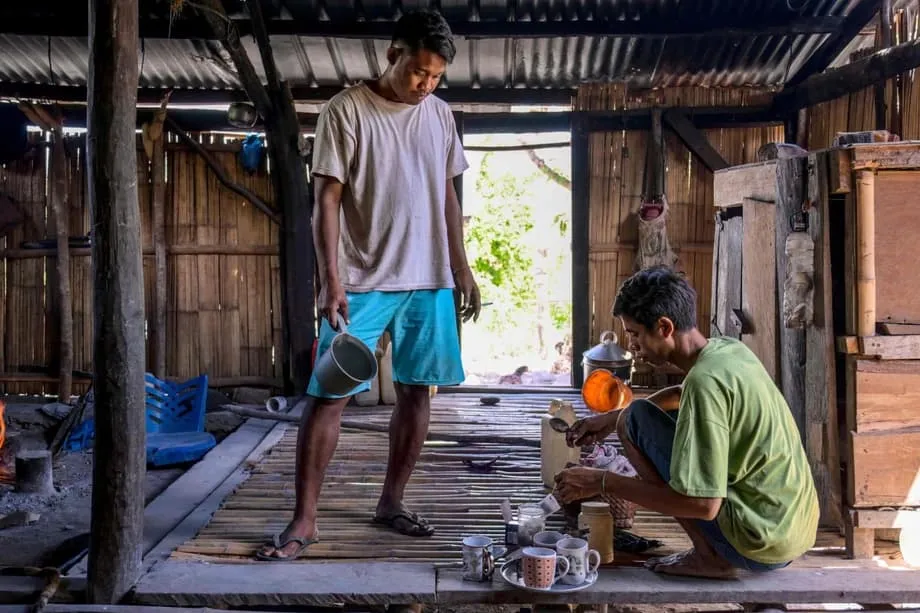
Kanisius Kanyali Hambarita lives in Tanggedu with Umbu Ana Rara, a maramba aged 31 who is three years younger than him. Kanisius prepares drinks, performs household work and helps care for animals. The two have been photographed sitting together in the heat, chewing betel nuts as chickens and geese wander around their feet.
Umbu Ana says he treats Kanisius as a family member. He allows him to earn a small income driving a motorcycle taxi and to grow food on a plot of land. Both men sleep on mats on the floor of a tall traditional house with a roof shaped like buffalo horns.
Kanisius has said that being an ata is not a burden for him. He regards the status as a symbol of tradition inherited from ancestors and says it cannot simply be wiped away. His acceptance reflects how deeply the social order can become part of a person's understanding of family and belonging.
Some masters provide food, shelter and limited access to land while receiving unpaid work from socially subordinate members of the household. When a person has no realistic alternative, dependence can resemble family life. Permission to earn a little money or cultivate a plot still leaves the noble family controlling essential resources.
Many atas have no land of their own, little schooling and insufficient money for transport or legal help. Leaving can mean losing a home, food supplies and farmland at once. Even someone who moves out may continue depending economically on the same family.
Tanggedu's surroundings help explain that isolation. Reaching the village in East Sumba requires travel over rocky roads between dry hills and the coast. Some areas lack a reliable mobile phone signal. Residents cook over wood fires, while cattle, goats and wild horses move through the landscape.
Leaving the Household Without Escaping Dependence
A man from nearby Napu, now in his 40s, recalls being beaten as a child when he did not work hard enough. After school, he had to work in the fields, feed pigs and cook for his master. He remembers being hit and having water thrown at him.
The man later raised his own family outside the noble household. Using government grants and money from livestock, he managed to send two of his four children to university. That is half of his children gaining access to an education that has helped them imagine a different life.
His independence remains incomplete. The land where he grows corn, cassava and vegetables belongs to his former master. When that family needs his labor, he goes to work for them. When they do not call, he works for himself.
He has avoided directly confronting his former master, choosing to build a separate life while retaining access to the family's land. His experience shows how inherited servitude can continue after a person leaves the household: ownership of the resources needed to survive preserves the old relationship.
The man still considers himself a slave, but hopes his children will be free from the maramba. For him, education connects closely with freedom because it gives people greater knowledge of their rights and the laws that protect them.
Sexual Violence and the Fear of Testifying
Pastor Marlin Lomi, head of the influential Protestant synod in East Sumba, says some masters believe they are entitled to use female servants. Andy Yentriyani, a former head of Indonesia's National Commission on Violence Against Women, says girls in the ata class can be treated as their masters' property.
Victims may fear retaliation, lack money or believe police will not challenge a noble family. Those pressures can keep abuse out of official records. Martha Hebi says violence frequently goes unpunished because victims do not dare to testify.
The young woman's complaint in Waingapu illustrates the difficulty of obtaining protection and a completed investigation after reporting abuse. Her allegation concerns rape by two members of the household that controlled her life, beginning when she was 13. She sought police help after giving birth and now remains under protection in her village.
The chronology of the legal ban, changing oversight and that complaint stretches across generations:
- More than 160 years before July 2026, Indonesia prohibited slavery.
- Indonesia's 1945 Constitution bans slavery.
- Until the early 1990s, police watched some noble funerals because of fears that human sacrifice might occur, according to anthropologist Janet Hoskins.
- In 2024, the young woman reported the alleged rapes to police in Waingapu after giving birth.
- By July 21, 2026, the investigation had not been completed, according to Dian Sasmita.
No date for completing the investigation was given. For people dependent on powerful households, witness protection and a place to live are practical requirements for seeking justice, alongside police and court action.
Land, Political Power and Ritual Authority
Sumba lies about 2,000 kilometres east of Jakarta. Distance from the national capital, difficult roads and uneven public services help preserve local authority structures. National laws apply on the island, but enforcement becomes weaker when victims live far from government offices and depend on the people they would need to report.
Gidion Mbilijora, who led East Sumba district for 13 years, says the caste structure is deeply rooted. He has also acknowledged owning two atas. When local leaders, landowners and influential families belong to the maramba class, a challenge to hereditary servitude can carry a high personal cost.
Large funerals display the continuing authority of noble families. Thousands of guests may attend, including atas, and horses are sacrificed in marapu ceremonies. Anthropologist Janet Hoskins has documented police observation of some such funerals until the early 1990s because officers feared human sacrifice might occur.
In an earlier period, marapu ritual was said to require a slave to be buried with his master. The history of those ceremonies forms part of the wider relationship between noble authority, inherited obligation and the status of atas.
Bondan Kanumoyoso, a historian at the University of Indonesia, describes Sumba's system as distinct because the relationship can pass from one generation to the next, with masters and slaves living together. He says temporary debt bondage has also existed elsewhere, including among some Dayak communities in Kalimantan.
Debt bondage ties work to a debt. Hereditary servitude ties a person's position to birth. On Sumba, children can inherit the same subordinate status as their parents, while land ownership and household dependence make it difficult for successive generations to leave.
Reform Begins Inside Some Noble Households
Norlina Rambu Jola Kalunga, a noblewoman and pastor aged 54, inherited five atas when she married into a royal family. She supports emancipation and argues that reform should begin within noble households.
She has also said that freeing her own atas would violate local custom. Her grandfather once freed all the atas under his leadership of a Protestant community in neighbouring Central Sumba. Her position illustrates the conflict between personal convictions and obligations attached to noble status.
Tamu Rambu Margaretha, widely known as Mama Margaretha, has campaigned for better conditions in Prailiu and traveled to Jakarta to advocate emancipation. She sent her atas to school alongside her children, arguing that people unable to read or write are less able to understand their rights.
Her son, Umbu Remi, runs a gallery where local women sell ikat textiles. The cloth can take months to weave and dye. Selling it gives several women, including atas, a source of income outside direct household labor.
Mama Margaretha says she would not stop her atas from leaving. None has left, however, because they lack the resources to live independently. Permission alone cannot supply housing, land, food or an income.
Education and earnings can give people more choices, as the Napu man's children and the women selling textiles demonstrate. Freedom also requires protection from retaliation and secure access to the resources a household needs. Without those supports, a person may remain dependent even when a master says departure is allowed.
Immediate Freedom or Gradual Change?
Amnesty International and Human Rights Watch have urged Jakarta to enforce the constitutional ban on slavery and Indonesia's commitments under international agreements against discrimination. Amnesty Indonesia representative Haeril Halim says the government knows about the situation on Sumba but has not taken measures capable of ending it.
Andreas Harsono of Human Rights Watch Indonesia has called for the government to declare all atas free from their maramba masters. His proposal treats inherited status as a violation of rights requiring immediate action, rather than a cultural practice to be changed gradually.
Human Rights Minister Yusril Ihza Mahendra says Indonesia is highly diverse and that social development differs among ethnic groups. He says the government does not want to impose sudden change and prefers to respond to each community step by step. He also says education will change the situation.
Gidion Mbilijora expresses a similar view. He says greater knowledge will help people in lower social classes understand that the bond is no longer acceptable. Some local leaders support gradual change, while rights advocates warn that waiting leaves people exposed to violence and forced labor for years.
The disagreement concerns how quickly people should gain practical freedom and how authorities should secure it. Rights groups seek immediate enforcement of existing protections. Government statements place greater weight on education and changes within communities.
Effective action would require investigations into abuse, protection for witnesses, registration of land rights, support for children's education and safe routes for atas who want to leave. Police and courts would need to treat sexual violence and forced labor as crimes regardless of an offender's social rank.
Turning Legal Rights Into Daily Freedom
Indonesia's Constitution grants freedom, while customary authority determines who owns land, who performs labor and whose voice carries influence in many Sumba villages. A person who inherits subordinate status, works without pay, fears punishment and risks losing food or land by leaving has fewer choices than the person controlling the household.
Family language remains central to how many participants describe these relationships. A master may provide shelter and meals while also controlling a worker's labor, movement, marriage prospects and children. The support and the control exist within the same household.
Churches, customary leaders, women's groups, teachers and former atas all have roles in changing the practice. Religious institutions already assist some victims who speak out. Support organized within communities could help people report abuse without losing their homes or exposing their children to retaliation.
Tourism may bring new income to Sumba, but visitors are unlikely to see the full structure behind village life. A traditional house, textile gallery or waterfall reveals little about who owns the surrounding land or who worked without pay to maintain it.
Public attention can help when it leads to protection and accountability. The central task is practical: people need to be able to refuse unpaid work, report violence, educate their children and leave a household without losing the means to survive. Those choices connect Indonesia's legal promise of freedom with everyday life on Sumba.
The Bottom Line
- Hereditary slavery persists in parts of East Sumba despite a prohibition dating back more than 160 years and the ban in Indonesia's 1945 Constitution.
- Estimates range from about 1,700 atas in East Sumba to several thousand across Sumba.
- Atas occupy the lowest position in a social hierarchy linked to marapu traditions, below nobles and ordinary people.
- Unpaid labor and dependence on noble families for land, food and housing make leaving difficult.
- Accounts of abuse include childhood beatings, forced labor and sexual violence against women and girls.
- A rape complaint filed in Waingapu in 2024 remained under investigation by July 21, 2026, according to Dian Sasmita.
- Rights advocates seek immediate enforcement and freedom for atas, while government officials favor gradual change through education.
- Schooling, independent income, land access, housing and legal protection are central to helping families leave bondage.