A floating air base for communities cut off by disaster
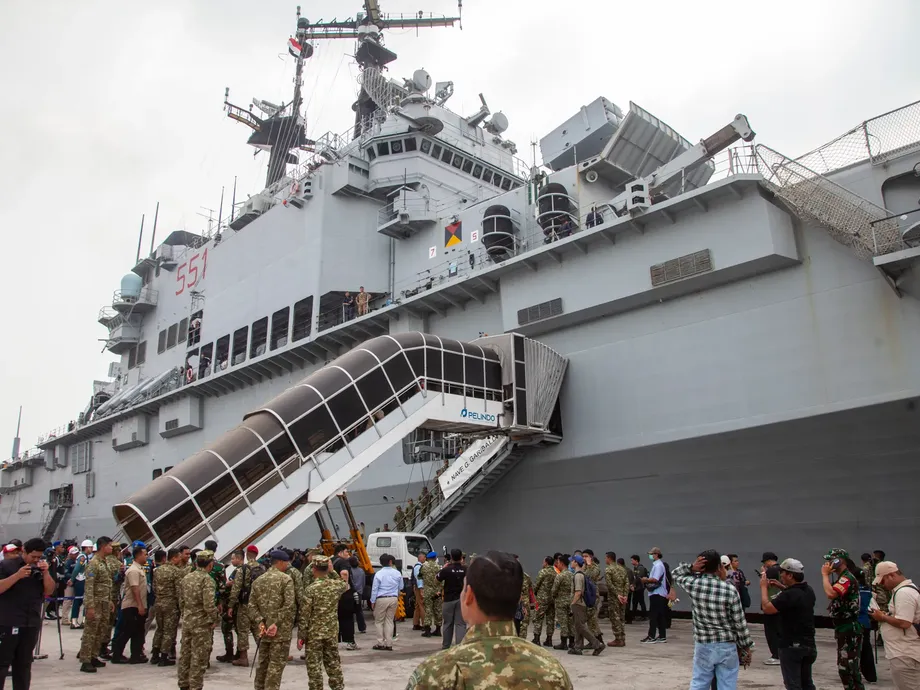
Indonesia is preparing its first aircraft carrier, KRI Sriwijaya-100, to deliver emergency supplies, move relief personnel and support evacuations across its scattered islands, following its commissioning at Jakarta's Tanjung Priok Port on September 24, 2026.
Contents
- A floating air base for communities cut off by disaster
- Why helicopters are central to the plan
- From Italian service to the Indonesian fleet
- What the vessel can carry and coordinate
- Disaster relief alongside maritime defense
- A donated ship with substantial running costs
- Keeping an aging aviation platform available
- Turning capacity into relief deliveries
- Key Points
The former Italian Navy carrier Giuseppe Garibaldi can carry up to 18 helicopters and accommodate up to 830 personnel, according to an Indonesian Navy statement. Those capacities put helicopter operations at the center of the government's case for using the vessel when damaged roads, bridges or other facilities block access to communities.
Brigadier General Rico Sirait, head of the Defense Ministry's Information Office, said the ship was ready to support military operations outside combat, particularly disaster response. Government Communications Agency head Muhammad Qodari said modifications to support helicopters and drones were being prioritized following President Prabowo Subianto's direction at a limited meeting on disaster management.
The humanitarian mission comes with a substantial financial commitment. Indonesia's Finance Ministry approved $450 million in financing for the carrier program in 2025, while further estimates of modernization and operating expenses have prompted scrutiny of how the country will sustain the vessel.
For people awaiting assistance after a disaster, the intended benefit is straightforward: a ship carrying aircraft and supplies could position itself offshore and send help toward places that relief vehicles cannot reach. Making that service dependable will require aircraft, trained crews, maintenance and funding alongside the ship itself.
Why helicopters are central to the plan
Qodari identified earthquakes, floods, landslides, and forest and land fires among the emergencies Indonesia faces. In his September 28 statement, he described the difficulty of getting personnel and basic supplies to people when transport infrastructure is disrupted.
Qodari, whose agency communicates government policy, explained how the carrier could help overcome that access problem:
"With its ability to support helicopter movements and carry and distribute various supplies, the KRI Sriwijaya-100 can help reach areas that are difficult to access by land or other means," he said.
Helicopters can take off and land vertically, allowing them to operate without a conventional runway. A ship equipped to support them can provide a movable departure point near an affected area, reducing dependence on facilities ashore.
Sirait described the vessel as a floating air base able to support helicopters and drones while underway. The government's intended missions include large deliveries of supplies, evacuation, medical operations and emergency assistance in remote areas.
The Navy has also described facilities for helicopter and drone operations. Officials have not specified the aircraft allocation, medical capacity, relief cargo capacity or a completion date for the modifications. Those details will determine how much assistance the carrier can deliver during a particular emergency.
From Italian service to the Indonesian fleet
KRI Sriwijaya-100 was built by Fincantieri at Monfalcone in Italy and entered Italian naval service in 1985. Its arrival in Indonesia in 2026 followed an agreement in March for Italy to give the carrier to Jakarta.
The vessel reached Tanjung Priok in North Jakarta on September 18 after sailing from Italy via Colombo and the Malacca Strait. Naval chief Muhammad Ali described its arrival as Indonesia moved to bring the former Italian ship into service.
The transfer and preparation unfolded through several milestones:
- 2025: Indonesia's Finance Ministry approved $450 million in financing for the aircraft carrier program.
- March 2026: Italy agreed to give the Giuseppe Garibaldi to Indonesia.
- September 18, 2026: The carrier arrived at Tanjung Priok after its voyage from Italy.
- September 24, 2026: Italy formally handed over the vessel, and Indonesian Armed Forces commander General Agus Subiyanto commissioned it as KRI Sriwijaya-100.
- September 28, 2026: Qodari outlined the priority given to disaster response and humanitarian missions.
The September 24 ceremony included lowering the Italian flag and raising Indonesia's flag. The name Sriwijaya recalls the maritime kingdom based in Sumatra that became a major naval and trading power in Southeast Asia between the seventh and 13th centuries.
What the vessel can carry and coordinate
The Defense Ministry gives the carrier's length as 180 meters and its displacement as 12,000 tons. Analyst Dr. Jannus TH Siahaan describes it as nearly 14,000 tons in his assessment of the acquisition; displacement measures a ship's weight through the amount of water it pushes aside.
The Navy's stated capacity of up to 18 helicopters and 830 personnel gives a sense of the platform's scale. Actual deployments will depend on the aircraft selected, the personnel needed to operate them and the supplies carried for each mission.
The Defense Ministry also says the vessel can serve as a maritime operations command center. In a disaster response, that means providing a place from which military teams can coordinate aircraft movements, relief deliveries and other activity at sea.
Medical operations form part of the government's proposed humanitarian role. Siahaan has separately suggested developing a floating hospital function as part of a broader concept for using the ship as a base for helicopters and unmanned aircraft.
For communities isolated by damaged infrastructure, the combination matters: carrying supplies close to an affected region and coordinating flights from the same platform could connect assistance offshore with people inland.
Disaster relief alongside maritime defense
Qodari said the carrier's humanitarian work would complement its principal maritime defense function. He placed disaster response within Military Operations Other Than War, commonly shortened to MOOTW and known in Indonesia as OMSP.
Qodari explained the priority in his statement:
"This capability is prioritized to support Military Operations Other Than War (MOOTW), particularly disaster mitigation and humanitarian missions," he said.
The term describes military activity outside fighting a war. For this ship, officials have identified practical tasks such as transporting aid, deploying personnel and helping evacuate people.
Navy chief Muhammad Ali also said the vessel could "be deployed for combat missions if necessary". The Defense Ministry has identified defense diplomacy as another role, placing the carrier within Indonesia's military relationships as well as its domestic emergency planning.
The acquisition forms part of Prabowo's wider effort to upgrade military equipment. Indonesia signed an $8.1 billion agreement in 2022, when he was defense minister, to buy 42 French Rafale fighter jets. The carrier adds a different capability: an aviation platform that can move by sea.
A donated ship with substantial running costs
Indonesia received the vessel as a donation, but bringing it into sustained service involves refurbishment, crew costs, maintenance and fuel. The $450 million financing approval is the main government financing figure identified for the program.
Siahaan, writing an assessment dated October 13, 2026, put the donated asset's value at €54 million, or about Rp1.1 trillion. He estimated modernization costs at Rp7.2 trillion to Rp7.5 trillion and routine operating expenses at about Rp101 billion a month.
Using that monthly estimate, 60 months of operation would cost Rp6.06 trillion. Adding the modernization range produces Rp13.26 trillion to Rp13.56 trillion for refurbishment and five years of operation, before other expenses. Those amounts are estimates in Siahaan's assessment rather than a final government spending account.
Siahaan also cited fuel costs of roughly Rp1.8 billion for each day at sea. How often the ship sails will therefore be an important part of planning its annual budget.
Opposition politicians have expressed concern that the eventual bill could exceed the approved financing. The practical budget question extends through the carrier's service: Indonesia must fund its availability for emergency missions as well as the initial work needed to prepare it.
Keeping an aging aviation platform available
The carrier was 41 years old on arrival in 2026. Ali said he hoped it could serve Indonesia for another 15 to 20 years, expressing confidence in its condition.
Ali, the Indonesian Navy chief of staff, described his expectation this way:
"Its condition is still very good and hopefully it can be used by the Indonesian navy for the next 15 to 20 years," he said.
Sirait highlighted the use of domestic resources and expertise to maintain and modify the ship as part of efforts to strengthen Indonesia's defense industry. Siahaan described a retrofit involving the Defense Ministry and Indonesian shipbuilder PT PAL, including work on air conditioning, combat management systems and defensive armament.
Siahaan also identified training, maintenance facilities and specialist personnel as requirements for making the carrier useful over time. Operating aircraft from a moving deck requires coordinated work by flight crews, deck teams and maintenance personnel.
A planned base at Teluk Ratai in Lampung features in his assessment. He also highlighted the need for docking capacity for maintenance and major overhauls. Time spent undergoing repairs will affect when the ship can be sent to an emergency.
Turning capacity into relief deliveries
Prabowo's disaster response direction gives the carrier a concrete public mission. Indonesia wants a platform able to move aircraft and supplies around an archipelago where a single damaged connection can leave a community difficult to reach.
Ali explained the reasoning behind the helicopter capacity:
"There are many disasters in this country. So we really need a vessel or platform that could carry many helicopters, because the helicopters can drop logistics quickly to remote areas," he said.
The ship brings several proposed functions together: transporting supplies, supporting flights, coordinating maritime operations and assisting medical and evacuation work. Each requires people and equipment assigned to the task, from aircraft maintenance teams to personnel handling relief cargo.
Indonesia's immediate challenge is to connect the government's disaster response priority with that continuing operational support. For residents cut off after an earthquake, flood or landslide, the useful measure will be how quickly supplies and rescue personnel arrive, and how reliably assistance continues.
Key Points
- KRI Sriwijaya-100 entered the Indonesian Navy on September 24, 2026, after serving Italy as Giuseppe Garibaldi.
- The Navy says the vessel can carry up to 18 helicopters and accommodate up to 830 personnel.
- Officials are prioritizing helicopter and drone capabilities for disaster response alongside maritime defense.
- Proposed humanitarian tasks include aid deliveries, evacuation, medical operations and emergency coordination.
- Indonesia approved $450 million in program financing in 2025; refurbishment and operating costs remain central to the spending debate.
- Training, maintenance, aircraft availability and sustained funding will shape the carrier's ability to respond.