A New Era for Distributed Power Generation
In late September 2025, Kawasaki Heavy Industries quietly opened the order book for a machine that could reshape how factories, hospitals, and data centers think about their carbon footprint. The company began accepting commercial orders for what it describes as the first large scale gas engine in the world capable of generating electricity using a fuel mix containing 30 percent hydrogen by volume blended with natural gas. This announcement represents a concrete step toward reducing emissions without requiring operators to dismantle functional infrastructure that still has decades of service life remaining. The timing addresses growing concerns about grid stability and rising energy costs that have moved climate considerations from abstract policy debates into immediate operational decisions for facility managers worldwide.
The new engine belongs to the KG series platform and falls within the eight megawatt class, a size category commonly used in distributed power plants that provide electricity directly to industrial facilities or local grids. Unlike experimental prototypes that exist only in laboratory conditions, this unit carries a warranty and a defined service schedule, signaling that the technology has moved beyond research into commercial viability. Kawasaki launched sales only after completing an eleven month operational verification campaign at its Kobe works facility, a trial that ran from October 2024 through September 2025 and subjected the engine to real world industrial conditions rather than controlled test environments. Engineers monitored combustion sensors, pressure levels, and thermal stress throughout the long operation to confirm performance under variable load conditions.
For many facility managers, the energy transition has remained an abstract concept discussed in policy papers and distant climate conferences. This changes when the monthly utility bill arrives or when summer heat waves strain aging electrical grids. The KG series engine offers a tangible middle path, allowing existing natural gas infrastructure to accommodate a gradually increasing share of hydrogen without requiring immediate replacement of pipelines, storage tanks, or turbine buildings. The timing coincides with growing pressure on industrial operators to demonstrate emission reductions while maintaining the reliability required for continuous manufacturing processes. By providing a retrofit option for existing equipment, Kawasaki enables plant operators to extend asset life while beginning the transition to lower carbon fuels, avoiding the capital expenditure and permitting delays associated with building entirely new generation facilities.
Why Thirty Percent Represents a Sweet Spot
Engineers selected the 30 percent hydrogen blend threshold after extensive analysis of existing gas distribution networks. Hydrogen molecules behave differently than methane, the primary component of natural gas, and can seep through seals and joints that effectively contain larger molecules. At concentrations up to 30 percent by volume, however, the blended fuel can typically move through existing pipeline systems with only limited adjustments to compression and monitoring equipment rather than a complete rebuild of the distribution infrastructure.
This compatibility threshold creates a unique value proposition for facilities that installed KG series engines during the past decade. Since 2011, Kawasaki has received more than 240 orders for earlier generations of these machines worldwide. The company has confirmed that many of these existing units can be retrofitted to accommodate the same 30 percent hydrogen co firing specification now available in new models. For a power plant built ten years ago to run exclusively on natural gas, this upgrade path offers a way to extend operational life while progressively lowering carbon intensity rather than waiting for an entirely new fleet to arrive.
The retrofit approach carries significant economic implications. Building new power generation facilities requires capital expenditure, environmental permitting, and grid connection studies that can span years. By contrast, upgrading existing infrastructure allows operators to begin reducing emissions immediately while spreading investment costs over time. The engine generates electricity through a conventional four stroke combustion process, but with modified fuel injection timing and carefully calibrated air to fuel ratios that account for hydrogens rapid flame speed and wide ignition range.
Containing the Lightest Element
Hydrogen presents unique engineering challenges that rarely appear in marketing materials but consume considerable attention in control rooms. As the smallest molecule in existence, hydrogen can escape through microscopic gaps that effectively seal methane. It embrittles certain metals over time, potentially compromising structural integrity in components designed for natural gas service. Perhaps most concerning for safety engineers, hydrogen ignites across a much broader range of fuel to air mixtures than conventional hydrocarbons and requires less energy to spark.
During the eleven month verification campaign at Kobe, engineers dedicated substantial resources to testing safety systems under failure scenarios. The commercial engine now includes distributed hydrogen sensors positioned throughout the fuel delivery path, capable of detecting leaks before they reach explosive concentrations. Nitrogen purging systems can flush fuel lines during startup, shutdown, or fault conditions, effectively inerting the system when hydrogen flow needs interruption. These features add layers of protection for operators and surrounding communities while allowing the engines to operate within standard industrial safety protocols.
Combustion stability required equally careful attention. Hydrogen burns hotter than methane, which increases the risk of forming nitrogen oxides, or NOx, pollutants that contribute to acid rain and respiratory problems. To manage this, designers implemented high pressure fuel injection combined with redesigned cooling channels around the combustion chamber. Testing confirmed that the modified engine maintains emissions within regulatory limits for natural gas power plants while reducing carbon dioxide output by roughly ten percent compared to pure natural gas operation. The system successfully operated across load ranges from 25 percent to full capacity, collecting performance data that will refine digital control systems for real time operation.
From Stationary Plants to Moving Vessels
While Kawasaki prepared the KG engine for commercial power generation, parallel development teams focused on applying similar combustion technology to maritime propulsion systems. In October 2025, the same month the stationary engine completed verification, a consortium comprising Kawasaki Heavy Industries, Yanmar Power Solutions, and Japan Engine Corporation announced the completion of the first land based operation in the world of marine hydrogen engines. This demonstration used a newly developed liquefied hydrogen fuel supply system installed at Japan Engines facility in Hyogo Prefecture.
The maritime project operates under Japans Green Innovation Fund, administered by the New Energy and Industrial Technology Development Organization (NEDO), which has allocated approximately two trillion yen toward achieving national carbon neutrality by 2050. The consortium tested medium speed four stroke engines capable of running on hydrogen at rated output, validating stable combustion under marine load profiles. A separate low speed two stroke engine, the type used for main propulsion on large cargo vessels, is scheduled to enter trials in spring 2026. All three engine configurations share a dual fuel architecture, allowing crews to switch between hydrogen and marine diesel depending on bunkering availability at specific ports.
This dual fuel capability addresses a practical constraint that will persist for decades. Global hydrogen refueling infrastructure for maritime use remains essentially nonexistent outside experimental facilities. A vessel equipped with hydrogen capable engines but conventional diesel backup can operate on established routes while gradually shifting to cleaner fuels as supply chains mature. The technology requires advanced combustion control to handle hydrogens wide flammability range and low ignition energy, with systems designed to prevent flashback, a dangerous phenomenon where flames travel backward into fuel supply lines.
The Infrastructure Gap
Engines can reach commercial readiness long before the fuel networks needed to supply them. Japan imports nearly all of its primary energy, making domestic hydrogen production insufficient for large scale industrial adoption. Recognizing this bottleneck, Kawasaki has pursued parallel development of import and storage infrastructure that will eventually feed both coastal bunkering stations and inland power plants. The company recognizes that without reliable fuel availability, even the most advanced combustion technology remains a stranded asset, unable to deliver environmental benefits or economic returns.
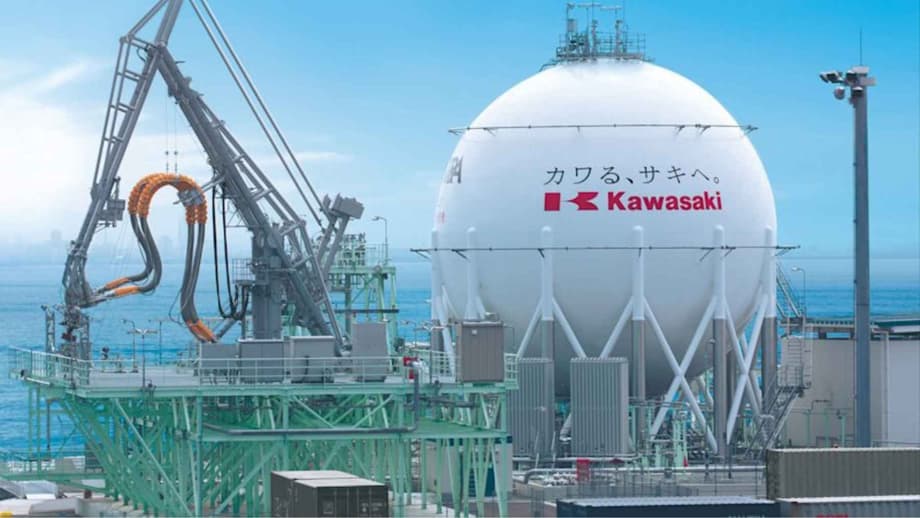
In November 2025, Kawasaki Heavy Industries and Japan Suiso Energy broke ground on the Kawasaki LH2 Terminal on Ogishima in Kawasaki City. Described as Japans first commercial scale liquid hydrogen import base, the facility centers on a cryogenic tank capable of holding approximately fifty thousand cubic meters of liquefied hydrogen at temperatures near minus 253 degrees Celsius. The terminal will include systems for ship handling, regasification, and truck dispatch, with commercial operations planned for approximately 2030. To supply this terminal, the partners are constructing a forty thousand cubic meter liquefied hydrogen carrier, a dramatic scale up from the experimental Suiso Frontier that demonstrated the first hydrogen shipment from Australia to Japan several years ago.
Kei Nomura serves as Executive Central Manager of Kawasaki’s Hydrogen Strategy Division. In connection with the marine demonstration and infrastructure development, Nomura emphasized the companys long term commitment to establishing the necessary technological foundation.
“Liquid hydrogen is a vital key to realising a sustainable energy society, and we have long been committed to building the technological foundation to support it.”
The search for supply extends beyond Asia Pacific. Kawasaki has partnered with Canadian organizations including the Edmonton Region Hydrogen Hub and Albertas Industrial Heartland to explore liquid hydrogen trade routes between the two countries. Canada offers abundant low cost natural gas and carbon capture capacity that could produce hydrogen for export, addressing Japans limited access to domestic renewables and natural gas reserves. These international partnerships aim to establish the supply security necessary before industrial buyers will commit to long term hydrogen offtake agreements.
Economic Realities for Early Adopters
Despite the technical achievements, the KG series engine enters a market where fuel availability remains severely constrained. Early adopters face three unappealing choices: pay premium prices for limited local hydrogen production, operate exclusively on natural gas while ignoring the hydrogen capability they purchased, or delay purchase decisions until supply chains mature. None of these options deliver immediate environmental benefits at scale, creating a classic supply and demand deadlock where infrastructure developers wait for confirmed demand while potential buyers wait for affordable fuel.
The public funding model attempts to break this deadlock. NEDOs Green Innovation Fund shoulders development risks that private markets might avoid, financing long term durability studies for hydrogen valves, crew training programs for handling cryogenic fuel at sea, and the retrofit kits needed to upgrade existing engines. This government backing reflects a strategic decision to avoid stranded assets, ensuring that power plants and vessels built today can adapt to tomorrows fuel rather than becoming obsolete liabilities when carbon regulations tighten further.
For facility operators watching their energy costs, the immediate value proposition lies in optionality rather than overnight decarbonization. The KG series provides a hedge against future fuel price volatility and regulatory changes, preserving capital investments while keeping the technical pathway open for deeper emission reductions as hydrogen becomes more available. The warranty coverage and service support that accompany commercial sales suggest manufacturer confidence that these machines will operate reliably for decades, bridging the gap between current natural gas dependence and a future hydrogen economy.
Key Points
- Kawasaki Heavy Industries launched commercial sales of the first 30 percent hydrogen co firing gas engine in the world in September 2025 following an eleven month operational trial.
- The eight megawatt KG series engine can retrofit into existing power plants, allowing over 240 previously installed units worldwide to upgrade for hydrogen blending.
- Safety systems include distributed leak detectors and nitrogen purging to manage hydrogens small molecular size and wide ignition range.
- Parallel development continues on marine hydrogen engines through a consortium with Yanmar and Japan Engine Corporation, with large vessel trials scheduled for spring 2026.
- Japan is building the Kawasaki LH2 Terminal with fifty thousand cubic meter storage capacity and a forty thousand cubic meter carrier ship to establish import infrastructure by 2030.
- The NEDO Green Innovation Fund provides two trillion yen in public backing to support development of hydrogen supply chains and engine technologies.