
A Two Kilometre Warning Built Into the Highway
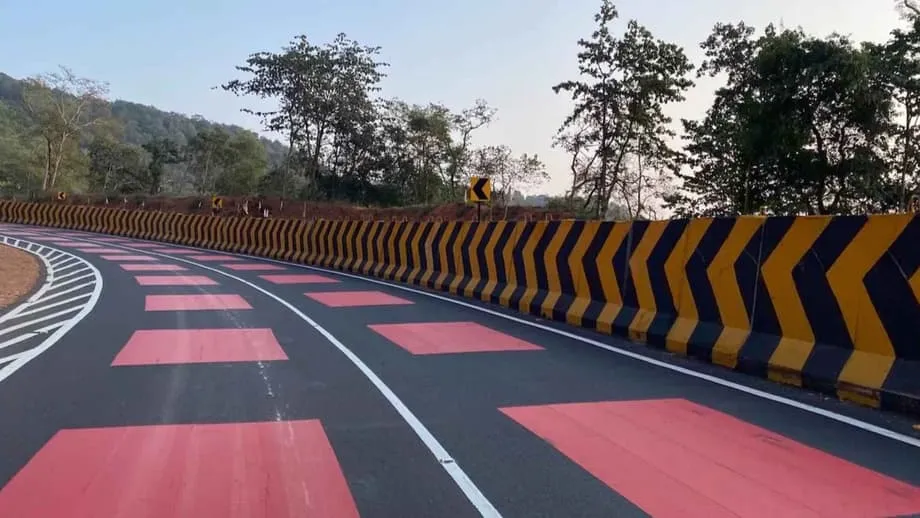
A two kilometre section of National Highway 45 in Madhya Pradesh has been given a red thermoplastic surface, five millimetres thick, to encourage drivers to slow down where wildlife may cross. The treatment forms part of an 11.96 kilometre corridor passing through the Veerangana Durgavati Tiger Reserve and skirting the Nauradehi Wildlife Sanctuary.
Contents
- A Two Kilometre Warning Built Into the Highway
- How Colour and Texture Encourage Slower Driving
- Keeping the Warning Visible After Dark
- Underpasses and Fencing Do the Physical Work
- What Wildlife Crossing Research Suggests
- Will Assisted Driving Systems Read the Road Correctly?
- The Human Cost and the Project's Timeline
- Chile Builds Wildlife Routes Into a Larger Highway Plan
- Success Depends on Results and Maintenance
- Key Points
The National Highways Authority of India (NHAI), under the Ministry of Road Transport and Highways, describes the installation as India's first table-top red marking on a national highway. Its purpose is to make the danger visible and physically noticeable through the tyres, without the sharp jolt of a conventional speed breaker.
The red surface is the most conspicuous part of a larger project. Along the corridor, 25 animal underpasses, continuous fencing approximately eight feet high, cameras and solar lighting are intended to separate wildlife movement from traffic while keeping drivers alert to remaining risks.
Madhya Pradesh recorded 237 collisions between animals and vehicles and 94 human deaths over the previous two years. Those figures give the experiment a human safety purpose as well as a conservation purpose. An animal suddenly entering a vehicle's path can leave a driver only a fraction of a second to respond.
The project seeks to influence behaviour through road design, reducing reliance on warning signs and enforcement alone. Animals cannot read a sign, and a speed camera cannot stop an animal from stepping into traffic. The intended response begins earlier: a driver sees the unusual colour, feels the change in surface and reduces speed before reaching a dangerous crossing area.
The approach brings together three tasks that must work together: slowing vehicles, keeping animals away from the carriageway and giving wildlife a usable route beneath it.
How Colour and Texture Encourage Slower Driving
NHAI's red treatment uses a layer of thermoplastic applied while hot. Thermoplastic is a material that softens with heat and hardens as it cools. Here, the five millimetre layer creates a slightly raised surface rather than simply changing the colour of the asphalt.
The design combines a visual warning with mild tactile and audible feedback through the tyres. Drivers are meant to notice the change without harsh braking, vehicle damage or discomfort. The table-top treatment therefore aims for a gentler response than the sudden impact associated with a traditional speed breaker.
Red light has a long wavelength, and the project's explanation presents the colour as an attention cue compared with the familiar white and yellow markings that motorists may learn to overlook. Together, the colour and texture are intended to prompt slowing before a driver has fully processed the danger.
Vishal Gupta, Executive Director at Deloitte India, describes the intervention as a subtle psychological nudge. In his assessment, it signals entry into a danger zone without distracting drivers or delivering a sharp jolt.
Gupta also points to the value of interrupting the monotony of a long drive. The unusual surface may help reduce fatigue in tropical environments where highway hypnosis contributes to accidents. Highway hypnosis describes the loss of active attention that can occur during a repetitive journey, even while a driver continues steering.
Keeping the Warning Visible After Dark
The thermoplastic contains glass beads that reflect light from vehicle headlamps. This makes the red treatment visible after dark, with reflectivity intended to remain effective in both dry and wet conditions.
Dawn, dusk and nighttime are especially difficult periods on wildlife corridors. Animal movement is high while visibility is low, and most collisions between wildlife and vehicles occur during these hours. A warning that works only in daylight would miss much of the danger the project is trying to address.
The surface therefore combines two kinds of feedback: reflected light helps drivers see the zone, while the texture makes the change noticeable through the vehicle. Solar lighting at bridges and junctions adds visibility at particular points without placing a large additional environmental burden on the corridor.
Underpasses and Fencing Do the Physical Work
NHAI has built 25 dedicated animal underpasses along the 11.96 kilometre stretch, placing them at documented wildlife movement locations. Tigers, deer, sambar and jackals can use these passages to cross beneath the highway instead of moving through traffic.
Continuous chain-link fencing runs along both sides of the road. At approximately eight feet high, it is intended to stop animals entering the carriageway and guide them towards the underpasses. In deep cutting sections, where the road passes through excavated ground, the fencing works with the surrounding terrain, which also forms a natural barrier.
Cameras mounted on minor bridges monitor activity at crossing points. Solar powered cameras are used to track wildlife movement and check whether animals are using the routes provided for them.
Amritlal Sahu, an NHAI official associated with the project, says underpasses help but cannot remove the danger unless motorists also change their behaviour. The red markings were introduced at persistent accident pockets where fencing and underpasses alone had been insufficient.
The corridor therefore has two complementary functions. Fencing and passages manage where animals move. The red surface manages how drivers approach the places where a collision remains possible. A tunnel can provide a route beneath the road, but an animal must reach it and choose to use it for that protection to work.
The project operates under NHAI's Green Highways initiative and is aligned with the Ministry of Road Transport and Highways' 2015 policy on environmentally responsible road building. Its wildlife structures are part of the highway's safety design, rather than a separate conservation activity beside the road.
What Wildlife Crossing Research Suggests
Research on wildlife collisions gives particular weight to the combination of fencing and crossing structures. A large analysis combining results from multiple studies found an approximately 83 percent reduction in deaths of large mammals on roads where the two measures were used together.
Fencing alone produced a reduction of roughly 54 percent. The difference between those figures is 29 percentage points, showing the stronger result associated with giving animals a crossing route as well as a barrier.
Crossing structures without fencing showed little detectable benefit in that analysis. Animals need guidance towards a passage: providing a tunnel nearby does not necessarily change where they attempt to cross.
Research published in Conservation Biology also found that fencing length and continuity affect results. Fenced stretches of at least five kilometres delivered collision reductions of at least 80 percent. Shorter sections produced much less consistent outcomes, ranging from zero to 94 percent, with an average reduction of 52.7 percent.
NH-45's nearly 12 kilometres of continuous fencing exceeds the five kilometre length associated with stronger results in that research. Its multiple underpasses also match the combination that performed best in the broader analysis. Actual performance will depend on the corridor's operation, including whether barriers remain intact and animals use the crossings.
United States federal studies estimate that vehicles collide with large animals between one million and two million times each year. Such crashes endanger people and are a major cause of wildlife deaths. For some species federally listed as threatened, road mortality ranks among the main threats to survival.
Those findings show why the NH-45 project extends beyond a coloured warning zone. The research places much of the protective value in the less visible infrastructure: long, continuous barriers connected to usable animal passages.
Will Assisted Driving Systems Read the Road Correctly?
India's preparation for vehicles that use software and sensors raises another design question: how will driving assistance systems respond to a red road surface? Modern systems use more information than colour alone to understand their surroundings.
Abhishek Mohan, Chief Engineer for Advanced Driver Assistance Systems (ADAS) at Tata Technologies, explains that contemporary platforms use edge detection, contrast analysis, reflectivity and semantic interpretation. In simpler terms, they look for boundaries, differences between surfaces, reflected light and the likely meaning of what their sensors detect.
Sensor fusion combines information from cameras, radar and LiDAR. LiDAR uses light to measure distances. Using these inputs together gives a vehicle more ways to understand the road than relying on a camera's recognition of a particular colour.
Mohan considers the red treatment largely compatible with ADAS Level 2 and Level 3 systems, provided it leaves the normal lane markings visible. These systems primarily use white and yellow lines running along the road to help control the vehicle's position within a lane. Coloured treatments running across the road are generally interpreted as surface features.
Lane marking continuity is therefore essential. If the red treatment temporarily masks underlying lane paint, a system may ask the driver to take over or may disengage. Mohan describes that response as safe and expected behaviour.
Azmathullah Mohammed, Senior Sales Director at Dassault Systèmes India, points to simulation as a way to check designs before they are installed. Platforms such as CATIA SCANeR allow developers to test how a vehicle system might respond in a virtual environment before physical deployment.
The treatment's compatibility depends on good lane paint, appropriate calibration standards and coordination between road designers and vehicle manufacturers. As vehicles take on more driving tasks through advanced sensor fusion, infrastructure also needs to be designed with their operation in mind.
The Human Cost and the Project's Timeline
India lacks comprehensive national data on collisions between animals and vehicles, but figures from individual states show the danger. In Punjab, direct collisions with animals account for 53 percent of fatalities linked to such accidents.
Madhya Pradesh's 237 animal and vehicle collisions and 94 human deaths over the previous two years place the issue close to the NH-45 project. The state is known as India's Tiger State and hosts the country's highest number of tiger reserves.
Growing tiger populations in reserves such as Veerangana Durgavati are pushing animals beyond protected boundaries. Highways cutting through traditional movement corridors create points where those journeys meet fast traffic.
The NH-45 upgrade cost Rs 122 crore, and its schedule called for completion by 2025. Officials also anticipate that the improved road will support tourism and local economic activity following the reclassification of nearby wildlife zones.
The dates connected with the Indian project and a comparable Chilean scheme show the different stages of policy, construction planning and operation:
- 2015: India's Ministry of Road Transport and Highways introduced its policy on environmentally responsible road building.
- 2025: The NH-45 upgrade's schedule called for completion.
- February 2026: Chile's Ministry of Public Works announced the Chacao to Chonchi Route 5 concession on Chiloé Island.
- April 16, 2026: The NH-45 red surface experiment was being described alongside its fencing, underpasses and monitoring measures.
- 2028: Construction of Chile's concession is projected to begin after detailed engineering and environmental assessment.
- Around 2033: The Chilean route is expected to reach full operation.
Chile Builds Wildlife Routes Into a Larger Highway Plan
Chile's Ministry of Public Works announced a $594 million concession in February 2026 for 126 kilometres of Route 5 between Chacao and Chonchi on Chiloé Island. The project includes seven wildlife crossings, also described as ecological corridors, intended to protect the island's natural environment.
The concession also includes a new bridge over the Pudeto River measuring roughly 750 metres, additional bridges, pedestrian walkways and service roads. It represents one of the island's largest infrastructure commitments in recent decades.
Detailed engineering and an environmental impact assessment are to precede construction, which is projected to begin in 2028. Full operation is expected around 2033.
India's NH-45 project and Chile's concession share the decision to include animal movement in highway planning. Their sizes and arrangements differ: NH-45 has 25 underpasses along 11.96 kilometres, while the Chilean plan includes seven wildlife crossings across a concession covering 126 kilometres.
NH-45 places passages at documented movement locations and adds a surface treatment intended to change driver behaviour. Chile's planned crossings sit within a much larger package of bridges, roads and pedestrian infrastructure. Both projects connect transport construction with protection of the surrounding environment.
Success Depends on Results and Maintenance
NHAI's experiment will need to be assessed through three practical measures: vehicle speeds in the red zones, collision counts before and after the intervention, and camera evidence showing whether animals use the underpasses rather than searching for gaps in the fence. Results for those measures were not given.
Speed data would show whether the colour and texture produce the intended slowing. Collision counts would track the safety outcome. Camera monitoring would help explain how wildlife responds to the passages and barriers.
Maintenance is central to keeping those protections working. A break in the fence can give animals access to the carriageway. A blocked underpass can remove a crossing route. Vegetation spreading over the red surface can make the warning harder for drivers to see.
The thermoplastic treatment is designed for straightforward maintenance and replacement. It is also reversible if a future upgrade requires a different approach. The surface treatment requires no change to the pavement structure or drainage patterns and produces less noise than conventional rumble strips.
Solar lighting and monitoring cameras add another part of the operating task: checking visibility and wildlife movement after construction. The corridor's value depends on continued attention to the road surface, fencing and passages together.
India has more than 150,000 kilometres of national highways, many of which intersect environmentally sensitive regions. If the Madhya Pradesh experiment succeeds, similar designs could be used on other routes passing through forests and wildlife corridors.
NH-45 combines ecology, driver behaviour and vehicle technology in one safety project. Its central idea is practical: provide animals with another way across, guide them towards it and make the remaining danger harder for a motorist to miss.
Key Points
- NH-45 has a two kilometre red warning zone with thermoplastic surfacing five millimetres thick, described by NHAI as India's first table-top red marking on a national highway.
- The 11.96 kilometre corridor passes through Veerangana Durgavati Tiger Reserve and skirts Nauradehi Wildlife Sanctuary.
- The project includes 25 animal underpasses, continuous fencing approximately eight feet high, monitoring cameras and solar lighting.
- Research found about an 83 percent reduction in large mammal road deaths with fencing and crossings together, compared with roughly 54 percent for fencing alone.
- Compatibility with driving assistance systems depends on keeping standard lane markings visible and maintaining appropriate calibration.
- Madhya Pradesh recorded 237 collisions between animals and vehicles and 94 human deaths over the previous two years.
- The NH-45 upgrade cost Rs 122 crore, with a schedule calling for completion by 2025, and aligns with India's Green Highways policy of 2015.
- Chile's $594 million Route 5 concession includes seven wildlife crossings along 126 kilometres, with construction projected for 2028 and full operation around 2033.
- Vehicle speeds, collision counts, underpass use and continued maintenance will determine how well the Indian project works.