
A widening gap after 22 years of Korean leadership
Taiwan's GDP per capita is projected to reach $56,101 in 2031, compared with South Korea's $46,019, putting the gap at $10,082. The International Monetary Fund's latest World Economic Outlook points to a widening lead for Taiwan after it overtook Korea in 2025, ending 22 consecutive years of Korean leadership in this measure.
Contents
- A widening gap after 22 years of Korean leadership
- How the dollar figures climb through 2031
- Why Taiwan's chip industry benefits from AI demand
- Korea's memory strength brings a different exposure
- Growth forecasts show the scale of the divergence
- The won and government debt add pressure
- A warning about Korea's place in the AI supply chain
- How the reversal developed in 2025
- What Korean officials say about the forecasts
- The Bottom Line
Figures compiled by the Bank of Korea and financial authorities from the IMF report released on April 15, 2026, put Taiwan's GDP per capita at $42,103 this year and Korea's at $37,412. The difference of $4,691 is expected to more than double within five years.
Artificial intelligence demand sits at the center of the reversal. Taiwan's semiconductor industry has benefited from growing orders for advanced processors and the services needed to manufacture them. Korea remains a major chip producer, but its heavier concentration in memory products leaves it facing a different mix of opportunities, price swings and competition.
GDP per capita divides the value of an economy's output by its population. It offers a way to compare economic output per person, while the dollar figures also move with exchange rates. Purchasing power parity, another measure used in the IMF forecasts, adjusts for differences in local prices.
As of April 20, 2026, the projections describe two economies moving at different speeds. Taiwan combines strong growth with relatively low inflation, while Korea faces weaker expansion, a depreciating currency and government debt growing faster than nominal output. The figures also put Japan behind both economies on GDP per capita.
The projected global rankings sharpen the contrast: Taiwan is expected to move from 32nd to 30th among 197 nations, while Korea moves from 40th to 41st. Those changes extend a reversal that began with the 2025 crossover.
How the dollar figures climb through 2031
Korea's projected GDP per capita of $37,412 in 2026 represents a 3.3 percent increase from $36,227 in the previous year. Taiwan's projected $42,103 represents growth of 6.6 percent, twice Korea's percentage increase, and puts it above the $40,000 threshold ahead of Korea.
Korea is forecast to cross that threshold in 2028, reaching $40,695. Taiwan is projected to exceed $50,000 in 2029, reaching $50,370, while Korea remains much closer to the $40,000 level. Japan is forecast to reach $40,398 in 2029, crossing $40,000 one year after Korea.
The annual figures show how steadily the difference between Taiwan and Korea is expected to increase:
- 2026: Taiwan leads Korea by $4,691 per person.
- 2027: The projected gap reaches $5,880.
- 2028: The gap rises to $6,881, as Korea reaches $40,695.
- 2029: Taiwan reaches $50,370, with a projected lead of $7,916.
- 2030: The gap increases to $9,073.
- 2031: Taiwan reaches $56,101 and Korea $46,019, a difference of $10,082.
Japan's projected GDP per capita is $35,703 in 2026 and $43,038 in 2031. Korea therefore retains a lead over Japan throughout those endpoints, even as Taiwan pulls further ahead of both.
The purchasing power comparison produces a larger numerical gap. Taiwan's GDP per capita adjusted for purchasing power parity is projected at $98,051 this year, compared with Korea's $68,624. By 2031, Taiwan is expected to approach $124,000, while Korea reaches about $83,696.
Purchasing power parity asks how much goods and services money can buy locally. It uses an adjustment for prices rather than simply converting economic output at market exchange rates. This helps explain why its figures differ so much from the dollar amounts used in the headline comparison.
Why Taiwan's chip industry benefits from AI demand
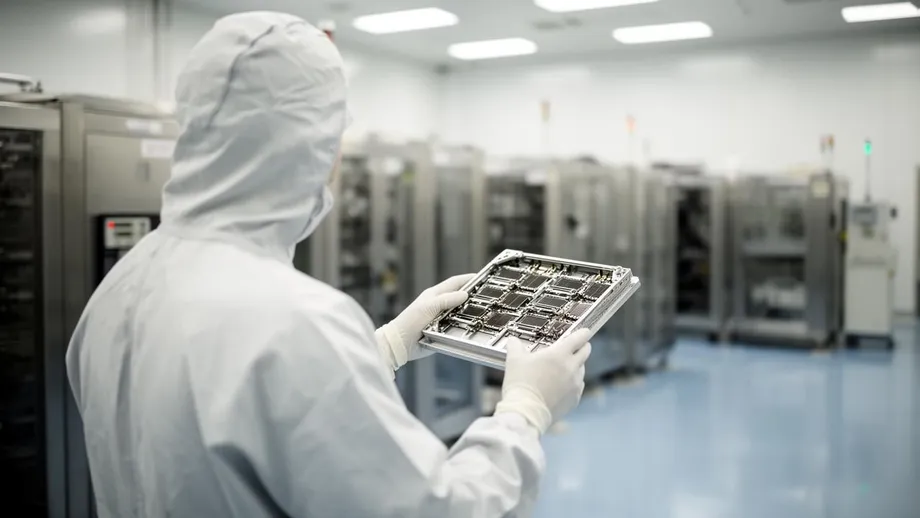
Taiwan's advantage centers on the foundry business, which manufactures chips designed by other companies. Its factories produce advanced processors for Nvidia, Apple and AMD. Taiwan Semiconductor Manufacturing Company, the world's largest contract chipmaker, has become a leading beneficiary of demand for computing chips used in artificial intelligence.
A processor performs calculations, including the large volumes of calculations needed by AI systems. Taiwan's position in making advanced processors places its industry close to the surge in spending on AI infrastructure. The foundry model also connects manufacturing with design support and advanced packaging, which prepares chips for use in computing systems.
The Korea Center for International Finance describes Taiwan's semiconductor ecosystem as an integrated network stretching from raw wafer production to packaging and testing. Wafers are the material on which chips are manufactured. Having connected businesses across these stages helps Taiwan respond quickly when orders rise.
Taiwan's network also includes chip design houses, equipment suppliers and packaging services. Yeh Chun-hsien, head of Taiwan's National Development Council, attributed Taiwan's rise to TSMC's success and booming demand from industries that depend on chips.
Those connections reinforce the industry's competitive position. A manufacturer needs equipment, materials, technical services and reliable partners to turn a design into a finished chip. Taiwan's strength across those activities allows it to capture business at several stages of the AI supply chain.
AI applications are spreading across smartphones, automobiles and data centers. The economic value associated with that expansion increasingly concentrates in advanced logic chips and specialized AI processors, areas in which Taiwan holds a commanding market position.
Korea's memory strength brings a different exposure
South Korea built much of its semiconductor success around memory chips, particularly DRAM and NAND flash storage. DRAM provides working memory for computing tasks, while NAND stores information. Both are needed in computing systems, including those used for AI.
More than 60 percent of Korea's semiconductor shipments are concentrated in memory products, according to the Korea Center for International Finance. Memory prices can fluctuate sharply, and competition from Chinese manufacturers adds pressure on profit margins.
Korean companies therefore face a more concentrated exposure to changes in a particular product market. Memory remains essential, but its more standardized products face persistent price competition. Taiwan's wider network of foundries, design services and packaging businesses gives it a different position in the current wave of AI investment.
KCIF researchers Kim Mi-seung and Lee Chi-hoon said narrowing the gap would take time and substantial structural adjustments. They identified an increasingly imbalanced Korean export structure, with heavy reliance on one product category leaving the economy exposed to downturns in that sector.
Samsung Electronics and SK Hynix have world class capabilities in memory. Korea has nevertheless struggled to build comparable dominance in logic chips and foundry services. Its efforts to expand foundry production and AI chip design remain at an early stage compared with Taiwan's established ecosystem.
Korea also faces challenges in diversifying supply chains and broadening its industrial base beyond memory production. Its strengths in automobiles, petrochemicals and shipbuilding remain part of the economy, but the recent reversal shows how strongly semiconductor performance is affecting the comparison with Taiwan.
Growth forecasts show the scale of the divergence
Major global investment banks forecast Taiwan's economic growth at an average of 7.1 percent for 2026, according to KCIF figures compiled at the end of March. That was an upward revision from 6.2 percent just weeks earlier, reflecting stronger than expected AI demand.
Taiwan's economy grew 8.6 percent in 2025. That growth rate was eight times Korea's last year. The forecast pattern puts Taiwan's expansion around 7 to 8 percent, while Korea is struggling to reach 2 percent.
Korea's 2026 growth expectations sit in the upper part of the 1 percent range, with some forecasts near 1 percent. The difference matters because faster expansion increases the output available to divide across the population, contributing to Taiwan's rising GDP per capita.
Taiwan is also projected to have inflation of 1.9 percent in 2026, below the target level described in the comparison. Korea's projected inflation is 2.4 percent, above the typical 2 percent target and higher than its economic growth rate.
Taiwan's combination of rapid expansion and controlled prices stands out in the forecasts. Korea faces the less favorable combination of weaker growth and somewhat faster price increases, alongside currency pressures that affect the value of its economy when measured in dollars.
The won and government debt add pressure
The Korean won has depreciated against the US dollar more than twice as much as the Taiwan dollar this year. A weaker currency reduces the dollar value of output measured in local money, weighing on Korea's nominal GDP per capita in international comparisons.
The IMF's Fiscal Monitor projects Korea's government debt at 54.4 percent of GDP in 2026 and 56.6 percent in 2027. The latter figure would exceed the average for advanced economies without reserve currencies. By 2031, Korea's ratio is projected to reach 63.1 percent.
Since 2020, Korea's nominal GDP has grown by an average of 5.3 percent annually, while national debt has increased by 9 percent annually. Nominal GDP measures output at current prices. When debt grows faster than that output, the debt burden becomes larger relative to the economy supporting it.
The IMF expects that trend to continue through 2031. A rising ratio places greater demands on the economy's capacity to service government borrowing and can constrain the room available for spending priorities.
The comparison with reserve currency economies helps explain the concern. The debt ratios cited for G7 economies such as the United States, Japan and the United Kingdom are around 120 to 130 percent. Their currencies serve as global reserves, providing protection against capital flight and exchange rate volatility during external shocks.
Korea lacks that reserve currency protection and is more exposed to international financial market fluctuations. The concern therefore involves the pace of debt growth and the country's financial setting, alongside the level of debt itself.
A warning about Korea's place in the AI supply chain
Park Jung-woo, an economist at Nomura Securities, warned that continued dependence on memory exports could leave Korean businesses in a secondary position within an AI supply chain led by Taiwanese companies. He called for a wider semiconductor and AI ecosystem and more financial support for technology businesses.
If Korea continues to depend solely on memory semiconductor exports in the AI era, it risks becoming a subcontractor to Taiwanese firms. Korea must expand its semiconductor and AI ecosystems to sustain growth. Financial investment should be strengthened to support the tech sector. Scaling up funding through specialized financial intermediaries focused on venture capital will be key to efficiently channeling capital.
Park's recommendation focuses on organizations that direct investment toward young technology companies. Venture capital provides funding to businesses seeking to develop and expand, including companies that may bring new chip designs or AI products to market.
Korea's funding mechanisms have traditionally favored large conglomerates over smaller startups. Taiwan benefits from close connections with Silicon Valley supply chains and venture networks, supporting its links with companies designing and using advanced chips.
Expanding that financial support would sit alongside the industrial changes identified by KCIF. The challenge involves funding new businesses, developing a broader supplier network and building capabilities outside Korea's established memory strengths.
How the reversal developed in 2025
Korea first overtook Taiwan in GDP per capita in 2003 and maintained its lead for 22 consecutive years. The 2025 reversal became a major benchmark in Korean policy discussions, where comparison with Taiwan has long served as a measure of national competitiveness.
October 2025 marked the formal crossover in IMF data. Taiwan's GDP per capita was shown rising 11.1 percent to $37,827, while Korea's fell 0.8 percent to $35,962. The April 2026 outlook uses a higher figure of $36,227 for Korea's previous year, reflecting a later set of estimates.
The timeline shows the move from a longstanding Korean lead to a widening projected Taiwanese advantage:
- 2003: Korea overtakes Taiwan in GDP per capita.
- 2025: Taiwan regains the lead after 22 consecutive years behind Korea.
- October 2025: IMF figures put Taiwan at $37,827 and Korea at $35,962.
- Late March 2026: KCIF's compilation puts investment banks' average Taiwan growth forecast at 7.1 percent, up from 6.2 percent weeks earlier.
- April 15, 2026: The latest IMF World Economic Outlook sets out projections extending through 2031.
- 2031: The projected GDP per capita gap reaches $10,082.
Taiwan's earlier lead belonged to a very different economic period, before smartphones and social media had emerged and when China's economic weight was relatively modest. Its return to the lead through technology raises the issue of how Korea's industrial policies have adapted to the platform economy and the AI transition.
The wider regional comparison lists Singapore at $94,480 per person, Macau at $74,920 and Hong Kong at $56,840. Taiwan follows in fourth place in that ordering, with Korea fifth and Japan sixth. Both Taiwan and Korea therefore remain below the leading figures in the regional comparison.
What Korean officials say about the forecasts
A spokesperson for Korea's Ministry of Planning and Budget said the IMF debt figures are based on rolling fiscal management plans that are revised annually. Policy responses can change those plans and the resulting projections.
The spokesperson also said Korea's projected debt levels remain relatively low compared with averages for the G20, G7 and European Union. That response places the rising Korean ratio alongside the larger debt burdens carried by other groups of economies.
Choi Ji-young, an IMF director, said Korea's projected debt ratio had decreased compared with earlier Fiscal Monitor outlooks. She described treating the recent designation as a warning as an overreaction and said projections for fiscal deficits over the medium term had also been lowered.
Those official responses leave room for policy changes to alter the fiscal numbers. The figures through 2031 are forecasts, with future results dependent on economic conditions and government decisions.
Korea's industrial challenge extends beyond fiscal adjustments. The concerns raised by Park and the KCIF researchers focus on the mix of semiconductor products, the reach of supplier networks and access to investment. Taiwan's advantage rests on those industrial connections as well as faster current growth.
The comparison therefore brings several forces together: AI demand supports Taiwan's foundry ecosystem; Korea's memory concentration exposes it to sharper swings in a narrower market; and exchange rates and debt trends add pressure to Korea's economic position. The IMF's projected $10,082 gap by 2031 expresses how those differences could accumulate over five years.
The Bottom Line
- Taiwan's projected GDP per capita is $42,103 in 2026, compared with Korea's $37,412.
- By 2031, the IMF projects Taiwan at $56,101 and Korea at $46,019, a gap of $10,082.
- Taiwan regained the lead in 2025 after 22 consecutive years of Korean leadership.
- Taiwan's foundries and connected semiconductor businesses are benefiting from AI demand, while more than 60 percent of Korea's chip shipments are memory products.
- Investment banks' average Taiwan growth forecast reached 7.1 percent for 2026; Korea's forecasts are in the upper 1 percent range, with some near 1 percent.
- Korea's government debt is projected to rise from 54.4 percent of GDP in 2026 to 63.1 percent in 2031.
- Purchasing power adjusted GDP per capita is projected at $98,051 for Taiwan and $68,624 for Korea this year.
- Taiwan is projected to rise from 32nd to 30th in global rankings, while Korea moves from 40th to 41st.
- Korean officials say fiscal projections can change, while economists call for broader semiconductor capabilities and more investment in technology businesses.