
From a Jakarta Stall to a $17 Million Profit
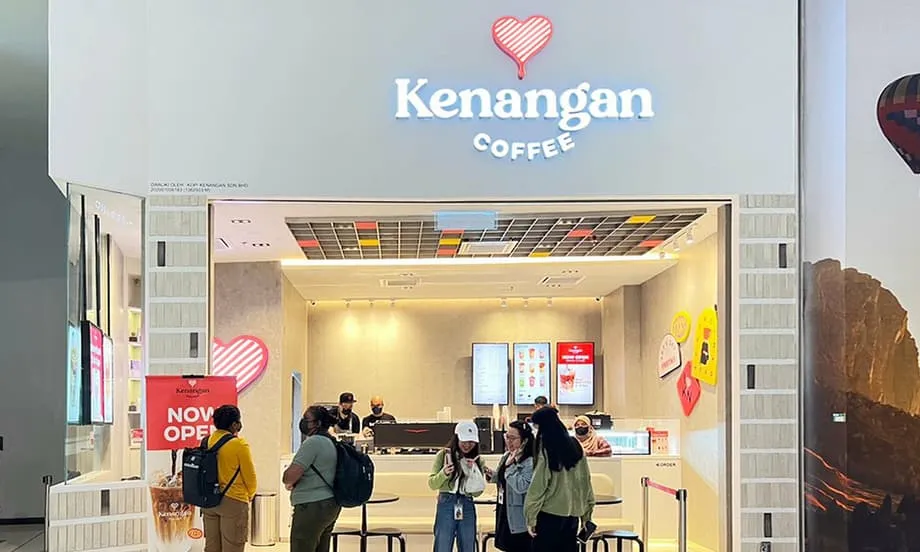
Kopi Kenangan ended 2025 with its first annual profit after five years of losses: $17 million in net income on revenue of $184 million, up 45% from the previous year. The Indonesian coffee company had grown from a single stall in Jakarta's Standard Chartered tower in 2017 to more than 1,324 outlets across six countries by late 2025.
Contents
- From a Jakarta Stall to a $17 Million Profit
- A Founder Shaped by Cards, Coal and Tea
- What the $1.30 Latte Changed
- Phones Became Part of the Business
- Seven Markets and Different Ways to Expand
- The Investors Behind the Expansion
- Why the Company Pulled Back From Other Concepts
- Competition Moves Beyond Counting Stores
- A $200 Million Plan Without an Immediate Listing
- Key Points
Taiwan became its seventh market in early 2026, with the first store opening in Taipei in April. As of April 25, 2026, founder and chief executive Edward Tirtanata is pursuing a much larger goal: 4,000 locations and $650 million in annual revenue by 2030, supported by a projected $200 million investment.
The business rests on a simple proposition. Its signature palm sugar latte costs Rp22,000, roughly $1.30, placing freshly brewed coffee within reach of customers who find international chains too expensive. The company now serves millions of cups each month, and that drink has become a cultural phenomenon among Indonesian millennials and Gen Z consumers.
Kopi Kenangan means "coffee memories" in Indonesian. Its growth has made it the region's dominant local coffee chain, while its next expansion will test whether a business built around Indonesian tastes can become a much larger international brand.
Tirtanata, who founded the company with James Prananto and Cynthia Chaerunnisa, describes his ambition in terms of earnings as well as outlets:
We'd like to be the single company or brand that is the most dominant in Southeast Asia, not just by store count but by revenue and profitability.
The 2025 results give that ambition a financial starting point. Net income is the profit left after expenses; the $17 million earned on $184 million in revenue amounts to about 9.2% of sales. Keeping that business profitable while expanding is now central to the company's plans.
A Founder Shaped by Cards, Coal and Tea
Edward Tirtanata grew up in Jakarta with entrepreneurial parents and began making money while still at school, trading Pokemon cards and gaming bots. His interest was in doing business itself, rather than simply accumulating money.
Tirtanata recalled that early enthusiasm:
But whenever there is an opportunity to make money or do businesses, I always [got] excited.
It's not about the money — it's about the pleasure of doing it.
At Northeastern University in Boston, he studied finance and accounting and developed a daily coffee habit at the campus Dunkin' Donuts. He returned to Indonesia in 2010 and initially worked with his father in coal marketing.
The collapse in commodity prices in 2014 changed how he thought about business. Coal prices were set by a market beyond his control, leaving him exposed when they fell. Tirtanata described the lesson:
I was at the mercy of the market.
After that, I promised myself my next venture would be in a business where I could control my price.
His first beverage venture, the premium tea chain Lewis & Carroll, failed to meet expectations. Yet it helped him identify an opening for a different kind of drinks business, one aimed at customers between street vendors and expensive international cafes.
In 2017, Tirtanata, his high school friend James Prananto and marketing veteran Cynthia Chaerunnisa pooled Rp150 million, roughly $10,000, from their savings. They used it to open the first Kopi Kenangan outlet in the Standard Chartered tower, beginning with a small operation selling coffee for customers to take away.
What the $1.30 Latte Changed
Indonesia's coffee prices gave the founders a clear opening. Street vendors sold instant coffee for about Rp5,000, or $0.30, while international chains charged Rp40,000 to Rp50,000, equivalent to $2.33 to $2.92. With average monthly wages around $200, a daily Starbucks visit was beyond the budget of many Indonesians.
Tirtanata explained the pricing problem he saw when the company began:
When I started, companies were selling coffee at Rp40,000 to Rp50,000 per cup, which was unaffordable for most Indonesians.
Kopi Kenangan offered freshly brewed coffee made with Indonesian arabica and robusta beans for Rp22,000. Customers paid more than they would for street coffee, but between Rp18,000 and Rp28,000 less than the international chain prices cited by Tirtanata.
The bestselling Kopi Kenangan Mantan, loosely translated as "coffee memories of my ex," mixes espresso with milk, creamer and gula aren, a local palm sugar. Its name and ingredients connect the product to Indonesian culture rather than copying an international cafe menu.
The small store format also supports the price. Selling drinks to take away removes the need for expensive seating areas and large retail spaces, allowing the company to direct resources toward ingredients while keeping prices low.
Kopi Kenangan adjusts its recipes when it enters other markets. In Singapore, the same latte contains less sugar to suit local preferences. Tirtanata said the balance of sweetness and coffee strength matters:
We want to make sure that the sweetness and robustness of the coffee really suits the market that we are operating in.
The approach combines a recognizable Indonesian drink with changes for local tastes. That gives the company a common product identity without requiring every market to receive an identical recipe.
Phones Became Part of the Business
Kopi Kenangan launched its mobile application in 2019, offering advance orders, delivery and loyalty programs. During the COVID-19 pandemic, lockdowns reduced traffic in offices and shopping malls, forcing the company to shut dozens of stores.
Tirtanata responded with what he called a "massive strategic reshuffle." Digital ordering became central to reaching customers as the usual flow of people past stores weakened.
By December 2025, the application had 1.5 million active users, more than twice the number a year earlier, and generated nearly half of all sales. Tirtanata described the broader importance of mobile ordering:
The app was a byproduct of the pandemic. Seventy percent of orders are placed via cellphones.
The application launched before the pandemic, while the disruption made its role in the business more important. The figure for orders placed by cellphone covers a broader activity than sales generated through the company's own application.
Digital orders also give Kopi Kenangan information about what customers buy. The company uses those preferences to introduce new beverages every two months and improve its supply chains, the arrangements that move ingredients and other supplies to stores.
Artificial intelligence has a place in the company's internal work as well. It is used to screen resumes and help employees analyze financial information, giving more staff access to advanced analysis rather than keeping that work within a small specialist group.
Seven Markets and Different Ways to Expand
Indonesia remains Kopi Kenangan's core business. More than 1,100 stores there contribute 75% of revenue. Overseas, the company operates under the name Kenangan Coffee, with Malaysia its largest international market at approximately 158 outlets, followed by Singapore with 10.
Expansion has moved beyond those neighboring markets. In 2024, the company entered the Philippines through a partnership with Fredley Group of Companies, planning an initial 10 stores. In early 2025, it appointed former Subway executive Dheeraj Maini as head of business development for India.
The first Indian store opened at Pacific Mall in Delhi. Plans for that market call for 50 locations and investment of up to INR40 crore. In April 2026, Taiwan's first outlet opened at Taipei's Shin Kong Mitsukoshi A11, attracting 350 visitors a day on weekends during its soft opening.
The main steps in the company's expansion and financing have unfolded over several years:
- 2017: The founders opened the first Kopi Kenangan outlet in Jakarta.
- 2019: The company launched its mobile application.
- 2021: A $96 million Series C funding round lifted its valuation above $1 billion.
- 2024: It entered the Philippines through Fredley Group of Companies.
- Early 2025: Dheeraj Maini was appointed to lead business development in India.
- Late 2025: The chain exceeded 1,324 outlets across six countries and recorded its first annual profit.
- Early 2026: Taiwan became its seventh market, with the first Taipei store opening in April.
- 2030: The company aims to reach 4,000 locations and $650 million in revenue.
Kopi Kenangan owns and operates stores in Indonesia, Singapore, Malaysia and India. It uses franchise arrangements in the Philippines and Australia. Under franchising, a partner runs outlets under the brand, rather than the company operating every store itself.
Tirtanata says franchising will be the default option for new markets beyond 2026. His goal is a regular flow of country launches:
To be a true global brand, we need to add two to three countries a year.
The Investors Behind the Expansion
Kopi Kenangan became Southeast Asia's first food and beverage "unicorn" in 2021 after raising $96 million in Series C funding. A unicorn is a privately held company valued at more than $1 billion. Its total funding across multiple rounds has reached $234 million.
Its investors include rapper Jay-Z through Arrive, tennis star Serena Williams through Serena Ventures, and Meta Platforms cofounder Eduardo Saverin through B Capital. Singapore's sovereign wealth fund GIC, Hong Kong billionaire Solina Chau's Horizons Ventures and Peak XV Partners also backed the business.
Peak XV, formerly Sequoia India & Southeast Asia, has invested $25 million in the chain. Its managing director, Rohit Agarwal, recalled a first meeting at which Tirtanata brought the product rather than beginning with a presentation.
Agarwal described how the founder arrived:
Ed showed up with four cups of coffee and it was a very atypical meeting, where, instead of starting with a slide deck, a founder comes with a cup of coffee.
There was something about the taste that just felt right.
The funding helped support rapid growth. Tirtanata's experience also led him to argue that abundant capital can encourage founders to spread their attention across too many projects.
Why the Company Pulled Back From Other Concepts
Between 2020 and 2024, Kopi Kenangan tried several concepts outside its main business. Kenangan Heritage and Kenangan Signature targeted affluent customers with artisanal brewing and larger cafes. Satu Kenangan went in the opposite direction, selling Rp7,000 cups for a mass market in rural areas.
Those experiments diverted resources from the core chain. Tirtanata said the company recognized that it had taken on too much:
After 2022, I realised that we were doing too many things.
We realised those distractions were pulling us away from our core business.
The company has since stopped expanding those secondary brands. Its focus is now on the main Kopi Kenangan concept and Kopi Kenangan Hanya Untukmu, its line of drinks sold ready to consume. Unit sales for that line tripled in 2025.
Tirtanata links the change to a wider lesson about allocating money and management attention. He argues that receiving a large amount of funding early can make it easier to pursue ideas that rank below the company's most urgent priorities:
The biggest problem for startups in Southeast Asia is that their founders are too resource-rich, not resource-constrained.
When you raise funding of hundreds of millions of dollars, you start working on projects that are really only your fifth, sixth or seventh priorities.
Competition Moves Beyond Counting Stores
Kopi Kenangan faces regional rivals including Malaysia's Zus Coffee, Vietnam's Highlands Coffee and Thailand's Cafe Amazon. In Indonesia, competitors include Janji Jiwa, Fore Coffee and Tomoro Coffee. China's Luckin Coffee, with more than 31,000 stores, is a potential entrant into the regional market.
Momentum Works describes the competition as a "systems war." In practical terms, that means success depends on how efficiently a chain runs its stores, gets supplies to them and handles digital orders, rather than simply how many outlets it opens.
The difference can be seen in daily sales volumes. Leading chains now serve 600 to 800 cups a day, compared with 300 to 400 for typical stores, while peak performers reach 9,000 cups. Higher volumes make reliable operations and supply arrangements increasingly valuable.
Tirtanata sees space for competitors because freshly brewed coffee consumption in Indonesia remains low. He puts it at 2.7 cups per person annually, the lowest in Asia, and projects that it could rise to 4.2 cups within four years.
That would be an increase of 1.5 cups per person, or about 56%, from the starting figure he gives. His view is that rival chains can help bring more people into the market rather than merely compete for existing customers.
Tirtanata summed up that position:
There's room for everyone.
A $200 Million Plan Without an Immediate Listing
Kopi Kenangan's 2030 plan calls for roughly tripling its late 2025 outlet count to 4,000 locations. The planned distribution includes 2,600 stores in Indonesia and 800 in Malaysia, with the remainder across other markets. The company is considering entry into 10 to 15 additional countries.
The business aims to open roughly one store a day and reach $650 million in annual revenue. Compared with the $184 million recorded in 2025, that revenue target is more than three and a half times as large.
Tirtanata plans to fund the projected $200 million expansion through operating cash flow rather than new capital. Operating cash flow is the money generated by running the business, which the company intends to put back into growth.
An initial public offering, or IPO, would sell shares to public investors and place the company on a stock exchange. Tirtanata says Kopi Kenangan is "IPO-ready" from a governance perspective, but an immediate offering appears unlikely and no listing date has been given.
The company has engaged PricewaterhouseCoopers as its auditor and tested its internal controls under pressure following the collapse of Indonesian unicorn eFishery. Tirtanata called that collapse "a necessary wake-up call" about transparency risks. Auditors examine financial accounts, while internal controls are checks intended to keep a company's reporting and decisions reliable.
Tirtanata said he prefers to wait for the right stage of the business rather than hurry into a public listing:
Many companies go public too early.
For us, this is a once-in-a-lifetime opportunity, so it is better to do it properly.
Taiwan and India are now part of a wider effort to take Indonesian coffee culture abroad. Tirtanata says that ambition existed from the company's first days:
From day one, we believed there would be unique demand for an Indonesian coffee chain globally.
We always said that we are from Indonesia to the world. The journey is just beginning.
Key Points
- Kopi Kenangan grew from one Jakarta stall in 2017 to more than 1,324 outlets across six countries by late 2025.
- Taiwan became its seventh market in early 2026, with the first Taipei store opening in April.
- The company earned its first annual profit in 2025: $17 million on revenue of $184 million, up 45%.
- Its signature palm sugar latte sells for Rp22,000, roughly $1.30, below the cited prices at international chains.
- Indonesia contributes 75% of revenue and has more than 1,100 stores.
- The application had 1.5 million active users in December 2025 and generated nearly half of sales.
- The company stopped expanding secondary cafe concepts and refocused on its main chain and drinks sold ready to consume.
- Tirtanata targets 4,000 outlets and $650 million in revenue by 2030, with a projected $200 million expansion funded through operating cash flow.
- The company says it is ready for an IPO from a governance perspective, but no listing date has been announced.