A Historic Offer in Indo-Pacific Naval Cooperation
Japan has offered India the complete design and local construction rights for its advanced Mogami class stealth frigates, marking the first time Tokyo has proposed transferring a major frontline warship to New Delhi. The proposal emerged during initial discussions on April 19 and 20, just one day before the Japanese cabinet revised longstanding rules restricting exports of defence equipment and technology on April 21. Each vessel carries an estimated price tag of roughly US$500 million and would be built in Indian shipyards using Japanese materials and selected sensitive technologies. If realised, the arrangement would represent one of the largest and most ambitious defence industrial ventures ever contemplated between the two Asian powers.
- A Historic Offer in Indo-Pacific Naval Cooperation
- What Makes the Mogami Class a Naval Game Changer
- The Australia Deal and Japanese Export Evolution
- Shared Anxieties Over Chinese Naval Expansion
- A Clear Signal to Beijing and Beyond
- Indian Shipyards and the Atmanirbhar Bharat Vision
- Filling Critical Gaps Without Undermining Indigenous Ships
- Obstacles and the Long Road to Delivery
- The Bottom Line
The initiative aligns precisely with Indian campaigns to expand local defence production while reducing dependence on foreign arms imports. For Japan, the offer reflects a decisive break from the cautious posture that governed its defence exports for decades following World War II. Tokyo relaxed its arms export restrictions in 2014, yet remained reluctant to share sophisticated combat platforms or sensitive naval technologies even with close partners. By offering New Delhi complete ship design data alongside production support, Japan is signalling that it now views defence industrial cooperation as a central instrument of regional strategy rather than a commercial transaction alone. Neither government has formally confirmed the negotiations, meaning no request for proposal or binding contract currently exists. The absence of official confirmation leaves room for uncertainty regarding timelines, the depth of technology transfer, and the final configuration of any vessels built for the Indian Navy. Still, defence analysts across both nations have greeted the proposal with extraordinary attention because it suggests Tokyo is willing to export not merely components, but entire frontline naval architectures to trusted Indo Pacific partners.
What Makes the Mogami Class a Naval Game Changer
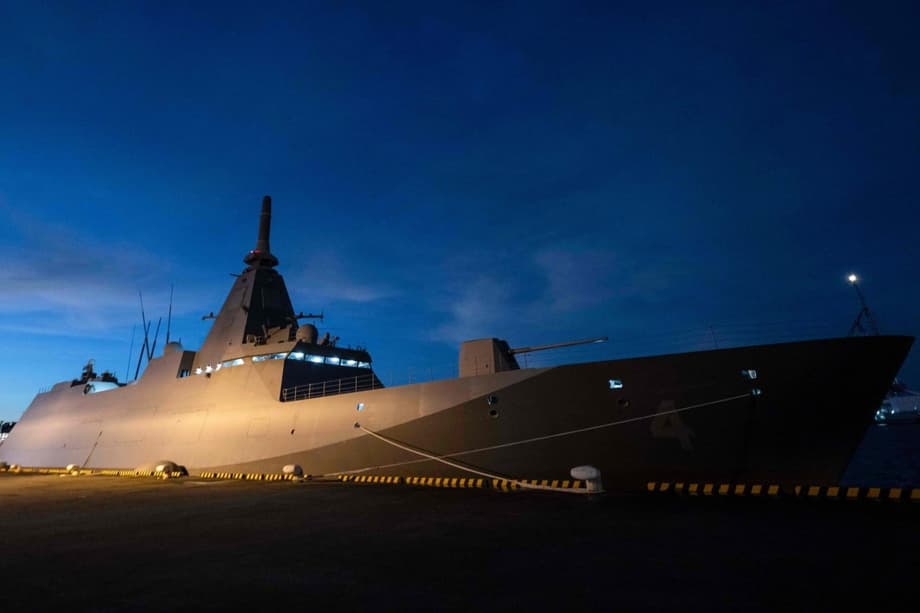
The Mogami class was conceived by Japan as a highly automated, multi mission stealth frigate capable of performing anti submarine warfare, anti surface warfare, mine countermeasures, and maritime security missions from a single platform. The baseline vessel displaces approximately 3,900 tonnes standard and roughly 5,500 tonnes when fully loaded, measuring 132.5 metres in length and capable of speeds exceeding 30 knots. Propulsion comes from a combined diesel and gas arrangement featuring a Rolls Royce MT30 gas turbine paired with two MAN diesel engines. Perhaps the most striking feature of the design is its radical approach to crew size. While conventional frigates of comparable displacement often require 200 to 250 sailors, the Mogami class operates with approximately 90 personnel thanks to extensive automation, advanced sensor fusion, and a futuristic circular Combat Information Centre that uses augmented reality displays.
This reduced manpower burden carries major strategic significance for India, where the Navy faces persistent challenges involving recruitment, training, and retention of technically skilled sailors over extended Indo Pacific deployments. The warship incorporates a stealth shaped hull and an integrated mast structure known as UNICORN, which encloses communication, electronic warfare, and radar antennas within a single housing to drastically reduce the radar cross section. Its anti submarine warfare package includes variable depth sonar, towed array sonar, and full helicopter support, capabilities that have become increasingly vital as Chinese submarine deployments into the Indian Ocean continue to expand. The current armament suite features a 127 mm Mk 45 naval gun, eight Type 17 anti ship missiles, a SeaRAM close in defence system, lightweight torpedoes, and a 16 cell vertical launch system. An upgraded variant known as the New FFM extends the hull to approximately 142 metres, increases displacement, and expands the vertical launch system to 32 cells, offering significantly improved air defence and strike capacity for task group operations.
The Australia Deal and Japanese Export Evolution
The proposal to India follows a landmark contract with Australia that has established the Mogami class as the template for Japanese warship export strategy. On April 18, Australian and Japanese officials signed contracts for an AUD 10 billion (US$6.5 billion) fleet of Japanese designed frigates, with Mitsubishi Heavy Industries constructing the first three vessels in Japan and Australian shipyards building another eight in Western Australia. The first ship is scheduled for delivery in 2029, a timeline Australian Defence Minister Richard Marles described as the fastest acquisition of a surface combatant into Royal Australian Navy service ever. Australian officials pointed to the frigates small crew requirement as a decisive factor in their selection, noting that 92 sailors compare favourably against complements roughly twice as large aboard the ageing ANZAC class vessels being replaced.
New Zealand has also begun weighing the Mogami class against the British Type 31 frigate as a replacement for its two ANZAC class ships, which are expected to reach the end of their design life by the mid 2030s. Wellington plans to increase defence spending toward 2 per cent of gross domestic product, citing rising geopolitical tensions across the Pacific. For Japan, the Australian contract offered proof of concept that its advanced naval platforms could find foreign buyers, reviving an export industry that suffered a major setback when Australia chose a French design for submarines in 2016. The India proposal appears even more ambitious than the Australian arrangement because it reportedly envisions immediate local manufacturing and potentially wider technology transfer from the outset. Tokyo appears to be pursuing a distributed Indo Pacific naval industrial network in which trusted partners build and maintain common platforms, creating strategic redundancy should Japanese shipbuilding infrastructure face strain during a future regional crisis.
Shared Anxieties Over Chinese Naval Expansion
Behind the technical and industrial dimensions of the offer lies a hard edged geopolitical logic rooted in shared concerns about Chinese maritime assertiveness. The Chinese navy has been rapidly expanding its carrier fleet, submarine force, and long range maritime surveillance capabilities, while operating increasingly near both Japanese and Indian waters. Tokyo faces sustained pressure in the East China Sea around the Senkaku Islands, while New Delhi confronts growing Chinese naval activity across the Indian Ocean, including frequent submarine patrols and ongoing warship deployments. Analysts observe that both Japan and the United States face challenges in maintaining massive naval fleets across the Pacific and Indian Oceans simultaneously. By strengthening Indian blue water navy capabilities, Tokyo effectively creates a strategic multiplier that allows New Delhi to serve as the primary security provider in its own maritime backyard.
This approach aligns with the broader Quad objective of building a network of interoperable naval forces spanning the Indo Pacific. Should India, Japan, and Australia operate technically similar vessels, combined naval exercises, shared maintenance hubs, and unified logistical supply chains become far simpler to coordinate. India sits at the geographic centre between the Arabian Sea and the Bay of Bengal, a position that makes it essential to regional stability plans championed under the Japanese Free and Open Indo Pacific vision. The frigate proposal therefore carries a powerful strategic message to Beijing. Rather than answering Chinese maritime expansion through isolated national programmes, Tokyo and New Delhi appear intent on deepening military industrial integration across multiple theatres.
A Clear Signal to Beijing and Beyond
The timing of the proposal carries weight far beyond the bilateral relationship. Chinese naval expansion continues at a pace that threatens to alter the regional balance, with new carriers, destroyers, and submarines entering service on a regular schedule. By placing one of its most advanced stealth frigate designs inside Indian shipyards, Tokyo is declaring that it views New Delhi not merely as a partner, but as a co producer of regional maritime deterrence. This industrial logic mirrors wider thinking among the Quad members. Trusted partners increasingly cooperate across logistics, technology, supply chains, maintenance, and defence manufacturing rather than operating independently.
For Beijing, the prospect of Indian built Mogami class frigates patrolling the Indian Ocean represents a new complication in naval planning. Rather than facing isolated regional navies, China would confront an increasingly interconnected network of capable maritime forces operating similar platforms and sharing common maintenance protocols. Even at the proposal stage, Japanese willingness to share guarded naval architecture sends a clear message throughout the Indo Pacific. Tokyo is prepared to trust sensitive military technologies with partners who share its commitment to a stable, rules based maritime order.
Indian Shipyards and the Atmanirbhar Bharat Vision
The construction phase of any agreement would likely fall to one of Indias experienced public sector shipyards, with Mazagon Dock Shipbuilders Limited and Garden Reach Shipbuilders and Engineers serving as the most probable candidates. Mazagon Dock currently builds the Project 17A Nilgiri class stealth frigates of the Indian Navy, while Garden Reach has participated in multiple major surface combatant programmes, meaning existing industrial infrastructure could support a Mogami class line without entirely new facilities. Building six to eight frigates locally would place the total programme value between US$2.7 billion and US$4 billion, ranking it among the most important naval procurement projects for India. Local construction would generate thousands of skilled jobs in manufacturing, electronics, propulsion, and systems integration, while permanently embedding advanced Japanese automation and modular design philosophies inside the Indian defence industrial base.
Co producing these frigates would help India widen its network of defence partners while upgrading domestic shipyard capabilities. Successfully managing a complex warship building project of this scale would also cement the growing reputation of India as a capable global centre for advanced defence manufacturing. Yet Indian planners would almost certainly seek compatibility with domestically produced weapons, potentially including the supersonic BrahMos anti ship missile already deployed aboard several Indian warships. Integrating Indian sensors, combat management systems, datalinks, or weapons would necessitate significant redesign work despite the promise of full design transfer, because the BrahMos missile is substantially larger than the Japanese Type 17 anti ship missile currently used aboard Mogami class vessels. Reports suggest the proposal may involve the larger New FFM variant precisely because its expanded hull and 32 cell vertical launch system offer more flexibility for Indian customisation.
Filling Critical Gaps Without Undermining Indigenous Ships
Some defence observers have questioned whether importing a Japanese design might undercut the formidable Project 17A Nilgiri class programme of India. The two platforms serve distinctly different purposes, however, and the Mogami class would address urgent capabilities that domestic programmes do not currently cover. The Nilgiri class frigates are heavy, frontline combatants built explicitly for high intensity blue water engagements with strong anti air, anti surface, and anti submarine weaponry. The Mogami class operates on a hybrid philosophy that marries modern stealth frigate characteristics with highly specialised mine warfare capabilities. This distinction matters enormously because the Indian Navy has operated without a single dedicated Mine Countermeasure Vessel since retiring the last Soviet era minesweeper in 2019. Securing maritime chokepoints and harbour approaches against naval mines has been a documented vulnerability for New Delhi.
Rather than acquiring an entirely separate fleet of single purpose minesweepers, the Mogami class can deploy Unmanned Surface Vehicles and Autonomous Underwater Vehicles to detect and neutralise underwater threats directly from a capable combat frigate. This integrated approach offers immense operational flexibility while avoiding the immense cost of a dedicated mine warfare fleet. Beyond mine warfare, the Mogami class offers India a chance to compress decades of warship design learning into a single programme. Japanese shipbuilders have perfected an efficient construction process that launches these complex vessels within two to three years. Absorbing such rapid construction methodologies through a technology transfer framework could prove invaluable to the domestic maritime industry. The true strategic prize is not simply adding another frigate class to the fleet, but permanently securing the advanced automation, modular frameworks, and integrated sensor technologies that will shape the future of Indian naval operations.
Obstacles and the Long Road to Delivery
Despite the excitement surrounding the proposal, major obstacles remain before any steel is cut in an Indian shipyard. Neither Tokyo nor New Delhi has issued an official confirmation of negotiations, meaning the project could remain stalled for months or even years while bureaucratic and technical details are hammered out. Questions persist regarding export controls on classified technology, the precise depth of design transfer, and how Indian and Japanese systems would coexist within a single hull. Any requirement to integrate indigenous sensors or weapons would complicate an already complex undertaking, potentially extending development timelines and increasing costs. There is also the question of which variant India might receive. While the baseline Mogami class offers proven capabilities, the larger New FFM variant selected by Australia provides greater growth potential for Indian requirements. Choosing between immediate availability and long term expansion capacity will require careful analysis by Indian naval planners.
Finally, the political sensitivity of loosening export controls inside Japan cannot be overlooked. Although the cabinet revised defence export rules in April 2026, domestic opposition to arms exports remains a factor in Japanese politics. Sustaining political support for a programme of this magnitude will require both governments to demonstrate clear returns in terms of regional security and industrial collaboration. Until formal requests for proposal appear and contract signatures follow, the Mogami class offer remains a bold declaration of intent rather than a guaranteed procurement programme.
The Bottom Line
- Japan has offered India complete design and local production rights for Mogami class stealth frigates, a first for Tokyo.
- The proposal values each frigate at roughly US$500 million, with local construction expected at Indian shipyards under Make in India frameworks.
- The highly automated warships require only about 90 crew members and offer advanced anti submarine, mine countermeasure, and stealth capabilities.
- The offer follows a landmark US$6.5 billion Australian contract and signals a major shift in Japanese postwar defence export policy.
- Shared concerns over Chinese naval expansion in the Indian Ocean and East China Sea drive deeper military industrial cooperation between Tokyo and New Delhi.
- Major questions remain regarding technology transfer depth, integration of Indian weapons like BrahMos, and final contract timelines.