Breaking the Stealth Barrier
One year after Pakistani forces successfully countered a massive Indian air assault using Chinese warplanes and missiles, the Pakistan Air Force has signaled its intention to leap into the fifth generation of aerial combat. Air Vice-Marshal Tariq Ghazi, deputy chief of air staff, confirmed at an Islamabad press conference that the service has signed an “initial collaborative agreement” for the Shenyang J-35 stealth fighter. This platform would mark a qualitative shift in South Asia’s military balance, potentially delivering operational stealth capability to Islamabad years before New Delhi fields comparable technology.
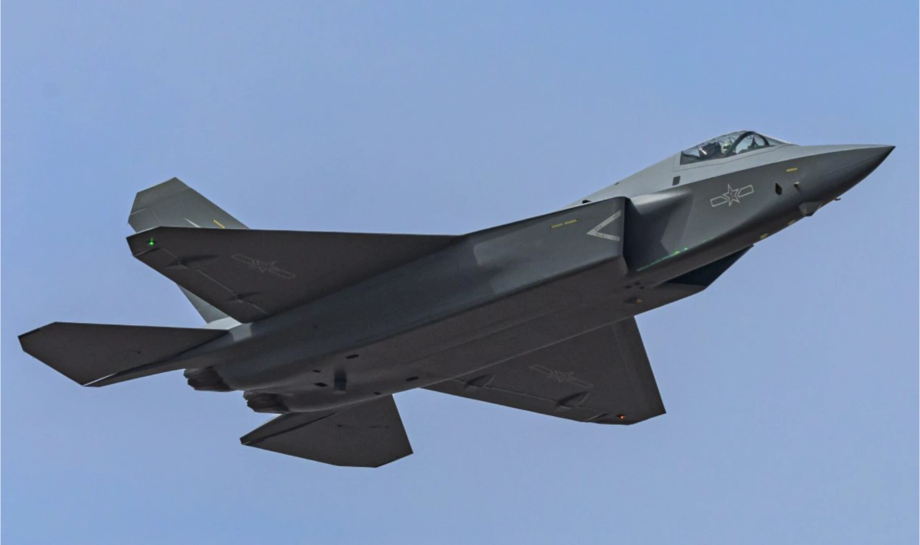
The announcement coincides with the recent unveiling of the J-35AE export variant by China’s Aviation Industry Corporation. State broadcaster China Central Television aired footage showing a fully operational export model bearing manufacturer logos rather than People’s Liberation Army Air Force markings. The aircraft, designated J-35AE, represents the first time Beijing has showcased a complete export configuration of its twin engine stealth platform. Speculation suggests Pakistan could receive initial deliveries by mid-2026, an accelerated timeline that would position the PAF as the inaugural foreign operator of Chinese fifth generation combat aviation technology.
Context for this procurement stretches back to Operation Sindoor in May 2025, when the PAF relied heavily on Chinese supplied J-10C fighters and JF-17 Thunder jets to repel Indian aerial operations. The successful employment of these platforms against French Rafale and Russian Su-30MKI aircraft flown by the Indian Air Force demonstrated the effectiveness of Beijing’s export ecosystem. Now, with the J-35 agreement, Pakistan appears positioned to consolidate its transition toward fully integrated Chinese aerospace warfare doctrine, moving beyond individual platform acquisitions toward comprehensive network centric combat capability.
Technical Architecture of the Gyrfalcon
The J-35 family represents China’s second operational fifth generation design, developed by Shenyang Aircraft Corporation as a lighter complement to the heavy J-20. The export variant J-35AE retains the twin engine configuration, internal weapons bays, and advanced avionics of its domestic counterparts while incorporating modifications for foreign customer requirements. The aircraft features a blended wing body design, diverterless supersonic inlets, edge aligned control surfaces, and radar absorbent coatings that reduce electromagnetic observability.
Performance specifications indicate maximum speeds approaching Mach 1.8 and a combat radius extending to 1,200 kilometers, providing sufficient reach for deep strike operations across contested South Asian airspace. The aircraft’s active electronically scanned array radar enables simultaneous tracking and engagement of multiple targets, while internal carriage of the PL-15 beyond visual range missile and PL-10 short range air to air missiles maintains low radar cross section during combat operations. This first look, first shot capability would allow Pakistani pilots to engage adversary aircraft before reciprocal targeting solutions can be established.
Analysts note the platform’s evolution from the earlier FC-31 demonstrator through the J-31 prototype to the current J-35 configuration, which includes more powerful WS-21 engines with a planned upgrade path to WS-19 propulsion systems. The aircraft’s sensor fusion architecture integrates electro optical targeting systems and networked data sharing capabilities, allowing operation within a broader combat ecosystem. Unlike fourth generation fighters that rely on speed and maneuverability, the J-35 prioritizes information dominance and signature reduction, rendering traditional radar acquisition timelines insufficient against coordinated stealth operations.
The Temporal Advantage
Perhaps the most consequential aspect of the prospective acquisition involves timing. India currently operates a substantial fleet of 4.5 generation fighters including Rafale, Su-30MKI, and Mirage 2000 aircraft, yet possesses no operational stealth combat capability. The Indian Air Force’s indigenous Advanced Medium Combat Aircraft program, while progressing through development stages, is not expected to achieve operational maturity before the mid-2030s. This timeline creates a potential window of seven to ten years during which Pakistan could maintain a qualitative advantage in low observable aerial warfare.
Defense planners in New Delhi face the prospect of confronting a two front challenge, with China’s PLAAF operating approximately 200 J-20 fighters and potentially doubling that figure by 2030, while Pakistan fields J-35 squadrons. The absence of Indian stealth capability would compel reliance on layered ground based radar networks and airborne early warning systems to detect and track low observable targets. Retired Indian Air Force officers have expressed concern that even limited Pakistani stealth squadrons could force significant resource allocation toward defensive counter air missions rather than offensive operations.
The accelerated delivery timeline reportedly moved from late 2026 to mid-2026 suggests both Beijing’s confidence in production scalability and Islamabad’s urgency in fielding the capability. Chinese assembly lines reportedly possess capacity to produce one J-35 every 72 hours, though export variants may follow different scheduling. For Pakistan, the question remains whether financial constraints will permit the infrastructure investment necessary to support fifth generation operations, including climate controlled hangars, specialized maintenance facilities, and secure datalink architecture required for network centric warfare.
Beyond the Aircraft
The J-35 acquisition cannot be viewed in isolation. Reports indicate the agreement includes a comprehensive combat ecosystem including KJ-500 airborne early warning and control aircraft and HQ-19 high altitude missile defense systems. This package approach reflects Beijing’s evolving export strategy of selling integrated operational architectures rather than individual platforms. The KJ-500 provides long range airborne detection and battlespace coordination, while the HQ-19 offers exo atmospheric interception capability comparable to the American THAAD system.
Air Vice-Marshal Ghazi’s reference to long range precision weapons alongside next generation platforms suggests Pakistan seeks integrated deep strike capability combining stealth penetration with standoff munitions. The Fatah series cruise missiles and submarine launched systems already tested by Pakistan complement this architecture, creating a multilayered detect track engage combat chain. Retired Group Captain Sultan M. Hali described the potential acquisition as Pakistan’s entry into “the fifth generation era with an entire combat ecosystem,” stressing network centric integration over mere platform replacement.
This ecosystem approach builds upon existing Pakistani familiarity with Chinese aerospace systems. The PAF serves as the first and only export operator of the J-10C, while the JF-17 Thunder program established co production infrastructure at Kamra involving 58 percent local manufacturing content. The induction of J-10C aircraft accelerated interoperability with Chinese avionics, electronic warfare protocols, and beyond visual range missile systems. The J-35 represents a logical progression of this military technical dependence, reducing integration risks compared to alternative export customers lacking compatible maintenance systems and established supply chain relationships.
Signals and Denials
Despite mounting evidence of preparation for J-35 induction, official Pakistani messaging has remained deliberately ambiguous. In July 2025, Defence Minister Khawaja Asif publicly refuted acquisition reports, describing them as “media chatter” beneficial primarily for Chinese defense marketing. This denial followed the deletion of a Pakistani government social media post that had referenced approximately forty J-35 fighters alongside KJ-500 and HQ-19 systems in a $4.6 billion contract. President Asif Ali Zardari’s subsequent visit to AVIC facilities in September 2025, however, reinforced continued high level interest.
Aviation researcher Andreas Rupprecht has cautioned against premature conclusions, noting that while the J-35AE export prototype has flown, no binding delivery schedule has been confirmed. He suggests an undisclosed customer may have financed initial development, speculating that the United Arab Emirates could potentially emerge as the true launch customer. The Pentagon’s 2025 report to Congress identified the UAE, along with Egypt and Saudi Arabia, as interested clients for the J-35, reflecting efforts by these nations to circumvent American export restrictions designed to maintain Israel’s qualitative military edge.
The possibility of alternate customers highlights the commercial risks facing Beijing’s defense export ambitions. China lacks extensive experience exporting high end combat types in large numbers, and international customers typically demand robust after sales support, maintenance infrastructure, and complete customer service packages. Pakistan’s existing Chinese origin combat infrastructure substantially reduces these risks, making Islamabad the most plausible initial recipient despite official denials and financial constraints that might otherwise impede a multi billion dollar procurement.
Regional Realignment
The potential induction of J-35 fighters intersects with broader Pakistani defense diplomacy initiatives. The PAF recently deployed JF-17 squadrons to Saudi Arabia under a mutual defense pact signed in September 2025, while negotiations continue regarding Bangladeshi acquisition of JF-17 Block 3 aircraft and Super Mushshak trainers. These activities demonstrate Islamabad’s effort to utilize its Chinese aligned aerospace sector for regional influence, even as it pursues fifth generation capability for itself.
For India, the strategic consequences extend beyond immediate operational concerns. The emergence of Pakistan as a showcase for Chinese fifth generation technology could validate Beijing’s defense industrial model across the Middle East, Africa, and Southeast Asia. Countries unable to afford or access American F-35 fighters due to political constraints may view the J-35 as a viable alternative, particularly when offered as part of integrated ecosystem packages. This dynamic threatens to erode Western dominance in high end fighter markets while simultaneously complicating Indian security planning.
The financial architecture of any eventual deal remains unclear. Pakistan’s defense budget faces significant constraints, and sustaining fifth generation capability requires investment far beyond initial acquisition costs. Some analysts suggest third party financing from Gulf partners seeking alignment with Chinese defense ecosystems could enable the purchase. Whether through external funding or domestic allocation, the program would likely reach several billion dollars, representing a long term strategic commitment binding Islamabad to Beijing’s aerospace industrial base for decades to come.
The Bottom Line
- Pakistan has signed an initial agreement for Chinese J-35 stealth fighters, potentially becoming the first export operator of Beijing’s fifth generation combat aviation technology.
- Deliveries could commence as early as mid-2026, creating a temporary qualitative advantage over India, which operates no stealth fighters and will not field indigenous equivalents until the mid-2030s.
- The acquisition likely includes integrated support systems including KJ-500 airborne warning aircraft and HQ-19 missile defense, representing a comprehensive combat ecosystem rather than standalone fighter procurement.
- Despite official denials from Pakistani defense officials, evidence including pilot training rumors, infrastructure preparation, and CCTV footage of the J-35AE export variant suggests advanced negotiations are underway.
- The deal reinforces Pakistan’s deepening military technical dependence on China while potentially triggering accelerated arms competition across South Asia as India evaluates countermeasures and interim stealth options.