A Year After Operation Sindoor, Pakistan Charts a Stealth Future
One year after Pakistani and Indian forces clashed in the aerial engagements of Operation Sindoor, the Pakistan Air Force has announced an ambitious modernization roadmap that could alter the military balance across South Asia. At a press conference in Islamabad on Thursday, Air Vice-Marshal Tariq Ghazi, the deputy chief of air staff, confirmed that the service had signed an initial collaborative agreement to acquire the Chinese Shenyang J-35 fifth generation stealth fighter. Ghazi outlined a broad modernization agenda and stated that preparations were already in motion for several major programs.
- A Year After Operation Sindoor, Pakistan Charts a Stealth Future
- Technical Profile of the J-35AE Export Fighter
- Why the Deal Extends Beyond the Fighter Jet
- India Confronts a Looming Stealth Disadvantage
- Economic and Political Obstacles Remain
- The Race for First Customer Status
- A New Chapter in South Asian Air Power
- The Essentials
Foundations have been laid for the acquisition of advanced capabilities, including long range precision weapons, next generation platforms, additional J-10C aircraft and much upgraded JF-17s.
While specific details about the scope of the J-35 deal remain undisclosed, the announcement signals a determination in Islamabad to move beyond the current inventory of fourth generation platforms.
The declaration comes as Pakistan observes the first anniversary of a conflict in which Chinese-supplied warplanes and missiles played a central role in repelling a large-scale Indian air assault. The press briefing by Ghazi served to reinforce the message that Islamabad intends to deepen defense ties with Beijing across multiple domains.
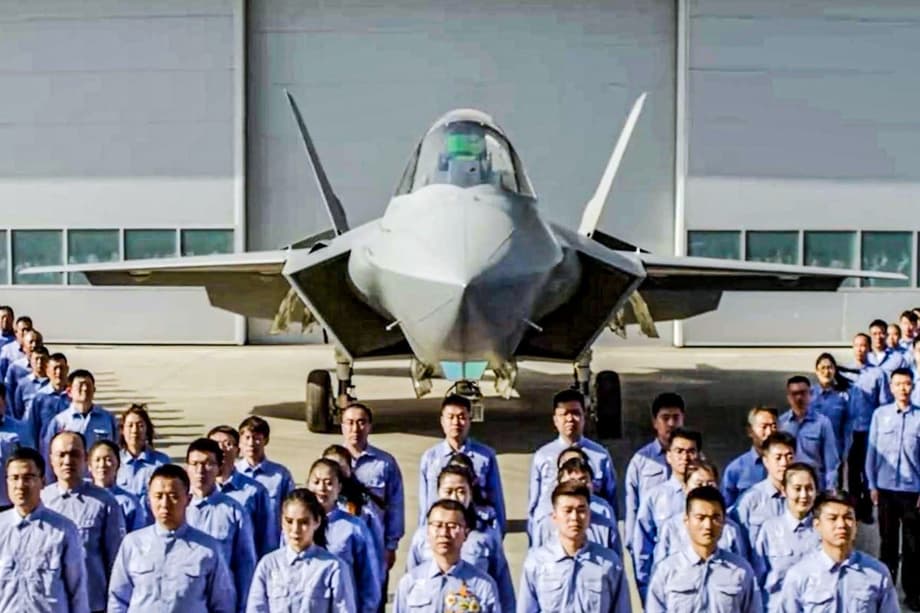
Speculation about an imminent delivery intensified after China Central Television aired footage last week showing a fully operational export version of the J-35. Military observers noted that the aircraft bore the logo of the Aviation Industry Corporation of China rather than markings of the Chinese air force, a detail that strongly suggests the jet was built for a foreign buyer. With Pakistan standing as the only confirmed overseas customer to date, the footage fueled expectations that an initial batch of J-35s could arrive by the end of this year.
Technical Profile of the J-35AE Export Fighter
The aircraft at the center of this deal is the J-35AE, an export specific variant of the J-35A land based stealth fighter operated by the Chinese air force and navy. Developed by the Shenyang Aircraft Corporation, the J-35 family represents the second fifth generation combat jet to enter production in China, following the heavier Chengdu J-20. Unlike the J-20, which Beijing has withheld from the export market, the J-35 was conceived from the outset as a platform for both domestic use and foreign sales.
From a design perspective, the J-35AE shares the same twin engine layout, internal weapons bays, and radar absorbent materials that define modern low observable aircraft. The jet features a blended wing body configuration, diverterless supersonic inlets, and edge aligned surfaces intended to minimize radar reflection. Internal bays allow the aircraft to carry air to air missiles such as the PL-15 without compromising stealth, while external hardpoints offer additional flexibility for less demanding missions. The platform is also equipped with an active electronically scanned array radar capable of tracking multiple targets simultaneously, along with an electro optical targeting system integrated into the fuselage rather than mounted in an external pod.
Performance estimates circulated by defense analysts suggest the fighter can reach speeds of up to Mach 1.8, with a combat radius of approximately 1,200 kilometers and a service ceiling near 16,000 meters. China has reportedly managed to keep production costs competitive, with per unit estimates ranging between 35 million and 80 million United States dollars. By comparison, the American F-35 Lightning II typically costs substantially more per unit, a price difference that positions the Chinese offering as an attractive alternative for nations unable to access Western stealth technology.
China Central Television has indicated that the Shenyang assembly line can produce a new J-35 every 72 hours, suggesting that manufacturing capacity will not constrain export deliveries if political and financial agreements are finalized.
Why the Deal Extends Beyond the Fighter Jet
Military analysts watching the defense relationship between Beijing and Islamabad closely believe the J-35 acquisition may form part of a far broader package. Indicators from multiple defense assessments point toward Islamabad exploring the purchase of KJ-500 airborne early warning and control aircraft alongside HQ-19 high altitude missile defense systems. Together, these systems would create an integrated combat ecosystem rather than a simple fleet replacement.
The KJ-500 would serve as a flying command center, using its own active electronically scanned array radar to detect distant threats and distribute targeting data to stealth fighters operating in contested airspace. The HQ-19 system, meanwhile, offers an exo atmospheric interception capability conceptually comparable to the American THAAD architecture, adding a strategic air defense layer against ballistic missiles. If combined with the low observability and long range strike potential of the J-35, this trio of systems would give Pakistan its first true network centric warfare capability.
Retired Pakistan Air Force Group Captain Sultan M. Hali described the potential acquisition as entry by Pakistan into the fifth generation era with an entire combat ecosystem. He argued that the interest in Islamabad centers upon integrated network centric warfare rather than merely procuring another combat platform. This doctrinal shift would represent a qualitative transformation for a force that has historically depended heavily on American F-16s and French Mirage aircraft.
In June 2025, a social media post from the government of Pakistan briefly claimed that China had offered approximately 40 J-35 fighters, KJ-500 aircraft, and HQ-19 systems in a deal valued at roughly 4.6 billion dollars. The post was deleted without explanation, but its contents aligned closely with independent assessments of the long term modernization plan of the Pakistan Air Force.
India Confronts a Looming Stealth Disadvantage
For India, the prospect of Pakistani J-35 squadrons taking to the sky within the next two years presents a disquieting strategic challenge. The Indian Air Force currently operates an impressive inventory of fourth and 4.5 generation fighters, including French Rafales, Russian Su-30MKIs, and upgraded Mirage 2000s. Yet New Delhi has no operational fifth generation stealth aircraft, and the indigenous Advanced Medium Combat Aircraft program is not expected to achieve operational status before the mid-2030s.
This timeline creates a potential capability window during which both China and Pakistan could field stealth fighters while India remains reliant on conventional platforms. Military analysts have described this as a two front challenge, referencing the possibility that Indian planners might simultaneously face Chinese J-20s along the northern frontier and Pakistani J-35s along the western border. During this period, adversaries could exploit reduced radar visibility to conduct first strike operations against high value Indian assets such as airborne warning aircraft, refueling tankers, and ground based radar stations.
Indian defense experts have urged decision-makers in New Delhi to consider interim solutions. Some have advocated purchasing the Russian Su-57 as a stopgap measure, while others emphasize expanding existing orders of Rafale jets and relying on the S-400 air defense network to detect low observable targets. Squadron Leader Vijainder K. Thakur, a retired Indian Air Force officer, warned earlier that by 2030 the Pakistan Air Force could be operating approximately 40 J-35 fighters while the Indian Air Force would possess no stealth fighters at all. This gap, he suggested, would force India to dedicate a larger share of its combat fleet to defensive detection and interception roles rather than offensive operations.
The competitive dynamic between the two South Asian rivals has already established a clear pattern. The induction of Rafale jets by India prompted Pakistan to acquire the J-10C, becoming the first and only foreign operator of that Chinese platform. Now, the planned acquisition of 114 additional Rafales by India appears to be driving Islamabad toward stealth technology in an effort to maintain qualitative parity.
Economic and Political Obstacles Remain
Despite mounting evidence that Islamabad is moving toward acquisition, significant uncertainty persists regarding financing, delivery schedules, and official commitment. Pakistan faces severe economic constraints that could complicate the sustainment of an expensive fifth generation fleet. Operating stealth aircraft requires specialized infrastructure, including climate controlled hangars, hardened shelters, low observable coating maintenance facilities, and secure datalink architecture. These supporting investments often exceed the cost of the aircraft themselves.
Pakistani officials have also sent conflicting signals about the program. In July 2025, Defense Minister Khawaja Asif publicly dismissed reports of a J-35 purchase, stating that the speculation existed only in media and served primarily to benefit Chinese defense sales. His comments followed the deletion of the June 2025 social media post that had outlined the multi billion dollar arms package. Yet other indicators contradict this denial. Reports from defense intelligence sources in June 2025 indicated that Pakistani pilots had already begun training in China for J-35 induction, and the chief of the Pakistan Air Force had publicly confirmed preparations for the acquisition in early 2024.
Analysts suggest the most probable scenario involves limited initial deliveries of between four and twelve aircraft during 2026 or 2027, followed by gradual expansion as funding and infrastructure allow. If Pakistan ultimately procures the full complement of 40 jets, the package could represent one of the largest defense investments in the history of the country, potentially requiring financial assistance from Gulf partners or preferential loan arrangements from Beijing.
The Race for First Customer Status
While Pakistan remains the most frequently cited candidate to receive the J-35AE, some experts have floated an alternative possibility. Andreas Rupprecht, a respected researcher of Chinese military aviation, has suggested that an undisclosed customer may have helped finance the J-35 export program from its inception. He identified the United Arab Emirates as a potential launch customer, noting that the United States Pentagon listed the Emirates, Saudi Arabia, and Egypt as interested clients in a 2025 report to Congress.
The Emirates previously sought to purchase the American F-35 but encountered restrictive export regulations designed to preserve the qualitative military edge of Israel in the Middle East. Blocked from acquiring Western stealth technology, Abu Dhabi could view the Chinese platform as a viable alternative. Rupprecht noted that international buyers tend to demand robust after sales support and maintenance networks before committing to high end platforms, suggesting that China may need to demonstrate comprehensive customer service capabilities before closing deals with demanding Gulf clients.
Even if the United Arab Emirates eventually purchases the J-35AE, Pakistan still appears best positioned to receive the first operational export aircraft. The Pakistan Air Force already operates Chinese J-10C and JF-17 fighters, creating established maintenance pathways, pilot conversion experience, and supply chain relationships that reduce integration risks. This institutional familiarity makes Islamabad a natural early adopter of new Chinese combat ecosystems.
A New Chapter in South Asian Air Power
The potential arrival of J-35 stealth fighters in Pakistan marks more than a routine equipment upgrade. It signals a fundamental shift in how air combat could be conducted across one of the most volatile regions in the world. Fifth generation aircraft are designed to penetrate heavily defended airspace, evade detection, and strike critical targets before adversaries can organize an effective response. When networked with airborne early warning platforms and advanced missile defenses, these jets transform a traditional air force into a distributed, sensor fused fighting force.
Pakistan has already begun expanding the geographic reach of its air power beyond South Asia. In April 2026, the Pakistan Air Force deployed a squadron including JF-17 fighters to Saudi Arabia under a mutual defense pact signed the previous September. The addition of stealth fighters and long range precision weapons would enhance the ability of Islamabad to project force into the Persian Gulf, a development likely to draw close attention from both regional monarchies and global powers with interests in the Middle East.
For Beijing, a successful J-35 export program would validate China as the first power outside the Western world capable of selling a complete fifth generation combat ecosystem. Such a breakthrough would burnish the reputation of the Chinese defense industry and potentially open doors across Africa, Southeast Asia, and the Middle East. The partnership with Pakistan functions simultaneously as a strategic counterweight to India and as a live demonstration of Chinese aerospace technology for other prospective buyers.
The Essentials
- The Pakistan Air Force has signed an initial agreement to acquire Chinese J-35 fifth generation stealth fighters, with potential deliveries starting in late 2026.
- China recently showcased the J-35AE export variant, a twin engine stealth jet capable of Mach 1.8 and equipped with advanced radar and internal weapons bays.
- Analysts speculate the deal could include KJ-500 airborne early warning aircraft and HQ-19 missile defense systems, creating an integrated combat network.
- India currently operates no fifth generation stealth fighters, and the indigenous AMCA program is not expected to be operational before the mid-2030s.
- Pakistani officials have issued conflicting statements about the acquisition, with some denying a finalized deal while others confirm foundational preparations.
- The United Arab Emirates remains a possible alternative first customer, though Pakistan is widely viewed as the most likely launch operator because of existing defense ties.
- If confirmed, the sale would make Pakistan the first foreign operator of a Chinese fifth generation fighter and could reshape the regional airpower balance.