
Guangzhou's Robot Crowds Tell a Bigger Trade Story
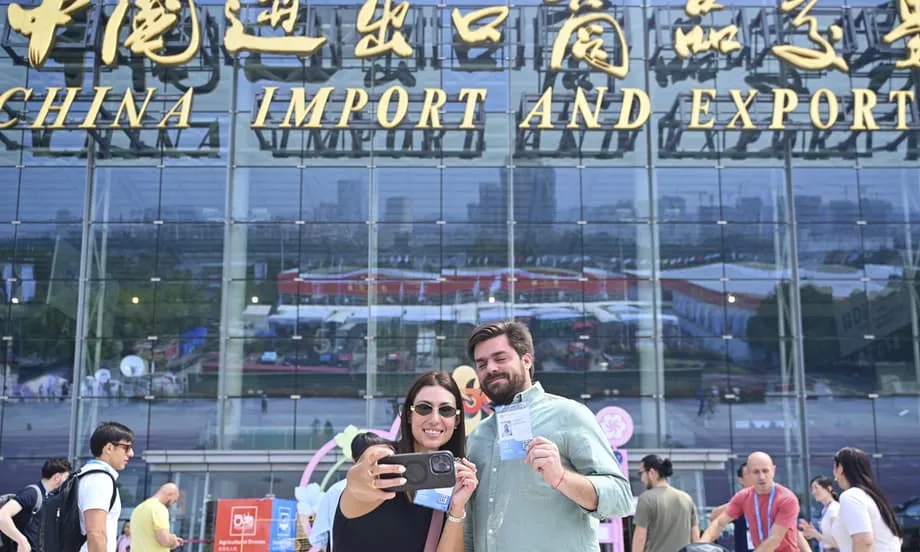
A humanoid robot waving more than 7,000 times a day, a robotic coffee maker producing about 800 cups daily and queues stretching 30 meters, three rows deep, to play badminton against a machine have become defining sights at the 139th Canton Fair. The China Import and Export Fair opened on April 15 in Guangzhou, bringing a new generation of Chinese technology into direct contact with international buyers.
Contents
- Guangzhou's Robot Crowds Tell a Bigger Trade Story
- How the Fair's Center of Gravity Has Changed
- More Buyers, More Specialized Exhibits
- Why Buyers Are Queuing for Service Robots
- A Drone Delivers Tea, Then a Robot Hands It Over
- Gree Shows the Industrial Work Behind the Spectacle
- Circuit Breakers Become Sources of Useful Data
- From Producing for Others to Selling a Chinese Brand
- China Is Buying More as Well as Selling More
- The Bottom Line
As of April 20, 2026, the exhibition offers a picture of how Chinese businesses are moving from making products for others toward developing their own technology, brands and services. Humanoid robots, artificial intelligence terminals, smart wearables and equipment for activities in low airspace are drawing attention alongside the industrial systems that support them.
The fair occupies 1.55 million square meters, contains 75,700 booths and hosts more than 32,000 enterprises. More than 11,000 participating businesses are described as "Little Giant" firms, specialized and sophisticated enterprises associated with manufacturing excellence and innovation. The event's scale and participation figures set new historic benchmarks.
April's session is the first Canton Fair of China's 15th Five-Year Plan period, which runs from 2026 to 2030. Its displays connect a national push for technological development with practical business questions: what overseas customers want to buy, which Chinese brands they will distribute and what support they expect after a purchase.
Visitors waiting for Dobot robots to make ice cream have made video calls to their families or livestreamed the experience. The crowds illustrate the public appeal of intelligent machines, while negotiations elsewhere in the halls show how manufacturers hope to turn that attention into international business. Together, the exhibits present a journey from Chinese manufacturing through intelligent manufacturing to Chinese creation.
How the Fair's Center of Gravity Has Changed
The Canton Fair's transformation stretches across three decades of manufacturing development, with changes especially visible during the last three Five-Year Plan periods. Traditional light industry and basic mechanical and electrical products dominated during the 13th Five-Year Plan, from 2016 to 2020. China's competitive strength rested heavily on its ability to produce at enormous scale.
The 14th Five-Year Plan period, from 2021 to 2025, brought a different group of products to the foreground. New energy vehicles, lithium-ion batteries and photovoltaic products, collectively described as the "new trio," became prominent from the 129th through the 138th sessions. Photovoltaic products turn sunlight into electricity.
Green production, lower carbon emissions and technologies developed independently became central themes. Chinese brands with growing international competitiveness reflected the country's movement toward more advanced, intelligent and environmentally focused manufacturing.
The progression is visible in several milestones:
- 2016 to 2020: During the 13th Five-Year Plan, traditional light industry and basic mechanical and electrical goods remained dominant.
- 2021 to 2025: During the 14th Five-Year Plan, the new trio gained prominence across the 129th to 138th sessions.
- April 2023: At the 133rd session, an unmanned helicopter became a major attraction, and new exhibition zones opened for industrial automation equipment and intelligent new energy vehicles.
- April 15, 2026: The 139th session opened with AI terminals, humanoid robots, smart wearables and equipment for the low-altitude economy among its leading attractions.
- May 1, 2026: China's announced zero-tariff treatment for imports from 53 African countries with which it has diplomatic relations is scheduled to take effect.
The latest exhibition presents another change in emphasis, from competing mainly through production volume toward competing through innovation. Its frontier products reflect China's stated progression from catching up technologically toward taking a leading role.
More Buyers, More Specialized Exhibits
More than 210,000 overseas buyers had preregistered by April 9. Attendance confirmations also included 290 major global retail leaders, an increase of 30 percent from a year earlier. Buyers from Belt and Road partner countries, Latin America and Africa were driving substantial increases in registrations.
Zhu Yong, head of the China Foreign Trade Centre, described the Canton Fair as evolving with national development goals and promoting closer connections between trade and investment. The exhibition now has 179 specialized sections, including nine new zones. Smart wearables, display technologies, consumer drones, agricultural drones and prefabricated housing are among the sectors covered by the additions.
The expanded layout gives businesses selling advanced technology and products with greater value more opportunities to reach international customers. It also makes room for emerging companies alongside manufacturers with decades of export experience.
About 60 percent of exhibitors display their own independent brands, while nearly 20 percent have expanded through investment overseas. More than one-third have moved beyond selling products alone to an "export plus service" model. That approach combines a physical product with support suited to the buyer's needs.
The fair brings together 210 specialized institutions providing customized technical support, including quality inspection using AI and intelligent management of supply chains. A supplier can therefore offer help with checking products and organizing their movement, rather than ending the relationship when a shipment leaves the factory.
Those changes explain why the fair's business model matters as much as its popular demonstrations. Exhibitors are competing on the identity of their brands, the technology inside their products and the services that accompany a sale.
Why Buyers Are Queuing for Service Robots
The service robot hall has become so popular that organizers have limited how many visitors can enter at the same time. Demonstrations range from hospitality tasks to physical interactions that show how AI can guide a machine's movements.
Ti5 Robot's humanoid badminton player responds to approaching shuttlecocks in under a second. Wang Mengdi, head of branding for the company that developed the robot, explained how its training allows its wrist to move in several ways, helping it reproduce human racket movements.
Through multi-stage learning, the robot has developed multiple degrees of wrist freedom, enabling it to replicate human wrist motion," said Wang Mengdi. "It can execute forehand, backhand, and high-clear shots, making it a capable 'badminton partner.'
Another Ti5 Robot humanoid waves to global purchasers more than 7,000 times each day. Nearby, the COFE+ robotic coffee maker operates continuously and produces approximately 800 cups a day, while Dobot robots prepare ice cream for visitors recording the encounter on their phones.
The appeal extends beyond watching machines perform familiar tasks. Buyers can see how a robot responds to people, handles repeated work and fits into a service setting. Hospitality demonstrations give a visible form to a wider effort to connect digital intelligence with physical activity.
Industrial applications elsewhere in the exhibition build on that same connection. The coffee and badminton displays attract the crowds, while automation equipment shows how intelligent systems are being incorporated into production and energy management.
A Drone Delivers Tea, Then a Robot Hands It Over
Osama, a buyer from Saudi Arabia, ordered milk tea through the Canton Fair mobile app. Minutes later, a drone carrying an orange delivery box landed at a designated pickup point. A humanoid robot retrieved the drink and handed it to him.
Osama described his first experience of drone delivery and the convenience of receiving an order within the large exhibition venue.
Very cool! This is my first time experiencing drone delivery," said Osama. "In such a large venue, I didn't have to queue or walk around. It's fast and completely new.
The demonstration brought several technologies into a single service: a mobile ordering system, an aircraft carrying the purchase and a robot completing the handover. It showed how equipment for the low-altitude economy, activities involving aircraft operating in low airspace, can work with services on the ground.
Juan, a buyer from Brazil, explored a different aircraft application. He examined an ultra-light flying cart developed by Yufei Aviation that uses electric vertical takeoff and landing technology, known as eVTOL. The term describes an electric aircraft that can take off and land vertically.
Juan asked about payload, speed and safety features before concluding that the product had strong market potential in Brazil. His questions shifted the discussion from the excitement of a new aircraft to the practical details a prospective buyer needs to assess.
These encounters make the fair a testing ground for technologies that connect digital systems with physical infrastructure. Buyers can examine how devices work together and consider where they might fit in their own markets.
Gree Shows the Industrial Work Behind the Spectacle
Gree Electric, which has participated in the Canton Fair for 31 consecutive years, brought 130 products to its largest exhibition area in the event's history. More than 80 percent feature AI, green technologies that save energy or other advanced technologies.
The company's SilenzX air conditioners reduce outdoor unit sound pressure to 29 decibels, compared with an industry average of 42 decibels. The series is backed by 137 invention patents. Decibels are the measurement used to describe sound levels.
Gree has also applied R290 refrigerant technology, presented as environmentally friendly, across its product range. Its photovoltaic air conditioning system is described as achieving "zero carbon emissions, zero electricity bills, and zero waste." That system connects solar electricity generation with air conditioning.
The GMV 9 series operates across temperatures from minus 35 degrees Celsius to 60 degrees Celsius. Gree presents these products as evidence of technological independence across the full system, from essential components to their integration into a working unit.
The industrial displays broaden the picture beyond robots serving drinks. Air conditioners, their components and the systems controlling them show how manufacturers are incorporating advanced technology into established product categories.
Gree's export figures also connect product development with brand ownership. Independent brands account for 70 percent of its total export volume, rising above 85 percent in Belt and Road countries. One of the first Chinese home appliance companies to venture overseas, Gree now operates in more than 190 countries and regions.
Circuit Breakers Become Sources of Useful Data
MAXGE and CNC Electric are showing how low-voltage circuit breakers have developed from conventional safety devices into connected parts of energy management systems. Their solutions use sensors to monitor current, voltage, temperature and power quality as conditions change.
The devices send that information to platforms in the cloud, where it can support predictive maintenance. In simple terms, a business uses operating data to identify when equipment may need attention and plan repairs before a problem becomes more disruptive.
Smart breakers can shorten troubleshooting, extend equipment life and cut repair costs by up to 30 percent. The change gives a familiar industrial component a second function: alongside its safety role, it becomes a source of information for managing the wider electrical system.
Raw material costs are adding another pressure on manufacturers. Silver prices rose from approximately $29 per ounce in early 2025 to more than $120 per ounce in early 2026, while copper reached record highs. The silver figures represent an increase to more than four times the earlier price.
Manufacturers are responding with aluminum alternatives and modular designs to control costs while maintaining safety. Modular design divides a product into components or units, allowing manufacturers to adjust its construction more flexibly.
The combination of connected equipment and material changes illustrates two sides of industrial adaptation. Businesses are seeking greater value through technology while adjusting production to volatile input costs. The exhibits present that flexibility as a strength of Chinese industrial supply chains.
From Producing for Others to Selling a Chinese Brand
ZXMOTO, a championship motorcycle manufacturer exhibiting at the fair for the first time, became a major attraction. New exhibitors at successive sessions often introduce technologies and ideas that point toward the next stage of China's technology sector.
A Singaporean buyer waiting at the ZXMOTO booth wanted to secure agency rights for Singapore and Cambodia. The buyer expressed surprise at the Chinese brand's rise.
"I never imagined a Chinese brand could enter the motorcycle market and become the world's No.1," the buyer remarked, while aiming to secure agency rights for Singapore and Cambodia.
A veteran exhibitor who has attended 40 Canton Fair sessions described another route to brand ownership. Twenty years ago, his company made irons for German customers as an original equipment manufacturer, or OEM. Under that arrangement, a manufacturer produces goods for another business rather than selling them under its own brand.
Today, those former German partners compete for exclusive European distribution rights to the company's smart steam irons and fully automatic coffee machines powered by AI. The company has accumulated more than 2,600 patents, with more than 400 still valid. More than half of the valid patents are invention patents.
The contrast between making goods for a foreign customer and negotiating who may distribute a proprietary product gives concrete meaning to the move toward "Created in China." Brand ownership and intellectual property become part of what the company brings to a negotiation.
Veteran exhibitors combine complete supply chains with the ability to keep pace with technology. Their transition toward intelligent manufacturing retains the production capabilities built over earlier decades, while adding products and identities of their own.
China Is Buying More as Well as Selling More
China's General Administration of Customs reported that goods trade grew by 15 percent compared with a year earlier in the first quarter of 2026. Exports increased by 11.9 percent, while imports rose by 19.6 percent. Import growth was 7.7 percentage points faster than export growth.
The figures place the fair within a trade environment shaped by fragmentation, changing geopolitical alignments and protectionist measures elsewhere. China's approach at the event stresses openness and trade in both directions, giving international companies opportunities to sell into China as Chinese exhibitors seek customers abroad.
The Canton Fair introduced its first import section at the 101st edition in 2007. The planned removal of tariffs on imports from 53 African countries with which China has diplomatic relations, effective May 1, 2026, adds another element to that focus on incoming trade.
China's growing consumption potential is also linked to changing preferences. In Zhejiang Province, disposable income per person exceeded 70,000 yuan, equivalent to $10,262, in 2025. Rising incomes are associated with demand for products of higher quality and purchases valued for the experience or emotional satisfaction they bring.
The Canton Fair and the concurrent China International Consumer Products Expo in Hainan provide platforms for both selling to the world and buying from it. The connection between upgraded consumption and market openness gives overseas businesses another reason to participate.
German household appliance company Severin has attended the Canton Fair for more than 30 years. Its long involvement, alongside growing interest from Belt and Road partner countries, Latin America and Africa, illustrates the range of commercial relationships gathered at the exhibition.
Officials describe the approach as "symbiotic globalization," presenting cooperation in trade as mutually beneficial and governed by rules. The diversity of participation makes the fair a barometer of international trade sentiment as well as a showcase for Chinese manufacturing.
The Bottom Line
- The 139th Canton Fair opened in Guangzhou on April 15, 2026, as the first session of the 15th Five-Year Plan period.
- The exhibition covers 1.55 million square meters, with 75,700 booths and more than 32,000 participating enterprises.
- More than 210,000 overseas buyers had preregistered by April 9, and 290 major global retail leaders had confirmed attendance.
- Humanoid robots, AI terminals, drones and smart wearables illustrate a shift from competing on manufacturing scale toward competing on innovation.
- About 60 percent of exhibitors showcase independent brands, and more than one-third combine exports with services.
- Gree's displays and connected circuit breakers show how advanced technology is changing established industrial products.
- China's first-quarter imports grew by 19.6 percent, compared with export growth of 11.9 percent.
- Zero-tariff treatment for imports from 53 African countries with diplomatic relations with China is scheduled to begin on May 1, 2026.