Solar Income Pays for Village Life
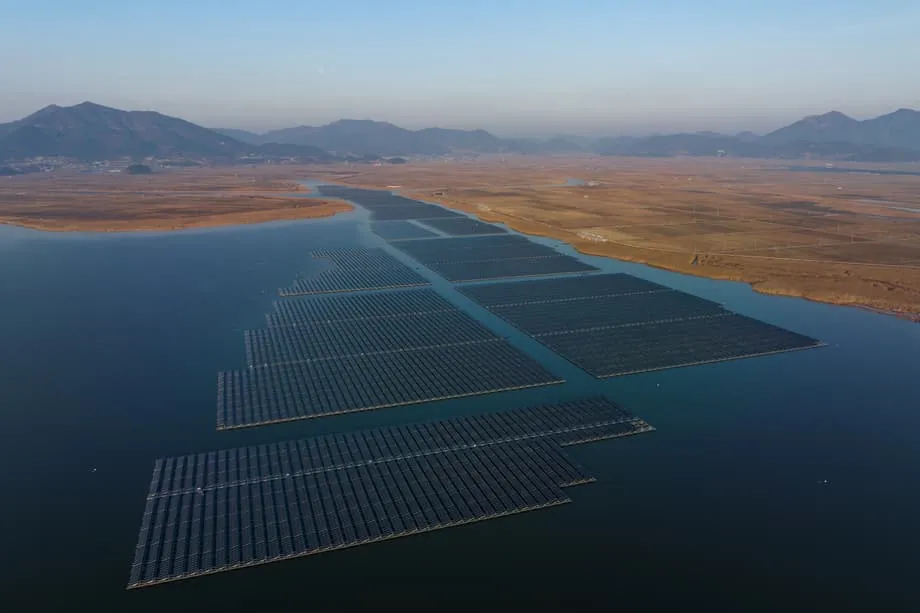
In Guyang-ri, a farming village of roughly 130 people about 90 minutes southeast of Seoul, a solar installation with one megawatt of capacity generates approximately 10 million won ($6,800) in net profit each month. Since 2022, that income has helped residents share free lunches six days a week, turning electricity production into a source of everyday support.
Contents
- Solar Income Pays for Village Life
- Hormuz Disruption Gives the Transition New Urgency
- What the Government Plans to Build
- Rising LNG Prices Change the Cost Calculation
- Chip Production Makes Reliable Power Essential
- Coal and Nuclear Power Remain in the Plan
- Grid Connections Could Slow the Solar Expansion
- Fuel Relief and Clean Energy Funding Pull in Different Directions
- Pakistan and Europe Show Other Responses
- Asia Balances Immediate Supply With Lasting Change
- Key Points
The meals are paid for by solar revenue, rather than government welfare or charitable donations. Before the project began, the village had no restaurant, few transport options for older residents and little communal infrastructure. Its solar earnings now also support a "happiness bus" for seniors, a table tennis facility and cultural activities.
Village chief Jeon Joo-young says residents chose to spend the money on shared services rather than distribute it as individual income. For him, the meals have changed how neighbours relate to one another.
Residents eat lunch together every day, so we see each other's faces, talk together. Bonds and solidarity between residents become much stronger. Life becomes more enjoyable. If you divide money as individual income, people feel disconnected. People who didn't know each other for years now get to know each other within days through the restaurant.
Guyang-ri has become the prototype for South Korea's national "solar income village" programme. As of April 16, 2026, the government aims to create 700 such villages during the year and reach 2,500 by 2030, expanding from roughly 150 established previously.
The village offers a practical example of the government's larger ambition: generate more energy inside South Korea while giving communities a reason to support the installations. Its experience also shows why the way solar income is spent matters. Residents receive benefits through meals, transport and activities they use together.
Hormuz Disruption Gives the Transition New Urgency
South Korea imports more than 90% of its primary energy, the energy supplied before it is converted into electricity or other usable forms. Approximately 70% of its crude oil arrives through the Strait of Hormuz, making disruption at that maritime chokepoint a direct threat to the country's energy supply.
The Iran conflict erupted in late February 2026 and disrupted traffic through the strait. Crude oil prices surged by 50%, while prices for liquefied natural gas (LNG) bought on the spot market nearly doubled. Spot purchases are made at current market prices, leaving buyers exposed when supplies suddenly tighten.
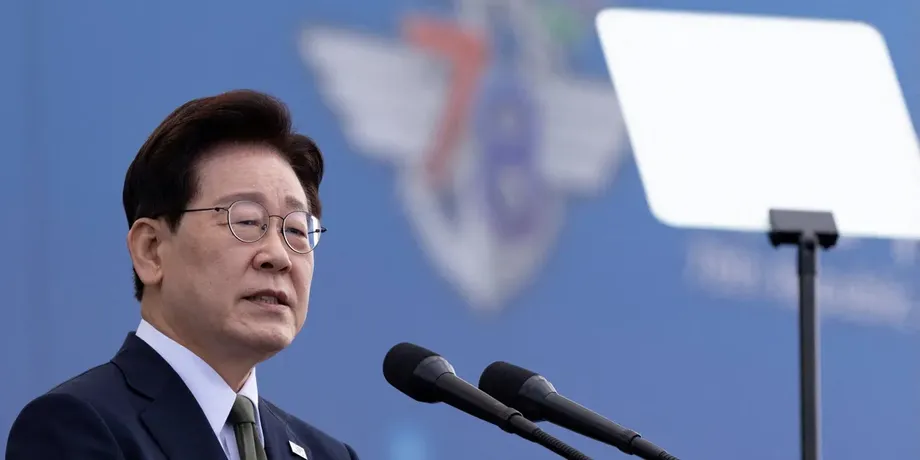
President Lee Jae Myung has repeatedly told his cabinet that dependence on fossil fuels is a strategic liability. He has said the "nation's fate" depends on accelerating the shift toward power generated domestically.
Kim Sung-whan, the minister of climate, energy and environment, links South Korea's response to a wider movement toward renewable energy.
Around the world, the Middle East war is driving even faster acceleration of renewable energy transition, so Korea too must pick up the pace.
The government has introduced fuel price caps and released oil from strategic petroleum reserves to address the immediate shock. Those measures provide relief during a supply emergency; the renewable programme addresses the continuing dependence on imported fuel.
The key dates connect a local experiment with a national response:
- 2022: Guyang-ri's solar project began changing village life through revenue for shared services.
- Late February 2026: The Iran conflict erupted, disrupting Hormuz traffic and driving up oil and LNG prices.
- 2026: South Korea plans to create 700 solar income villages.
- 2027: The new semiconductor complex in Yongin is scheduled to begin opening in part.
- 2030: The government targets 2,500 solar income villages and 100 gigawatts of renewable capacity.
What the Government Plans to Build
South Korea's accelerated roadmap targets 100 gigawatts of renewable generating capacity by 2030. The government aims to increase renewables from roughly 10% of electricity generation to more than 20%, at least doubling their share.
Capacity measures how much power equipment can produce at a given moment. The share of generation measures how much electricity it actually supplies over time. Both targets matter: installing equipment and delivering electricity are connected tasks, with grid access affecting how much new generation reaches consumers.
A supplementary budget allocates approximately 500 billion won to energy transition initiatives. Annual support for renewable projects reaches a record 1.1 trillion won ($670 million), while 400 billion won in loans at low interest rates is directed specifically toward the solar villages programme.
The plan extends beyond rural communities. The government proposes RE100 industrial complexes where renewable sources meet most or all energy demand. Placing electricity generation close to the businesses consuming it is intended to reduce costs.
Public sector organisations are expected to lead rooftop solar adoption across commercial, residential and agricultural buildings. Together, these measures seek to expand renewable power in villages, workplaces and existing buildings rather than rely on a single type of development.
Rising LNG Prices Change the Cost Calculation
The Institute for Energy Economics and Financial Analysis (IEEFA) sees a strong economic case for the renewable targets, despite South Korea's comparatively expensive solar and wind projects. Their costs remain 80% to 250% above global averages because of permitting difficulties and limited deployment scale.
IEEFA's analysis indicates that the levelized cost of renewable electricity can already compete with, or fall below, the marginal fuel costs of LNG generation. Levelized cost spreads the expense of producing electricity across a project's operating life. Marginal fuel cost is the fuel expense associated with producing additional electricity at an existing plant.
LNG prices have doubled to approximately $20 per million British thermal units, a unit used to measure energy. Solar generation costs ranging from $0.07 to $0.11 per kilowatt-hour now provide a competitive alternative. A kilowatt-hour measures an amount of electricity generated or consumed.
The comparison gives the renewable programme an economic purpose alongside its security goal. Solar and wind remain costly to develop in South Korea relative to global averages, but the sharp rise in imported gas prices makes their electricity more attractive against the fuel expense of gas generation.
Chip Production Makes Reliable Power Essential
Samsung Electronics and SK Hynix dominate a semiconductor sector that accounts for nearly 40% of South Korea's stock market capitalisation and 80% of global production of high-bandwidth memory. This advanced memory is essential for artificial intelligence systems, and the factories producing it require vast amounts of stable electricity.
The new semiconductor complex under construction in Yongin, Gyeonggi Province, is scheduled to open in part in 2027. It will require 16 gigawatts of power to operate, equivalent to roughly 17% of national peak electricity demand. Peak demand is the highest level of electricity use the national system must meet.
Energy already accounts for a growing share of chip fabrication costs. Sustained price increases could weaken South Korea's competitive position in advanced memory production, connecting the fuel crisis to an industry central to both the national economy and global technology supply chains.
Taiwan's leading chipmaker, TSMC, has committed to sourcing 100% renewable electricity by 2040. It treats clean power as strategic infrastructure for semiconductor competitiveness, offering a comparison with South Korea's effort to expand renewable supply for industry.
Hong Jong Ho, an energy economist at Seoul National University, argues that South Korea's energy problems began well before the Iran war. He points to decades of artificially low electricity prices maintained by the state utility Korea Electric Power Corporation (KEPCO).
Decades of government-subsidised electricity have led many Koreans to view power as a public good that the government should provide cheaply and abundantly, which erodes public acceptance of the costs of transition.
Hong's argument places public expectations alongside construction and financing in the transition debate. The government is asking people to accept the costs of changing the energy system after a long period in which cheap electricity was treated as something the state should provide.
Coal and Nuclear Power Remain in the Plan
South Korea is expanding renewables while delaying some coal plant closures and accelerating nuclear reactor restarts. Officials describe these steps as temporary measures to maintain grid stability, with five nuclear reactors undergoing accelerated restarts.
A recent cabinet meeting confirmed that 21 plants burning coal will continue receiving "capacity payments" beyond 2040 as emergency reserves. These payments provide guaranteed income for keeping generating capacity available, giving the plants a continuing role even as the government pursues its renewable targets.
Japan, under Prime Minister Sanae Takaichi, is taking a different approach. It is restricting mega-solar projects while accelerating nuclear restarts. Japan also possesses nuclear latency, the capability to develop nuclear weapons rapidly without actually building them, and maintains 45 tons of weapons-grade plutonium.
Takejiro Sueyoshi, vice-chair of the Renewable Energy Institute in Tokyo, says Japan lacks the sense of urgency needed to turn the war into an opportunity for energy transition.
In Japan we don't have any sense of crisis. The war, although it is an unhappy development, we should take that as an opportunity to fully go for energy transition in this country.
South Korea faces a nuclear decision of its own. Its 1974 nuclear cooperation agreement with the United States prohibited domestic uranium enrichment, the process of increasing the proportion of uranium used for nuclear fuel. Recent amendments now allow enrichment up to 20% for civilian purposes.
The change has prompted warnings from North Korea and China. Beijing has cautioned that even civilian enrichment could trigger economic coercion or military escalation, adding a regional security dispute to South Korea's choices about domestic energy production.
Grid Connections Could Slow the Solar Expansion
Large parts of South Korea's south and southwest, where solar and wind development has concentrated, already face limits on grid capacity. Gigawatts of renewable projects are waiting for connections, leaving some clean energy capacity unused.
KEPCO plans to build high voltage transmission lines to move electricity from southern regions rich in renewable resources to Seoul. The projects face growing resistance from rural residents who question why their communities should accept changes to scenery and concerns about safety to supply the capital.
South Korea's uniform national electricity pricing system offers those residents no price benefit for hosting the infrastructure. Guyang-ri's shared solar revenue provides a contrast: the village receives visible local services from its installation, while communities along proposed transmission routes question what they receive in return.
Transmission infrastructure typically takes more than a decade to build. That timetable is much longer than the immediate response demanded by the Iran crisis and creates a practical challenge for the renewable expansion planned by 2030.
South Korea has battery storage capabilities second only to China's, which could be paired with solar generation to increase energy autonomy. Recent legislative amendments removing local distance restrictions on solar deployment also provide a route to faster installation. Grid access, storage and permission to build all affect how quickly new equipment can supply usable electricity.
Fuel Relief and Clean Energy Funding Pull in Different Directions
Environmental groups point to the difference between approximately 500 billion won supporting energy transition and around 5 trillion won being used to absorb fossil fuel price increases. The latter includes direct subsidies to oil refineries and electricity price caps, an allocation about ten times the size of the transition funding.
Gahee Han, from Solutions for Our Climate, argues that keeping fossil fuel prices down conflicts with the government's request for the public to conserve energy.
The government that suppresses price signals is the same government asking the public to conserve energy. This contradiction reflects a deeper institutional mindset that continues to shield fossil fuel incumbents from market reality. The window for transformative change is open now. Whether this government has the institutional courage to use it is the question that will define Korea's energy future.
Price caps reduce the increase consumers see in their bills, while conservation appeals ask them to respond to a shortage by using less energy. Han's criticism concerns how those policies work together and how public money is divided between immediate relief and changes to the energy supply.
Solar expansion also brings a manufacturing dependency. China supplies most panels installed in South Korea, reflecting its global manufacturing dominance and lower costs. Seoul has responded with requirements for domestic modules in the solar villages programme and plans for carbon footprint certification on imports.
The programme therefore combines two goals: producing more electricity domestically and supporting domestic equipment production. Its village model links those industrial decisions to services residents can see and use.
Pakistan and Europe Show Other Responses
Pakistan imports 99% of its LNG from the Gulf, making its energy supply particularly exposed to disruption in the region. Solar's share of its energy mix rose from 2.9% in 2020 to 32.3% in 2025, an increase of 29.4 percentage points and more than eleven times the earlier share.
The expansion has saved Pakistan more than $12 billion in avoided oil and gas imports. It began with affluent households and businesses installing rooftop panels, then spread to poorer communities pooling resources for shared installations. Like Guyang-ri, these communities use collective investment to obtain a local energy benefit.
Spain provides another example of how earlier renewable investment can help during a fuel crisis. Approximately half of its electricity already comes from renewable sources, and the country has maintained lower fuel prices than many European neighbours.
France has responded by nearly doubling funding for electrification, the shift toward using electricity in place of fossil fuels. It aims to reduce fossil fuel dependency from 60% to 40% by 2030, a decline of 20 percentage points.
Asia Balances Immediate Supply With Lasting Change
India and China have drawn down domestic coal stockpiles during the LNG shortage, while Indonesia has increased mining output. Some Asian economies are using coal as a bridge fuel to meet immediate needs while imported gas is scarce.
Vietnam has revived abandoned nuclear power plans, and Bangladesh faces severe fuel rationing. The responses show how the same supply disruption is producing different choices across countries, from restrictions on fuel use to renewed investment in domestic generation.
Wood Mackenzie analysts suggest that, if disruptions persist, growth in Asian LNG demand may never recover even after prices fall. Countries could permanently reorganise their energy systems around domestic sources rather than return to their previous reliance on imported gas.
South Korea's challenge is to maintain stable electricity supplies now while building greater energy sovereignty for the longer term. The 2030 targets set the direction, but transmission delays, electricity pricing, industrial demand and equipment supply will shape the pace of delivery.
Guyang-ri gives that national effort a concrete starting point. Its one megawatt installation produces income that residents have chosen to share through communal services. The government's task is to expand that local benefit while connecting much larger amounts of renewable electricity to the homes and industries that need it.
Key Points
- Guyang-ri's solar installation earns approximately 10 million won ($6,800) in monthly net profit, funding free lunches six days a week, senior transport and other shared services.
- South Korea plans 700 solar income villages in 2026 and 2,500 by 2030, alongside 100 gigawatts of renewable capacity.
- The country imports more than 90% of its primary energy, with approximately 70% of crude oil passing through the Strait of Hormuz.
- The Iran conflict began in late February 2026, pushing crude prices up 50% and nearly doubling spot LNG prices.
- Renewables are intended to supply more than 20% of electricity by 2030, up from roughly 10%.
- The Yongin semiconductor complex is scheduled to begin opening in part in 2027 and will require 16 gigawatts of power, roughly 17% of national peak demand.
- Grid congestion and transmission projects taking more than a decade could slow renewable deployment.
- Approximately 5 trillion won is absorbing fossil fuel price increases, compared with about 500 billion won for energy transition initiatives.
- Five nuclear reactors are undergoing accelerated restarts, while 21 coal plants will receive capacity payments beyond 2040 as emergency reserves.
- Pakistan's solar share reached 32.3% in 2025, while Japan is restricting mega-solar projects and accelerating nuclear restarts.