A Promise to Feed 83 Million People Meets a Tight Budget
Indonesia has committed 335 trillion rupiah, roughly $19.7 billion, to its free meals program in 2026, nearly 10 percent of total state expenditure. President Prabowo Subianto wants the initiative to reach almost 83 million people, approximately 30 percent of the population, even as the government approaches its legal borrowing limit and thousands of children have suffered food poisoning.
Contents
- A Promise to Feed 83 Million People Meets a Tight Budget
- What Feeding a Remote Village Requires
- Food Safety Problems Follow Rapid Expansion
- How the Spending Has Grown
- Village Gains Come With Uneven Benefits
- Schools Face Competing Needs
- Credit Warnings Add Pressure
- Officials Seek Savings While Prabowo Holds Firm
- Procurement and Leadership Face Scrutiny
- Legal Challenges and Political Stakes
- How the Program Reached This Point
- The Bottom Line
As of April 16, 2026, the Makan Bergizi Gratis (MBG) program has become a test of whether Indonesia can deliver a vast social promise without weakening other public services or its finances. More than 25,000 kitchens operate across the country's thousands of islands, serving schoolchildren, toddlers, pregnant women and nursing mothers.
Prabowo, a retired army general who took office in 2024, made free nutritious meals a central campaign promise. He presents the program as a way to improve nutrition, keep children in school and bring economic activity to villages. Launched in January 2025, it has rapidly become one of the largest initiatives of its kind in the world.
Indonesia's budget leaves little room for mistakes. The deficit reached 2.92 percent of gross domestic product (GDP) in 2025, close to the statutory ceiling of 3 percent. The 2026 target is 2.68 percent. A deficit is the gap between what the government spends and what it collects; GDP measures the size of the economy against which that gap is assessed.
The central tension is already visible: the president wants wider coverage, while officials are trying to contain costs and kitchen operators struggle to provide safe meals reliably. Higher oil prices, expensive energy subsidies and weak tax collection are making that task harder.
What Feeding a Remote Village Requires
Toineke, a coastal village on Timor in Indonesia's southernmost province, is closer to Australia than to Jakarta. Before dawn, workers in a small blue and white building begin preparing meals under the supervision of Yufrianti Hautias. Her kitchen produces 2,500 lunches a day for local schools and health centers.
Fresh ingredients require a round trip lasting four hours because nearby farmers cannot produce enough to meet the kitchen's demand. The promise of buying locally therefore runs into a practical problem: a large kitchen needs a steady volume of food that surrounding farms may be unable to supply.
Muddy roads and frequent flooding interrupt deliveries to remote health hubs. When trucks cannot proceed, workers carry meal trays the remaining distance on foot. Hautias describes the difficulty of serving scattered communities, including delivery points with only 10 or 20 recipients.
The National Nutrition Agency, known as BGN, oversees the program and has instructed kitchen heads not to force people to participate. Uptake is uneven in places where families prefer traditional cooking at home or food bought commercially.
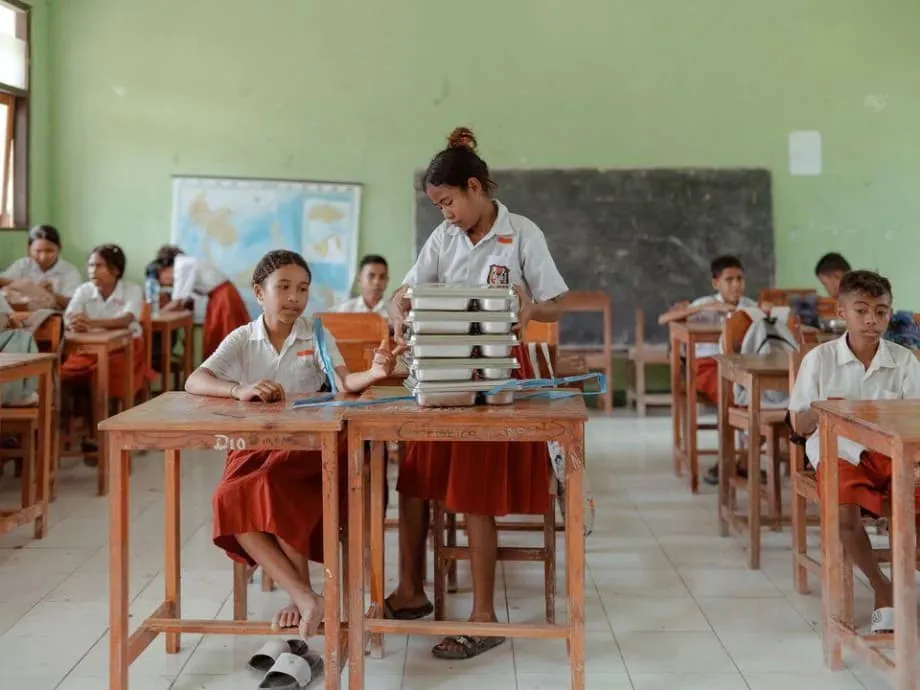
Children's preferences also affect whether a delivered meal is eaten. In one incident in Timor's East Nusa Tenggara province, children pushed green beans around their trays and eyed fried eggs covered in thick red sauce with disdain, preferring snacks from outside vendors. The episode illustrates the daily challenge of turning food distribution into meals that children accept.
Food Safety Problems Follow Rapid Expansion
Government figures record more than 5,900 cases of food poisoning among students since January 2025; independent monitors put the toll at close to 6,500. BGN has suspended operations at more than 2,000 kitchens for hygiene breaches and temporarily stopped payments to others.
BGN head Dadan Hindayana acknowledges the early problems but says the program will continue as designed. He speaks with Prabowo several times a week and receives consistent instructions to accelerate delivery rather than pause the expansion.
The agency has proposed an accreditation system that would rate kitchens A, B or C using performance measures. Its approach puts quantity before quality, while critics argue that the pace of expansion has left food safety and professional nutrition expertise with too little influence.
Critics also question the use of a command structure modeled on the military for a public health program. Coordinating supplies and deliveries is one part of feeding children; choosing suitable diets and maintaining safe preparation practices require knowledge of nutrition, food safety and child development.
How the Spending Has Grown
Authorities allocated 51.5 trillion rupiah, approximately $3.8 billion, to the meals initiative in 2025. The 2026 budget of 335 trillion rupiah is about 6.5 times that rupiah allocation. Such a large increase concentrates a substantial share of public spending in a single program.
Indonesia's tax revenue is around 9 percent of GDP, compared with about 30 percent in developed economies. Economists warn that this limited revenue base makes it difficult to sustain expansive social programs without increasing borrowing and pressure on debt repayment.
Oil prices above $100 a barrel amid Middle East tensions add another burden. Energy subsidies already consume 210 trillion rupiah, or about $12.3 billion. Higher oil prices make those subsidies more expensive, leaving less money for other commitments within the deficit limit.
The 2025 deficit was only 0.08 percentage points below the legal ceiling. The 2026 target leaves a margin of 0.32 percentage points. Unexpected subsidy costs, weaker revenue or additional spending could quickly use up that space.
For families, a free lunch provides a direct benefit. For the state, its cost must fit alongside schools, health services, energy support and interest payments. Indonesia's fiscal challenge is to keep those commitments affordable together.
Village Gains Come With Uneven Benefits
Prabowo says the meals program has increased prosperity in villages. Economic modeling by the National Research and Innovation Agency projects that it could add between 14.5 trillion and 26 trillion rupiah to GDP, a small amount compared with the annual spending commitment.
The projected increase in economic output suggests limited multiplier effects. A multiplier describes how an initial payment can generate further activity as businesses pay workers, purchase supplies and spend income. The estimates point to modest additional output relative to the program's cost.
Farmers were supposed to benefit from local purchasing, but suppliers in Kupang describe sporadic and stressful dealings with kitchen operators. Late orders can trigger frantic searches for produce. Prices set barely above production costs can make a contract difficult to sustain.
Rinto Jami, a vegetable farmer aged 26, rejected a supply contract because the offered price would have left him making a loss. His mother, Dina Udju Edo, questioned the arrangement while sorting vegetables in their field:
If we were making losses, who exactly is feeding the children, the farmers or the government?
The family's experience captures a problem within the promise of village prosperity. A kitchen can create demand for vegetables, yet farmers benefit only when the payment covers what it costs them to grow and supply those vegetables.
Schools Face Competing Needs
Funding for the meals has largely come from cuts to education and health budgets, diverting resources from teacher salaries and school operations. Analysts at the Institute for Development of Economics and Finance (INDEF) warn that the large allocation reduces funding available for other essential sectors.
INDEF estimates an education funding shortfall of 27 trillion rupiah, with approximately 723,000 jobs potentially at risk. Those figures describe the scale of the pressure that education could face as the government directs money toward meals.
A headmistress at an elementary school in Kupang says free lunches help, but better facilities, libraries and technology would do more to keep children in school. Hundreds of students at the school share a single projector and three laptops.
Bhima Yudhistira Adhinegara, executive director of the Jakarta based Center of Economic and Law Studies, gives a harsh assessment of both the program's finances and its operation:
I would give it an 'F'. The free meals programme is quite problematic in the fiscal space but also on the ground.
Education advocates point to 4.3 million children aged 7 to 18 who remain out of school. The MBG budget dwarfs spending on teacher training and school facilities, making the choice between food and other educational needs central to the debate over how Indonesia invests in its children.
Credit Warnings Add Pressure
Moody's and Fitch have cut Indonesia's credit outlook to negative. S&P Global warns that the country is more vulnerable than its Southeast Asian neighbors to weakening credit measures amid turmoil in the Middle East.
A credit outlook signals the direction a rating agency thinks a country's creditworthiness could take. Investors use credit assessments when judging the risk of lending to a government. Concern about public finances can make borrowing more difficult or costly.
S&P Global warns that supply disruptions caused by the closure of the Strait of Hormuz could last for months. Higher energy prices increase subsidy payments and put pressure on the deficit. If inflation pushes market interest rates higher, government interest payments could also rise.
Louis Lau, a portfolio manager at Brandes Investment Partners, regards the meals program's scale as a net negative development and questions the government's spending priorities. The concern extends beyond the cost of lunches to the administration's broader use of public money.
Prabowo's enlarged cabinet includes 48 ministers and 56 vice ministers, alongside new coordinating ministries. That structure has increased government overheads without clear efficiency gains. Weak tax collection leaves the state dependent on borrowing to finance its ambitions.
Officials Seek Savings While Prabowo Holds Firm
Finance Minister Purbaya Yudhi Sadewa has acknowledged the strain and announced measures to reduce meal distribution from six days to five days a week. The change is projected to save 40 trillion rupiah annually.
The government has also revived austerity measures, restricting nonessential travel and considering cuts to ministers' salaries. These efforts seek savings while preserving the president's signature program.
Prabowo remains publicly committed to expansion and has suggested including elderly beneficiaries. Asked in March whether he would reduce the program to bring the budget under control, the president said:
I wouldn't touch free meals. I did it because I could not see our children malnourished.
The president frames the initiative as a moral obligation, citing encounters with children affected by stunting during his 2024 campaign. Stunting means a child has not grown as expected, a concern closely connected to his stated aim of improving nutrition.
The proposed weekly reduction shows how officials are seeking a smaller operating bill while keeping the program in place. Prabowo's interest in adding elderly recipients, however, points toward a wider commitment at the same time that the finance ministry is trying to save money.
Procurement and Leadership Face Scrutiny
BGN's spending has attracted scrutiny beyond the kitchens themselves. Data published by the National Procurement Agency show that BGN allocated 113.9 billion rupiah, about $6.65 million, to 16 event management companies.
The activities ranged from support for the agency's headquarters office to a fun run marking International Anticorruption Day. Procurement packages included 19 billion rupiah for the BGN headquarters and 1.34 billion rupiah for the event in Senayan.
Those expenditures have drawn criticism while education budgets face cuts and kitchens operate with minimal oversight. The dispute concerns whether the agency's spending priorities match the urgent requirements of delivering nutritious food safely.
BGN has a few civil service deputies but lacks trained public health experts in senior positions, relying instead on retired military and police officers. Critics say professional nutritionists have been sidelined by leaders whose experience does not cover food safety or child development.
An internal memo stated that the agency would use the army's logistics network and integrate officers into its organizational structure. The approach rests on the assumption that feeding children resembles a military operation. Critics argue that this leaves the program exposed to inefficiency or failure where public health expertise is essential.
Legal Challenges and Political Stakes
Cases challenging the program's legality are moving through the Constitutional Court. Petitioners argue that universal distribution wastes resources that should be directed toward regions with demonstrated need. No court decision or next hearing date was given.
The political picture is mixed. Prabowo's approval remains near 80 percent, according to Indikator Politik Indonesia, while support for the free meals program fell by 0.27 points on a scale of four points between March and October 2025.
Support is strongest in rural villages, where the visible provision of food reinforces an image of Prabowo as a father figure feeding his people. The program fulfills a tangible campaign pledge and could be politically valuable if he seeks reelection after his term of five years.
Prabowo's spending priorities also include military procurement, including a proposed purchase of a decommissioned Italian aircraft carrier for $450 million. Education advocates question the meals program's dominance while millions of children remain outside school and classrooms lack equipment.
Cabinet ministers reportedly fear raising concerns about the program's cost because of Prabowo's temper and his deep personal commitment to it. Critics describe an environment where loyalty outweighs technical competence, increasing the risk that persistent budget imbalances will go unaddressed until they become a crisis.
The debate is therefore about the program's purpose as well as its cost. Supporters see investment in children's nutrition and village economies. Critics question whether the current design delivers those benefits efficiently or gives political visibility priority over other needs.
How the Program Reached This Point
Indonesia's meals initiative moved from campaign promise to nationwide expansion in little more than a year. Its key dates show how quickly operational demands and financial commitments grew:
- 2024: Prabowo campaigned on free nutritious meals and took office as president.
- January 2025: The government launched MBG, with a 2025 allocation of 51.5 trillion rupiah.
- March to October 2025: Support for the program fell by 0.27 points on a scale of four points.
- End of 2025: Indonesia's budget deficit reached 2.92 percent of GDP, close to the statutory ceiling of 3 percent.
- 2026: The meals budget rose to 335 trillion rupiah, while the government targeted a deficit of 2.68 percent of GDP.
- March 2026: Prabowo rejected reducing free meals to control the budget.
- April 16, 2026: More than 25,000 kitchens were operating, while officials sought savings and the initiative faced safety, procurement and legal scrutiny.
Toineke's daily production of 2,500 lunches shows the work behind the national target. The same program must serve isolated communities, pay suppliers fairly, prevent food poisoning and fit within a constrained budget. Its success depends on how those demands are handled together.
The Bottom Line
- Indonesia aims to provide free nutritious meals to nearly 83 million people, about 30 percent of its population.
- The 2026 allocation is 335 trillion rupiah, roughly $19.7 billion and nearly 10 percent of state expenditure.
- The 2025 deficit reached 2.92 percent of GDP, just below the legal ceiling of 3 percent.
- Government figures record more than 5,900 student food poisoning cases; independent monitors estimate close to 6,500.
- BGN has suspended more than 2,000 kitchens for hygiene breaches and temporarily halted payments to others.
- INDEF estimates an education funding gap of 27 trillion rupiah, potentially putting approximately 723,000 jobs at risk.
- Reducing distribution from six days to five days a week is projected to save 40 trillion rupiah annually.
- Prabowo remains committed to the program, while critics call for more targeted coverage, stronger oversight and leadership with public health expertise.