Rp 335 Trillion Promise Meets Pressure on the Ground
Indonesia has set aside Rp 335 trillion, approximately US$19.7 billion, for its free meals program in 2026, roughly 11 percent of total government spending. President Prabowo Subianto wants the initiative to reach nearly 83 million people, even as food poisoning, rising oil prices and pressure on public finances test his signature campaign promise.
Contents
- Rp 335 Trillion Promise Meets Pressure on the Ground
- Expansion Remains the Presidential Priority
- Why Oil Prices Threaten the Budget
- A Shorter Meal Schedule Offers Limited Relief
- Food Safety Tests the Drive for Speed
- Spending Choices Draw Public Anger
- Economic Benefits Face a Cost Test
- Schools and Farmers Bear the Tradeoffs
- Political Support Meets Questions About Governance
- The Bottom Line
In Toineke, a remote village in East Nusa Tenggara that lies closer to Australia than Jakarta, the scale of that promise becomes a daily kitchen routine. Workers in a small blue and white building prepare 2,500 meals for schools and health hubs. Their shifts begin at 2:00 am and continue through the afternoon.
Yufrianti Hautias, 24, a former teacher who now manages the kitchen, described the workload:
The work goes on continuously, day after day. As one team finishes, the next takes over. Sundays are a bit quieter, but even then, we have to prepare for Monday distribution. There is essentially no time for us to rest.
Prabowo made free nutritious meals a pillar of his 2024 presidential campaign. Since its January 2025 launch, the initiative has rapidly become one of the largest social programs of its kind globally. It seeks to reach children across Indonesia's thousands of islands regardless of household income or individual need, alongside toddlers, pregnant women and breastfeeding mothers.
As of April 16, 2026, the central challenge is delivering that promise at a cost Indonesia can sustain. The program must provide safe food across difficult terrain while competing with schools, health services and other public needs for money. Its success also carries political weight for a president who has made the meals central to his leadership.
Expansion Remains the Presidential Priority
The government allocated Rp 51.5 trillion, or S$3.8 billion, to the program in 2025. The Rp 335 trillion allocation for 2026 is about 6.5 times that amount, showing how quickly the administration intends to expand coverage.
Dadan Hindayana, head of the National Nutrition Agency, known as BGN, says he speaks with Prabowo several times a week. The president's instruction has remained consistent: accelerate implementation despite logistical constraints.
Prabowo, a retired army general, presents the meals as a way to improve nutrition and help children stay in school. He also expects the program to create jobs, increase farmer incomes and boost consumption as kitchens buy ingredients and workers spend their earnings.
The original service promise covered balanced meals on weekdays for students and six days a week for toddlers and mothers. Critics argue that offering meals regardless of economic need directs scarce public money toward households that can already afford adequate food. Activists are pressing for coverage focused on people who need assistance most.
The main developments span more than two years:
- During the 2024 presidential campaign, Prabowo made free meals a central promise.
- In January 2025, the program began operating.
- By late September 2025, government figures recorded more than 5,900 food poisoning incidents linked to the meals.
- In a March 2026 interview, Prabowo rejected compromising on the initiative. Days later, the government announced a reduction in distribution from six days to five days a week.
- In April 2026, S&P Global Ratings highlighted Indonesia's exposure to higher energy prices.
Why Oil Prices Threaten the Budget
Moody's Ratings and Fitch Ratings have both lowered Indonesia's credit outlook to negative, citing concerns that the country could breach its statutory budget deficit ceiling of 3 percent of gross domestic product, or GDP. A deficit is the gap when government spending exceeds its revenue. GDP measures the size of the economy.
The ceiling is one of the surviving legacies of the 1997 Asian financial crisis and has served for decades as a foundation of Indonesia's financial discipline. A negative credit outlook signals concern about the direction of public finances and the country's ability to maintain its financial standing.
The Iran war has pushed oil prices above US$100 a barrel, compared with the US$70 assumption used in Indonesia's 2026 budget. Coordinating Minister for Economic Affairs Airlangga Hartarto warned that prices of US$115 to US$120 a barrel could widen the deficit to approximately 4.06 percent of GDP. That would put it 1.06 percentage points above the legal ceiling.
Finance Minister Purbaya Yudhi Sadewa acknowledged the pressure while defending the government's current measures. He said the average crude oil price remained near the budget assumption. His assessment focused on the average price, while Airlangga's warning described what could happen under a higher price scenario.
Purbaya also described the consequences of a much larger oil shock:
If oil reaches $200 per barrel, then the entire global economy, not just Indonesia, would face a recession.
S&P Global Ratings, in its April 2026 assessment, identified Indonesia as vulnerable compared with other Southeast Asian economies. Higher energy prices increase government subsidy payments and put pressure on the deficit. Inflation could also push market interest rates higher, making government interest payments more expensive.
More costly oil imports would widen the current account deficit, a measure of the gap in a country's transactions with the rest of the world. Higher prices for palm oil and nickel could offset some of that pressure, but the combination of energy costs, subsidies and borrowing expenses leaves the budget under strain.
A Shorter Meal Schedule Offers Limited Relief
Purbaya outlined a proposal to reduce the meals program from six days to five days a week, with potential annual savings of roughly Rp 40 trillion, or US$2.4 billion. Other efficiency measures, aimed at spending on travel and meetings considered unnecessary, were intended to save another Rp 80 trillion.
In his March 2026 interview, Prabowo said he was unwilling to compromise on the program, presenting it as essential to prosperity at the grassroots. Days later, the government announced the shorter distribution schedule, with estimated savings of Rp 20 trillion to Rp 40 trillion.
Even the higher savings estimate amounts to about 12 percent of the Rp 335 trillion allocation. The adjustment therefore reduces costs while preserving the bulk of the program and its universal ambition. Prabowo continues to resist broader cuts, and expansion to elderly people is already under consideration.
The budget dispute is about more than the number of meal days. It concerns how much the government can commit to one initiative while maintaining its deficit limit and funding other services. Rising oil prices make those competing demands harder to reconcile.
Food Safety Tests the Drive for Speed
Government figures recorded more than 5,900 food poisoning incidents linked to the program by late September 2025; independent monitors put the toll closer to 6,500. The cases have brought scrutiny to the way BGN is organized and to the expertise guiding a rapid expansion.
The agency relies heavily on retired military and police officers rather than trained nutritionists or public health experts. Its internal planning documents describe the use of military logistics networks and the integration of retired officers into the organizational hierarchy.
Critics argue that this structure treats meal distribution too much like a military operation. Moving food to thousands of destinations is a logistics task, but a nutrition program also requires specialist judgment about food safety and the dietary needs of the people receiving it. The poisoning cases have made that management concern urgent.
East Nusa Tenggara illustrates the practical difficulties. Kitchens face round trips of four hours to obtain fresh ingredients because local farmers cannot supply enough. Trucks become stuck in mud, and workers sometimes have to carry meal trays by hand to small health hubs serving only 10 or 20 people.
Hautias, the Toineke kitchen manager, described the delivery conditions:
The distances are long and some delivery points serve just 10 or 20 people. With muddy roads and frequent flooding, getting meals to them is often a real challenge.
Small delivery groups and long journeys add to the workload even when relatively few meals are involved. The president's demand for speed reaches kitchens where ingredient supply, road conditions and safe distribution already stretch staff.
Spending Choices Draw Public Anger
Procurement reports recorded Rp 113.9 billion, equivalent to US$6.65 million, allocated to 16 event management companies. Their activities ranged from headquarters office operations to a fun run for International Anticorruption Day.
The expenditure has fueled anger over BGN's priorities while kitchens struggle to deliver safe meals and face criticism for cutting nutritional corners. Public concern centers on whether administrative and event spending deserves those resources when basic operations are under pressure.
BGN's leadership is also part of a wider debate about appointments across the administration. Critics say political loyalty and military backgrounds increasingly outweigh professional qualifications, weakening the technical capacity needed to manage complicated public programs.
Economic Benefits Face a Cost Test
Prabowo's economic case rests on meals generating work, helping farmers and increasing consumption. Independent estimates suggest some gains, but place them far below the annual budget allocation.
Economic modeling by the National Research and Innovation Agency estimates that the program could add Rp 14.5 trillion to Rp 26 trillion to GDP. Those amounts are equivalent to about 4.3 percent to 7.8 percent of the Rp 335 trillion outlay. Other projections put the GDP boost at only 0.06 percent, or roughly Rp 7.2 trillion.
These estimates concern additional economic output. The program's other stated goals are better nutrition and keeping children in school, so the policy debate also turns on whether those benefits justify its scale and whether public money could achieve more elsewhere.
Bhima Yudhistira Adhinegara, executive director of the Jakarta based Center of Economic and Law Studies, known as Celios, gave a blunt assessment of the program's efficiency:
I would give it an 'F'. The free meals programme is quite problematic in the fiscal space but also on the ground.
Louis Lau, a portfolio manager at Brandes Investment Partners, described the program's scale as "a net negative development" and questioned the government's spending priorities. He warned that high spending could continue through 2027 and beyond, limiting other critical investments.
The concern is that an expensive commitment becomes difficult to reduce once households depend on it and the government has tied its credibility to continued delivery. Each year's allocation then competes with other public investments.
Schools and Farmers Bear the Tradeoffs
Nearly all the program's initial funding came from cuts to education and health sectors, redirecting resources from teacher salaries and school operations. Analysts estimate that the reallocation could eliminate some 723,000 education sector jobs.
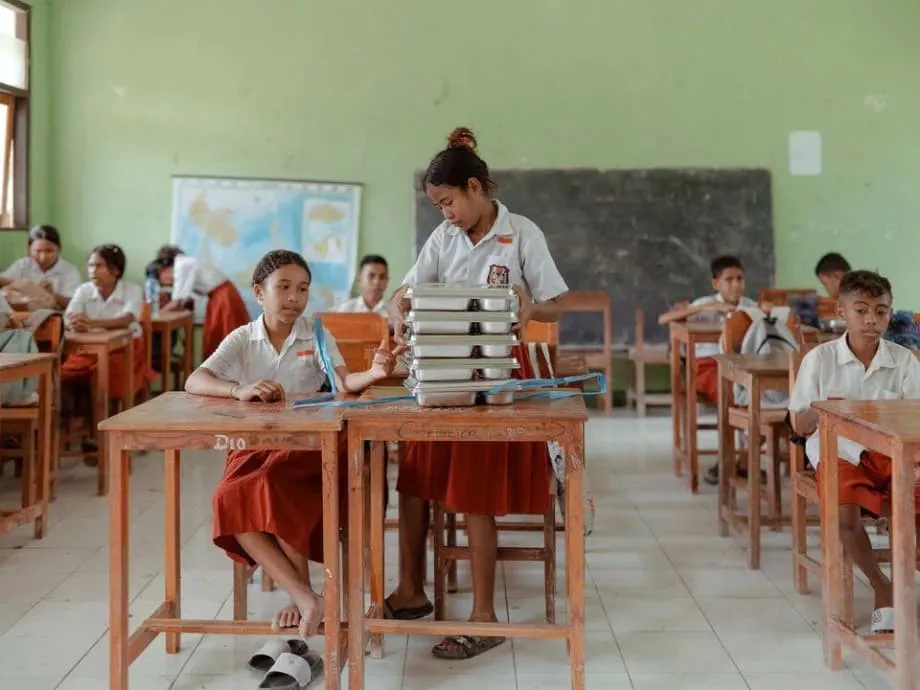
At an elementary school in Kupang, the headmistress said free meals help, but argued that better facilities, including a library, would do more to keep students in school. Hundreds of pupils share a single projector and three laptops.
The school illustrates an opportunity cost: money spent on one useful service becomes unavailable for another. A meal can address hunger during the school day, while teachers, learning materials and facilities serve other needs that also affect attendance and education.
Farmers near Kupang have also questioned the promised benefits. Rinto Jami, 26, rents four vegetable plots and rejected a kitchen's supply offer because the proposed price barely covered his production costs.
His mother, Dina Udju Edo, questioned the arrangement while working in their fields:
If we were making losses, who exactly is feeding the children, the farmers or the government?
The purchasing terms matter for the president's claim that the program will raise farmer incomes. A large government buyer can create demand, but farmers need prices that cover the cost of producing what kitchens require.
The program also changes who earns money from school food. Kitchen staff are classified as volunteers and receive hourly wages. Existing canteens and small businesses that previously supplied school meals have lost markets as government provision replaces their services.
Political Support Meets Questions About Governance
Prabowo retains public satisfaction ratings of nearly 80 percent, with his strongest support in rural villages that form his electoral base. Free meals fulfill a central campaign promise and reinforce his image as a father figure providing for the population.
His commitment combines personal conviction with political calculation. Dadan's frequent conversations with the president show how closely Prabowo follows implementation, while consideration of extending meals to elderly people points toward further demands on the program.
The administration's structure has added to concerns about costs and accountability. Prabowo's cabinet contains 48 ministers and 56 vice ministers, making it Indonesia's largest since the 1960s. Several new coordinating ministries have increased fiscal overheads without clear efficiency gains.
Policy analysts describing the wider pattern of patronage appointments argued that responsibility is becoming separated from relevant expertise:
Patronage appointments undermine the crucial link between responsibility and expertise, leaving critical programs in the hands of those unprepared to manage them.
They also warned about the consequences for the design and operation of public programs:
This pattern compromises policy design and implementation, leaving crucial programs vulnerable to inefficiency, corruption or outright failure.
Danantara, the new sovereign wealth fund controlling state owned enterprises, adds another layer to the governance debate. Officially modeled on Singapore's Temasek, it reports directly to the president and has limited independent oversight, raising concerns about transparency. Ray Dalio's departure from its advisory board in May 2025 signaled international apprehension about governance safeguards.
The free meals program is also being challenged at the Constitutional Court, while activists lobby for assistance based on need instead of universal coverage. No court hearing date or decision timetable was given. The immediate choices concern how to keep meals safe, contain costs and preserve resources for other services while Prabowo remains committed to expansion.
The Bottom Line
- The program targets nearly 83 million people and has a Rp 335 trillion allocation for 2026, approximately 11 percent of government spending.
- Moody's and Fitch have lowered Indonesia's credit outlook to negative amid concerns about the 3 percent deficit ceiling and higher oil costs.
- Government figures recorded more than 5,900 food poisoning incidents by late September 2025; independent monitors estimated closer to 6,500.
- Reducing distribution from six days to five days a week is expected to save Rp 20 trillion to Rp 40 trillion.
- Economic estimates show modest additional output relative to the allocation, while schools, farmers and existing food businesses face tradeoffs.
- Prabowo retains nearly 80 percent public satisfaction, but the program faces a court challenge and scrutiny over safety, appointments and spending priorities.