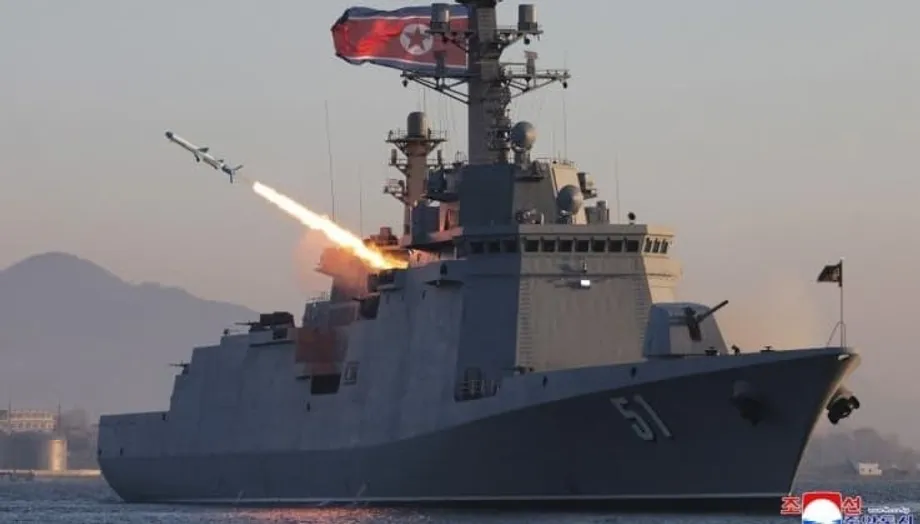
Five missiles test a growing naval ambition
North Korea's Choe Hyon destroyer launched two strategic cruise missiles and three missiles designed to strike ships during an April 12, 2026, exercise near the country's west coast. The coordinated firing tested the warship's weapons and crew while displaying a capability intended to put distant military targets, including American bases in the Pacific, under threat.
Contents
- Five missiles test a growing naval ambition
- What makes the Choe Hyon different?
- How the ship combines attack and defence
- Why the two kinds of missile matter
- A nuclear launcher at sea
- From one destroyer to a larger fleet
- The main dates in the expansion
- Larger ships and submarines widen the ambition
- Allied readiness and the risk of escalation
- Russian equipment and competing design influences
- Construction speed brings practical pressures
- What to Know
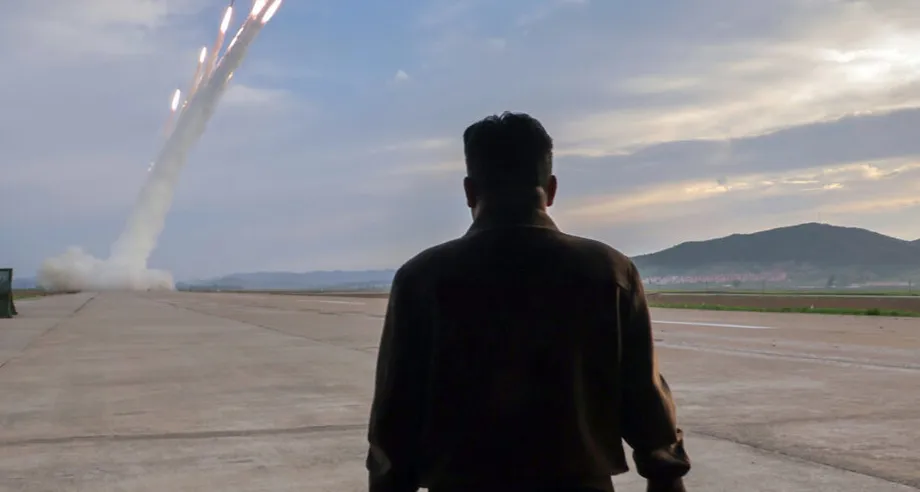
The two cruise missiles flew for between 7,869 and 7,920 seconds, more than two hours. The three missiles aimed at maritime targets remained airborne for more than 30 minutes. North Korean state media said the weapons struck their targets with ultra-precision accuracy.
The Korean People's Army Navy used the exercise to assess the destroyer's integrated combat systems, meaning how its sensors, weapons and crew work together during a mission. Launching weapons against both land and maritime targets demonstrated the range of roles Pyongyang wants its new surface fleet to perform.
North Korea describes the cruise missiles as strategic, a term it uses for systems capable of carrying nuclear weapons. Kim Jong Un has also said the destroyer class will carry tactical ballistic missiles fitted with nuclear warheads. Together, those weapons would give the navy options for attacking ships, military bases and logistics hubs from a moving platform.
The demonstration forms part of a wider effort to turn a navy historically focused on coastal waters into a force able to operate far from the Korean Peninsula. Such a force is often called a blue-water navy. For the United States, South Korea and Japan, the concern is a growing number of possible launch locations and missile types to monitor.
As of April 16, the destroyer's combat readiness, the sustainability of the planned construction programme and its ability to survive a major conflict remain uncertain. Its trials nevertheless show how closely North Korea is linking its naval expansion with its nuclear ambitions.
What makes the Choe Hyon different?
The Choe Hyon measures approximately 144 metres in length and displaces an estimated 5,000 tons. Displacement describes the weight of water a ship pushes aside and is a standard way of expressing its size. It is the largest surface combatant constructed by North Korean shipyards.
The vessel was first launched on April 25, 2025, at the Nampo commercial shipping port. Its appearance has drawn comparisons with modern destroyers operated by China, South Korea and the United States, although assessments caution that its actual combat capabilities probably lag behind those of comparable foreign vessels.
The ship carries 74 vertical launch cells of different diameters. These are compartments from which missiles launch upward before turning toward their targets. Using different cell sizes allows a single vessel to carry several kinds of weapons.
Analysis by the Center for Strategic and International Studies assigns 44 cells to missiles intended to intercept aircraft and other airborne threats. Another 30 larger cells accommodate cruise missiles and tactical ballistic weapons. The larger group represents about two fifths of the 74 cells, giving the ship substantial space for weapons intended to strike targets beyond its immediate surroundings.
Kim has said the arsenal can include hypersonic strategic cruise missiles and tactical ballistic missiles with nuclear warheads. Cruise missiles generally travel through the atmosphere along a controlled flight path, while ballistic missiles follow an arcing trajectory for much of their journey. Putting different weapons aboard the same ship gives commanders more choices about how to attack a target.
How the ship combines attack and defence
The Choe Hyon carries the Russian Pantsir-M air defence system, the first deployment of this weapon in North Korean service. Designed for close protection, it is intended to intercept threats including helicopters, unmanned aerial vehicles and cruise missiles.
The destroyer also has phased array radars, electronic warfare equipment and a main naval gun measuring 127 millimetres in calibre. These systems provide several layers of attack and protection, from detecting threats to trying to disrupt or destroy them.
Other equipment includes systems for identifying friendly and hostile forces, electronic support measures and dispensers for countermeasures intended to reduce the ship's vulnerability to detection and attack. Its flight deck can support helicopters or unmanned aerial vehicles, extending surveillance beyond the reach of sensors mounted on the vessel itself.
Connecting those aircraft with wider reconnaissance networks could help the destroyer locate targets beyond the horizon. For a ship carrying weapons intended to travel long distances, finding and tracking a target is an essential part of making those weapons useful.
Why the two kinds of missile matter
The April exercise brought together weapons intended for attacks on land and weapons intended to strike ships. The ability to conduct both missions from a surface vessel remains relatively uncommon worldwide, with the United States, United Kingdom and Russia among the navies associated with this combination.
The strategic cruise missiles followed low flight paths intended to make radar detection harder. Their flight profiles use terrain following techniques, keeping the weapons close to the surface along their route. Flying low can reduce the distance at which a defending radar can detect an approaching missile.
Weapons of this kind typically use turbofan engines and inertial navigation, which tracks movement from a known starting point, supplemented by satellite updates. Recent improvements have focused on resistance to electronic jamming so that navigation can continue when an opponent tries to disrupt signals.
The missiles intended to attack ships use active radar seekers during the final stage of flight. A seeker is the sensor that guides a weapon toward its target. An active radar seeker sends out radar signals and uses their reflections to locate a vessel, allowing the missile to acquire a moving target autonomously.
Combining these weapons allows the Choe Hyon to move between missions aimed at denying an enemy fleet access to an area and attacks against fixed sites on land. Military bases and the hubs that supply them are among the targets that make the ship's development relevant beyond North Korea's coastal waters.
The mix also creates a more complicated defensive task. A force facing cruise and ballistic missiles, with possible conventional or nuclear warheads, must prepare for weapons arriving along different flight paths and presenting different interception problems.
A nuclear launcher at sea
Kim's stated plan to place tactical ballistic missiles with nuclear warheads aboard the destroyer gives particular importance to its larger launch cells. Several of those cells are designed to accommodate such weapons, making the vessel part of North Korea's effort to diversify how it could deliver a nuclear strike.
A moving launch platform changes military planning. Fixed launchers stay in one location, while a ship can change position and approach a target from a different direction. North Korean destroyers operating in international waters would also present a different tracking problem from missile silos or mobile launchers travelling within the country's borders.
Radar horizons and geographic features can limit detection from particular positions. Mobility could help a vessel survive an initial attack and retain the ability to retaliate, a concept known as a second-strike capability.
That prospect has competing effects on a crisis. A government that believes it can retaliate may feel less pressure to fire immediately. At the same time, uncertainty about a ship's position, weapons or intentions can increase the risk that an opponent misjudges a move and escalates the confrontation.
From one destroyer to a larger fleet
Kim has committed to building two destroyers annually during the current plan covering five years, with a target of ten additional ships over the coming years. The proposed annual output would exceed current United States Navy destroyer construction, although North Korea must support that ambition alongside its ground forces and nuclear programmes.
The second ship in the class, Kang Kon, suffered damage during an unsuccessful launch at Chongjin Shipyard on May 21, 2025. It was raised and towed approximately 50 miles north to Rajin Shipyard before being successfully relaunched on June 12.
A third destroyer is under construction at Nampo. State media has indicated that it should be completed by October 2026. Kim has also reviewed plans for a fourth vessel, pointing toward a group of destroyers intended to operate as a coordinated force rather than a handful of separate experimental ships.
Lim Eul-chul, a professor at Kyungnam University, linked the discussion of further vessels to the pace of testing and production:
The mention of the third and fourth destroyers suggests North Korea is accelerating the formation of a destroyer flotilla rather than fielding isolated platforms. Faster follow-on production typically follows once initial testing is deemed successful.
A flotilla is a group of warships operating together. Building one requires more than repeating a ship design: crews, maintenance facilities, supplies and command arrangements must support several vessels at the same time.
The main dates in the expansion
North Korea's destroyer programme has moved through launches, an accident, repairs and weapons trials within less than a year. Its more recent announcements also extend beyond the Choe Hyon class.
- April 25, 2025: The Choe Hyon was first launched at the Nampo commercial shipping port.
- May 21, 2025: The Kang Kon was damaged during a failed launch attempt at Chongjin Shipyard.
- June 12, 2025: The second destroyer was successfully relaunched after being raised and moved to Rajin.
- August 18 to August 28, 2025: The United States and South Korea held Ulchi Freedom Shield 25, an exercise focused on combined joint operations across all domains.
- December 2025: North Korea unveiled its first submarine powered by a nuclear reactor.
- March 2026: Kim confirmed development of a larger destroyer class displacing 8,000 tons.
- March 11 and April 12, 2026: Cruise missile launches formed part of an intensive series of weapons tests, with the April exercise combining attacks against land and maritime targets.
- October 2026: State media's stated completion target for the third destroyer at Nampo.
The succession of trials is aimed at establishing an initial operational capability, the point at which a new ship and its crew can begin carrying out their intended missions. Sustained operations would require continued training and support after that first stage.
Larger ships and submarines widen the ambition
Kim's March confirmation of an 8,000-ton destroyer class points to a vessel substantially larger than the Choe Hyon. Using the stated figures, it would displace 3,000 tons more, an increase of 60 percent over the current class's estimated 5,000 tons.
North Korea is also pursuing submarines powered by nuclear reactors, following the December 2025 unveiling. Nuclear propulsion describes the source of a submarine's power. The destroyer programme, by contrast, centres on the weapons a surface ship can carry and launch.
Together, the surface and submarine projects express Pyongyang's determination to operate in the central and eastern Pacific. Those ambitions include potentially threatening Hawaii and, eventually, targets on the continental United States.
The immediate regional concern remains the spread of possible missile launch positions and the threat to American and allied military bases across the Pacific. A fleet able to operate farther from home would extend the geographic area that opposing forces need to watch.
North Korea's approach combines ballistic missiles launched from land, cruise missiles launched at sea and, eventually, weapons launched from submarines. Often described as an anti-access and area-denial strategy, the aim is to make it dangerous for an opponent to enter or operate within a particular area.
Threats arriving from several directions and environments place additional demands on intelligence, surveillance and reconnaissance. Those activities involve finding military assets, watching their movements and collecting the information needed to assess or respond to them.
Allied readiness and the risk of escalation
The United States, South Korea and Japan face a more complicated defensive environment as North Korea adds maritime launch platforms. A destroyer carrying a mixture of missiles could force defenders to track the ship while also preparing to intercept several kinds of weapon.
General Xavier T. Brunson, commander of United Nations Command, Combined Forces Command and U.S. Forces Korea, described allied exercises as defensive when discussing Ulchi Freedom Shield 25. The exercise ran from August 18 to August 28, 2025, and focused on combined joint operations across all domains.
UFS is a defensive exercise designed to enhance our readiness, stress-test our combined capabilities, and build seamless interoperability with our ally and UNC. There is no substitute for being ready, and our ability to fight tonight and deter aggression is directly grounded in how we train today.
Brunson's statement connects deterrence with the ability of allied forces to operate together. North Korea's destroyer programme adds another set of targets, launch routes and possible threats for that preparation to address.
Lim also assessed that Pyongyang appears to be using global strategic distractions, including conflicts in the Middle East, to accelerate weapons development. The launches on March 11 and April 12 form part of the intensive testing effort accompanying its shipbuilding plans.
Russian equipment and competing design influences
The Pantsir-M system is a prominent sign of a possible Russian contribution to North Korea's naval development. South Korean officials and independent analysts suspect Russian involvement in the destroyer's development, particularly given that equipment and Kim's 2023 visit to Vladivostok, where he toured Russian Pacific Fleet frigates.
Growing military and technical cooperation between Pyongyang and Moscow provides the wider setting. North Korea has shipped weapons to support Russia's invasion of Ukraine, and possible technology transfers could help accelerate its own naval modernisation.
Independent defence analysts have also identified visual similarities between the Choe Hyon and China's Type 055 and Type 052D destroyers, as well as South Korea's Sejong Daewang class. Direct copying appears unlikely given the differences in technical capabilities.
North Korean engineers instead appear to have drawn on several influences while adapting the ship and its systems to what domestic industry can produce. The result combines a large missile battery, radar equipment, electronic warfare systems and close protection on a platform unlike the country's older coastal vessels.
Operating that equipment successfully depends on how well the systems work together. A radar must detect a threat, the combat system must assess it, and the crew must select and use the appropriate weapon or countermeasure. Live firing is one stage in testing that chain.
Construction speed brings practical pressures
North Korea's limited experience with complex surface combatants makes crew training and systems integration major concerns. Rapid construction and testing can put ships into the water quickly while leaving substantial work to prepare them for demanding operations.
Surface warships can also be detected and destroyed once hostilities begin. The Choe Hyon's mobility gives military planners another problem to solve, while its size and role make its survival during an intense conflict a central concern.
A growing destroyer fleet would require extensive logistics, advanced maintenance facilities and highly trained personnel. North Korea's limited economy must meet those costs while supporting modernisation of the army and continued nuclear development.
The launch accident involving the Kang Kon illustrates the practical difficulties accompanying the expansion. Raising, towing and relaunching the ship allowed the programme to continue, but building multiple vessels creates recurring demands for shipyard capacity and technical support.
Kim also has political reasons to pursue the fleet. As he approaches his fifteenth year in power, transforming the navy into a force able to operate far from home would provide a legacy that neither Kim Jong Il nor Kim Il Sung achieved.
Advanced destroyers therefore carry domestic propaganda value as well as military value. The central task now is turning ambitious construction targets and successful missile launches into a fleet that can be crewed, maintained and operated consistently. The next stated shipbuilding milestone is completion of the third destroyer in October 2026.
What to Know
- The April 12 exercise involved two strategic cruise missiles and three missiles intended to strike ships near North Korea's west coast.
- The cruise missiles flew for more than two hours; state media claimed highly accurate strikes.
- The Choe Hyon is approximately 144 metres long, displaces an estimated 5,000 tons and carries 74 vertical launch cells.
- Kim says the class will carry tactical ballistic missiles with nuclear warheads.
- North Korea plans two destroyers annually, targeting ten additional ships during its current plan covering five years.
- The second destroyer, Kang Kon, was relaunched after a May 2025 accident. The third is expected to be completed in October 2026.
- An 8,000-ton destroyer class and submarines powered by nuclear reactors form part of the wider naval expansion.
- Training, maintenance, funding and survival in combat remain central challenges for the planned fleet.