A missile display with a message beyond North Korea
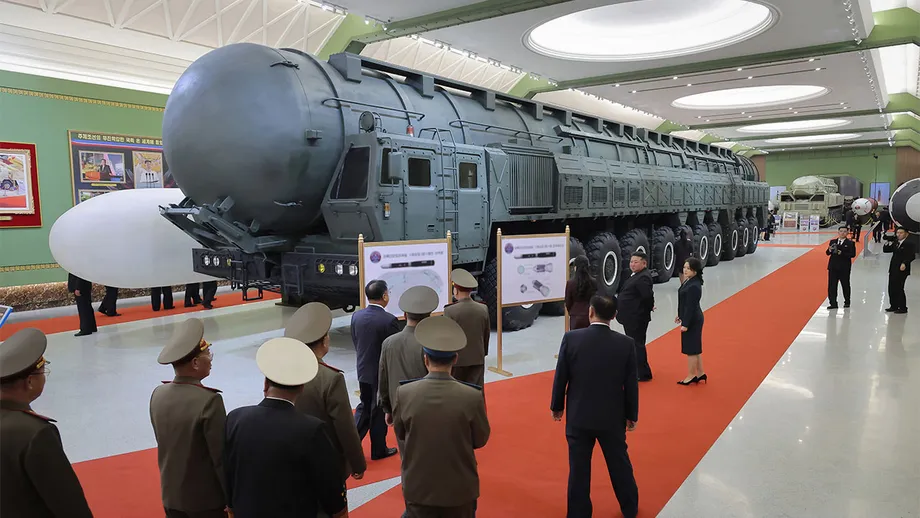
North Korea opened its Second Economic Commission's Defense Revolution Museum on October 11, 2026, displaying the Hwasong-20 intercontinental ballistic missile, its mobile launcher and diagrams presenting a capacity to carry multiple warheads. A range map accompanying the missile extended beyond the United States mainland to the Middle East, Australia and South America, according to a South Korean defense specialist's assessment of the photographs.
Contents
- A missile display with a message beyond North Korea
- Who attended the October 11 ceremony?
- What the Hwasong-20 exhibit claims
- How the display fits the missile development sequence
- Beyond the ICBM: missiles, artillery and drones
- Kim promises continued weapons development
- A domestic audience, with Kim's family present
- A possible message to Trump, not a confirmed meeting
- The October 12 test was a separate development
- Russia adds another dimension to the defense industry push
- Key Points
The opening, announced on October 13 to mark the Workers' Party's 81st anniversary, brought together Kim Jong Un, his wife Ri Sol Ju, his daughter Ju Ae and senior party and military officials. Exhibits ranged from individual combat equipment to submarine launched missiles, artillery, tanks and drones.
The event combined three distinct messages: a celebration of weapons development under Kim, a promise to continue expanding the defense industry, and a presentation of military reach as the possibility of another meeting with U.S. President Donald Trump was being discussed.
Those messages should not be confused with proof of every advertised capability. A diagram showing several warheads does not establish that a missile can successfully deliver them, and a range map is not a flight test. Reports also identify some exhibits differently, particularly the hypersonic missiles.
The distinction matters because the museum appeared alongside a separate announcement of an October 12 tactical ballistic missile test. The displayed Hwasong-20 and the missiles fired that day were different systems, with different missions and different levels of publicly described evidence.
Who attended the October 11 ceremony?
Kim cut the opening ribbon and toured the museum with Workers' Party Central Committee secretaries, members of the party's central leadership bodies, defense industry officials, Defense Ministry commanders, service chiefs and commanders of major military formations. Builders and museum staff also attended.
The ceremony included a performance by the Defense Ministry's central military band, the national anthem and a video presentation about weapons recently deployed to the armed forces. The account of that presentation did not identify which displayed systems had entered service.
Kim Jong Sik, a member of the Workers' Party Central Military Commission and first deputy department director of the party's Central Committee, delivered the commemorative speech. He presented the museum as a record of military industry development under party leadership and a demonstration of national defense capacity.
The Second Economic Commission oversees North Korea's military industry, including nuclear and missile production. Its responsibility for the museum connects the exhibition directly to the institution managing weapons development and manufacture, rather than treating it simply as a collection of military history.
Most accounts distinguish the October 11 ceremony from its October 13 announcement. One account describes the museum as opening on October 13, but also discusses the announcement issued that day. The detailed ceremony narrative places the ribbon cutting and tour on October 11.
What the Hwasong-20 exhibit claims
The Hwasong-20 was displayed with a transporter used to move and launch the missile. Its presentation also included a drawing showing multiple warheads and a world map indicating extensive reach.
Shin Jong Woo, secretary general of the Korea Defense and Security Forum, interpreted the arrangement as an attempt to demonstrate the results of Kim's defense science development plan. He said the map and drawing presented the missile as capable of reaching the United States mainland as well as the Middle East, Australia and South America.
An intercontinental ballistic missile, or ICBM, travels over a very long distance before its warhead returns through the atmosphere toward a target. Carrying several warheads could allow one missile to threaten more than one target, depending on its design. The exhibition does not establish whether the Hwasong-20 can deploy independently guided warheads.
Reports describe North Korean ICBMs as having the flight range to reach the United States mainland, while also noting that warhead reentry technology has not been verified. Reentry requires a warhead to survive intense heat and physical stress while returning through the atmosphere.
The museum photographs therefore document what North Korea chose to display and advertise. They do not resolve the missile's tested payload, accuracy, reentry performance or operational readiness. No specific Hwasong-20 flight test establishing those capabilities is described in these accounts.
How the display fits the missile development sequence
The Hwasong-20 presentation follows a reported progression from the liquid propellant Hwasong-17 toward the solid propellant Hwasong-18 and Hwasong-19. Liquid propellant systems use liquid fuel and oxidizer, while solid propellant missiles contain their propellant in solid form and can generally be prepared for launch more quickly.
One account places the Hwasong-20's first public appearance at the October parade marking the party's 80th anniversary, a year before this museum opening. The exhibition gives that weapon a permanent place in North Korea's public account of its military development.
- 2022: North Korea tested the liquid propellant Hwasong-17.
- From 2023: Testing shifted toward the solid propellant Hwasong-18 and Hwasong-19.
- October 2025: The Hwasong-20 was reportedly unveiled at the Workers' Party's 80th anniversary parade.
- October 11, 2026: Kim attended the Defense Revolution Museum opening.
- October 12, 2026: North Korea conducted a separate tactical ballistic missile test.
- October 13, 2026: The museum opening and missile test were publicly announced.
This sequence shows how North Korea is presenting successive weapons as evidence of continuing development. It does not establish that every new designation represents a fully tested or deployed system.
Beyond the ICBM: missiles, artillery and drones
The exhibition's breadth is part of its political message. Alongside the Hwasong-20 were a new submarine launched ballistic missile, a hypersonic missile identified in several accounts as Hwasong-16ma, a 600 mm multiple rocket launcher and the Badasuri missile designed to strike ships.
Other reports describe Hwasong-17 and Hwasong-12 missiles, tactical guided missiles, 240 mm rocket launchers, a 155 mm howitzer, eight varieties of Hwasal cruise missile and an improved Chonma-20 tank. They also identify the Saetbyol-4 reconnaissance drone and Saetbyol-9 attack drone.
These systems have different purposes. Submarine launched missiles provide a means of attacking from the sea. Cruise missiles sustain powered flight through the atmosphere, unlike ballistic missiles, which follow a trajectory largely shaped by gravity after their powered phase. Reconnaissance drones gather information, while attack drones carry weapons or strike targets themselves.
The collection also included sights and other individual combat equipment. That range allows the museum to connect strategic missiles with the equipment of ordinary troops, presenting military industry as a broad national achievement rather than a single missile program.
Reports differ on some names. Several identify the hypersonic exhibit as Hwasong-16ma, while others name Hwasong-16na and additional Hwasong-11ma variants. One identifies a submarine launched missile as Pukguksong-6, while others give no model name. These differences cannot be settled from the descriptions alone.
Kim promises continued weapons development
Kim's remarks presented the museum as both a monument to past achievements and a commitment to further weapons development. He tied national dignity, security and peace to the growth of the defense industry.
Kim Jong Un, North Korea's leader, described the museum in words translated from Korean as:
A national treasure among national treasures.
He also described building the world's strongest defense industry as the Workers' Party's duty. His remarks promised continued development and completion of weapons built under the banner of Juche, North Korea's doctrine of national independence and self reliance.
The promise extended to the institution itself: Kim said the museum would grow in scale and content. No construction timetable, budget, additional exhibition plan or public access schedule was announced in the accounts of the ceremony.
Kim also assigned museum staff and guides an explicitly political responsibility, urging them to preserve the party's account of defense development and act as its propagandists. That instruction makes the museum's educational purpose inseparable from the leadership's preferred explanation of why North Korea needs its weapons.
A domestic audience, with Kim's family present
Photographs of the opening appeared prominently on the front page of the Workers' Party newspaper read by North Korean residents. The museum was therefore presented to a domestic audience as well as to governments watching the country's missile development.
A South Korean Unification Ministry official assessed the event as an effort to justify North Korea's defense policy, strengthen internal unity and display achievements abroad. That assessment is consistent with the ceremony's combination of party history, weapons imagery and speeches crediting Kim's leadership.
Ri Sol Ju and Ju Ae accompanied Kim on the visit. Their presence placed his family within a ceremony centered on military strength and the party's future. Some commentary interpreted that appearance as a signal of continuity across generations, but the event contained no reported announcement assigning Ju Ae a new position or defining a succession arrangement.
The publicity surrounding the museum contrasted with the treatment of the October 12 missile test. The test was announced through an external state media channel but was reportedly absent from the domestic party newspaper. The difference shows that the two events were presented differently to audiences, although it does not establish why editors made that choice.
A possible message to Trump, not a confirmed meeting
The range display drew particular attention because Trump had again left open the possibility of meeting Kim. On October 12, local time, he was asked whether he planned to meet the North Korean leader during an Asian visit associated with the Asia Pacific Economic Cooperation summit.
Donald Trump, the U.S. president, replied, in the Korean account's rendering of his answer:
That could happen.
That response indicated a possibility, not a scheduled summit. No agreed meeting date, location or negotiating agenda was reported.
Shin interpreted the prominent presentation of the Hwasong-20's explanatory panel as potentially directed at Trump. In his assessment, advertising reach and multiple warheads could be intended to improve North Korea's position before any renewed talks.
Lim Eul Chul, a professor at Kyungnam University's Institute for Far Eastern Studies, offered a stronger interpretation: that the museum signaled North Korea would no longer consider denuclearization negotiations. This was his assessment of the event, not a new negotiating statement formally issued at the ceremony.
The distinction between interpretation and announced policy is essential. Kim's reported remarks committed to continued weapons development. They did not set terms for a meeting with Trump or provide a detailed diplomatic proposal.
The October 12 test was a separate development
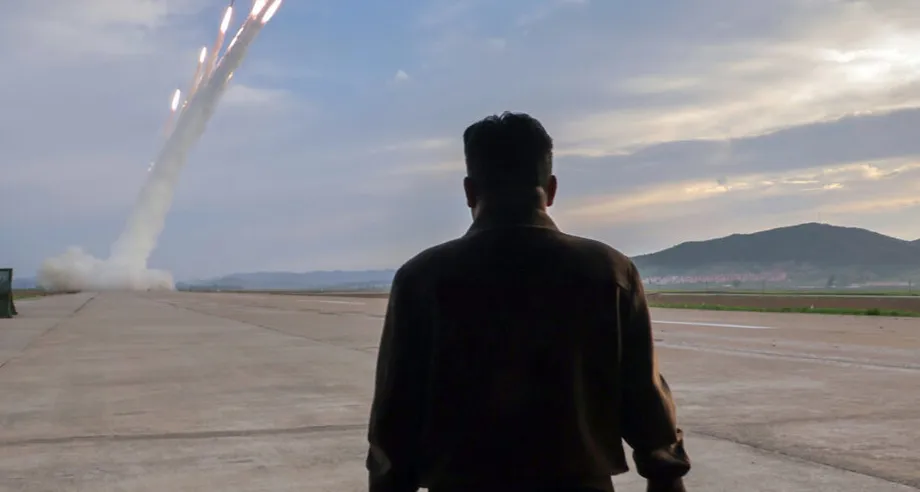
North Korea said its Missile Administration conducted a tactical ballistic missile test on October 12 to confirm technical updates to important components. It described the launch as part of routine work by the administration and its research institutes to improve weapons performance.
South Korea's Joint Chiefs of Staff said several ballistic missiles were launched from the Pyongyang area toward the sea east of the peninsula and flew approximately 900 kilometers. The U.S. military assessment cited in the reports counted two missiles and said the launches posed no immediate threat to U.S. personnel, territory or allies.
The accounts therefore differ in precision rather than necessarily contradicting each other: South Korea initially reported several missiles, while the U.S. assessment specified two. Photographs were interpreted as showing an improved missile from the KN-23 family, but that identification was not presented as a confirmed model announcement.
The launch occurred four days after South Korea's October 8 first test of a domestically developed hypersonic glide vehicle at the Agency for Defense Development's Anheung testing site. President Lee Jae Myung attended that test, conducted from an offshore barge.
A hypersonic glide vehicle travels at more than five times the speed of sound and can maneuver while gliding through the atmosphere. The timing prompted interpretations of the North Korean launch as a response, but timing alone does not prove that motive. Neither the approximately 900 kilometer flight nor the component test announcement verifies the Hwasong-20's advertised intercontinental capabilities.
Russia adds another dimension to the defense industry push
The commitment to expand weapons production also comes amid reports that North Korea has supplied Russia with missiles and ammunition for its war against Ukraine, receiving oil, grain and other economic benefits in return. Reports also describe North Korean troop deployments and possible Russian transfers of military technology.
Ukraine's Defense Intelligence agency, known as HUR, was cited in accounts saying Russia had received KN-23 and KN-24 missiles and had requested improved weapons including the KN-30. No underlying intelligence document or detailed quantities were included in those accounts.
Those reports connect North Korea's military industry to an external customer as well as to its own armed forces. They do not establish that the Hwasong-20, the submarine launched missile or other specific museum exhibits have been exported. The ceremony itself contained no reported export contract or announcement of a transfer to Russia.
The distinction leaves several central issues unresolved: which exhibits are operational, which advertised capabilities have been demonstrated, and whether another U.S. meeting will take place. No deadline for resolving those issues was announced. What the museum does establish is the leadership's public commitment to continue weapons development and make that program a permanent part of the party's political narrative.
Key Points
- The Defense Revolution Museum opened on October 11, 2026, with the announcement issued on October 13.
- Kim Jong Un attended with Ri Sol Ju, Ju Ae and senior party, military and defense industry officials.
- The Hwasong-20 exhibit included a mobile launcher, multiple warhead imagery and a map advertising extensive reach.
- The exhibition also featured submarine launched missiles, artillery, drones and other combat equipment.
- Reports differ on some missile designations, and the display does not verify every advertised capability.
- A separate October 12 tactical missile test flew approximately 900 kilometers, according to South Korea's military.
- Trump left open the possibility of meeting Kim, but no summit date or agenda was announced.
- Kim promised continued weapons development and expansion of the museum.