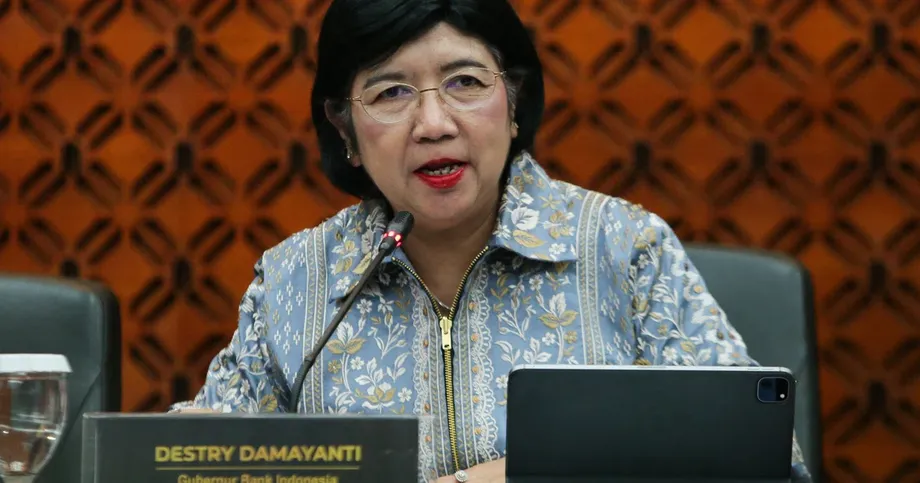
Damayanti draws a line between coordination and control
Bank Indonesia Governor Destry Damayanti says the central bank alone decides interest rates, despite closer involvement with President Prabowo Subianto's government. Her assurance on October 12, 2026, comes after a total increase of 100 basis points in May and June, a benchmark rate held at 5.75% in September, and persistent investor concern about the rupiah and political influence over monetary policy.
Contents
- Damayanti draws a line between coordination and control
- The government also rejects interference in rates
- A leadership change followed months of currency pressure
- The legal debate goes beyond a governor's promise
- Why appointments and oversight trouble investors
- Rates rose, then the bank sought another way to support the rupiah
- Fiscal pressure makes the boundary harder to maintain
- Reserves provide support, with obligations to consider
- Local currency settlement is expanding rapidly
- Key Points
Government representatives have been invited to attend part of the central bank's monthly monetary policy review. Damayanti also participates in meetings with Prabowo. She says neither arrangement gives the government a say in setting rates.
Damayanti, who became governor after serving as the bank's second most senior official, described the boundary between discussions with the government and decisions by Bank Indonesia:
When we're about to make a policy decision - whether to raise or lower interest rates or to use other incentives - we have full authority to make that decision.
That distinction matters because the debate extends beyond the benchmark rate. Changes to the bank's mandate, government bond operations and transfers of public funds into commercial banks have brought monetary policy closer to the administration's growth agenda.
Damayanti's position is that cooperation helps fiscal and monetary policymakers move in the same direction without surrendering the bank's decision making authority. Investors are weighing that assurance against a currency described as emerging Asia's worst performer, concerns about government finances, export policy changes and transparency in the stock market.
The government also rejects interference in rates
Finance Minister Suahasil Nazara gave a similar assurance in a television interview aired on October 2. He said he would not tell Bank Indonesia what to do with interest rates, explaining that the government and the central bank have separate mandates. He described their relationship as cooperation and coordination, rather than government direction of monetary decisions.
The distinction is practical. Fiscal policy covers government spending, taxation and borrowing. Monetary policy includes setting the central bank's benchmark interest rate and managing monetary conditions. Decisions in one area affect the other, making communication necessary even when authority remains separate.
Damayanti said regular discussions with the government cover the issuance of rupiah and foreign currency bonds, management of government cash reserves and ways to stimulate demand for loans. These subjects can affect liquidity, borrowing costs and demand for Indonesian assets without requiring the government to choose the policy rate.
The governor also explained why she considers meetings with the president compatible with the bank's position within the state:
In Indonesia, the president is both the head of government and the head of state. BI is under the state of Indonesia, so automatically, if the president wants to know about developments, I think it's normal.
The assurances do not settle every independence concern. Control over the benchmark rate is one issue; whether other central bank operations are increasingly serving government financing objectives is another.
A leadership change followed months of currency pressure
Damayanti's appointment followed the departure of Perry Warjiyo in late July. Most accounts describe a surprise resignation, while one commentary describes him as having been ousted by Prabowo. Those descriptions differ on the circumstances of his exit, even though they agree that Damayanti succeeded him after serving as his top deputy.
Accounts of the transition also differ: most place her takeover in September, while one summary places it in the month following the July departure. An academic commentary gives September 2 as her inauguration date and identifies her term as 2026 to 2031.
The sequence shows how the leadership transition fits into a longer period of pressure:
- Mid January 2026: Thomas Djiwandono's nomination as deputy governor coincided with the rupiah briefly reaching 16,985 per US dollar.
- May and June: Bank Indonesia raised its policy rate by a cumulative 100 basis points as the rupiah weakened further.
- Late July: Warjiyo left office. The academic commentary dates his resignation to July 26.
- September 2: Damayanti was inaugurated, according to that commentary.
- September 22 and 23: Bank Indonesia held its benchmark rate at 5.75%.
- October 2 and October 12: Suahasil and Damayanti, respectively, rejected government control over rate decisions.
The September inauguration brought some market relief. The academic account records the rupiah at 17,763 per dollar that day, a gain of 1.4% since July 26, and the Jakarta Composite Index at 6,595, up 6.6% over the same period. Those gains indicate an improved reception during the transition, not a reversal of the currency's broader weakness. A separate account put its decline against the dollar at more than 6% for the year.
The legal debate goes beyond a governor's promise
Indonesia's central bank independence rests on reforms introduced after the 1997 and 1998 Asian financial crisis. In an April 10 analysis of BI independence, Deni Friawan, a researcher at the Centre for Strategic and International Studies in Jakarta, explains that the 1999 Law on Bank Indonesia and its 2004 amendment insulated monetary policy from political pressure and assigned the bank a mandate to maintain rupiah stability.
Friawan puts the subsequent inflation record in perspective: inflation averaged 3% to 4% from 2016, compared with around 58% during the financial crisis. Those figures cover very different periods, but show the scale of the stability achieved after the crisis and institutional reforms.
The 2023 Law on the Development and Strengthening of the Financial Sector expanded Bank Indonesia's responsibilities to include payment and financial system stability in support of sustainable growth. Friawan says the law formally preserves independence, while making the bank's role more sensitive to shifts in policy.
A later analysis of BI's mandate by economist Suryaputra Wijaksana and ISEAS fellow Maria Monica Wihardja examines Law No. 4/2023 and its June 2026 amendment. They argue that statutory exceptions and political oversight have constrained independence and drawn the bank toward both monetary management and government financing.
These are academic assessments, not court rulings. They identify legal and operational concerns beyond the narrower question Damayanti addressed: who has the final authority to raise or lower interest rates.
Why appointments and oversight trouble investors
Prabowo's appointment of his nephew, Thomas Djiwandono, as a Bank Indonesia deputy governor brought those concerns into sharper focus. Friawan records a rapid market reaction to the nomination in mid January, while cautioning that global rates, fiscal conditions and broader perceptions of governance also shaped the response.
The rupiah's fall cannot therefore be assigned to one appointment. The same caution applies to the currency's later weakness: concerns about fiscal health, export rules and stock market transparency sit alongside questions about monetary independence.
Wijaksana and Wihardja examined monthly data from January 2022 to June 2026 and found a break in policy rate behaviour around November 2024. They report changes in the rate's relationship with US interest rates and bank credit growth, rather than with inflation or the exchange rate.
The authors describe their evidence as tentative. A statistical change in relationships does not, by itself, establish government direction of a particular rate decision. Their concern is that credit increasingly driven by state projects and fiscal policy may weaken the effect of conventional monetary tools.
They recommend making price and rupiah stability the overriding objectives, removing parliament's binding evaluation and dismissal powers, and restricting purchases of government bonds at issuance to clearly defined crises with an exit strategy. These are recommendations, not announced reforms or pending decisions with a stated timetable.
Rates rose, then the bank sought another way to support the rupiah
The 100 basis point increase in May and June amounts to one percentage point. It took the benchmark from the 4.75% recorded during the January rate hold to the 5.75% maintained at the September meeting. September marked the third consecutive meeting at that level.
The earlier January decision had already shown the bank prioritizing currency stability over further easing. By June, the rupiah had reached a new historical low, prompting a stronger rate response. No June exchange rate level is given here, so it cannot be compared precisely with January's 16,985 per dollar.
Since the increases, Bank Indonesia has offered discounted foreign exchange hedging instruments. Hedging lets investors reduce the risk that a currency move erases the return on an investment. Damayanti said the discount could add 40 basis points, or 0.4 percentage points, to foreign investors' returns from rupiah assets without another rate increase.
That is a different intervention from raising the benchmark. It lowers the cost of managing currency risk for investors using the instruments rather than increasing borrowing costs throughout the economy.
Damayanti said future rate decisions would depend on economic data and that the bank was ready to respond when needed. She did not announce another increase or cut. The reported inflation target is 1.5% to 3.5%, while the September decision was described as supporting rupiah stability, keeping inflation within target and sustaining economic growth.
Fiscal pressure makes the boundary harder to maintain
The government's ambition is to reach 8% economic growth by 2029. Friawan's analysis describes limited room to finance that push: public debt is around 40% of gross domestic product, the fiscal deficit is approaching its statutory ceiling of 3% of GDP, and tax revenue is around 10% of GDP.
Debt servicing costs exceeded 45% of government revenue in 2025, according to that analysis. Debt relative to the economy and servicing costs relative to revenue measure different things. A moderate debt ratio can coexist with a heavy budget burden when government revenue is low.
Wijaksana and Wihardja identify another channel connecting fiscal priorities and the banking system. They say Bank Indonesia transferred accumulated government budget surpluses totaling 300 trillion rupiah, approximately $17 billion, from central bank accounts to state commercial banks beginning in September 2025, following Finance Ministry directives.
That figure is larger than the roughly 200 trillion rupiah described during the 2025 growth policy debate. The later analysis gives an accumulated total beginning in September, while the earlier coverage described the placement at that stage. The difference should not be treated as an identical transaction measured inconsistently without a fuller breakdown.
The academic authors say lending to state enterprises grew at more than twice the pace of lending to the private sector. They argue that such credit direction, together with purchases of longer maturity government bonds, can support public programmes while weakening the separation between monetary policy and fiscal financing.
The risk depends partly on whether additional liquidity is offset by other monetary operations. That process, called sterilisation, removes money elsewhere to counter an injection. Without an offset, more liquidity can complicate inflation control even while the headline interest rate stays high.
Reserves provide support, with obligations to consider
Indonesia's foreign exchange reserves stood at $146.3 billion at the end of September. Damayanti said that amount was adequate to stabilize the rupiah, including reserves held through US dollar placements by commercial banks at Bank Indonesia.
Some market estimates put forward reserve liabilities at around $30 billion. Forward liabilities are obligations associated with transactions that settle later. They are not the same as an immediate withdrawal from the published reserve total, but they matter when assessing future foreign currency commitments.
The estimated $30 billion is about 20.5% of the $146.3 billion reserve stock. That comparison shows the scale of the estimate, not a verified calculation of freely usable reserves. Simply subtracting one figure from the other would not establish the bank's net capacity to intervene.
Damayanti said most banks place funds in instruments with maturities of one year and that these placements would be rolled over. Discussing the continuing stock of funds banks maintain at the central bank, she said:
They usually have what is called 'iron stock', a position that's guaranteed to always be here,
That is the governor's assessment of the persistence of those placements. It is not a published maturity schedule or a detailed reconciliation of the estimated forward liabilities. She also said stronger exports would better support reserves.
Local currency settlement is expanding rapidly
Bank Indonesia is also seeking to reduce dependence on the US dollar for trade and investment settlement. Damayanti said transactions in local currencies reached $49.42 billion through August, compared with $25.74 billion for the whole of the previous year.
The first eight months therefore exceeded the previous full year by $23.68 billion, or about 92%. Because the reporting periods differ, that is not a comparison with the same eight months a year earlier. It nevertheless shows that transactions had already reached about 1.92 times the preceding annual total.
About three quarters of the current total were in Chinese yuan, Damayanti said. Applied to $49.42 billion, that approximate share represents around $37.1 billion in yuan transactions. The concentration means the shift away from dollar settlement is largely associated with one alternative currency, rather than evenly distributed across partners.
The bank has pursued settlement arrangements with China, Japan, South Korea and Singapore. An arrangement with India is in the pipeline, but no completion date was announced. Local currency settlement can reduce the need to obtain dollars for eligible transactions; it does not remove Indonesia's exposure to dollar borrowing, international capital flows or exchange rate pressure.
Damayanti's immediate test is whether the bank's actions match its assurance of autonomy across rates, liquidity and bond operations. No next policy meeting date, new rate decision, legal reform timetable or detailed reserve liability schedule was specified. The firm developments are the September rate hold, the governor's October assurance and the ongoing use of tools beyond interest rates to support the rupiah.
Key Points
- Destry Damayanti says Bank Indonesia retains full authority over rates despite closer government coordination.
- The benchmark stood at 5.75% in September after increases totaling one percentage point in May and June.
- Academic analyses question how expanded mandates, political oversight and government financing operations affect independence.
- September reserves were $146.3 billion; some market estimates put forward liabilities near $30 billion.
- Local currency transactions reached $49.42 billion through August, about 92% above the previous full year's total.
- Future rate decisions depend on data. No new rate move or date for the planned India settlement arrangement was announced.