Three laboratories seized, but ownership remains unresolved
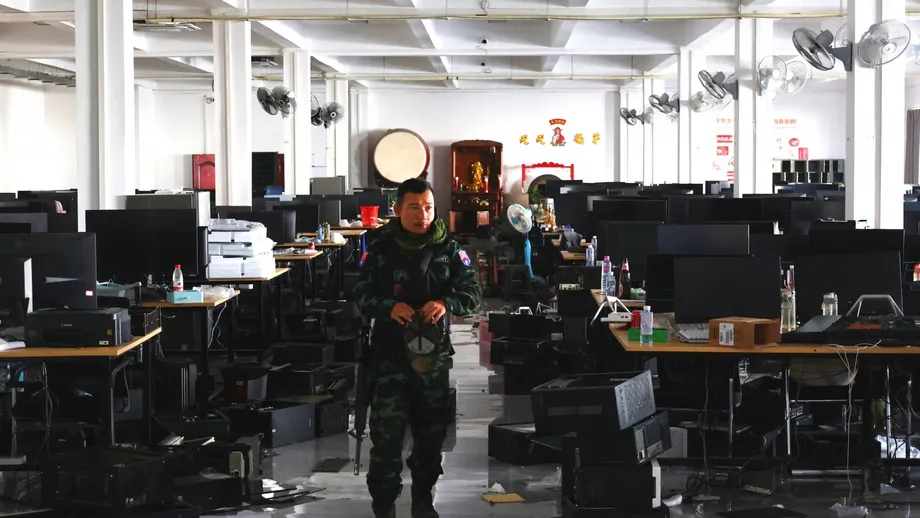
Myanmar's military announced on January 14, 2026 that it had captured three major methamphetamine laboratories in northern Shan State, presenting the operation as its largest drug enforcement success. Police linked the facilities to more than a third of the 37 tonnes of methamphetamine seized nationally in 2025. Yet the announcement did not identify the owners, leaving a central question unanswered: whether the operation would reach the people financing and directing production.
Contents
- Three laboratories seized, but ownership remains unresolved
- What the military's laboratory estimate actually measures
- Arrests do not establish who controls production
- A timeline of expanding supply
- More poppy fields, but lower yields
- Prices explain why farmers keep planting
- Eradication fell as cultivation expanded
- Regional seizures show a much larger meth market
- New routes extend the consequences beyond Myanmar
- What remains unproven after the seizure
- Key Points
The laboratories were described as lying south of Hsipaw, in the area between Hsipaw and Mongyai. Two facilities shown during a military organized press tour had their own roads, living quarters, power systems and water infrastructure. Their scale suggested established industrial operations rather than temporary workshops.
The military also reported six arrests and chemicals valued at about 1,620 billion kyat. Uniforms associated with the Shan State Progress Party and its armed wing, the Shan State Army North, were reportedly found. That discovery alone does not establish who owned the laboratories, who supplied their chemicals or who received their profits.
The announcement came weeks after the United Nations Office on Drugs and Crime published its Myanmar Opium Survey 2025. The survey estimated 53,100 hectares of poppy cultivation, a 17% increase from 2024 and the highest level since 2015. Taken together, the laboratory seizure and the cultivation figures expose two distinct parts of Myanmar's drug economy: synthetic drugs made in chemical facilities and opium grown by farmers. Neither can be measured adequately by arrest totals alone.
What the military's laboratory estimate actually measures
Military spokesman Zaw Min Tun described the January operation as an unprecedented enforcement achievement.
"This is the biggest seizure and destruction by an anti-drugs operation in our history," Zaw Min Tun said.
Police said their estimate of the laboratories' contribution rested on informant information and comparisons of tea and coffee bags used to conceal drugs. Their claim was that the facilities produced more than a third of the methamphetamine seized in Myanmar during 2025.
That is narrower than a claim that the laboratories supplied a third of Myanmar's total methamphetamine production. National seizures measure what authorities intercepted, not everything manufactured. Without an independently established production total, the facilities' share of the country's output cannot be calculated.
The military said it discovered the laboratories after regaining territory from armed opponents during a lull in fighting. Ceasefires brokered by China had separated two powerful armed groups from the broader opposition offensive that began in late 2023. The timing ties the discovery to shifting territorial control, although it does not establish how long the facilities operated or which authorities previously knew about them.
Arrests do not establish who controls production
The January seizure challenges the strongest version of the argument that authorities never find production sites. Large facilities were identified and publicly displayed. It does not, however, resolve the more substantial concern that enforcement often reaches couriers and workers without exposing the organizations behind them.
The area has been described as under the influence or control of the Shan State Progress Party, which has participated in peace discussions with the military. The military also maintains a peace arrangement with the United Wa State Army, another armed organization associated in reporting with synthetic drug production. Those relationships make responsibility and political protection legitimate subjects of scrutiny, but they are not proof of ownership of these particular laboratories.
A separate compilation of military seizure announcements gives a total exceeding 1,923 billion kyat across 128 operations, with about 300 people arrested, described largely as transporters rather than owners or producers. That compilation labels its period as the first nine months of 2026. It should not be treated as a contemporaneous measure of the January operation without clarification of its reporting dates.
There is also an earlier official acknowledgment that arrests had not stopped the trade. Soe Htut, then head of Myanmar's Central Committee for Drug Abuse Control, said in June 2023 that prosecutions were failing to reduce supply.
"Even though countless drug abusers, producers, traffickers and cartels were arrested and prosecuted, the production and trafficking of drugs have not declined at all," Soe Htut said.
A timeline of expanding supply
The January laboratory announcement follows several years of rising cultivation, growing regional seizures and falling synthetic drug prices. The sequence matters because a single operation cannot show whether the wider market is contracting.
- 2019: East and Southeast Asia seized about 140 tonnes of methamphetamine. Myanmar's fresh opium price was about $145 per kilogram.
- 2021 onward: Methamphetamine production and trafficking in Shan State rose sharply amid the crisis following the military takeover.
- June 2023: Soe Htut acknowledged that arrests and prosecutions had not reduced drug production or trafficking.
- 2024: Regional methamphetamine seizures reached a record 236 tonnes, while Myanmar's poppy cultivation was estimated at 45,200 hectares.
- December 3, 2025: UNODC announced that Myanmar's poppy cultivation had reached 53,100 hectares.
- January 14, 2026: The military announced the capture of three major methamphetamine laboratories in northern Shan State.
Earlier enforcement had often targeted smaller facilities. A UNODC assessment described the methamphetamine sites dismantled in Myanmar since 2020 as smaller tablet production operations in South Shan, insufficient to reflect the total supply originating from Shan's drug producing areas.
The newly announced laboratories therefore represent a different scale of target. Whether their destruction translates into less supply depends on matters the announcement did not settle, including replacement capacity elsewhere and the fate of their financial and chemical supply networks.
More poppy fields, but lower yields
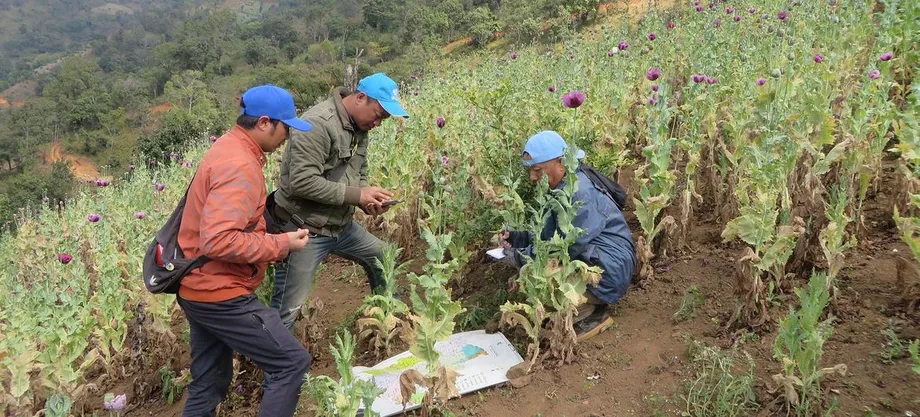
UNODC estimated that Myanmar's poppy area expanded from 45,200 hectares in 2024 to 53,100 hectares in 2025, an increase of 7,900 hectares. Shan State accounted for 46,700 hectares, or about 88% of the national total, and roughly 85% of estimated opium production.
South Shan alone contained 44% of the country's poppy fields and supplied 38% of its opium output. East Shan recorded a 32% increase in cultivation, while Chin State recorded a 26% increase. Northern Sagaing, fully included in the survey area for the first time, had an estimated 552 hectares under cultivation. That finding documents cultivation there; it does not mean every field was newly planted that year.
Expansion did not produce a comparable jump in output. Average dry opium yield fell from 22 kilograms per hectare to 19.2 kilograms, a decline of 13%. Estimated production increased from 995 to 1,010 metric tons, which UNODC describes as a 1% rise.
The 1,010 metric ton figure refers to potential dry opium production, not heroin production. Opium is harvested from poppies; heroin is manufactured from substances extracted from opium. Treating the two weights as interchangeable would greatly overstate heroin output.
Prices explain why farmers keep planting
UNODC's December survey announcement connects expanding cultivation to conflict, economic instability and rising prices. Fresh opium prices increased from $145 per kilogram in 2019 to $329 in 2025, a rise of approximately 127%.
Dry opium, a different product with less moisture, averaged about $365 per kilogram in 2025. Estimated farmer earnings from opium sales ranged from $300 million to $487 million. Fresh and dry prices should not be compared as though they describe identical quantities of the same product.
Delphine Schantz, UNODC Representative for Southeast Asia and the Pacific, described the pressures drawing farmers into cultivation.
"Driven by the intensifying conflict, the need to survive and the lure of rising prices, farmers are drawn to poppy cultivation," Schantz said.
Conflict also reduces productivity. Farmers can struggle to obtain fertilizer and other supplies or to tend fields safely. Yield declines were particularly evident in North Shan and Kachin, where armed clashes expanded. This helps explain why planted area rose sharply while estimated output changed little.
Schantz also warned that enforcement without viable income alternatives would leave the underlying dependence intact.
"Unless viable alternative livelihoods are created, the cycle of poverty and dependence on illicit cultivation will only deepen," she said.
Eradication fell as cultivation expanded
Myanmar's Central Committee for Drug Abuse Control reported destroying 1,917 hectares of poppy during the 2024 to 2025 growing season, down from 2,502 hectares in the previous season. That is a reduction of 585 hectares, or 23%, while estimated cultivation increased by 17%.
The reported eradication area was equivalent to about 3.6% of the estimated 53,100 hectares cultivated in 2025. The comparison illustrates the difference in scale, not a precise measure of how much of the crop authorities prevented from reaching harvest. UNODC did not independently verify the eradication figures, and operations were concentrated almost entirely in South Shan.
The committee also reported seizures of 1,005 kilograms of opium and 1,530 kilograms of heroin between January 1 and October 21, 2025. Those are partial year totals and involve separate products. They cannot simply be added together and compared with the dry opium production estimate.
After allowing for reported opiate seizures, UNODC estimated that 99 tons of raw opium and between 71 and 122 tons of heroin reached illicit markets inside Myanmar and abroad. These are modeled estimates, not directly observed shipments. Their distinction from the cultivation and production figures is essential to understanding the scale of the trade.
Regional seizures show a much larger meth market
East and Southeast Asia seized 236 tonnes of methamphetamine in 2024, up 24% from 190 tonnes in 2023. Compared with about 140 tonnes in 2019, the 2024 total was roughly 69% higher. Southeast Asia accounted for 85% of the regional total.
UNODC official Benedikt Hofmann cautioned against treating the seizure record as the full size of the market.
"The 236 tons represent only the amount seized," Hofmann said.
Thailand seized one billion methamphetamine tablets in 2024. Separate reported figures for 2025 put Myanmar's seizures at 337 million tablets and 37 tonnes of crystal methamphetamine, compared with more than one billion tablets and about 55 tonnes in Thailand.
On those reported 2025 figures, Thailand intercepted nearly three times as many tablets and about 1.5 times as much crystal methamphetamine as Myanmar. The comparison shows the scale of downstream interception, but it does not establish the percentage escaping enforcement in either country. Routes, policing intensity and reporting practices affect seizure totals.
The price evidence points in the same direction as the supply figures. Crystal methamphetamine wholesale prices in Cambodia, Thailand and Malaysia fell from roughly $10,000 to $12,000 per kilogram in 2019 to $4,000 to $7,000 in 2023. UNODC linked cheaper supply to expanded manufacturing and the use of chemicals outside existing controls. Methamphetamine tablets, often called yaba, commonly contain methamphetamine and caffeine; crystal methamphetamine is often called Ice.
New routes extend the consequences beyond Myanmar
Thailand remains a major transit and destination country, but trafficking routes are spreading. Cambodia reported nearly 10 tons of methamphetamine seized in 2024, its largest recorded total. UNODC identified rapid growth in the route connecting Shan State to Cambodia, primarily through Laos, and a growing corridor linking Malaysia, Indonesia and the Philippines.
Maritime trafficking also allows large consignments to move beyond land border checkpoints. In 2023, Thai authorities seized more than 900 kilograms of crystal methamphetamine from a trawler in the Gulf of Thailand and arrested six crew members. Shipments exceeding one tonne, sometimes containing ketamine alongside methamphetamine, were intercepted on or toward maritime routes during 2023 and early 2024.
Heroin routes may also be changing. European authorities reported seizures in 2024 and early 2025 involving airline passengers travelling from Thailand to Europe, with the heroin believed to originate in or around Myanmar. UNODC described these as emerging signs, largely individual cases, rather than proof of a fully established replacement supply network following Afghanistan's production collapse.
The health burden is visible in Singapore's enforcement figures. Authorities arrested 1,621 methamphetamine users in 2023, compared with 1,451 in 2022. Among 952 newly identified drug users in 2023, 599 had used methamphetamine. Arrest figures are not a population survey, but they show that the regional supply problem reaches beyond production sites and trafficking corridors.
What remains unproven after the seizure
The January operation demonstrated that large methamphetamine facilities could be located and destroyed. It did not publicly establish their ownership, the roles of the six arrested people, the source of their chemicals or whether the organizations behind them retained other production sites. No court timetable or further disclosure deadline was identified in the accounts of the announcement.
The opium findings provide a separate warning: rising prices and insecure livelihoods were expanding cultivation even as yields declined and reported eradication fell. Myanmar's estimated 1,010 metric tons of dry opium was more than twice Afghanistan's output, making Myanmar the world's leading known source of illicit opium.
For synthetic drugs, the strongest evidence of scale lies beyond any single raid: record regional seizures, cheaper wholesale prices and expanding land and maritime routes. Judging the January operation requires keeping three measures separate, drugs confiscated, production capacity removed and people responsible brought to account. The military has announced progress on the first two; the third remains unresolved.
Key Points
- Myanmar's military announced the capture of three major methamphetamine laboratories on January 14, 2026, but did not identify their owners.
- Police linked the facilities to more than a third of Myanmar's 2025 methamphetamine seizures, not a verified share of total national production.
- UNODC estimated 53,100 hectares of poppy cultivation in 2025, up 17%, with Shan State accounting for 88%.
- The estimated 1,010 metric tons of production refers to dry opium, not heroin.
- Reported poppy eradication fell 23% and was not independently verified by UNODC.
- Regional methamphetamine seizures reached 236 tonnes in 2024, while prices fell and trafficking routes expanded.