Two Days of Attacks Hit Villages and a Place of Refuge
Airstrikes on October 11 and 12 killed at least five civilians in Myanmar's Sagaing Region and struck a historic Buddhist monastery where displaced families and older worshippers had gathered. Reports differ on the toll: one account records five deaths and 23 injuries across Shwebo and Wetlet townships, while another puts the number killed at six, with about 21 injured.
Contents
- Two Days of Attacks Hit Villages and a Place of Refuge
- What Happened at the Monastery?
- Wetlet Villages Were Bombed Before Dawn
- A Timeline of the Reported Attacks
- Casualty Figures Differ, but the Civilian Toll Is Consistent
- Religious Sites Face Damage Across Myanmar
- Places of Worship Are Also Places of Shelter
- What Is Established and What Still Needs Investigation?
- Key Points
The attacks included three strikes on the Mahasi monastery compound in Seikkhun village, Shwebo Township, followed by bombing of four villages in neighboring Wetlet. Both accounts agree that two people died and eight were injured at the monastery. The disagreement concerns casualties in Wetlet, where residents said there was no fighting during the aerial attacks.
The two people killed at the monastery were identified in one account as Ma Hnin Thant Kyaw and Ma Win May, displaced women aged around 23. Children and people aged between about 40 and 75 were among those injured. Some civilians had taken shelter there after a military advance late the previous month; others were observing the Buddhist Sabbath.
The monastery was formerly presided over by Mahasi Sayadaw Sobhana, a renowned Buddhist monk whose teaching reached followers around the world. An anonymous Shwebo resident described the destruction of buildings commemorating him:
All the memorial buildings dedicated to the late Mahasi Sayadaw, who spread Buddhism around the world, have been destroyed, leaving nothing salvageable.
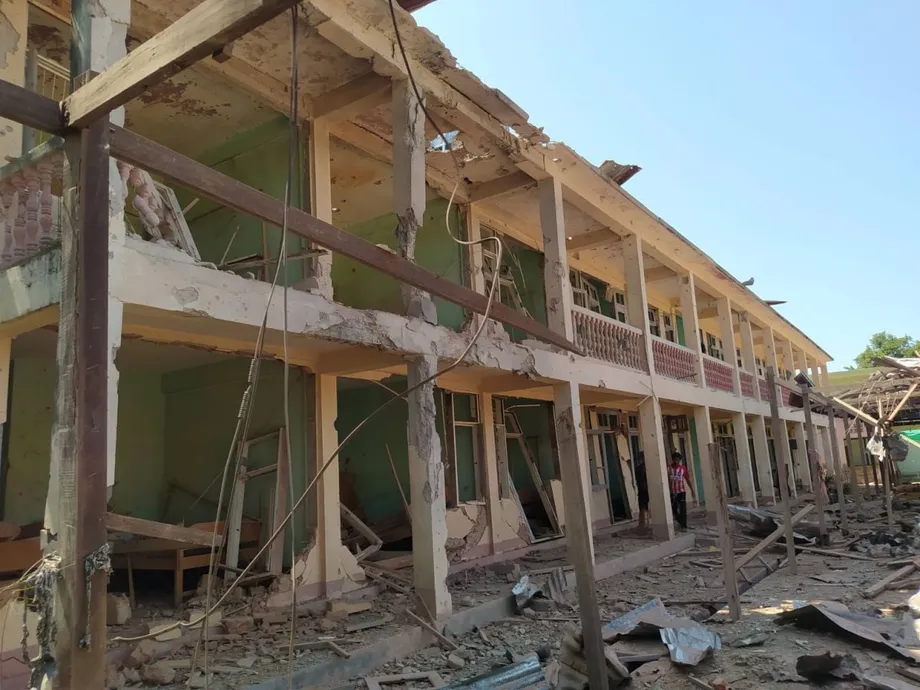
That account describes extensive destruction, while another report describes damage to numerous buildings within the compound. A complete assessment of the historic site's losses has not been established.
What Happened at the Monastery?
The monastery attack began after 11 a.m. on October 11, according to a Shwebo township resistance official. An aircraft bombed the compound three times. The site lies in Seikkhun village, on the western side of the Ayeyarwady River and beside the Shwebo to Monywa road.
A local People's Defence Force account said older civilians and people displaced from their homes were among the casualties. People's Defence Forces, commonly called PDFs, are resistance groups that emerged after the military takeover in February 2021. The attacks occurred in territory described as partly controlled by the National Unity Government, the opposition administration.
The presence of displaced families was linked to a military advance in Shwebo Township late the previous month. According to a township resistance official, the monastery had become a refuge for people escaping that operation. The same official said there was no battle at the monastery when it was struck and accused the military of deliberately attacking displaced civilians. That allegation has not been independently established.
Photographs released by local resistance groups were described as showing damage to religious halls, meditation accommodation, covered walkways and other monastery buildings. These details suggest losses across several parts of the compound, rather than damage confined to a single structure.
Seikkhun is a large village of more than 2,000 households. Residents said the military retained a foothold at its police station. That local military presence is relevant to the surrounding conflict, but it does not establish that the monastery itself was being used for military purposes.
Wetlet Villages Were Bombed Before Dawn
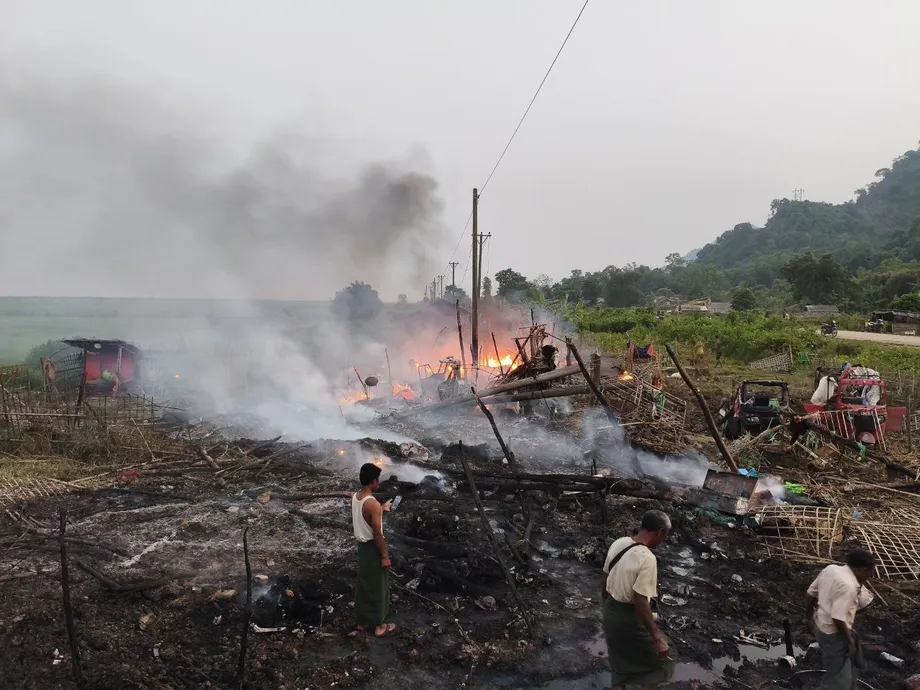
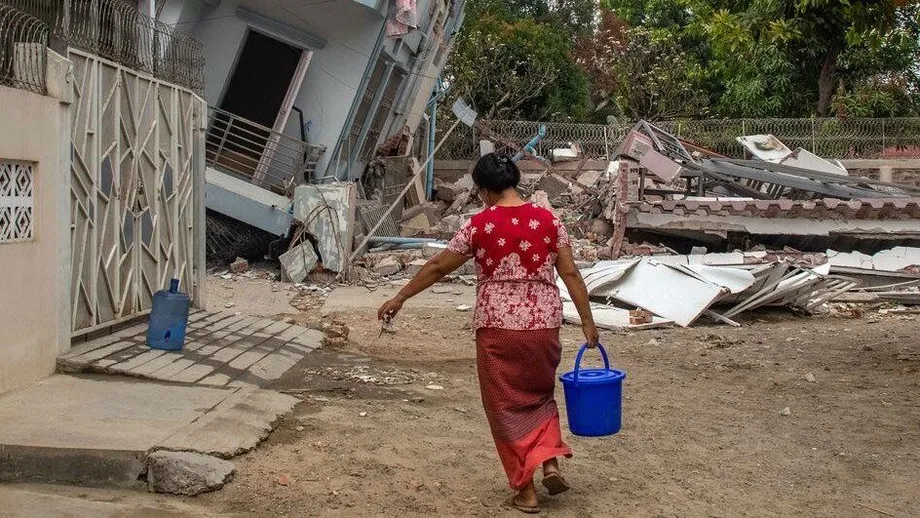
The following morning, attacks began around 3:30 a.m. in western Wetlet Township, according to one account. Residents identified the four villages as Mae Kone, also rendered as Megon, Ye Htut, Ooyan and Kyee Kan North. Wetlet is about 50 miles, or 80 kilometers, east of Sagaing's regional capital, Monywa.
One report attributes the bombing to a Y-12 transport aircraft. It records four deaths and about 13 injuries, with all four deaths in Mae Kone. The Wetlet Informational Network gave an injury breakdown of seven in Mae Kone, four in Ye Htut, and one each in Ooyan and Kyee Kan North.
A separate account records at least three deaths and 15 injuries across the four villages. An anonymous Megon resident said nine people there, including a child, had been injured. Those village figures differ from the network's account and should not be combined into a new total.
Reports also describe the scale of the attack differently. One records 30 strikes, while a resident quoted in another said 50 bombs were dropped directly on the four villages. A count of strikes and a count of individual bombs are not necessarily the same measure, so these figures cannot be treated as a confirmed contradiction or added together.
Residents said there was no fighting or military column in the villages during the bombing. One resident explained that casualties were still being counted because people had fled, making it difficult to locate everyone. That disruption helps explain why early figures may change, although it does not resolve the differences between the reported totals.
Resistance members urged residents to prepare shelters and follow aircraft warnings transmitted by radio. Local groups also reported tighter checks on movement between Shwebo and Wetlet, along with a military column stationed in Shwebo's Obo village since late the previous month. Those conditions could complicate escape and efforts to establish an accurate casualty count.
A Timeline of the Reported Attacks
The October strikes followed another deadly attack on a monastery in Sagaing in August. The sequence links separate incidents, without establishing that they formed part of a single operation.
- August 21: An airstrike on a Buddhist monastery in Swel Le Oh village, Myaung Township, killed 15 people.
- Late the month before the October attacks: A military advance in Shwebo Township prompted civilians to seek shelter at the Mahasi monastery.
- October 11, after 11 a.m.: Three reported strikes hit the monastery compound in Seikkhun, killing two people and injuring eight.
- October 12, from around 3:30 a.m.: Four villages in western Wetlet were bombed, with reports recording either three or four deaths and either 15 or about 13 injuries.
The year of the October attacks is not established consistently in the accounts, so the chronology should not be assigned one without further confirmation. The reported times nevertheless describe a clear sequence: daytime attacks on a refuge in Shwebo, followed by bombing of Wetlet villages before dawn.
Casualty Figures Differ, but the Civilian Toll Is Consistent
The two principal accounts agree on the monastery's immediate human toll: two deaths and eight injuries. One adds three deaths and 15 injuries in Wetlet, producing a combined total of five killed and 23 injured. The other adds four deaths and about 13 injuries, producing six killed and about 21 injured.
These are alternative accounts of the same attacks, not separate casualty groups. Adding them would count the same people more than once. The sound conclusion is that at least five civilians were reported killed across the two townships, with a second account recording a sixth death.
The damage assessment also requires care. The Shwebo resident's statement that all memorial buildings were destroyed is stronger than the description of numerous damaged buildings in the other account. Both indicate serious harm to the compound, but neither provides a complete inventory distinguishing destroyed structures from those that might be repaired.
There was no military response addressing these specific attacks in the reporting. Repeated calls to U Aung Zaw Oo, the military appointed Sagaing spokesperson and minister responsible for planning, economy and finance, went unanswered. The military has previously said it attacks only legitimate military targets and has accused resistance forces of terrorism. That general position does not answer the allegations concerning Seikkhun and Wetlet.
Religious Sites Face Damage Across Myanmar
The Sagaing attacks sit alongside documented damage to places of worship elsewhere in Myanmar. Myanmar Witness, a project of the Centre for Information Resilience, examined five claims of airstrikes causing major physical damage to churches in Chin State during 2023 and concluded that all five could be verified.
The project checks photographs, videos and witness accounts against satellite imagery and other evidence. Its findings support the occurrence of those five attacks and the resulting damage. They do not establish whether each church was deliberately selected as a target. The report said the Myanmar Air Force's overwhelming air superiority made government responsibility likely.
The Chin Human Rights Organization separately reported that at least 107 religious buildings had been destroyed in Chin State since the 2021 takeover, including 67 churches and five Buddhist monasteries. A 2023 International Commission of Jurists report, covering the period through April, counted 94 major Buddhist religious sites and 87 Christian sites destroyed or damaged nationwide.
The commission's two categories total 181 sites. That figure cannot be added to the Chin organization's 107: the counts cover different geographical areas, periods and damage definitions, and may include some of the same buildings. They nevertheless show that damage to religious sites extends beyond one faith or one region.
Matt Lawrence, the Myanmar Witness project director, described the purpose of collecting and verifying this evidence:
providing material to international mechanisms that can hold perpetrators of atrocities to account.
The distinction between verifying damage and proving intent matters. Images can establish that a building was hit, while responsibility, military use and the decision to attack may require further evidence.
Places of Worship Are Also Places of Shelter
The Mahasi monastery attack exposes the danger faced by civilians who turn to religious compounds for refuge. In Seikkhun, displaced families were reportedly sheltering alongside older people observing a religious day. The August 21 attack in Myaung also struck a monastery where a meditation retreat was taking place and killed older people among its 15 victims.
Salai Mang Hre Lian of the Chin Human Rights Organization said attacks were not confined to Christian buildings. He described a suspicion that can place Buddhist institutions at risk:
Buddhist monasteries suspected of providing shelter or assistance to resistance groups have also been attacked.
That statement describes a broader pattern alleged by the organization. It is not evidence that the Mahasi monastery was assisting fighters. Providing shelter to displaced civilians is distinct from using a site for military activity.
Benedict Rogers, a former East Asia team leader at Christian Solidarity Worldwide, argued that attacks on places of worship also strike at communities' identity. His assessment of church bombing was explicit:
Targeting them is part of a deliberate strategy.
That is an attributed assessment, rather than a finding about every incident. Myanmar Witness's church investigation did not determine whether the strikes it examined were deliberate.
What Is Established and What Still Needs Investigation?
Accounts from eastern Myanmar describe similar destruction. Dave Eubank, founder and director of the Free Burma Rangers humanitarian group, said many churches around Demoso in Karenni State had been destroyed or damaged. Describing buildings he had seen, he said:
I can think of 10 that I've already seen in ruins or big holes in them, direct airstrikes,
Eubank also described helicopter gunships firing rockets and heavy machine guns into the steeple of a large Demoso church in 2022. His account adds a separate location and form of attack to the documented church damage in Chin and the reported monastery strikes in Sagaing.
Under international humanitarian law, civilians and civilian buildings are protected from attack, and religious buildings receive special protection. A site's actual military use can affect its legal status, but the presence of displaced families does not by itself make it a military target. Even when attacking a military objective, forces must distinguish civilians from combatants and take precautions against civilian harm.
For the October incidents, the accounts do not establish a military objective at the monastery or in the four villages. Residents and resistance officials said there was no fighting at the time. A legal determination would require evidence about the targets, the circumstances of the strikes and what those ordering or conducting them knew.
The unresolved facts include the final casualty count, the full extent of damage to the Mahasi memorial buildings, the number of bombs dropped and the military's explanation. No date for an independent investigation or official findings has been announced in the reporting.
Key Points
- Airstrikes in Shwebo and Wetlet on October 11 and 12 killed at least five civilians; another account records six deaths.
- Both accounts report two deaths and eight injuries at the Mahasi monastery in Seikkhun.
- The monastery victims were identified as displaced women Ma Hnin Thant Kyaw and Ma Win May.
- Four Wetlet villages were bombed before dawn, with residents reporting no fighting during the attacks.
- Historic memorial buildings and other monastery structures suffered extensive reported damage, but a complete assessment is unavailable.
- Separate investigations and rights organizations have documented damage to Buddhist and Christian sites elsewhere in Myanmar.
- The final casualty totals, targeting decisions and military explanation remain unresolved.