
A Smaller Military Footprint, but No Decisive Defeat
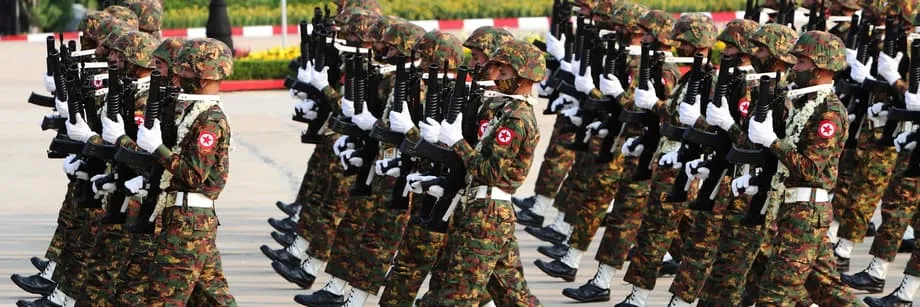
Myanmar's military controls an estimated 21 percent of the country's territory, while resistance forces and ethnic armies hold 42 percent. Yet by April 20, 2026, those battlefield gains have brought neither an end to military rule nor a unified alternative government. The army still holds most major cities, including Yangon, the economic hub, and Naypyidaw, the political capital.
Contents
- A Smaller Military Footprint, but No Decisive Defeat
- How the Coup Became a Nationwide War
- Operation 1027 Changed the Battlefield
- China Supports the Junta While Keeping Other Allies
- Border Trade Gives Beijing Pressure Points
- Drones and Conscription Help the Military Recover
- Civilians Face Displacement, Bombing and Blockades
- Elections Preserve Military Power Rather Than Resolve the War
- A Shared Enemy Has Not Produced a Shared Government
- Fragmentation Becomes a Lasting Risk
- Key Points
More than 90,000 people have been killed since the February 2021 coup, and the United Nations puts the number displaced at 3.6 million. Now in its sixth year, the conflict has become a strategic stalemate: the military cannot recover the whole country, while its opponents cannot deliver a decisive defeat or agree on how to govern together.
The military's struggle to recruit soldiers has produced a particularly cruel contradiction. The junta has repeatedly bombed its own troops while they were being held as prisoners of war. Preserving military power and its civilian front government has taken priority even over the lives of captured soldiers.
The State Administration Council (SAC) and the disparate forces fighting it retain different advantages. Resistance groups dominate large rural areas and border regions. The junta holds major urban centres and can use aircraft, artillery and growing numbers of drones to attack territory beyond its direct control.
Widely discredited elections held in stages through late 2025 have offered no political settlement. Instead, military adaptation, Chinese pressure and divisions among opposition forces have slowed the momentum that once appeared capable of overturning the junta.
How the Coup Became a Nationwide War
The armed forces seized power in February 2021 from the elected civilian government headed by Nobel laureate Aung San Suu Kyi. The army claimed irregularities in the 2020 elections without providing evidence.
Military leaders had expected competitive elections to serve as window dressing while their entrenched role in the state continued. They did not anticipate a genuine challenge to that position. The constitutional system reserved the military the power to remove civilian governments at will, leaving elected leaders operating beneath military authority.
The resistance that followed grew into a conflict involving the National Unity Government (NUG), its People's Defence Forces (PDFs), and ethnic armed organizations with their own territories and political goals. Their common opposition to the junta has not created a single chain of command.
Several dates explain how the war reached its present position:
- February 2021: The military overthrew the elected civilian government.
- Late October 2023: The Three Brotherhood Alliance launched Operation 1027 in Shan State, beginning a major series of military setbacks.
- February 2024: The junta implemented forced conscription to address shortages of soldiers.
- November 2024: An air strike on a village in Chin State killed 11 civilians, including eight children.
- Early 2025: China had brokered ceasefires and pressured the Myanmar National Democratic Alliance Army to return Lashio to junta control.
- August 2025: Chinese Foreign Minister Wang Yi stated China's opposition to chaos and war in Myanmar.
- Late 2025: Elections conducted in stages were widely condemned as neither free nor fair.
- April 20, 2026: Neither the military nor the divided resistance has secured a decisive victory.
Operation 1027 Changed the Battlefield
The Three Brotherhood Alliance brought together the Arakan Army, the Myanmar National Democratic Alliance Army (MNDAA), and the Ta'ang National Liberation Army (TNLA). Its coordinated offensive in late October 2023 captured substantial territory bordering China and seized more than 180 military outposts within weeks.
Operation 1027 became the most serious challenge to military rule since the coup. The alliance used advanced weapons, including drones acquired through foreign markets, and displayed a level of coordination that the military struggled to counter.
The offensive triggered attacks elsewhere in Myanmar. People's Defence Forces associated with the NUG and other ethnic armed organizations launched synchronized campaigns, temporarily moving the war's momentum toward the resistance.
The alliance's gains also exposed the limits of battlefield success without sustained support from a powerful neighbour. China initially gave tacit approval to the offensive because of frustration with cyber scam operations along the border that targeted Chinese nationals. Beijing later moved to restore a balance between the competing forces.
By early 2025, Chinese mediation and pressure had helped secure ceasefires and pushed the MNDAA to hand the strategic city of Lashio back to the junta. A city won through fighting became subject to negotiations shaped by China's priorities.
The military has since mounted limited recoveries, retaking Kyaukme, Hsipaw and Nawnghkio in northern Shan State. Aircraft supplied by China and Russia, sustained air strikes, new drone capabilities and waves of conscripted infantry have helped it regain ground. Those successes have given the junta enough strength to prevent collapse, even while much of the country remains beyond its control.
China Supports the Junta While Keeping Other Allies
China has become a central influence on the conflict, although its power over Myanmar's armed groups is neither complete nor exercised in just one direction. Beijing supports the junta while maintaining relationships with ethnic forces along its border.
Chinese Foreign Minister Wang Yi recently pledged $3 billion in assistance to the junta, including funds earmarked for a census and elections. Those activities were intended to give the military a route toward a political arrangement that would preserve its position.
President Xi Jinping has met junta leader Min Aung Hlaing. Chinese state media described the general as Myanmar's "acting president," upgrading his diplomatic treatment compared with earlier descriptions.
The United Wa State Army (UWSA), China's strongest ally among Myanmar's ethnic armed groups, receives Chinese weapons and passes them to various armed organizations, including forces fighting the junta. Beijing's relationships therefore reach into opposing camps.
China's approach seeks a buffer zone of influence along its border while preventing either a complete military collapse or a unified democratic victory. Supporting several partners gives Beijing ways to protect its interests as control of territory changes.
The same relationships have limits. Ethnic armed groups pursue their own goals, and Chinese support does not give Beijing automatic control over every decision they make.
Border Trade Gives Beijing Pressure Points
The Three Brotherhood Alliance captured border trade routes carrying more than $1.8 billion in commerce. China then cut electricity and internet services to pressure the armed groups into complying with its demands.
Beijing has also blocked exports of technology to opposition groups that could serve both civilian and military purposes. At the same time, it has supplied the junta with jet trainers, unmanned aerial vehicles and technical assistance for drone production.
Wang Yi, China's foreign minister, set out Beijing's concern in August 2025:
China opposes chaos and war in Myanmar,
He also described the policy in terms of preserving the state:
Beijing's policy is no state collapse.
China fears a collapse resembling Syria's on its southwestern border. Such an outcome could disrupt the China-Myanmar Economic Corridor and investments associated with the Belt and Road initiative.
Beijing views Myanmar's military as the only force capable of holding the country and its many ethnic communities together, despite its unease about the 2021 coup and the destruction that followed. That judgment helps explain why China has supported military recovery after initially tolerating resistance advances.
Drones and Conscription Help the Military Recover
Myanmar's war has become a technological contest in which both sides use drones extensively. The junta retains the stronger force of aircraft flown by pilots and heavy artillery, while resistance groups initially gained an advantage by adapting commercial drones for combat.
Resistance forces dropped 25,000 munitions from drones during Operation 1027 alone. These comparatively inexpensive machines allowed precise attacks and the use of several drones together against isolated military outposts.
The Myanmar Air Force has received FTC-2000G jet trainers from China and continues to operate aircraft supplied by Russia. By late 2024, it was conducting an average of nearly 300 air attacks a month.
The junta has responded to resistance drone tactics by creating dedicated drone units and importing kamikaze drones from China, Russia and Iran. These drones strike by crashing into their targets, giving the military another way to attack positions without sending a pilot overhead.
Forced conscription, implemented in February 2024, has brought approximately 60,000 to 80,000 recruits into military service. Many have received minimal training before deployment.
Three rebel fighters described seeing "human wave" tactics in central Myanmar: soldiers advancing in succession to overwhelm resistance positions, with replacements moving forward immediately after casualties. Some recruits advanced under threats from their own officers.
Maj. Naung Yoe, a military defector who researches the conflict, explained that the junta also changed its leadership after the shock of Operation 1027. Officers promoted through favouritism were replaced with more experienced commanders. Those changes, conscription and drone purchases have helped stabilize the military's position despite continuing territorial losses in outlying regions.
Civilians Face Displacement, Bombing and Blockades
The United Nations reports that 3.6 million people remain displaced, including more than 500,000 newly displaced since October 2023 alone. Families have been forced from their homes as fighting shifts and military attacks reach areas outside junta control.
Combat moving closer to major cities such as Mandalay has increased humanitarian needs to unprecedented levels. The UN response plan is the least well funded globally, receiving less than 30 percent of the financing required.
The junta has long restricted access for international aid organizations through legislation limiting how assistance can be delivered and who can receive it. After resistance groups take territory, the military often imposes blockades or carries out indiscriminate air strikes against schools, hospitals and camps for displaced people.
The November 2024 attack in Chin State killed 11 civilians, eight of them children. The toll captures the danger facing communities even when the immediate fighting is elsewhere.
Local aid organizations have supplied assistance where international nongovernmental organizations cannot operate effectively. They face severe shortages of resources and bureaucratic obstacles, including NUG requirements to obtain permission before entering areas under its control.
An international aid worker operating anonymously in Myanmar described the gap between the scale of need and the help reaching people:
We're trying to empty a pool with a spoon and the water keeps coming,
Thomas Kean, senior consultant on Myanmar for the International Crisis Group, warned that the new phase of fighting would have "a devastating impact" on civilians. He described the kinds of violence that desperate regimes could turn to:
booby traps and sinister stuff like that happening, retaliation, hit squads.
Elections Preserve Military Power Rather Than Resolve the War
The junta's elections, conducted in stages through late 2025, have been widely condemned as neither free nor fair. The National League for Democracy was forcibly dissolved, while Aung San Suu Kyi remains detained.
Removing the main civilian opposition and holding elections under military authority has made the process a way to legitimize continued military rule through civilian proxies. It has not resolved the conflict between the junta and the forces seeking to replace it.
Myanmar communities abroad have largely boycotted voting. In South Korea and Thailand, home to millions of Myanmar migrant workers, regime authorities reportedly required people applying to renew passports to complete voting forms. Authorities also telephoned people to urge them to participate.
Activists organized boycotts, and most migrants refused to take part in a process they regarded as a sham. The pressure applied to passport applicants extended the election campaign into communities living outside Myanmar.
A Shared Enemy Has Not Produced a Shared Government
The National Unity Government, formed by lawmakers removed from office, claims 85,000 fighters across various People's Defence Force formations. Yet it lacks command and control over the ethnic armed organizations holding the greatest amounts of territory and weaponry.
The Arakan Army and the United Wa State Army maintain distinct agendas. Their priorities often centre on securing local territory rather than completing a national democratic revolution.
Chinese ceasefire negotiations have further weakened trust between ethnic armed organizations and the wider PDF movement. The MNDAA agreed to return Lashio to the junta in exchange for recognition of its control over Kokang.
That agreement broke the collective bargaining principle established by the Three Brotherhood Alliance. It showed how an individual group could secure its own autonomous region through a deal that left other opponents of the military still fighting.
The Arakan Army controls most of Rakhine State and seeks a confederal arrangement rather than a federal one. In simple terms, its goal gives constituent regions greater independence than a federal system sharing power between regional authorities and a central government.
The Arakan Army's repressive policies toward the Rohingya risk provoking new insurgencies. The TNLA and MNDAA have also clashed with other ethnic groups over territory and resource extraction.
In central Myanmar, parts of the struggle that began around democratic demands increasingly resemble rule by local armed leaders. PDF units finance themselves through local taxation and criminal activities, adding another source of division to an already fragmented resistance.
Fragmentation Becomes a Lasting Risk
The International Institute for Strategic Studies describes Myanmar's conflict as a "war to nowhere." Prolonged violence is deepening divisions and narrowing routes to peace rather than bringing either camp steadily closer to national victory.
Three possible outcomes dominate strategic planning: continued prolonged violence; partial ceasefires that exclude some groups, stabilizing certain regions while fighting escalates elsewhere; or simultaneous ceasefires that include all sides. The third remains politically improbable because the armed movements are so divided.
Permanent fragmentation could leave Myanmar as a collection of autonomous territories dependent on neighbouring countries rather than a unified federal democracy. Local military control, separate political aims and negotiations conducted by individual groups are already pulling in that direction.
Changes abroad have strengthened these pressures. Donald Trump's return to the United States presidency in 2025 signalled diminished American interest in democratic norms overseas. Russia continues to provide the junta with diplomatic cover and military hardware.
The Association of Southeast Asian Nations (ASEAN) has failed to establish an effective unanimous position. The Philippines currently chairs discussions but lacks the influence needed to force concessions from Naypyidaw.
David Mathieson, an independent analyst following Myanmar affairs, described the regional body's position:
ASEAN cannot react with umbrage if China is making more 'progress' than the regional body; their regional efforts have been fruitless.
As of April 20, 2026, no route to a decisive military victory or an inclusive political settlement has been agreed. The junta has enough firepower and outside support to survive, while the resistance's territorial gains have not produced a government capable of uniting its competing forces.
Key Points
- The military controls an estimated 21 percent of Myanmar's territory, compared with 42 percent held by resistance forces and ethnic armies, but retains most major cities.
- More than 90,000 people have been killed since the February 2021 coup, and the UN reports 3.6 million displaced.
- Operation 1027 captured more than 180 military outposts within weeks, before Chinese pressure and military recoveries reversed some resistance gains.
- China pledged $3 billion in assistance to the junta while maintaining relationships with ethnic armed groups and pressing for ceasefires.
- Approximately 60,000 to 80,000 conscripts, expanded drone operations and changes in military leadership have helped the junta stabilize its position.
- Elections through late 2025 excluded the dissolved National League for Democracy while Aung San Suu Kyi remained detained.
- Divisions among armed organizations, inadequate aid and ineffective regional diplomacy are prolonging the war and increasing the risk of permanent fragmentation.