
Record Chip Profits Meet a Slowing Economic Foundation
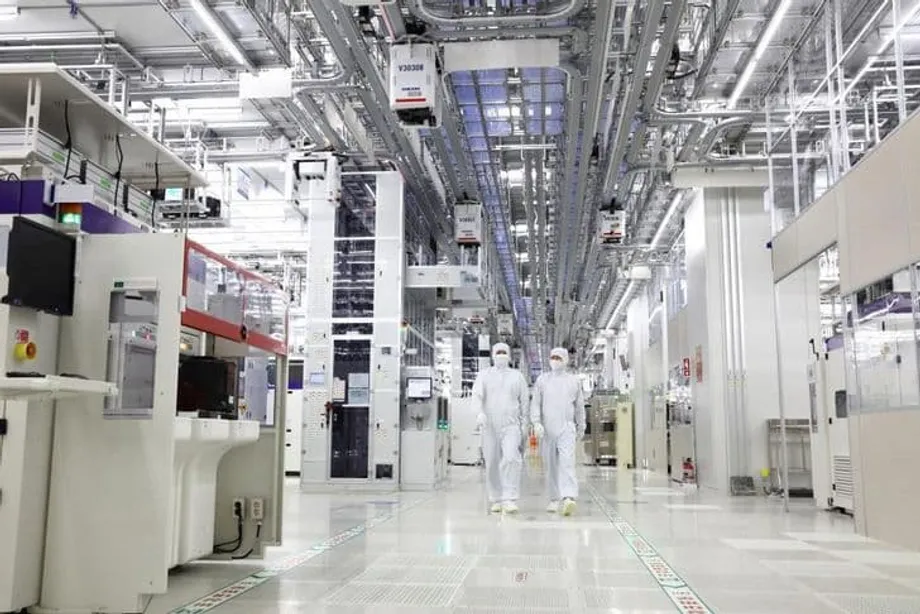
South Korea's economy expanded 1.7 percent in the first quarter of 2026 from the previous quarter and 3.6 percent from a year earlier, reversing a contraction in late 2025. Samsung Electronics and SK hynix posted record profits as demand linked to artificial intelligence lifted semiconductor sales, while the Kospi stock index climbed above 6,400 to unprecedented levels.
Contents
- Record Chip Profits Meet a Slowing Economic Foundation
- Why Potential Growth Keeps Falling
- Two Markets and a Narrow Range of Products
- Factories Caught Between Washington and Beijing
- Middle East Disruption Reaches Korean Manufacturing
- Emergency Oil Supplies Offer Partial Relief
- Ten Export Sectors Are Contracting
- Samsung Labor Disputes Add Another Risk
- Reform Plans Extend Beyond Short Term Stimulus
- Supply Diversification Has a 2030 Target
- The Essentials
Exports rose 5.1 percent, led by information technology products and memory chips bound for global data centers and smartphones. Manufacturing gross domestic product increased 3.9 percent. Those figures show how powerfully the semiconductor industry is driving the current recovery, even as much of the rest of the export economy struggles.
As of April 26, 2026, the central economic concern is the gap between this strong performance and South Korea's weakening capacity for sustained growth. The Organisation for Economic Co-operation and Development projects the country's potential growth rate at 1.71 percent in 2026, down from 1.92 percent in 2025, and expects another decline to 1.57 percent in 2027.
Samsung and SK hynix are benefiting from the global rush to build AI infrastructure. South Korea's stock market and corporate earnings reflect that demand. Yet the economy is becoming increasingly reliant on a single industry whose fortunes can shift with technology spending, geopolitical restrictions and changes in consumer demand.
Global conferences are celebrating South Korea's position in the AI era, but record market levels sit alongside mounting weaknesses in energy security, industrial diversity and productive capacity. The immediate expansion and the longer decline are happening together. Understanding both is essential to understanding why a semiconductor boom has not resolved the country's deeper economic problems.
Why Potential Growth Keeps Falling
The OECD's projections trace a long decline in South Korea's potential growth rate, from 3.63 percent in 2012 to 1.71 percent in 2026. By the fourth quarter of 2027, the quarterly rate is expected to reach 1.52 percent.
Potential growth measures how fast an economy can sustainably expand when its workers, capital and other resources are fully used, without generating inflation. Actual growth can rise sharply during a surge in demand. Potential growth concerns the economy's underlying ability to keep producing more over time.
South Korea's first quarter rebound therefore sits alongside a different, longer trend: the weakening of that underlying capacity. Strong orders for memory chips can lift production and exports now, while the broader economy continues to lose momentum in productivity and the use of its resources.
The United States provides a comparison. South Korea has trailed the world's largest economy in potential growth since 2023, when the gap was 0.03 percentage points. The difference is projected to widen to 0.38 percentage points by 2027. That growing distance points to South Korea losing ground even as investors push its stock market to record levels.
Two Markets and a Narrow Range of Products
The Bank of Korea has identified unusually high volatility in South Korea's semiconductor exports. Korean chip exports are 1.9 times more volatile than Taiwan's and 2.7 times more volatile than Japan's, largely because of dependence on China and the United States and concentration in smartphones and data center servers.
In 2022, China received 55 percent of South Korea's semiconductor exports, while another 7 percent went to the United States. More than 60 percent of Korean chips ultimately enter mobile devices and data center infrastructure. Those concentrations connect national export earnings closely to consumer electronics demand and spending on cloud computing.
China's economic slowdowns and decisions by US technology giants to reduce data center expansion can therefore cause disproportionately large falls in Korean exports. A narrow set of customers and uses makes the industry's swings harder for other sectors to absorb.
Yang Jun-seok, a professor of economics at the Catholic University of Korea, warned that the first quarter figures concealed weakness elsewhere in the economy:
The first-quarter growth was largely driven by semiconductors, masking weakness in other sectors. Amid concerns over an AI bubble, if the global demand for chips weakens, Korea's broader economy could face a significant shock.
Taiwan has a more balanced portfolio of chips other than memory chips for uses including electric vehicle batteries and appliances, while Japan has diversified its technological base. South Korea's concentration in memory chips for particular markets leaves it especially exposed to the current expansion of AI infrastructure.
Analysts have warned that the investment cycle may become difficult to sustain as AI moves from training models toward inference, the process of using a trained model to produce an answer or perform a task. South Korea's exposure depends heavily on how that transition changes demand for the chips it produces.
Factories Caught Between Washington and Beijing
The United States CHIPS and Science Act has imposed strict limits on technology investments in China. China's retaliatory measures against US chipmaker Micron Technology have added pressure on Korean manufacturers that operate in both markets.
Samsung Electronics and SK hynix together dominate global memory chip production, but both depend on major manufacturing facilities in China. SK hynix produces approximately half of its DRAM chips at its Wuxi plant. DRAM is memory used to hold information while a device is working. Samsung's Xian facility accounts for 40 percent of global NAND flash output. NAND flash stores information that remains available when power is switched off.
Those factories rely on technology originating in the United States that now requires waivers under export control rules. Their dependence on such permissions creates uncertainty over their long term viability, placing a large manufacturing base within the reach of decisions made outside South Korea.
China also supplies 47.5 percent of South Korea's rare earth inputs, materials needed for advanced semiconductor fabrication. Beijing's restrictions on gallium and germanium exports in 2023 demonstrated its willingness to use material supply chains as a policy tool. Gallium and germanium are another source of supply pressure alongside rare earth dependence.
Korean companies face competing demands: align with restrictions led by the United States on advanced technology transfers to China, while preserving access to their largest semiconductor export market. Their production facilities, customers and material suppliers connect them to both sides of that dispute.
Middle East Disruption Reaches Korean Manufacturing
South Korea imports 84 percent of its energy, and approximately 70 percent of its oil supplies pass through the Strait of Hormuz. Iran's ongoing blockade of that shipping chokepoint has forced Seoul to obtain emergency crude supplies while rising input costs threaten manufacturing competitiveness.
Semiconductor manufacturing requires large amounts of energy, so disruption reaches the same industry supporting the country's recovery. More expensive energy increases the cost of producing chips, while interruptions to essential supplies can put factory operations under pressure.
South Korea also depends on Israel for 97.5 percent of its bromine supplies. Bromine is a chemical used in chip production, making regional conflict a concern for materials as well as fuel. The concentration leaves manufacturers exposed to disruption in a second essential part of their production chain.
Japan diversified energy sources and built strategic reserves after the oil shocks of the 1970s. South Korea remains effectively an energy island with limited emergency options. Its dependence on imported fuel adds another external vulnerability to an economy already reliant on overseas semiconductor customers.
President Lee Jae Myung must balance stable energy supplies, industrial competitiveness and the public money needed for his progressive social agenda. Immediate fuel subsidies use funds intended for housing and welfare reforms. A transition toward renewable energy remains years away from providing relief.
Emergency Oil Supplies Offer Partial Relief
The government has secured 74.62 million barrels of crude oil for May and reduced dependence on Middle Eastern oil from 69 percent to 56 percent by increasing imports from the United States and Africa. That is a reduction of 13 percentage points in the regional share.
Naphtha and downstream product shortages remain a concern despite those crude purchases. Naphtha is a petroleum product used as an industrial feedstock, while downstream products are made through later stages of oil processing. Obtaining crude supplies and securing the products needed by factories are connected tasks, each requiring attention.
The coming May supplies address an immediate need. South Korea's wider challenge is to reduce exposure to disruptions while protecting industry and retaining the budget resources needed for domestic reforms. Energy costs link those goals directly: support for fuel users competes with other spending, while costly fuel puts pressure on manufacturers.
Ten Export Sectors Are Contracting
Ten of South Korea's 15 flagship export sectors are contracting even as semiconductor sales surge. Steel, petrochemicals, displays and secondary batteries are among the industries facing declines. The weakness across those sectors helps explain why the chip industry's success has become so central to national growth.
China's competition on price is eroding South Korea's position in machinery, steel and petrochemicals, industries that previously provided support when other parts of the economy weakened. With several established sectors under pressure at once, the country has fewer sources of export strength to balance a downturn in chips.
The industrial structure remains dominated by family controlled conglomerates known as chaebols. They concentrate resources in established sectors while crowding out innovative enterprises of medium size. That limits the economy's ability to adapt and develop a wider range of businesses capable of sustaining growth.
The Korea Institute for Industrial Economics and Trade projects export growth of 16.6 percent in 2026, slowing to 4.7 percent in 2027. The expected slowdown reflects stabilizing demand and base effects. A base effect occurs when the previous year's result changes how large the next year's percentage increase appears: growth becomes harder to match after an especially strong year.
Samsung Labor Disputes Add Another Risk
Samsung Electronics is South Korea's largest employer and a major engine of exports. Labor disputes at the company show how dependence on a single industrial giant can create another route for disruption to spread through the economy.
Prolonged strikes or interruptions to production could affect Samsung's output and quickly reach the wider economy. This adds a domestic source of uncertainty to the overseas demand, trade restrictions and energy pressures already facing the semiconductor industry.
Kim Dae-jong, a professor of business administration at Sejong University, argued that South Korea needs structural reform to address its dependence on chips:
An economy led almost entirely by semiconductors is not sustainable. Beyond external risks tied to the chip cycle, ongoing labor disputes at Samsung Electronics could weigh on the company's output and deal a blow to the broader economy.
Samsung's importance brings the broader concentration problem into focus. A company large enough to lift national export earnings can also transmit a production setback across the economy. Diversification concerns both the range of products South Korea sells and the range of companies supporting its growth.
Reform Plans Extend Beyond Short Term Stimulus
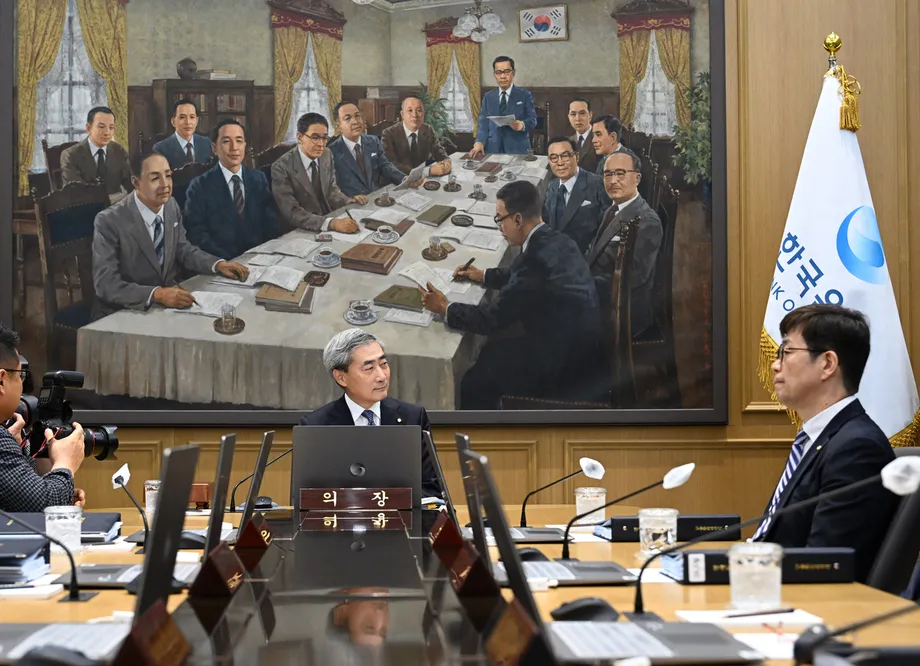
The Lee administration has identified six priority areas for reform: regulation, finance, public services, pensions, education and labor. Finance Minister Koo Yoon-cheol and Bank of Korea Governor Shin Hyun-song have pledged coordinated policy efforts to improve growth potential through structural changes rather than short term stimulus.
Shin said during his inauguration that the central bank should take a more active role in advancing reforms to address slowing growth. The policy focus is on improving the economy's capacity to produce and adapt, alongside managing the immediate expansion.
Progress remains tentative. Parliament has approved measures to eliminate treasury shares that cement chaebol control. Treasury shares are shares a company holds in itself. The measures address part of the corporate control structure, while the administration's broader reform agenda spans several areas of economic life.
South Korea has also continued to seek developed market status from MSCI without securing the upgrade. Index providers cite insufficient currency convertibility and market transparency. Currency convertibility concerns the ability to exchange money freely, while transparency concerns access to clear information about markets and their operation.
Those obstacles limit the global capital inflows that could help finance diversification. The government's reform agenda therefore connects domestic business structures with the conditions international investors face when putting money into Korean markets.
Supply Diversification Has a 2030 Target
The government aims to reduce reliance on Chinese industrial materials from 70 percent to 50 percent by 2030. It has pledged more than 55 trillion won to support domestic production and alternative supply chains. The target represents a reduction of 20 percentage points.
Participation in the Chip 4 alliance with the United States, Japan and Taiwan offers a route toward collective supply security. Seoul has maintained a cautious posture compared with Tokyo's enthusiastic embrace of the initiative, reflecting the pressures surrounding its position between major markets.
The administration is also exploring joint procurement with Japan and Singapore to secure essential raw materials. Buying together would form part of the effort to widen supply options, alongside domestic production and alternative suppliers.
South Korea's immediate position combines strong semiconductor earnings with weaker growth capacity, contracting export industries and concentrated dependence on overseas markets, energy and materials. May's emergency crude supplies and the 2030 materials target mark different stages of the response. The task is to preserve the gains from chips while building more dependable sources of growth across the economy.
The Essentials
- South Korea's GDP grew 1.7 percent from the previous quarter and 3.6 percent from a year earlier in the first quarter of 2026.
- The OECD projects potential growth falling from 1.92 percent in 2025 to 1.71 percent in 2026 and 1.57 percent in 2027.
- China received 55 percent of Korean semiconductor exports in 2022; more than 60 percent of Korean chips ultimately enter mobile devices and data centers.
- US technology restrictions and tensions with China threaten manufacturers with major production facilities in China.
- South Korea imports 84 percent of its energy and has secured 74.62 million barrels of crude oil for May amid Middle East disruption.
- Ten of 15 flagship export sectors are contracting, while export growth is projected to slow from 16.6 percent in 2026 to 4.7 percent in 2027.
- The government is pursuing six areas of structural reform and aims to reduce reliance on Chinese industrial materials to 50 percent by 2030.