A July deadline for a world first
Indonesia is preparing to introduce the world's first commercial B50 biodiesel program on July 1, 2026, raising the palm oil biodiesel content of its diesel fuel from 40% to 50%. The government expects the move to reduce fossil diesel consumption by about 4 million kiloliters a year and generate Rp 48 trillion ($2.8 billion) in savings during the first six months of implementation.
Contents
- A July deadline for a world first
- Why the government changed course
- Testing moves from roads to railways
- The dates shaping the transition
- Can biodiesel plants supply enough fuel?
- Filters, maintenance and methanol costs
- More palm oil for fuel, less available for export
- Markets respond to the stronger demand outlook
- Ethanol, aviation fuel and solar are also on the agenda
- Quick Facts
The planned mandate would require an equal mixture of biodiesel made from palm oil and conventional petroleum diesel. No other country has attempted this blending ratio in commercial distribution, leaving Indonesia to develop technical solutions without an international example to follow.
President Prabowo Subianto confirmed the July 1 implementation date during a business forum in Tokyo on March 30. He described the increase as part of a broader commitment to fuels produced from domestic agricultural resources.
We are going in a big way to biofuel. We will produce this year diesel oil from palm oil and now we are increasing from 40% to 50%.
The announcement reversed the government's position in January 2026, when authorities had shelved B50 for the year because of technical limitations and funding constraints. At that point, Indonesia intended to retain B40, its existing blend containing 40% biodiesel.
The change brings together two urgent priorities: reducing exposure to imported oil and making greater use of Indonesia's position as the world's largest palm oil producer. Coordinating Minister for Economic Affairs Airlangga Hartarto has said state energy company Pertamina is ready to carry out the blending requirements. Production capacity, equipment performance and the timing of adoption across different users remain central to delivering the program.
Why the government changed course
The US Israeli war on Iran disrupted energy supplies and pushed crude oil prices above $100 a barrel, placing pressure on Indonesia's economy and its energy subsidy budget. Higher international prices increase the cost of importing fuel and the amount the government must spend to keep subsidized energy affordable.
Finance Minister Purbaya Yudhi Sadewa estimated in early April that the effects of the Iran war could require up to Rp 100 trillion ($5.9 billion) in additional energy subsidies during 2026. The B50 push is intended to reduce part of that exposure by replacing more petroleum diesel with fuel produced domestically.
Indonesia imports approximately one million barrels of crude oil each day. Its annual bill for imports of crude oil, refined fuels and liquefied petroleum gas is roughly Rp 500 trillion, or about $30 billion. Biodiesel addresses the diesel portion of that dependence, while the government's broader energy plans cover other fuels and electricity.
Agriculture Minister Andi Amran Sulaiman has announced that imports of subsidized diesel of a lower grade, known locally as Solar, will stop completely from July 1. That date matches the planned B50 launch and makes the fuel switch a central part of the government's drive for energy independence.
The figure given for projected diesel imports in 2025 was 4.9 million kiloliters, representing about 10.6% of national demand. The anticipated annual reduction of 4 million kiloliters in fossil diesel use under B50 is equivalent to roughly 82% of that import volume. The two figures show the scale of the planned substitution alongside the government's separate commitment to end Solar imports.
Testing moves from roads to railways
Eniya Listiyani Dewi, director general of renewable energy at the Ministry of Energy and Mineral Resources, says Indonesia began developing its biodiesel blending programs approximately 15 years ago. She described B40 as operating successfully without major technical issues and B50 as the result of years of research and development.
Eniya said the higher blend requires Indonesia to work without technical references from countries that have already introduced a comparable commercial program.
There are no technical references we can access. We are moving forward without an example to follow, and that is something we are proud of,
Multiple countries have approached Indonesia to learn from its experience, according to Eniya. She declined to identify them.
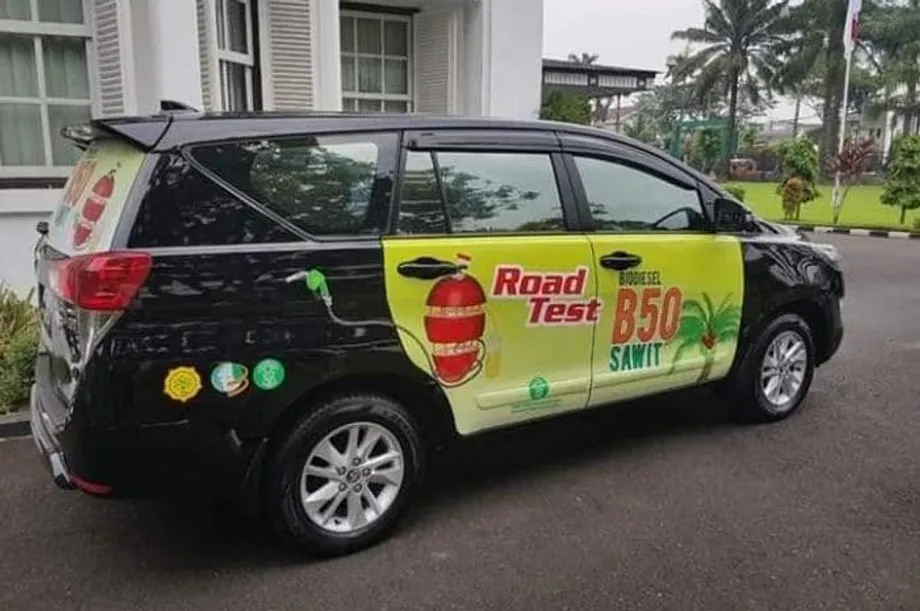
Trials launched on December 9, 2025, cover automotive vehicles, mining equipment, agricultural machinery, shipping applications and stationary generators. Testing across these uses matters because diesel engines operate under different loads and conditions, from continuous electricity generation to demanding industrial work.
Railway trials began in late March after being delayed to avoid disrupting the annual Eid al-Fitr travel surge, when millions of Indonesians return to their home regions. The railway program starts with diesel generators serving the Yogyakarta-Jakarta route, which are due to complete 2,400 operating hours of testing.
Locomotive trials on the Surabaya-Jakarta corridor are scheduled to follow and run for six months. The final phase of railway testing is expected to finish in October 2026, after the announced July launch date.
Heru Kuswanto, infrastructure management director at state railway operator PT Kereta Api Indonesia (KAI), confirmed the company's full support. He said trials take place under actual operating conditions to produce performance data relevant to everyday railway operations, with safety and reliability as the priorities.
The most important priorities are safety, security, and continuous technical evaluation to maintain the reliability of railway assets. We hope the program runs smoothly and delivers optimal benefits for the railway industry while supporting the national energy transition and sustainable, environmentally friendly transportation.
The dates shaping the transition
Indonesia's B50 preparations span testing, a policy reversal, fuel purchase restrictions and a proposed launch within less than a year. Railway testing continues beyond July, while the government's broader adoption schedule extends to 2028.
The main dates show how quickly the program has moved from technical preparation to a response to international energy disruption:
- December 9, 2025: Trials begin for automotive vehicles, mining equipment, agricultural machinery, shipping applications and stationary generators.
- January 2026: Authorities shelve B50 for the year because of technical limitations and funding constraints, choosing to maintain B40.
- Late March 2026: Railway testing begins after the Eid al-Fitr passenger surge.
- March 30, 2026: Prabowo confirms July 1 implementation during a business forum in Tokyo.
- April 1, 2026: A daily purchase limit of 50 liters of subsidized fuel per vehicle begins, with exemptions for public transportation operators.
- July 1, 2026: The B50 program is scheduled to launch, alongside the announced end of Solar imports.
- October 2026: The final phase of railway testing is expected to conclude.
- 2027: The broader strategy calls for subsidized diesel to transition to B50.
- 2028: All diesel users are required to adopt B50, with non-subsidized diesel following depending on production capacity.
The July announcement and the later adoption targets leave the precise scope of the initial rollout unresolved as of April 30. The government's stated timetable combines an accelerated launch with a staggered transition intended to match infrastructure readiness and supply availability.
Can biodiesel plants supply enough fuel?
Indonesia's B50 mandate would raise annual biodiesel demand to approximately 19 million kiloliters. Installed production capacity stands at about 19.6 million kiloliters a year, leaving little room for maintenance or interruptions if the entire requirement must be supplied.
Plants typically operate at only 85% of installed capacity because of routine maintenance downtime. At that rate, capacity of 19.6 million kiloliters would yield about 16.66 million kiloliters annually, roughly 2.34 million below the estimated B50 requirement.
Unggul Priyanto, a member of the National Energy Council's Technology Stakeholder Committee, says capacity needs to reach 24 million kiloliters to meet B50 demand while allowing for maintenance. That would require an increase of 4.4 million kiloliters, or about 22%, over existing installed capacity.
The 2026 biodiesel quota is 15.646 million kiloliters, compared with 15.62 million in 2025. The increase of 26,000 kiloliters is small beside the additional annual demand anticipated under B50, making production and allocation decisions a major part of implementation.
Some industry observers have suggested B45, a blend containing 45% biodiesel, as an intermediate step. A trader based in Singapore said current production capabilities could not meet full B50 demand and suggested that B45 might be necessary during the transition. No decision to adopt that intermediate blend has been given.
Filters, maintenance and methanol costs
Vehicles and machinery using B50 may need additional filters and slightly higher fuel volumes than they require with lower biodiesel blends. Previous transitions brought complaints about clogged filters and higher maintenance costs, particularly in mining, where equipment uses large quantities of fuel.
The Indonesian Mining Association has urged the government to evaluate B40 thoroughly before increasing the biodiesel share again. Its concerns focus on the cost pressures facing extraction operations that depend heavily on diesel machinery.
Eniya's assessment that B40 has operated without major technical issues sits alongside those complaints from users. The ongoing trials are intended to assess performance and reliability across the different types of equipment expected to use the higher blend.
Methanol is another source of pressure. It is a key ingredient in transesterification, the process used to turn palm oil into biodiesel. Its price has risen because of the Middle East conflict, increasing costs for biodiesel producers even as the government asks them to supply more fuel.
Hoe Lee Leng, an analyst at RHB Investment Bank, suggested that the government may need to adjust biodiesel pricing formulas to give producers an incentive to increase supply as input costs rise. Without adjustments, producers could struggle to maintain their margins while meeting higher demand.
The daily limit of 50 liters of subsidized fuel per vehicle, introduced on April 1, is another measure supporting the transition. Public transportation operators are exempt. The restriction is intended to prevent hoarding and preserve adequate supply while the blending program changes.
More palm oil for fuel, less available for export
B50 would require between 17 million and 18 million metric tons of crude palm oil feedstock to supply the estimated 19 million kiloliters of annual biodiesel demand. Feedstock is the raw material processed into fuel.
Indonesia's palm oil association, Gapki, projected that biodiesel production would use about 15 million metric tons of palm oil in 2026 under B40, an increase of 2 million tons from the previous year. Moving to B50 would require another 2 million to 3 million tons compared with that B40 projection, an increase of roughly 13% to 20%.
Palm oil supports more than 16 million jobs directly and indirectly across cultivation, processing and distribution. Using more of it domestically for fuel would connect the energy independence strategy to a major source of agricultural employment.
Indonesia is also the world's largest palm oil exporter. Directing additional supplies into biodiesel could reduce the amount available overseas, tightening global vegetable oil supply and creating price pressure for major buyers including India and China. Malaysia could benefit as an alternative supplier.
Europe recently granted Indonesia a quota for up to one million tons of crude palm oil imports free of duty. A reduction in export availability would therefore matter to European buyers as well as to Asian markets.
Markets respond to the stronger demand outlook
Benchmark palm oil futures in Kuala Lumpur rose by as much as 1.9% after the B50 announcement, reaching their highest levels since 2024. The market reaction reflected expectations that Indonesia would retain more palm oil for domestic fuel production.
CIMB Securities raised its forecast for the average palm oil price in 2026 to 4,400 ringgit ($1,091) per ton from 4,000 ringgit. The revision represents a 10% increase and was based on the expected structural rise in demand.
Ivy Ng, head of Malaysia research and agribusiness at CIMB Securities, linked the renewed B50 push to energy supply concerns arising from the US Israeli war with Iran, high crude oil prices and Indonesia's effort to strengthen energy security. She also pointed to gasoil trading at a premium to palm oil. Gasoil is a petroleum fuel associated with the diesel market; that price relationship makes the palm oil alternative more attractive.
The international interest described by Eniya comes as other countries also expand biofuel use. Thailand recently announced plans to raise its biofuel blend to 7%, while the United States introduced expanded blending rules requiring record biofuel volumes in conventional diesel and gasoline.
Australia has invested approximately Rp 12 trillion ($725 million) in expanding canola and similar crops as alternatives to palm oil for bioenergy. That investment adds competition among vegetable oils used for renewable fuels, even as Indonesia seeks to make greater use of its own palm oil supplies.
Ethanol, aviation fuel and solar are also on the agenda
The B50 mandate forms part of a wider energy strategy reaching beyond road vehicles and railways. The staggered diesel targets call for subsidized fuel to move to B50 by 2027 and non-subsidized fuel to follow in 2028, depending on production capacity, with all diesel users covered by 2028.
Indonesia also plans to introduce ethanol into gasoline, beginning with a minimum blend of 5% in Java between 2026 and 2027 and increasing to 10% by 2028. Java is the country's largest fuel consumption market, making it the starting point for the planned gasoline transition.
The ethanol would come from domestic cassava, sugarcane and maize. While B50 replaces part of petroleum diesel with palm biodiesel, the ethanol plan would replace part of gasoline with a fuel derived from those crops.
A sustainable aviation fuel mandate is scheduled to begin in 2027. Flights departing from Jakarta's Soekarno-Hatta International Airport and Bali's I Gusti Ngurah Rai International Airport would have to use fuel containing at least 1% sustainable aviation fuel. The plan places Indonesia among a small group of emerging economies pursuing commercial biofuel mandates across several sectors.
Prabowo has also set a target of expanding solar power capacity to 100 gigawatts within the next three years. Together, the fuel and electricity plans aim to use domestic renewable resources, reduce dependence on imported fossil fuels and support rural agricultural economies.
The immediate focus is July 1. Pertamina's stated readiness and years of biodiesel development support the accelerated timetable, while plant capacity, raw material costs, equipment testing and the later deadlines for full adoption shape how far the initial launch can reach.
Quick Facts
- Indonesia plans to launch the world's first commercial B50 program on July 1, 2026, mixing 50% palm oil biodiesel with 50% petroleum diesel.
- The government reversed a January decision to retain B40 after the Iran war disrupted energy supplies and pushed crude oil above $100 a barrel.
- B50 is expected to reduce fossil diesel use by about 4 million kiloliters annually and save Rp 48 trillion ($2.8 billion) in its first six months.
- Solar imports are due to stop on July 1, while the broader B50 adoption schedule extends through 2028.
- Railway trials are expected to finish in October 2026. Other tests cover vehicles, mining, agriculture, shipping and generators.
- Estimated annual B50 demand of 19 million kiloliters puts pressure on installed capacity of 19.6 million kiloliters, with plants typically operating at 85%.
- B50 would require 17 million to 18 million metric tons of palm oil, potentially reducing exports and increasing prices for overseas buyers.
- B45 has been suggested as a possible intermediate blend, but no decision to use it has been given.
- Indonesia also plans ethanol blending in gasoline, a sustainable aviation fuel requirement from 2027 and a solar capacity target of 100 gigawatts within three years.