A Nation Confronts Its Pacifist Legacy
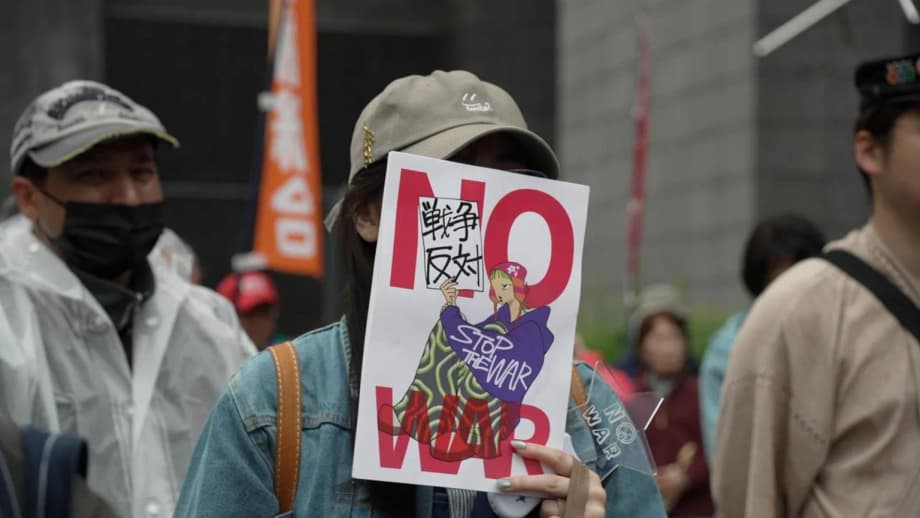
In the pouring rain on a Tokyo street corner, a swelling crowd gathered with drenched placards and sodden flags. One sign bore just two words in bold Japanese kanji characters: “No War”. This scene, repeated across major cities from Osaka to Fukuoka, marks a pivotal moment for Japan. An estimated 50,000 people converged on Tokyo’s Rinkai Disaster Prevention Park on Constitution Memorial Day, creating the largest anti-war demonstrations the country has witnessed in decades.
The protests represent a direct response to Prime Minister Sanae Takaichi’s aggressive push to dismantle long-standing pacifist constraints. Since assuming office in October 2025, Takaichi has moved rapidly to expand Japan’s military capabilities, most notably lifting the decades-old ban on exporting lethal weapons on April 21. For a nation where public demonstrations are typically restrained due to strong cultural emphasis on social harmony, the scale and intensity of these gatherings signal profound anxiety about the country’s future.
Public protests in Japan tend to be relatively muted affairs. When citizens take to the streets in large numbers, it usually indicates something deeper than routine political disagreement. This time, the core issue is nothing less than Japan’s national identity and the future of Article 9 of its constitution, the so-called “pacifist clause” that has defined the country’s post-war character for nearly 80 years.
The Sound of a New Generation
Perhaps most striking about the current wave of demonstrations is who is showing up. While older generations who remember World War II have traditionally led peace activism, the crowds now include significant numbers of people in their twenties and thirties. These younger protesters are bringing an unexpected cultural fusion to the movement, adopting tactics from South Korea’s vibrant protest tradition.
At rallies held on April 8 and April 19 in front of Japan’s National Diet Building, K-pop music played continuously, creating a concert-like atmosphere. Protesters waved light sticks (penlights) while chanting slogans such as “Protect the Constitution” and “Quit, quit, (Sanae) Takaichi government” to the beat of songs like KARA’s “Mister” and aespa’s “Whiplash.” On April 26, Osaka Station echoed with the Korean lyrics of Girls’ Generation’s “Into the New World,” a song that became symbolic of youth protests in Korea after the 2016 Ewha Womans University campus occupation.
Social media platforms like X have played a crucial role in mobilization, with posts encouraging participants to bring light sticks to signal that anyone can join casually, as if supporting their favorite idols. A self-employed man in his 30s who attended an April 8 rally near the National Diet Building observed, “In Japan, there’s usually a high barrier to participation for people in their 20s and 30s, but many came out voluntarily with light sticks.” A woman in her 20s told the Asahi Shimbun that the presence of participants drawing or knitting made it easier for others to join without pressure.
The banners at these protests reflect playful inclusivity inspired by Korean civic movements. Fictional group names such as “Union of People Who Just Add to the Crowd,” “Alliance of People Who Struggle in Crowds,” and “Association of Low-Stamina People Against War” demonstrate how ordinary citizens can lend their presence to social causes without formal organizational affiliation.
Takaichi’s Security Revolution
The demonstrations directly challenge Prime Minister Takaichi’s sweeping security agenda. On April 21, her government announced the lifting of long-standing restrictions on arms exports, a decision that clears the way for Japan to sell lethal weapons to the 17 countries with which it maintains defense agreements, including the United States and the United Kingdom. Previously, exports had been limited to five non-combat categories: search and rescue, transportation, warning, surveillance, and minesweeping.
Chief Cabinet Secretary Minoru Kihara defended the move as necessary to “safeguard Japan’s security and further contribute to the peace and stability of the region.” Takaichi herself wrote on X that “in an increasingly severe security environment, no single country can now protect its own peace and security alone.” She emphasized that there would be “absolutely no change in our commitment to upholding the path and fundamental principles we have followed as a peace-loving nation for over 80 years since the war.”
However, critics view these assurances with deep skepticism. The new rules permit the export of finished lethal weapons (warships, missiles, and other arms) subject to screening, with recipients required to pledge use consistent with the United Nations Charter. The ban on sales to countries involved in active conflict remains technically in place, though authorities note exceptions may be allowed “in special circumstances.”
Beyond arms exports, Takaichi has made constitutional revision a central priority. During an official visit to Vietnam, she called for “advanced discussions” on revising the 1947 constitution, arguing that it “should periodically be updated to reflect the demands of the times.” The specific target is Article 9, which renounces war as a sovereign right and prohibits the maintenance of armed forces.
The Ghost of Article 9
Japan’s constitution, drafted under the supervision of General Douglas MacArthur’s occupation forces following World War II, has remained unamended since taking effect on May 3, 1947. Article 9’s two paragraphs forever renounce “war as a sovereign right of the nation and the threat or use of force as means of settling international disputes,” and declare that “land, sea, and air forces, as well as other war potential, will never be maintained. The right of belligerency of the state will not be recognised.”
Despite this language, Japan has developed substantial Self-Defense Forces (SDF) through creative constitutional interpretation. The current debate centers on formally legitimizing these forces through amendment. Takaichi’s Liberal Democratic Party has long sought changes to remove perceived contradictions between the constitution’s text and military reality. Any revision requires a two-thirds majority in both houses of the Diet plus a simple majority in a national referendum.
For many Japanese, particularly hibakusha (atomic bomb survivors) and their descendants, Article 9 represents more than legal text. It embodies a moral commitment forged in the fires of Hiroshima and Nagasaki, where approximately 200,000 people died by the end of 1945. At the 2026 review conference of the Nuclear Non-Proliferation Treaty, hibakusha Jiro Hamasumi declared, “Nuclear weapons were used because we went to war. No more war, no more hibakusha.”
Protesters at the May 3 rally expressed similar sentiments. An 87-year-old participant in Osaka told the Kyodo news agency, “I want to cherish the constitution like I do my own child, and pass it on to the next generation.” Meanwhile, 30-year-old Akari Maezono held brightly painted paper lanterns calling for peace, stating, “I’m angry that these changes could be made without properly listening to us, the public.” An older gentleman stood nearby with a bright red banner declaring, “The Japanese constitution, Article 9 in particular, must be protected at all costs. It kept Japan from being drawn into past conflicts like the US-Iran war.”
“Under Takaichi, Japan is following America like a dog follows its owner. The LDP wants to turn the self-defence forces into a traditional military, because they know the constitution, as it is, prevents them from doing that.”
This sentiment was voiced by Hiroko Maekawa, a Tokyo ward councillor, capturing the fear that constitutional revision would transform Japan from a defensive power into an active military participant in global conflicts.
Geopolitical Pressures and Regional Tensions
Takaichi’s supporters argue that Japan’s security environment has fundamentally changed. Geographically, Japan faces an assertive China, an unpredictable North Korea, and an aggressive Russia. The United States, Tokyo’s closest ally, has persistently encouraged Japan to play a more active security role. In March 2026, when President Donald Trump reportedly requested Japanese maritime forces for the Strait of Hormuz, Takaichi declined citing Article 9 constraints, an episode that highlighted the operational limitations conservatives wish to remove.
However, these moves have dangerously escalated tensions with Beijing. China has expressed “serious concern” about what it describes as Japan’s “reckless militarisation,” vowing to remain “highly vigilant and resolutely opposed.” The rivalry has entered a more dangerous phase following Takaichi’s November 2025 statement that a Chinese attack on Taiwan could constitute a “survival-threatening situation” for Japan, a legal formulation that could permit SDF deployment.
In March 2026, Japan deployed upgraded Type-12 land-to-ship missiles with a range of approximately 1,000 kilometers, giving it standoff capability that could reach mainland China. Beijing is particularly concerned about plans to deploy missiles on Yonaguni, Japan’s westernmost island located just 110 kilometers from Taiwan. The April 17 passage of the Japanese destroyer JS Ikazuchi through the Taiwan Strait, coinciding with the anniversary of the treaty ceding Taiwan to Japan, further aggravated Chinese officials who launched combat-readiness patrols in the East China Sea in response.
Even as Takaichi pushes forward, some American voices have offered subtle support for the pacifist status quo. The US embassy in Tokyo posted on its official X account that the MacArthur-era constitution had upheld “popular sovereignty, respect for fundamental human rights, and pacifism,” noting that “this constitution, highly praised by Gen MacArthur in his memoirs, has continued to serve as the foundation of Japanese society for 79 years since its enactment, without ever having been amended.”
A Nation Divided
Japan’s public remains deeply split. Recent polls point in contradictory directions. The conservative Yomiuri Shimbun found 57% support for constitutional revision, while the liberal Asahi Shimbun reported only 47% in favor. An NHK survey in March suggested around half of Japanese opposed the arms export changes, with 32% supporting them. Notably, 80% oppose any change to the first paragraph of Article 9 (renouncing war), while opinion on modifying the second paragraph (regarding military forces) is more evenly divided.
This division manifests in daily life. During protests in Tokyo, a convenience store cashier expressed impatience with the demonstrators, remarking, “They’re always here,” before adding with finality, “Time for a new Japan.” Masako, a 29-year-old Tokyo resident attending an anti-export rally, offered the opposing view: “I’m angry that, even though Japan has been a peaceful nation for the past 80 years, a small group of people did something that outright denies that.”
The phenomenon of “Takaichi blues” has emerged to describe the anxiety felt by many citizens. Writer Masahiko Shimada, 65, argues that “Takaichi seems to have nothing but constitutional revision and preparations for war on her mind. There is not a single element that would improve people’s lives.” Essayist Keiko Kojima, 53, notes that the LDP’s 2012 draft revision replaced the word “individual” with “person” in Article 13, potentially transforming citizens from respected individuals into “human resources belonging to the state.”
Gohta Hashimoto, a 22-year-old university student, told The Guardian that the US-led war on Iran compelled younger Japanese to speak out. “I always thought of politics as something for older people, but that feels like turning over my future to someone else,” he explained. “Until now I’d never thought of the constitution as something young people needed to fight for.”
The Essentials
- An estimated 50,000 people gathered in Tokyo on May 3, 2026, marking Japan’s largest anti-war protests in decades against Prime Minister Sanae Takaichi’s military expansion policies
- The Japanese government lifted its 78-year ban on exporting lethal weapons on April 21, 2026, allowing sales to 17 allied nations including the US and UK
- Prime Minister Takaichi, who took office in October 2025, is pushing to revise Article 9 of Japan’s 1947 constitution, which renounces war and prohibits maintaining armed forces
- Young Japanese protesters are adopting K-pop culture elements including light sticks and Korean pop music to mobilize Generation Z and Millennials against constitutional revision
- Japan faces escalating tensions with China over Taiwan and missile deployments, while the US encourages Tokyo to assume greater regional security responsibilities
- Public opinion remains divided, with polls showing between 47% and 57% support for constitutional revision, but 80% opposition to changing Article 9’s war-renouncing first paragraph
- Constitutional amendments require a two-thirds majority in both houses of the Diet and approval in a national referendum