The Golden Fruit Goes Express
A new chapter in agricultural trade between Southeast Asia and China began rolling over the weekend as the first dedicated cold-storage rail service carrying Thai durians completed its inaugural journey to Kunming, the capital of southwest China’s Yunnan province. The train, laden with the pungent tropical fruit that commands extraordinary prices in Chinese markets, represents a logistical breakthrough that is already reshaping supply chains and consumer prices across the region.
The service, dubbed the “Durian Express” by industry observers, leverages the existing China-Laos railway infrastructure to create a seamless cold-chain connection from Thailand’s Laem Chabang Port through Laos and into China’s interior. State broadcaster CCTV reported that the first goods train began winding its way north through Laos over the weekend, marking the operational launch of a service that promises to transform how Southeast Asia’s most valuable fruit export reaches its largest market.
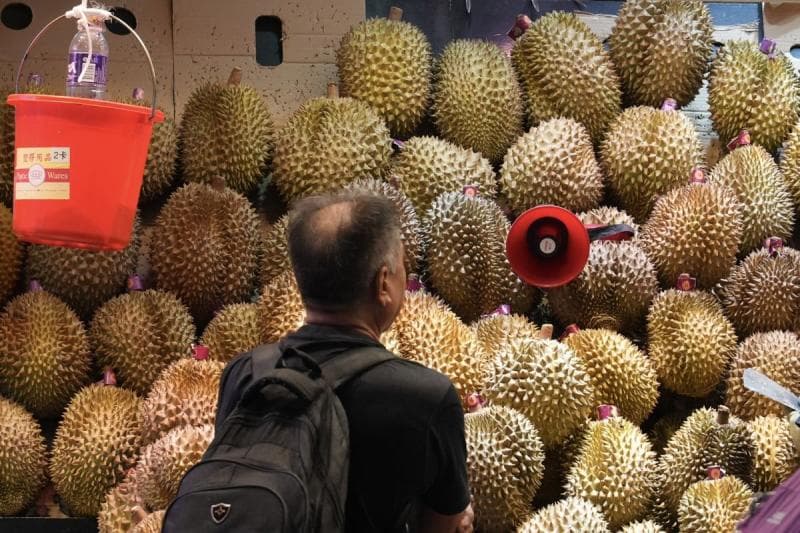
More than 90% of the world’s durian exports, valued at approximately $7.5 billion (224 billion baht) last year, currently reach China, where the fruit holds such cultural significance that it is frequently presented as a prestigious gift at formal events and business gatherings. A single six-kilogram durian can fetch up to 200 yuan (950 baht or roughly $29) in major Chinese cities, making the efficiency of transport an economic imperative for producers and traders across Southeast Asia, rather than merely a logistical concern.
Orathai Euatrakool, a former plant import and export expert for Thailand’s Ministry of Agriculture and Cooperatives who has observed the evolution of durian exports over decades, witnessed the departure of the inaugural train. She noted the dramatic shift from previous transport methods that often left fruit vulnerable to unpredictable delays.
Previously, large numbers of durians were delivered to China mostly by road and sea, but these routes were highly unpredictable due to factors such as bad weather, sometimes taking more than 20 days to arrive. Through the cold chain transportation on the China-Laos Railway, we hope that more Chinese consumers can enjoy the fresh and delicious Thai durians just like Thai people.
Revolutionizing the Supply Chain
The transition from traditional transport methods to dedicated rail service addresses longstanding vulnerabilities in the durian trade. Historically, Thai exporters relied on a combination of maritime shipping and overland trucking to move fruit to Chinese markets. Sea freight, while economical, exposed the perishable cargo to voyages that could stretch beyond a week, often resulting in spoilage rates of approximately 10%. Road transport offered more speed but suffered from border congestion, weather disruptions, and inconsistent cold-chain maintenance.
The new rail connection slashes transit times dramatically. The journey from Thailand to Kunming now takes just three days, with trains arriving each morning laden with fresh produce. For destinations deeper into China, such as Chengdu in the southwest, the total transit time has been reduced from roughly seven days to just five days. This acceleration allows exporters to harvest fruit at optimal ripeness rather than picking early to compensate for lengthy shipping periods.
The technical specifications of the service reveal the sophistication of modern agricultural logistics. The carriages maintain a constant temperature of 13 degrees Celsius (55 degrees Fahrenheit) throughout the journey, creating a “closed-loop” cold chain that preserves fruit quality from orchard to market. Industry experts estimate that spoilage rates will drop from the previous 10% to just 3%, representing substantial savings for exporters and improved product availability for retailers.
Corporate Investment and Quality Assurance
The rail service has attracted significant private sector investment, with logistics companies deploying specialized equipment to capitalize on the new route. LEO Global Logistics (LEO) opened this year’s durian season by deploying 50 company-owned refrigerated containers, known as reefers, to transport fruit from Thailand to Kunming. The company’s subsidiary, LaneXang Express (LXE), manages these operations in partnership with China Railway International Multimodal Transport (CRCT), a subsidiary of the state-owned China Railway Group.
Kettivit Sittisoontornwong, CEO of LEO Global Logistics, emphasized the strategic nature of the company’s investment in temperature-controlled transport infrastructure.
We are proud to be part of driving Thailand’s fruit export, especially durian, which is an important product of our country. We believe that the investment in reefers and the potential development of staff along the transport route will advance Thailand’s logistics capability to the regional level and build long-term sustainability.
The improved logistics infrastructure has coincided with evolving consumer expectations in China. JD Fresh, the fresh produce division of Chinese e-commerce giant JD.com, has introduced stringent quality benchmarks that leverage the faster, more reliable supply chain. The company recently launched an industry-first “Guaranteed 5-Lobe” standard for Monthong durians, selecting fruit exclusively from trees aged 10 years or older using criteria so strict that they eliminate 99 out of every 100 fruits. To support this premium tier, JD Fresh offers compensation for any missing lobes and full refunds for unripened or spoiled fruit, signaling a shift from volume-based to quality-focused market dynamics.
Economic Ripple Effects
The immediate impact of the rail service has been felt most keenly in market pricing. According to CCTV reports, imported durian prices have dropped by approximately 30% due to the increased supply efficiency and reduced spoilage. At Beijing’s Xinfadi wholesale market, one of the capital’s primary fresh produce hubs, vendors have observed dramatic price fluctuations. A standard 16-kilogram box of Golden Pillow durian that cost 1,100 to 1,200 yuan ($153-$167) just one month ago now trades for 730 to 780 yuan, reflecting the surge in available supply.
Natee Chuansanit, executive director of the Thailand Institute of Business Economics Research and Development, highlighted the strategic importance of the Chinese market for Thai agriculture.
China is currently Thailand’s most important durian export market. We hope that more Chinese consumers will be able to sample better-tasting durians, thereby expanding the market for Thai durians.
According to data from Thailand’s Ministry of Commerce, China absorbed more than 96% of Thai durian exports in 2022, with a total value of $3.09 billion. The current surge has accelerated this trend. In the first two months of this year alone, the value of durian imports through Yunnan ports reached 2.05 billion yuan ($285 million), representing a staggering 351.6% increase year-on-year. Tianbao Customs processed 14,000 tons of fruit imports from ASEAN countries during the same period, including more than 10,000 tons of durians.
Infrastructure and Geopolitical Context
The durian rail service operates within the broader framework of the Belt and Road Initiative (BRI), China’s ambitious infrastructure and economic development strategy. The 1,035-kilometer China-Laos railway, which forms the backbone of the new fruit transport corridor, entered service in 2021 with construction costs of $5.9 billion shared between the two nations. The line was designed specifically to provide Laos, a landlocked and historically impoverished nation, with direct trade links to China and regional markets.
The integration of Thai ports and produce centers into this network represents the next phase of regional connectivity. Kanokwan Suwankanit, director of the freight service department of Thailand’s State Railway, noted that freight volumes have grown from 500-600 TEUs (Twenty-Foot Equivalent Units) in 2019 to 2,000 TEUs in 2022, with further expansion expected to exceed 3,000 TEUs in 2023. This growth reflects increasing confidence in rail freight among agricultural exporters.
Officials have opened a “green channel” for durian transport, prioritizing unloading, transshipment, dispatch and clearance procedures. He Ruiqi, a staff member at China Railway Kunming Group, explained that operational standards require completing vehicle unloading and container transfer within 90 minutes of train arrival. To meet peak season demand, railway authorities have increased the frequency of Lancang-Mekong Express freight trains from two to six trips daily, deploying more than 4,000 refrigerated containers specifically for durian transport.
Alternative Routes and Future Horizons
While the China-Laos-Thailand rail corridor garners significant attention, it is not the only innovative transport solution emerging for Thai fruit exports. The “Pingxiang Model” operating through the Guangxi Zhuang Autonomous Region offers an even faster alternative, enabling delivery of fresh Thai durian to China in just one day. This service utilizes the Pingxiang Railway Port, the first railway port in China authorized to import foreign fruits, which functions as both a border checkpoint and central distribution hub.
The Pingxiang approach combines high-speed rail with fully digitalized logistics systems. Customs procedures that once consumed hours now require only three to four minutes, thanks to integrated digital port systems linking railway, customs, and border checkpoint data. Thai fruits transported via refrigerated trucks through Vietnam transfer to refrigerated trains at the Dong Dang border, maintaining constant temperature control throughout the journey.
Looking ahead, infrastructure planners are already preparing the next generation of connectivity. The China-Thailand High-Speed Railway, another BRI flagship project, is scheduled for completion by 2030. This line will offer one-stop cargo service that could further reduce transit times and costs. Xu Liping, director of the Center for Southeast Asian Studies at the Chinese Academy of Social Sciences, observed that these projects create mutual benefits.
For Thailand, increased exports will drive economic growth and create jobs in the agricultural sector. For China, the availability of high-quality Thai agricultural products will meet the diverse needs of its consumers and support the ongoing trend of consumption upgrading.
Despite these advances, challenges persist. Recent reports indicate that customs processes have become more complex due to residue testing requirements for substances such as Basic Yellow (BY2) and Cadmium, extending processing times from four days to eight or ten days in some cases. Additionally, the concentrated volume of cargo during peak season has created congestion at the Thai-Laos-China border checkpoint, affecting delivery schedules.
Key Points
- The new China-Laos-Thailand cold-storage rail service reduces durian transit time from over a week to just three days for Kunming and five days for Chengdu
- Carriages maintain 13 degrees Celsius throughout the journey, cutting spoilage rates from 10% to approximately 3%
- Imported durian prices in China have dropped 30% since the service launched, with wholesale boxes falling from 1,200 yuan to 780 yuan
- The $7.5 billion global durian export market sends more than 90% of its volume to China, where demand continues to grow exponentially
- Private logistics firms like LEO Global Logistics have deployed 50+ specialized refrigerated containers to support the trade
- The “Pingxiang Model” offers an alternative one-day delivery route through Vietnam and Guangxi
- Future infrastructure includes the China-Thailand High-Speed Railway, expected to be completed by 2030
- The service operates within China’s Belt and Road Initiative, supporting regional economic integration