A New Threat Points at Seoul
North Korea announced Friday that it will deploy new extended range artillery systems within the year capable of striking the capital region of South Korea, a move that sharply raises the conventional threat to one of Asia’s largest cities. The declaration came directly from leader Kim Jong Un following a visit to a major munitions factory where he inspected mass production lines for a new 155 millimeter mobile howitzer. According to the official Korean Central News Agency (KCNA), Kim ordered the systems sent to a long range artillery unit stationed along the southern border before the end of 2026.
The weapon carries a striking range exceeding 60 kilometers, or roughly 37 miles. That distance matters profoundly because Seoul, a crowded metropolis of approximately 10 million people, sits only 40 to 50 kilometers from the border between North and South. In practical terms, North Korea is fielding a system that can hit the northern districts of the capital from forward positions without advancing. Kim described the weapon in stark terms, stating that the rapid extension of range and improvement of capability would provide a great change and advantage in the land operations of the army.
While North Korean ballistic missile tests regularly capture international headlines, the artillery of the country has always represented a more immediate danger to the South. The country already maintains hundreds of guns and rocket launchers within range of Seoul, a legacy of the frozen conflict that has defined the peninsula since the 1953 armistice. The new howitzers do not replace that threat; they compound it by adding longer reach and, according to Pyongyang, greater precision. KCNA also reported that various operational and tactical missile systems, along with powerful multiple rocket launcher systems, are scheduled for deployment along the same front.
How the New Howitzers Change the Calculus
The specific system Kim inspected is a large caliber rifled gun mounted on a mobile chassis. Some analysts have compared it to the South Korean K9 Thunder, a widely exported howitzer with a range of roughly 40 kilometers. By pushing range past 60 kilometers, North Korea appears to be attempting to outmatch a platform once considered a symbol of Southern technical superiority. The extended range places not only Seoul but also much of Gyeonggi Province, home to key industrial hubs and additional millions of residents, within the arc of fire.
Lim Eul Chul, an analyst at the Institute for Far Eastern Studies, offered an assessment of the strategic meaning behind the new system.
By unveiling a precision strike system with a range exceeding 60 kilometers, North Korea is demonstrating its ability to conduct targeted strikes against key facilities in the greater Seoul area, moving away from its traditional reliance on mass, unguided fire.
Independent observers have not verified North Korean claims about accuracy or sustained firing performance. Still, the visible scale of production shown to Kim suggests a serious commitment to modernizing conventional forces alongside the more famous missile and nuclear programs of the country. The howitzers are expected to equip three battalions assigned to a border artillery unit, creating a concentrated salvo capability that could overwhelm missile defenses through sheer volume if not through precision alone.
The extended reach also complicates South Korean military planning. Commanders must now assume that key command nodes, airfields, and logistics centers previously considered safely outside artillery range could come under fire in the opening hours of any conflict.
Naval Power and a Public Debut at Sea
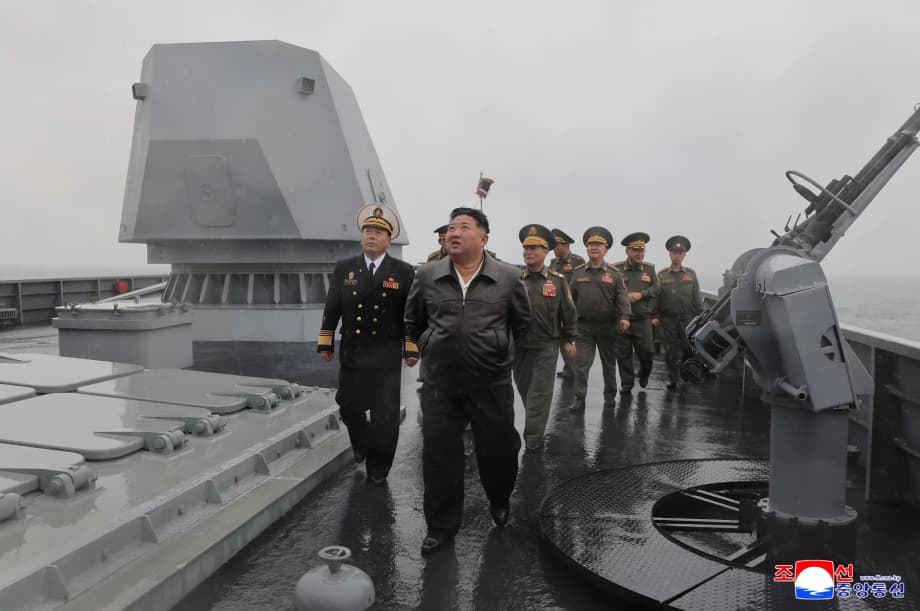
While the artillery announcement reshapes the land based threat picture, Kim Jong Un simultaneously advanced the naval modernization program of North Korea. On Thursday, he boarded the destroyer Choe Hyon to review its maneuverability during sea trials off the west coast of the country. The 5,000 ton vessel represents the largest and most advanced warship North Korea has ever built, and Kim expressed satisfaction with testing progress. He ordered authorities to hand the ship over to the navy by mid June as scheduled, with plans to build two additional destroyers of the same class by October.
The Choe Hyon first appeared last year to considerable fanfare in Pyongyang. North Korea later unveiled a second destroyer of identical design, though that vessel suffered damage during a botched launching ceremony. Despite the setback, Kim has pressed ahead with the program. Analysts believe the class may eventually carry strategic cruise missiles capable of being fitted with nuclear warheads, giving North Korea a naval strike platform that complicates allied defense planning.
The sea trial also carried a personal dimension. State media photographs showed the teenage daughter of Kim Jong Un accompanying her father aboard the destroyer. In one image, she stood behind him while he addressed sailors; in another, the two shared a meal with the crew. The National Intelligence Service of South Korea indicated last month that the daughter could be considered a potential heir, and her repeated appearances at military events add a symbolic layer to the weapons rollouts. The presence of a presumed successor at a flagship naval commissioning signals continuity and projects dynastic stability to both domestic elites and foreign analysts.
A Constitutional Break With the Past
The weapons inspections followed the revelation that the newly revised constitution of North Korea drops every reference to Korean unification, a concept that had anchored state ideology since the peninsula was divided. South Korean officials confirmed Wednesday that the document now defines the territory of North Korea strictly as the northern half of the peninsula and identifies South Korea by the official name, the Republic of Korea. The change codifies the January 2024 order of Kim Jong Un to abandon the idea of shared statehood, formally burying the unification dream pursued by his father and grandfather.
By establishing what Pyongyang now calls a hostile two state system, Kim has drawn a hard line that leaves little room for the engagement policies favored by the current liberal administration in Seoul. South Korean officials had taken steps to lower tensions, including halting propaganda loudspeaker broadcasts along the border and offering diplomatic overtures. North Korea has responded by blowing up liaison offices that once linked the two sides, severing road and rail connections, and now rewriting its fundamental law to cast the South as an adversary rather than separated kin.
This ideological pivot matters for regional security. For decades, even at the height of tension, the shared language of eventual unification provided a theoretical exit for diplomacy. By removing that framework, Kim is signaling that coexistence is no longer the goal. The artillery and destroyer deployments become the physical expression of that policy, arming a state that now formally views its neighbor as an enemy to be deterred or, in a crisis, targeted.
A Peninsula on Edge
The Korean Peninsula remains technically at war because the conflict from 1950 to 1953 ended with an armistice rather than a peace treaty. Over the past six years, the already fragile status quo has deteriorated. The high stakes nuclear diplomacy of Kim Jong Un with former U.S. President Donald Trump collapsed in 2019 without an agreement, and North Korea has since shunned formal dialogue with both Washington and Seoul. Instead, Pyongyang has focused on expanding its arsenal across every domain, from submarine launched ballistic missiles to solid fuel intercontinental ballistic missiles and now extended range artillery.
Recent reports indicate that North Korean arms supplies to Russia for use in Ukraine have given Pyongyang valuable battlefield data on weapons systems under combat conditions. That feedback loop may be accelerating improvements in range, accuracy, and reliability. Meanwhile, the Presidential Office of South Korea stated Thursday that it would continue to pursue peace efforts with the North, even as the constitutional revisions and weapons deployments suggest Pyongyang has little interest in reciprocating.
The combination of upgraded conventional firepower, a growing naval force, and an explicit legal framework defining South Korea as the enemy creates a volatile environment. Military planners in Seoul and Washington must now account for a North Korea that is building more nuclear weapons while also improving its ability to hold the South at risk through conventional means. The new howitzers can be moved and fired more quickly than ballistic missiles, making them harder to preempt. Their sheer numbers, combined with missiles and rockets, present a saturation challenge for any missile defense architecture.
For ordinary residents of Seoul, the developments reinforce a long standing reality: the capital lives within the shadow of North Korean guns. The new artillery does not fundamentally alter that geography, but it does extend the shadow. With Kim ordering border units equipped before the end of the year, and the Choe Hyon destroyer entering service within weeks, North Korea is pairing the political rejection of the South with tangible military upgrades. The message is aimed as much at Seoul and Washington as it is at the domestic audience in North Korea, warning that Pyongyang intends to meet what it calls hostility with hardware.
Key Points
- North Korea will deploy new 155 millimeter mobile howitzers with a range exceeding 60 kilometers to border units in 2026, placing Seoul within strike range.
- Leader Kim Jong Un inspected mass production of the artillery and ordered its deployment, while also overseeing sea trials for the 5,000 ton destroyer Choe Hyon.
- The destroyer is scheduled for commissioning by mid June, with Kim calling for two additional warships of the same class to be completed by October.
- North Korea revised its constitution to remove all references to peaceful unification with the South, instead defining its territory as the northern half of the peninsula and labeling South Korea a permanent hostile enemy.
- The moves follow the collapse of nuclear diplomacy with the United States in 2019 and signal a shift from engagement to open confrontation on the peninsula.