A Silent Admission Carved in Stone
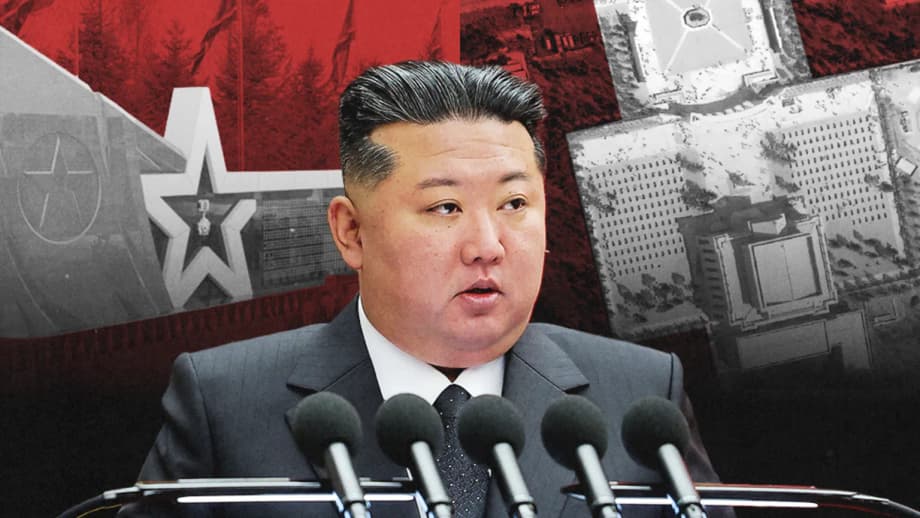
North Korean leader Kim Jong Un stood before a gleaming new complex in Pyongyang alongside Russian Defense Minister Andrey Belousov as military jets thundered overhead and white balloons drifted into the sky. The ceremony marked the unveiling of the Memorial Museum of Combat Feats at Overseas Military Operations, a monument that transforms one of Pyongyang’s most closely guarded secrets into public stone. For the first time, the secretive regime offered observable proof of the scale of its military intervention in Russia’s war against Ukraine. The names etched into two massive granite walls tell a story that neither Pyongyang nor Moscow had ever officially acknowledged. An examination of satellite images and official photographs indicates that the walls contain approximately 2,304 names of soldiers killed during operations to recapture Russia’s Kursk region from Ukrainian forces.
The timing carried heavy symbolism. The ceremony coincided with what Russian officials described as the first anniversary of Moscow’s reclamation of Kursk, a border territory where Ukraine had staged a surprise incursion in August 2024. South Korean intelligence agencies estimate that at least 11,000 North Korean troops were dispatched to aid Russia in that campaign. By transforming a covert deployment into a monument of national honor, Kim has signaled that the alliance with Moscow is no longer transactional. It is a bond cemented by the blood of thousands of young soldiers.
For ordinary North Koreans, the memorial serves as both a rallying point and a warning. State media described the fallen as true patriots who defended sovereignty against Western aggression. The regime has begun moving bereaved families into a new housing complex within the same district, weaving the sacrifices of the dead into the physical landscape of the capital.
How Many Died? The Numbers on the Wall
Satellite images provided by a commercial Earth observation company reveal that construction of the 52,000 square meter complex began in October 2025 in Pyongyang’s Hwasong district. A rudimentary shell was visible by December. Exterior work appeared largely complete by March, with landscaping finished last month. The speed of construction suggests the regime treated the project as an urgent priority.
The core evidence lies in the memorial walls themselves. Each structure stretches roughly 30 meters. An analysis of official photographs shows that each wall is divided into about 14 sections. Names are engraved in nine of these sections, with roughly 16 columns per section. Detailed images of the east wall show eight names inscribed in a single column. The arithmetic is stark. Sixteen columns multiplied by nine sections and eight names per column yields 1,152 names per wall. Across both walls, the total reaches approximately 2,304.
Songhak Chung, a senior researcher at the Korea Institute for Security Strategy, supports this assessment. He notes that the memorial walls are packed with names written in extremely small characters. Considering the surface area and text density, the number of people recorded there likely reaches several thousand. The exact figure cannot be ascertained without higher resolution images, but the memorial count aligns closely with earlier estimates from South Korea’s National Intelligence Service.
In September 2025, the spy agency said about 2,000 North Korean soldiers had been killed and another 2,700 wounded. By February 2026, the agency updated its assessment, stating that about 6,000 of the estimated 11,000 deployed personnel had been killed or wounded. Other Western and Ukrainian intelligence sources place total deployments higher, between 14,000 and 20,000, with some estimates suggesting roughly 6,000 deaths. Neither Pyongyang nor Moscow have released official figures. Discrepancies may reflect different counting periods, definitions of combatants versus support personnel, or varying access to battlefield data.
Russian Dignitaries and Promises of Forever
The unveiling was not a solitary affair for the North Korean leadership. Belousov stood beside Kim during the ceremony. Vyacheslav Volodin, speaker of Russia’s State Duma, also traveled to Pyongyang for the event. Their presence underscored that Moscow views this alliance not as a temporary convenience but as a lasting strategic partnership. State media described the affair as honoring a sacred war for territorial integrity against a Western hegemonic plot.
Volodin delivered explicit thanks to Kim for the liberation of Kursk, praising North Korean forces for fighting shoulder to shoulder with Russian soldiers.
Russian State Duma Speaker Vyacheslav Volodin addressed Kim Jong Un directly during the ceremony.
“Let me express these words of gratitude to you, Comrade Kim Jong Un, and to the Korean people for their fraternal support in the liberation of Kursk.”
Belousov went further. He announced that Moscow and Pyongyang had agreed to place military cooperation on a stable, long term footing. A bilateral plan covering 2027 through 2031 is expected to be signed within the year. He also presented Russian military awards to North Korean servicemen who took part in the Kursk operation. During separate meetings, Kim assured the Russian delegation that North Korea will as ever fully support the policy of the Russian Federation to defend national sovereignty, territorial integrity and security interests. State media reported Kim saying that Russia will surely win a victory in the just sacred war.
Martyrdom by Design
Perhaps the most chilling aspect of the memorial is what it honors beyond conventional combat deaths. Kim Jong Un publicly praised soldiers who detonated their own grenades to avoid capture by Ukrainian forces. This practice, described in state media as suicide attacks, confirms long held suspicions that Pyongyang orders its troops to commit suicide rather than surrender.
In North Korean military culture, capture is treated as treason. Soldiers undergo intense ideological conditioning that frames surrender as an unforgivable betrayal of the state and the ruling party. This mindset produced battlefield behavior that shocked even seasoned observers of the Korean People’s Army.
In a speech delivered during the memorial events, Kim Jong Un described these suicide attacks as the height of loyalty.
“Their self-sacrifice expecting no compensation, and the devotion expecting no reward. This is the definition of the height of loyalty of our army.”
The policy has tangible evidence beyond rhetoric. Seoul’s National Intelligence Service found memos on deceased North Korean soldiers pointing to these extreme orders. Earlier this year, footage emerged of one of only two known North Korean prisoners of war held by Ukraine. The soldier expressed regret on camera, stating that everyone else blew themselves up but he failed. Both prisoners have reportedly expressed a desire to resettle in South Korea.
Kim extended praise even to those who fell during frontal charges or from shrapnel wounds. He described them as the party’s faithful warriors and patriots. By framing mass death as mass loyalty, the regime seeks to sanitize catastrophic losses and transform them into political capital for domestic control.
Anatomy of the Memorial
The Memorial Museum of Combat Feats at Overseas Military Operations is not merely a wall of names. It is a carefully orchestrated hierarchy of remembrance designed to reinforce state propaganda about sacrifice and social order. Korean research company SI Analytics identified a tiered system of commemoration operating across the grounds.
Soldiers who demonstrated extraordinary valor receive outdoor graves with individual tombstones. Others are remembered through urns stored inside a central building. Satellite imagery taken in early April shows roughly 140 graves on the west side of the cemetery and 138 on the east. That accounts for approximately 278 individuals with marked burial plots. Researcher Kim Jin-mu, formerly with the Korea Institute for Defense Analyses, suggested those buried outside may include recovered bodies, senior officers, or individuals granted special recognition for self-sacrifice.
The grey building at the cemetery center appears to be a three story columbarium. According to researcher Songhak Chung, the entire wall appears to be filled with grid patterned storage compartments for remains. Even excluding offices and exhibition areas, the indoor repository alone would be able to house at least 1,000 sets of remains. This suggests that the vast majority of honored dead are stored as ashes rather than buried in full.
South Korea’s Ministry of Unification says it is difficult to confirm if all soldiers who were killed have been memorialized on the walls. However, researcher Kim believes it is highly likely that the names of all North Korean troops who died in Kursk have been inscribed. He argues that the memorial is intended to reward those who have sacrificed for the state and maintain public support. Omitting names could risk discontent among bereaved families and undermine the project purpose.
The Kursk Campaign and Its Aftermath
To understand the memorial, one must understand the operation that filled it. In August 2024, Ukrainian forces launched a surprise cross border offensive into Russia’s Kursk region. It was the first time since World War II that foreign troops had occupied sovereign Russian territory. The incursion threatened logistical hubs and caused significant embarrassment for the Kremlin.
Moscow responded by bolstering its defenses with North Korean troops. The first reports of transfers emerged in October 2024. South Korean intelligence recorded movements of approximately 1,500 soldiers initially, with total deployments eventually reaching estimates between 11,000 and 20,000. These forces were committed to combat in Kursk Oblast and reportedly assisted with drone operations and artillery spotting in neighboring Sumy Oblast. Russia declared it had fully regained control of Kursk by August 2025, though fighting persisted in border areas.
North Korean units suffered heavily during the counter-offensive. Their limited familiarity with modern drone warfare, combined with rigid command structures and communication barriers with Russian forces, contributed to high casualty rates. Not all deployments were purely combat roles. In December 2025, Kim Jong Un welcomed home the 528th Regiment of Engineers, which had conducted mine clearance and reconstruction work in Kursk. During that ceremony, he made a rare mention of nine heartrending losses within the engineering unit. Analysts interpreted this as a calibrated disclosure meant to downplay risks while still acknowledging sacrifice.
Beyond soldiers, North Korea also promised to send thousands of civilian workers to help rebuild Kursk. This mirrors a broader pattern in which Pyongyang exports not just weaponry and troops, but labor, often under conditions that channel wages back to the state.
A Partnership Forged in Blood
The memorial does not simply look backward. It anchors a future that both Pyongyang and Moscow are actively constructing. In June 2024, Russian President Vladimir Putin and Kim signed a treaty pledging mutual military assistance in the event of aggression against either country. Kim hailed the accord as the strongest ever. The pact was ratified by North Korea that November.
The returns for Pyongyang have been substantial. Analysts believe North Korea received massive grain shipments, hard currency, advanced satellite technology, and military technical assistance. One estimate suggests the Kremlin may have paid up to 14.4 billion dollars for troop support and weaponry, which included artillery ammunition, rockets, and missiles shipped since 2023. For an economy strangled by stringent international sanctions, this arrangement provides a vital lifeline.
The cooperation is deepening. Belousov’s visit yielded discussions on a bilateral military cooperation plan for 2027 through 2031. Western analysts fear this could eventually include transfers of North Korean ballistic missile components in exchange for Russian nuclear submarine designs or other advanced technology. Such exchanges would alter the security landscape of Northeast Asia and complicate efforts to contain Pyongyang’s nuclear and missile programs.
Russia is also building its own monument. Foreign Minister Sergey Lavrov promised in March to erect a memorial in the Kursk region to celebrate the combat brotherhood between the two nations. Moscow’s ambassador to North Korea attended the Pyongyang groundbreaking ceremony. The reciprocal gestures signal that both capitals view the alliance as permanent rather than temporary.
Rallying the Next Generation
Even as the dead are enshrined, Pyongyang is preparing more soldiers to take their place. At the Eleventh Congress of the Socialist Patriotic Youth League, held in the capital, Kim Jong Un cast citizens aged 14 to 30 as the vanguard of state goals. The ruling party explicitly tied youth loyalty to deployments in Russia, writing that young soldiers sent on overseas operations had become bombs and flames in defending the honor of the country.
The message serves a dual purpose. Internationally, it warns that North Korea can replenish its forces. Domestically, it tightens ideological control at a time when Kim has intensified restrictions on foreign cultural influence. Exposure to South Korean music, films, and slang is now treated as a serious political offense. The regime wants to ensure the next generation values state loyalty over individual survival.
This recruitment drive coincides with increasing public appearances by Kim alongside his young daughter, believed to be named Ju Ae. By linking dynastic continuity to military sacrifice, the regime attempts to bind families to the state through blood and honor. For Kim, the memorial is not simply a tribute to the dead. It is a monument to a new era of defiance against Western pressure, secured by the lives of his soldiers in the fields of Eastern Europe.
What to Know
- North Korea unveiled a memorial in Pyongyang honoring soldiers who died fighting for Russia in the Kursk region, with independent analysis suggesting roughly 2,300 names engraved on its walls.
- South Korean intelligence estimates between 11,000 and 20,000 North Korean troops were deployed to Russia, with total casualties ranging from roughly 2,000 to 6,000 dead depending on the source and date.
- Russian Defense Minister Andrey Belousov and State Duma Speaker Vyacheslav Volodin attended the unveiling, announcing long term military cooperation plans through 2031.
- Kim Jong Un praised soldiers who killed themselves with grenades to avoid capture, confirming a suicide before surrender battlefield policy.
- The complex includes memorial walls, a cemetery with approximately 278 graves, and a columbarium with capacity for over 1,000 urns, alongside new housing for veterans and bereaved families.
- North Korea is believed to have received food, money, technical assistance, and possibly billions of dollars in exchange for its military support.
- Russia has promised to build a reciprocal monument in Kursk, while North Korea appears to be preparing youth as young as 14 for future overseas military deployments.