A New Generation Picks Up the Lightsaber for Peace
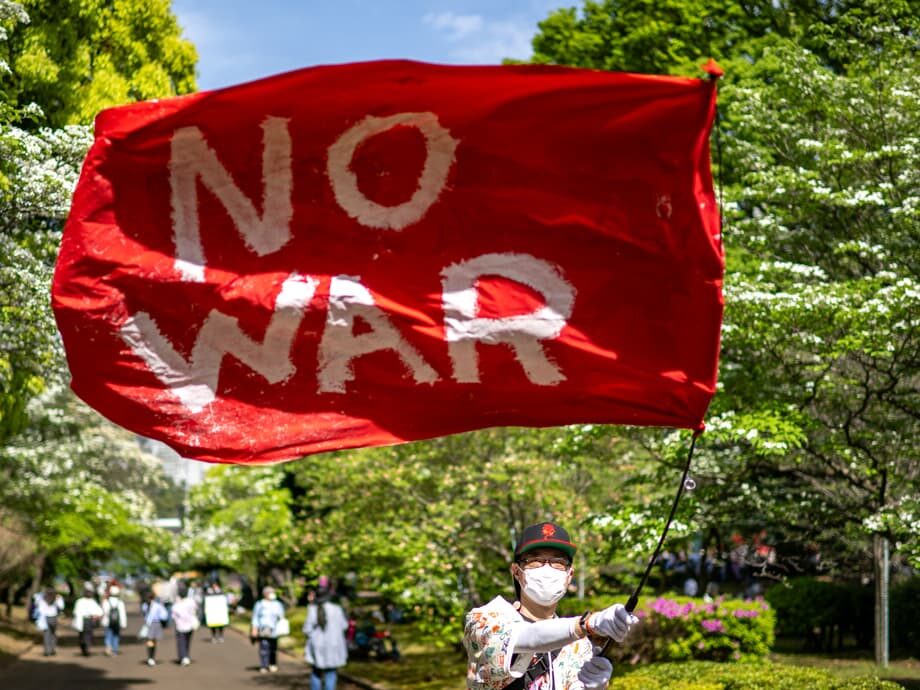
In the narrow streets surrounding Japan’s National Diet building, a sea of glowing light sticks pierced the evening darkness on April 19, 2026. Among the estimated 36,000 demonstrators gathered to defend the country’s postwar pacifist constitution stood Gohta Hashimoto, a 22-year-old university student clutching a toy lightsaber that has become an unlikely symbol of resistance. “I’ve been interested in the constitution for about a year, ever since the rise of far-right parties in Japan,” Hashimoto explained at a rally launching a petition to protect Article 9. “I wanted to be part of a movement that keeps my country peaceful and protects the constitution.”
The gathering represented the largest in a rapidly escalating wave of demonstrations that have swelled from 3,600 participants in late February to 24,000 by late March, culminating in this massive turnout outside Japan’s parliament. What distinguishes this movement from previous protest waves is its demographic composition: smartphone data analysis revealed that people in their 30s formed the largest single group, with more than 20 percent in their 20s, and women comprising 60 percent of all participants.
Article 9 Under Siege
At the heart of this civil awakening lies Article 9 of Japan’s 1947 constitution, a provision drafted by American occupation authorities under General Douglas MacArthur that forever renounces war as a sovereign right of the nation and bans the maintenance of armed forces. For nearly 80 years, this clause has constrained Japan’s military to a purely defensive posture, preventing the country from projecting power abroad or engaging in collective military operations with allies.
That framework is now crumbling under the administration of Prime Minister Sanae Takaichi, who inherited the constitutional revision agenda from her mentor, the assassinated former Prime Minister Shinzo Abe. In mid-April 2026, Takaichi declared before the Liberal Democratic Party’s 70th anniversary convention that “the time has come” for constitutional reform, announcing plans to present a formal amendment proposal within a year. Her government has already begun dismantling the legal architecture of pacifism through executive action, most notably by scrapping the decades-old ban on lethal weapons exports just days before the April protest.
The constitution enables us to stay out of America’s wars, including in this region. The thought that might change makes me really angry.
This policy reversal, approved by cabinet and the National Security Council, permits Japan to export fighter jets, missiles, and warships to allied nations including Australia, which recently signed a $7 billion agreement for Mitsubishi Heavy Industries to build eleven warships. The new rules require purchasing countries to pledge alignment with the United Nations Charter, but exemptions exist for “special circumstances” involving Japan’s national security, creating what critics call a loophole large enough to circumvent pacifist principles entirely.
The Light Stick Revolution
The visual vocabulary of these protests reflects both technological sophistication and cultural fluency. Demonstrators carry glowing sticks inspired by the December 2024 protests against South Korea’s impeached President Yoon Suk Yeol, creating illuminated waves that symbolize solidarity in the digital age. Some protesters wave bright yellow light sticks; others carry balloons shaped like the numeral “9” or placards reading “Cats, not bombs” and “No one should be sent to war.”
Yuri Hioki, a 28-year-old programmer holding a yellow light stick at the Tokyo rally, described the accessory as a source of courage. “When you have one of these it makes you realise you’re not alone,” she said. “It gives you the courage to come along and protest.” This sentiment speaks to a generation that has overcome the political reticence that previously characterized Japanese youth, where discussing politics was often considered social taboo.
The movement has transcended Tokyo, with coordinated demonstrations occurring at more than 130 locations across Japan on April 9 alone, according to reports by Tokyo Shimbun. Protesters have targeted specific military developments including the deployment of long-range missiles with “enemy base strike capabilities” to Kumamoto and Shizuoka prefectures on March 31, weapons that can strike targets over 1,000 kilometers away and represent a clear shift from defensive to offensive military posture.
Koichi Nakano, a professor of political science at Sophia University, argues that the Iran war and President Donald Trump’s erratic foreign policy have catalyzed this youth mobilization. “The war has brought home the risk that Japan could get involved in an illegal war under Takaichi,” Nakano observed. “So many more people feel they need to show their support for Article 9 as the last bulwark against war.”
From Executive Stretch to Constitutional Overhaul
While Takaichi frames her constitutional push as completing Japan’s journey to becoming a “normal country,” critics view it as the culmination of a decade-long strategy of gradually hollowing out pacifist constraints through reinterpretation rather than legislation. Former Prime Minister Abe stretched Article 9’s meaning in 2015 to permit “collective self-defense,” allowing Japanese forces to aid allies under attack even when Japan itself faces no direct threat. Subsequent administrations have acquired pre-emptive strike capabilities and overseas deployment permissions without constitutional amendment.
“Pro-revisionists know that there is no real consensus on these supposedly constitutional offensive measures, so they want to put the final nail in the coffin of the peace constitution,” Nakano explained. “By making the SDF ‘constitutional,’ they want to legitimise everything the SDF does, including the so-called limited collective self-defence.”
The specific amendments Takaichi seeks remain unclear, though analysts expect proposals to formally recognize the legal status of the Self-Defense Forces while potentially retaining Article 9’s renunciation of war in name only. Such changes would require a two-thirds supermajority in both houses of the Diet followed by a national referendum, a high bar that has defeated previous revisionist efforts.
Following February 2026 snap elections that delivered the LDP a two-thirds majority in the powerful lower house, Takaichi possesses the legislative momentum to advance constitutional proposals. However, she lacks equivalent support in the upper house, where opposition parties could block referendum authorization. Public opinion remains deeply divided, with polls showing roughly half supporting constitutional recognition of the military, while the weapons export reversal and Iran war risks may be pushing sentiment toward preservation of Article 9.
Historical Echoes and Generational Divides
Today’s youth movement carries distinct echoes of the 2015 protests against Abe’s security legislation, when the student collective SEALDs (Students Emergency Action for Liberal Democracy) pioneered a new style of Japanese activism combining street fashion, music, and social media savvy with political engagement. Those demonstrations, while ultimately unsuccessful in blocking the security bills, established templates for inclusive, non-violent protest that avoided the radical Marxist imagery and violent clashes with police that characterized 1960s student movements.
The current wave builds upon this legacy while expanding beyond student populations to include families, office workers, and veterans of earlier peace campaigns. At annual Constitution Day rallies held May 3 near Tokyo Bay, attendance reached 70,000 in 2019 before pandemic disruptions; this year’s demonstrations have similarly drawn multi-generational crowds including survivors of the 1945 atomic bombings and younger activists from the “Nihon Heiwa” (Japan for Peace) movement.
Yet the movement faces the challenge of generational turnover. Many core activists from the postwar boom years are aging, with some veterans of the 1960s protests now physically unable to march but still maintaining monthly vigils at local train stations on the ninth day of each month (symbolizing Article 9). The influx of twenty-somethings like Hashimoto represents a crucial replenishment of activist energy, driven by fears that constitutional revision could expose their generation to conscription or combat deployment.
“I always thought of politics as something for older people, but that feels like turning over my future to someone else,” Hashimoto reflected. “Until now I’d never thought of the constitution as something young people needed to fight for.”
Regional Reactions and Economic Tensions
The dismantling of Japan’s pacifist constraints has triggered sharp reactions across East Asia. Chinese Foreign Ministry spokesperson Guo Jiakun stated that “the international community, including China, will remain extremely vigilant on this issue and will firmly resist Japan’s reckless new militarization.” Beijing’s criticism extends to Takaichi’s ritual offering to the Yasukuni Shrine, which honors Japan’s war dead including over 1,000 convicted war criminals, a gesture perceived as contempt for nations that suffered Japanese wartime aggression.
South Korea has expressed particular concern about both the shrine offering and weapons exports, while the United States has welcomed Japan’s militarization as enhancing interoperability within the alliance. Australia, beneficiary of the warship construction contract, expressed satisfaction with the “regulatory clarity” provided by the export policy reversal.
Domestically, protesters have framed military expansion as a theft from social welfare. With Japan’s defense budget reaching a record 9.04 trillion yen (approximately $56.8 billion) for fiscal year 2026 while the population faces economic stagnation and declining living standards, demonstrators question the prioritization of military-industrial growth over healthcare and social services.
“Isn’t that murder? Weapons are used to kill people, to fight wars. Why only the military industry, which manufactures weapons, profits in the end? These weapons are even manufactured with our tax money. There is no way I can agree with such a thing,” one protester told Chinese media.
At a Shinjuku rally following the weapons export announcement, 74-year-old Ryozo Sawada articulated the sense of national betrayal felt by many older Japanese. “Ever since I was a child, the one thing about Japan I could truly be proud of was that we renounced war,” he said. “The fact that they actually decided to export weapons is incredibly frightening.”
The Road to Referendum
As Takaichi prepares to submit constitutional amendments to the Diet, the procedural hurdles remain formidable. Even with lower house supermajority support, she must either secure opposition cooperation in the upper house or win a national election to obtain the necessary two-thirds majority there. Most challenging of all, the amendment must survive a national referendum requiring simple majority approval.
The protests have transformed what might otherwise be an abstract constitutional debate into a visceral public reckoning with Japan’s wartime history and future security identity. Demonstrators chant “Stop sucking up to America” and carry signs reading “Hands off the constitution,” framing the revision push as submission to Washington’s geopolitical demands rather than autonomous Japanese decision-making.
For the youth activists who have abandoned political apathy to defend a document drafted before their grandparents were born, the stakes extend beyond legal technicalities to existential questions of national identity and personal safety. As the global arms market opens to Japanese manufacturers and the Self-Defense Forces prepare for potential combat operations abroad, Hashimoto and his generation face a referendum that will determine whether the pacifist experiment survives into its ninth decade or dissolves into history.
“More and more young people are standing up, which I think is truly encouraging,” one demonstrator observed. “Previously, those who participated in rallies are in their 60s, 70s, and 80s. But now, I find they have finally come to hold demonstrations in front of the Diet and join penlight demonstrations.”
Key Points
- An estimated 36,000 protesters gathered outside Japan’s National Diet on April 19, 2026, to oppose constitutional revision and lethal weapons exports
- Prime Minister Sanae Takaichi’s government lifted an 80-year ban on lethal weapons exports on April 7, 2026, allowing Japan to sell fighter jets, missiles, and warships to allies
- Article 9 of Japan’s 1947 constitution, drafted by US occupation authorities, renounces war as a sovereign right and bans maintaining armed forces
- Protest demographics have shifted dramatically, with people in their 30s forming the largest group and 60 percent of demonstrators being women
- Takaichi requires a two-thirds majority in both parliamentary houses and a national referendum victory to formally amend the constitution
- The Self-Defense Forces currently possess “enemy base strike capabilities” with missiles deployed in Kumamoto and Shizuoka prefectures
- Japan and Australia signed a $7 billion warship construction deal enabled by the new export regulations
- Opposition to constitutional change has spread to over 130 locations across Japan in coordinated demonstrations
- Defense spending has doubled to 2 percent of GDP while protesters demand prioritization of healthcare and social welfare
- China and South Korea have strongly criticized Japan’s militarization, while the United States has supported enhanced defense cooperation