Record-Breaking Year for Korea’s Natural Landscapes
South Korea’s national parks have emerged as major draws for international travelers, attracting a combined total of 2.05 million foreign visitors throughout 2025. The Korea National Park Service (KNPS) released these figures on Wednesday, revealing that 1.13 million were overseas tourists while approximately 920,000 were foreign residents already living in the country. This milestone represents a significant recovery and expansion of inbound tourism, positioning natural landscapes as central components of Korea’s evolving travel industry.
The statistics reflect a broader shift in how international travelers experience the country. While urban centers like Seoul and Busan remain popular, growing numbers of visitors are venturing into mountainous terrain, coastal regions, and volcanic landscapes. This diversification suggests that Korea’s appeal extends beyond shopping districts and cultural landmarks to include its preserved wilderness areas and geological formations.
KNPS President Joo Dae-yeong commented on the significance of these numbers.
The fact that foreign visitors to Korea are also visiting our national parks demonstrates that natural landscapes are an important part of Korea’s tourism appeal. Now that we can more accurately measure the scale of foreign visitation through roaming data analysis, we will expand tailored information services and programs for international visitors, and work to build national parks that grow together with local communities.
Which Parks Draw the Biggest Crowds?
Hallasan National Park on Jeju Island dominated the visitor statistics, recording 271,443 foreign visitors. As South Korea’s highest mountain and a dormant volcano, Hallasan offers hiking trails that wind through diverse ecological zones, from temperate forests to alpine meadows. The park’s popularity reflects a growing trend among foreign tourists visiting Jeju Island to incorporate natural landscape activities into their itineraries rather than limiting themselves to beach resorts and urban attractions.
Dadohaehaesang National Park ranked second with 141,190 foreign visitors. This park represents Korea’s largest protected area, spanning coastal regions and approximately 1,700 islands in South Jeolla Province. Its marine environment and scenic coastal views attract visitors interested in island hopping, coastal photography, and observing diverse marine ecosystems.
Taeanhaean National Park and Hallyeohaesang National Park followed closely, each drawing around 130,000 international visitors. Taeanhaean, located along Korea’s western coast, features calm beaches, tidal flats, and diverse marine life, making it particularly attractive for eco-tourism. Hallyeohaesang, stretching across the southern coast, combines rich marine ecosystems with unique rock formations and historical significance.
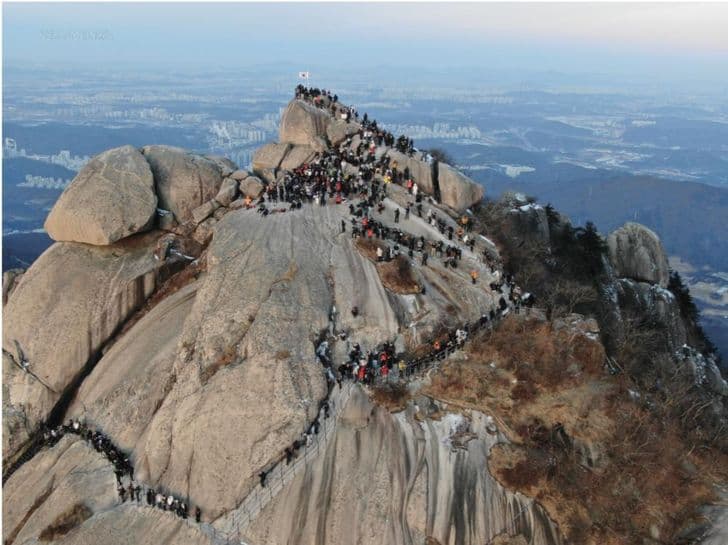
Mountain parks also featured prominently in the rankings. Seoraksan National Park in Gangwon Province attracted 111,731 foreign visitors with its dramatic granite peaks and seasonal foliage. Gyeongju National Park, which centers on the historical heritage of the ancient Silla Kingdom rather than pure wilderness, drew 102,166 visitors. Even Bukhansan National Park, located within Seoul’s metropolitan area, recorded 57,315 foreign visitors, demonstrating that accessibility does not diminish appeal.
Who is Visiting and When?
The demographic breakdown of visitors reveals distinct geographic patterns that align with broader tourism recovery trends. Chinese nationals constituted the largest single group, accounting for 250,000 visitors or 21.9 percent of the international total. Taiwan followed with approximately 130,000 visitors, while the Philippines contributed 90,000 and Indonesia added 80,000 to the count. Visitors from Chinese-speaking regions and Southeast Asian countries collectively represented a disproportionately large share of total visitation.
The United States contributed 60,000 visitors, while Japan accounted for 50,000. Additional sources indicate that France, Thailand, Germany, and India also contributed growing numbers of tourists, though in smaller volumes than the top six markets. This diversity suggests that Korea’s national parks attract not only regional tourists from neighboring Asian countries but also travelers from Europe and North America seeking experiences centered on natural environments.
Seasonal patterns proved equally revealing. Autumn emerged as the most popular season for foreign visitors, with the combination of fall foliage and mild temperatures creating optimal conditions for hiking and outdoor exploration. Spring ranked second in popularity, likely driven by cherry blossoms and comfortable weather. Summer attracted significant numbers despite higher temperatures, while winter recorded the fewest visits, suggesting that many international travelers, particularly those from tropical or temperate climates, avoid the colder months.
Technology Transforms Visitor Tracking
The 2025 statistics mark a methodological shift in how the KNPS monitors international visitation. Rather than relying on manual headcounts at park entry points, the agency now utilizes mobile roaming data from international arrivals to estimate the number of people present within national park boundaries. This approach based on data analysis represents a significant technological upgrade from previous years.
By analyzing mobile signals, park administrators can track visitor volume and movement patterns with greater precision than traditional counting methods allowed. The roaming data captures not just entries but presence within park boundaries, providing a more comprehensive picture of how visitors utilize different areas. This enhanced accuracy enables better resource allocation, safety planning, and infrastructure development based on actual usage patterns rather than estimates.
The adoption of this technology reflects a broader trend in tourism management worldwide, where digital footprints provide insights that manual surveys cannot match. For foreign visitors specifically, mobile data offers a non-intrusive way to understand where international tourists concentrate, how long they remain in specific areas, and which trails or attractions generate the most interest across different nationalities.
Economic Ripple Effects Across Industries
The surge in national park visitation has generated substantial economic activity beyond park boundaries. Airlines including Korean Air, Asiana Airlines, and Jeju Air have expanded routes and increased flight frequencies to accommodate growing demand from China, Japan, Taiwan, the United States, and Southeast Asian nations. Korean Air introduced additional services from Beijing, Shanghai, and Tokyo, while Asiana expanded routes to New York and Los Angeles. Jeju Air increased budget connections from Taipei and Manila specifically targeting nature tourists.
The hospitality sector has experienced corresponding growth. Marriott properties, particularly the Jeju Shinhwa World location, reported high occupancy rates during peak seasons. Lotte Hotel Jeju and Hyatt Centric Jeju experienced unprecedented bookings, with many reservations made months in advance for autumn foliage viewing. Beyond luxury accommodations, standard hotels and Airbnb properties near major parks saw increased demand from visitors seeking proximity to trailheads and natural attractions.
Travelers from the United States tend to stay longer than regional visitors, often combining trips to South Korea with visits to other destinations in Asia. This extended duration results in higher per-visitor spending compared to other nationalities. American tourists frequently cite Korean entertainment and cuisine as primary motivators for visiting, using these cultural interests as gateways to explore natural attractions.
This economic activity extends to local communities surrounding the parks. Restaurants, transportation services, and gear shops benefit from the influx of international visitors who require meals, transfers, and equipment rentals. The concentration of foreign tourists in specific regions, particularly Jeju Island and the southern coast, has created localized economic booms that support regional development initiatives.
Enhancing the Experience for International Guests
Responding to the growing demand, the KNPS has announced comprehensive upgrades to visitor services. The agency plans to intensify online outreach through English-language YouTube Shorts, creating bite-sized video content that showcases park features and provides practical visitor information. These digital initiatives aim to reach potential tourists during the planning phase of their trips.
The rental equipment program specifically targets the practical challenges faced by international travelers. Hiking boots and trekking poles, essential for safely navigating Korea’s steep mountain trails, often exceed airline luggage allowances or take up valuable suitcase space. By offering these items at park locations, the KNPS removes a significant barrier that might otherwise prevent spontaneous outdoor exploration. The artificial intelligence guidance system will function through mobile applications, providing real-time trail updates, weather alerts, and botanical information in languages including English, Chinese, Japanese, and others.
Perhaps most significantly, the KNPS will launch ranger-led programs designed exclusively for foreign visitors. These guided experiences will offer educational components about Korea’s natural heritage while ensuring safety on challenging terrain. The programs represent a shift from passive visitation to curated experiences that deepen international understanding of Korea’s conservation efforts and biodiversity.
The combination of accurate data analysis and enhanced services positions Korea’s national parks for continued growth in international tourism. By understanding exactly who visits, when they arrive, and what they seek, park management can tailor experiences that satisfy diverse international audiences while preserving the natural environments that draw visitors initially.
Key Points
- Korea’s national parks attracted 2.05 million foreign visitors in 2025, comprising 1.13 million international tourists and 920,000 foreign residents.
- Hallasan National Park on Jeju Island led all destinations with 271,443 foreign visitors, followed by Dadohaehaesang, Taeanhaean, and Hallyeohaesang National Parks.
- Chinese visitors represented the largest national group at 250,000, followed by tourists from Taiwan, the Philippines, Indonesia, the United States, and Japan.
- Autumn proved the most popular season for international visitors, driven by fall foliage and mild temperatures, while winter recorded the lowest visitation numbers.
- The KNPS now utilizes mobile roaming data rather than manual headcounts to track foreign visitors, enabling more accurate assessment of visitor volumes and movement patterns.
- Airlines and hotels have expanded services to meet demand, with Korean Air, Asiana, Jeju Air, Marriott, and Lotte all reporting increased capacity and bookings.
- Future enhancements include AI-powered multilingual guidance, rental safety gear including hiking boots and trekking poles, and ranger-led programs specifically designed for international visitors.