A Flexible Arm Takes Satellite Servicing Into Orbit
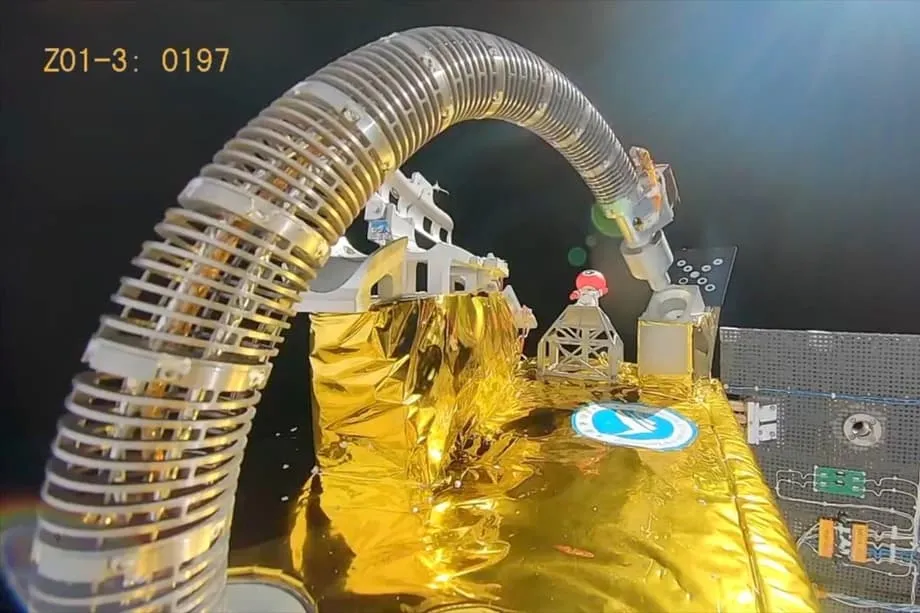
China's Hukeda-2 satellite, also designated Yuxing-3 06, has completed a refueling demonstration in low Earth orbit using a flexible robotic arm inspired by an octopus tentacle. The experiment simulated fuel transfer between spacecraft and tested the arm's ability to adjust its movement and contact pressure, a capability needed for delicate connections in space.
Contents
- A Flexible Arm Takes Satellite Servicing Into Orbit
- How the Tentacle Arm Works
- Why Gentle Contact Is a Difficult Task
- One Mission, Several Organisations
- An Inflatable Sphere for Retired Satellites
- What Refueling Could Change for Operators
- A Commercial Market With International Competition
- Satellites Designed to Receive Maintenance
- China's Commercial Space Sector Broadens Its Role
- Key Points
The satellite launched in mid-March aboard a Kuaizhou-11 rocket from the Jiuquan Satellite Launch Centre, a facility in the Gobi Desert in northwestern China. Chinese state television announced on Tuesday that the spacecraft had completed compliance control and refueling tests. As of March 26, 2026, the mission represents a step toward services that could keep satellites working after their original fuel supplies run low.
Hukeda-2 also carries a second experiment aimed at the other end of a satellite's life: an inflatable device designed to help retired spacecraft leave orbit more quickly. Together, the two technologies address a practical problem for an increasingly crowded orbital environment. Operators need ways to keep useful equipment running and to remove equipment that has finished its work.
The refueling test comes with an important unresolved detail. Mission information has not specified whether Hukeda-2 connected to another satellite or used a test fixture to simulate the connection. The reported demonstration covered the sequence from approach and identification through docking and simulated fuel transfer, while the precise arrangement of the target remains unclear.
The potential reward is substantial. Refueling could extend satellite lifespans by two to three times, reduce the need to manufacture and launch replacements, and potentially save operators millions of dollars per spacecraft. Those benefits underpin plans for commercial orbital servicing later this decade, with Chinese companies projected to begin providing services between 2027 and 2028.
How the Tentacle Arm Works
The Tsinghua Shenzhen International Graduate School developed the flexible robotic arm at the heart of the experiment. Its shape and movement draw on an elephant's trunk and an octopus tentacle, both of which can bend smoothly along their length instead of moving only at a few joints.
Conventional robotic arms on space stations generally use rigid sections connected by mechanical hinges. The Hukeda-2 mechanism instead consists of a series of linked tubes resembling coiled springs. Internal motors pull cables running through the structure, bending its joints in small increments to guide a nozzle at the tip toward a target port.
Cheng Lei, head of research and development at Suzhou Sanyuan Aerospace Technology, described how the arm differs from the rigid systems commonly used in space:
Unlike the rigid robotic arms commonly used on space stations, this one is designed more like an elephant's trunk or an octopus tentacle. It can bend smoothly along its length, making it more flexible and better able to adapt as it approaches a target.
The continuous bending gives the arm room to adjust its approach in tight or complicated spaces. It can move around obstacles and change its shape as it closes in on a connection point, providing a different range of movement from an arm built around rigid segments.
The development team also describes the design as inherently compliant. In simple terms, it can give slightly when it touches something instead of holding a completely rigid position. That ability matters when a nozzle must meet a sensitive port without pushing hard enough to damage it.
Why Gentle Contact Is a Difficult Task
Hukeda-2's compliance control tests addressed the balance between accurate positioning and controlled force. Too much pressure could damage a docking port. Too little could leave the nozzle unable to make a secure connection. The arm therefore needs to adjust both where it moves and how firmly it presses.
Microgravity makes that work demanding. Small vibrations can produce meaningful errors in the position of the arm's tip, while the arm's flexible structure introduces its own elastic movement. Sensors and control algorithms must account for those changes and adjust the mechanism as the connection develops.
The spacecraft involved in orbital refueling travel around Earth at approximately 27,000 kilometers per hour, or 16,800 miles per hour. Developers compare the precision involved to threading a needle while racing down a highway. For the arm, the immediate task is to manage the relative movement between the spacecraft and keep the nozzle aligned with the receiving port.
The intended docking operation calls for accuracy at the millimeter level. Compliance control allows the mechanism to keep adjusting while maintaining appropriate contact force, compensating for residual movement and vibration that could otherwise pull the nozzle out of alignment.
Low Earth orbit also exposes spacecraft to atmospheric drag and radiation. Testing the arm there gives developers experience with the conditions a commercial servicing vehicle would encounter, beyond what can be learned from a mechanism operating on the ground.
One Mission, Several Organisations
Hukeda-2 was jointly developed by Hunan University of Science and Technology and Suzhou Sanyuan Aerospace Technology. It serves as a technology demonstrator for Hangtian Yuxing Keji, a commercial space enterprise based in Beijing, and was constructed by Mofang Weixing Keji in Shenzhen.
Tsinghua Shenzhen International Graduate School contributed the flexible arm. The collaboration brings together university research, spacecraft manufacturing and a company seeking to turn an experimental capability into a commercial service.
The spacecraft combines more than one advanced technology within a single mission. Its refueling mechanism is intended to help active satellites remain useful, while its inflatable drag device is intended to shorten the time retired satellites spend in orbit. Testing both on one spacecraft increases the scientific return from the launch investment.
The main developments and projected next stage are:
- Mid-March 2026: Hukeda-2 launched aboard a Kuaizhou-11 rocket from the Jiuquan Satellite Launch Centre.
- Tuesday, before the March 26 article: Chinese state television announced completion of compliance control and refueling tests.
- 2027 to 2028: Chinese commercial space companies are projected to begin offering orbital servicing services.
- 2035: Industry projections place the potential orbital servicing market in the tens of billions of dollars.
The commercial schedule remains a projection. The mission supplies technical experience for future services, while the next stage requires turning the demonstrated operations into a practical system that can support customers in orbit.
An Inflatable Sphere for Retired Satellites
Hukeda-2 carries a device that can inflate into an ultralight sphere approximately 2.5 meters in diameter. Once deployed, the sphere would increase atmospheric drag, helping a satellite lose orbital height and return toward Earth faster.
Low Earth orbit still contains enough atmosphere for drag to affect spacecraft. Expanding the surface exposed to that thin atmosphere gives the drag device its purpose: it makes the retired satellite slow down more quickly than it would with its usual compact shape.
The technology could reduce the time a satellite remains in orbit after retirement from several decades to less than a year. That would shorten the period during which an inactive spacecraft contributes to orbital clutter and presents a collision risk.
Large satellite constellations, including SpaceX's Starlink, are adding thousands of spacecraft to low Earth orbit. As the number of objects grows, equipment that helps remove satellites at the end of their working lives becomes more valuable for managing traffic and avoiding collisions.
The sphere and refueling arm pursue complementary goals. Refueling aims to preserve a satellite that still has useful work to do. The drag device aims to remove one whose mission has ended. Hukeda-2 brings both approaches into the same experimental spacecraft.
What Refueling Could Change for Operators
Satellite operators currently face a costly limitation: a spacecraft can reach the end of its operational life when its fuel runs out, even when keeping the hardware in service would be useful. The existing approach often leads to manufacturing and launching another satellite to take its place.
Refueling offers a route to longer missions. The projected extension of two to three times the original lifespan could spread the cost of building and launching a spacecraft across many more years of service. Potential savings of millions of dollars per satellite would depend on the costs of the servicing operation and the replacement it avoids.
Cheng Lei said orbital refueling could transform the space economy by allowing continuous maintenance and upgrades of orbital assets instead of relying on replacement. The broader service model includes repair, upgrades and moving satellites to different orbital positions, alongside replenishing fuel.
A useful comparison is the maintenance of mobile communication towers on Earth. Operators repair or replace parts of a tower rather than replacing the entire structure whenever it needs attention. Orbital servicing seeks a similar role for satellites, treating them as equipment that can receive maintenance during their working lives.
Keeping spacecraft useful for longer could also reduce the resources needed to manufacture replacements and the environmental effects associated with additional launches. Combined with faster disposal of retired satellites, that approach links operating costs with the management of debris.
A Commercial Market With International Competition
Industry projections put the orbital servicing market at tens of billions of dollars by 2035. The potential business extends beyond a single refueling operation to repeated maintenance, repairs, upgrades and orbital repositioning throughout a satellite's life.
Chinese commercial companies could begin offering services between 2027 and 2028. Initial customers would likely be Chinese government satellite operators, followed by possible expansion to commercial providers around the world.
Japan's Astroscale is also developing debris removal and servicing capabilities for the global market. The projected Chinese timetable would place private enterprises from China in competition with international ventures pursuing related services.
Hukeda-2's reported success supports China's position in that emerging market by providing experience with a flexible arm operating in orbit. Moving from a demonstrator to a commercial service would bring the technology into a different setting, where customers need reliable connections and useful extensions to satellite missions.
The proposed business model changes what operators would buy. Instead of paying mainly for replacement spacecraft and their launches, they could also pay for services that keep existing assets operating. The commercial appeal rests on whether maintenance delivers more useful mission time at a lower cost.
Satellites Designed to Receive Maintenance
Future spacecraft could include standardized refueling ports and modular components designed for robotic maintenance. Such features would give servicing vehicles a more predictable connection point and make some parts easier to repair or upgrade.
Standardized charging ports in the electric vehicle industry provide a comparison for the idea. A common connection can support a broader network of service providers. For satellites, compatible ports could help refueling move beyond individual experiments toward repeatable operations.
The flexible arm addresses the movement needed to reach a port, while satellite design determines the interface it must connect to. Bringing those elements together would allow manufacturers and servicing companies to plan maintenance before a spacecraft launches.
Hukeda-2 therefore points toward changes in both operations and design. Longer missions would depend on the ability to deliver fuel and maintenance, while future spacecraft could be built with those visits in mind.
China's Commercial Space Sector Broadens Its Role
The mission illustrates the growing capabilities of China's commercial space sector beyond the traditional government aerospace institutions. Hangtian Yuxing Keji, Mofang Weixing Keji and Sanyuan Aerospace worked alongside universities on a spacecraft carrying several demanding experiments.
The collaboration reflects an ecosystem able to undertake sophisticated spacecraft development without direct state agency oversight. It also combines government supported research at Tsinghua with private sector implementation through Sanyuan Aerospace, linking sustained research resources with the pursuit of a viable business.
Flexible robotics already has applications in industry and medicine on Earth. Hukeda-2 brings that approach into space, where the ability to bend, adapt and control contact force can help a robot work around delicate equipment.
The project also fits China's broader effort to develop capabilities across state and commercial space activities. With thousands of new satellites launched annually, services that maintain, refuel and eventually remove spacecraft are becoming part of the infrastructure needed to manage growing orbital traffic.
Hukeda-2 brings those needs into one mission: a flexible arm for extending the lives of useful satellites and an inflatable device for speeding the departure of retired ones. Its reported tests give Chinese companies a technical foundation for pursuing both roles as commercial services later this decade.
Key Points
- Hukeda-2, also called Yuxing-3 06, completed compliance control and simulated orbital refueling tests using a flexible robotic arm.
- The spacecraft launched in mid-March 2026 aboard a Kuaizhou-11 rocket from Jiuquan in northwestern China.
- Tsinghua Shenzhen International Graduate School developed the arm, which bends like an elephant's trunk or an octopus tentacle.
- Mission details have not specified whether the arm connected to another satellite or to a test fixture.
- Refueling could extend satellite lifespans by two to three times and potentially save millions of dollars per spacecraft.
- An inflatable sphere measuring about 2.5 meters across could shorten disposal time from several decades to less than a year.
- Chinese commercial orbital servicing is projected to begin between 2027 and 2028, with the market potentially reaching tens of billions of dollars by 2035.