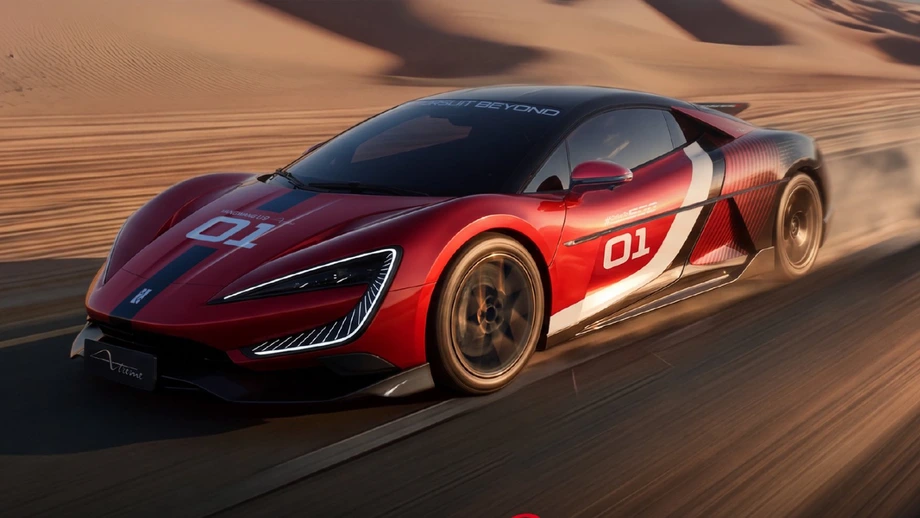
A violent crash on the way to 500 km/h
BYD test driver Jiang Wen escaped serious injury after a Yangwang U9 Xtreme struck barriers on both sides of a closed test track in China during preparations for a speed challenge above 500 km/h. The electric hypercar suffered extensive damage, including the reported loss of its rear assembly, while its carbon fibre passenger compartment remained intact.
Contents
- A violent crash on the way to 500 km/h
- What happened between the two barriers?
- Why Jiang stayed beside the wreck
- What remained intact around the driver?
- Nearly 3,000 horsepower from four motors
- How testing continued after the accident
- From Germany to an Abu Dhabi highway
- How the speed record was measured
- Key Points
The most detailed account of the accident places the first impact at about 360 km/h, after Jiang had been attempting a run in the 420–450 km/h range. Initial descriptions put the crash speed at approximately 450 km/h. Jiang's subsequent account describes the car slowing before it struck the first barrier.
BYD said a comprehensive hospital examination found no serious injuries. Jiang, who had worked at the company for 23 years and volunteered for the test, reportedly climbed out without assistance and initially stayed at the track to study the vehicle's path.
The footage captures an earlier stage of a programme that subsequently passed its target. Yangwang later announced a 503.17 km/h Abu Dhabi run, achieved by German racing driver Marc Basseng on 1 November, with recognition announced on 6 November 2026. The crash accounts describe the Chinese testing that preceded the overseas challenge.
That sequence gives the accident a specific place in the car's development: a heavily damaged test vehicle, a driver spared serious injury, and further work before a different driver took the model beyond 500 km/h.
What happened between the two barriers?
Jiang described the car beginning to slide during the domestic evaluation. He eased off the accelerator and tried to regain control, but the rear continued moving from side to side. At about 360 km/h, he could no longer correct its direction and struck the barrier on the left.
The first impact was followed by a loss of steering control. Jiang said he released the steering wheel and brought his hands to his chest as the car travelled across the track and hit the barrier on the opposite side. Other descriptions place the initial loss of control near the approach to a banked turn, where the track surface slopes upward through a curve.
The vehicle's front and rear bodywork were badly damaged. The rear axle assembly or subframe was reportedly torn away, and the driver's door was also reported to have detached. A subframe is a supporting structure that carries major mechanical components, so losing it represents damage well beyond broken exterior panels.
BYD has not published a technical explanation of what started the slide or a complete instrumented reconstruction of the accident. Jiang's description establishes the sequence he experienced: instability, an attempted correction, contact on the left, then a second collision on the right.
Why Jiang stayed beside the wreck
Hu Xiaoqing, general manager of Yangwang's sales division, described learning that Jiang had not immediately gone to hospital. After getting out, he remained at the scene examining how the vehicle had crossed from one barrier to the other.
Hu urged staff to take him for medical attention. BYD subsequently said hospital checks found no serious injuries. Accounts of the immediate aftermath also describe Jiang sitting up and speaking, with a recorded heart rate of about 120 beats per minute.
Jiang's long service at BYD and decision to volunteer explain his close involvement in the test programme. His interest in the accident's trajectory continued after the impact, but the team's immediate responsibility was to have his condition checked. The hospital examination supplied the medical assessment behind BYD's statement about his health.
The distinction between the violent appearance of the wreck and Jiang's medical outcome is central to the story. Large sections of the vehicle were destroyed or detached, while the space occupied by its driver remained protected.
What remained intact around the driver?
The U9 Xtreme uses a carbon fibre monocoque, a strong central shell that forms the main structure around the occupants. Carbon fibre combines low weight with high strength, allowing engineers to build a stiff passenger compartment without relying entirely on a conventional steel body.
Accounts of the wreck describe that compartment remaining intact, with no obvious deformation of the A pillars, the upright supports beside the windscreen. The windscreen was also reported to have remained unbroken. Preserving this space matters because it gives the occupant room to survive even when surrounding parts suffer extensive damage.
The traction battery, which stores the electricity used to drive the motors, reportedly did not smoke, catch fire or explode. That was a separate safety outcome from the condition of the passenger cell. A powerful electric car needs protection for both its occupants and its large store of electrical energy.
The car's path also helps explain why the stated speed alone cannot describe the forces on Jiang. It hit barriers, crossed the track and rotated, rather than stopping in a single direct impact. The angle of contact, changes in direction and distance over which a vehicle slows all affect the forces reaching its occupants.
At 360 km/h, a vehicle travels 100 metres each second. At 450 km/h, it covers 125 metres each second. Those figures show how quickly a developing slide can carry a car across a test area, leaving little time for the driver to respond.
Nearly 3,000 horsepower from four motors
The U9 Xtreme is a version of Yangwang's electric supercar developed for demanding track use and extreme speed. Its four motors each produce 555 kilowatts, giving a combined output of 2,220 kilowatts, or about 2,977 horsepower.
BYD's e4 platform allows the car to control the torque at each wheel independently. Torque is the turning force that drives a wheel. Controlling it separately at all four corners gives the vehicle another way to manage acceleration and stability, alongside its steering, tyres and suspension.
The car uses a 1,200 volt electrical architecture and an 80.0 kilowatt hour battery pack. Voltage describes the electrical potential driving current through the system, while kilowatt hours describe how much energy the battery stores. A higher voltage can deliver a given amount of power with less current, helping engineers manage electrical losses and heat.
BYD describes its platform as the world's first mass produced architecture operating at 1,200 volts and says the four motors are rated at 30,000 revolutions per minute. The U9 Xtreme also uses tyres intended for track performance and a revised version of the company's DiSus-X suspension system.
Its reported kerb weight is 2,480 kilograms. Moving that mass to extraordinary speeds requires both immense power and careful control. During its German record run, the model reportedly accelerated from 300 to 400 km/h in approximately 10 seconds.
How testing continued after the accident
The domestic programme progressed through several speed ranges before the crash. An initial run exceeded 350 km/h, followed by another above 420 km/h. The accident occurred during the next stage, described as an evaluation in the region of 420–450 km/h.
After reviewing the incident and making adjustments, the team continued testing and reached 457.89 km/h. The accounts do not identify the vehicle used for that later run or detail the engineering changes. The damaged car had suffered extensive structural and mechanical losses.
The 457.89 km/h result was 38.33 km/h below the model's existing German benchmark of 496.22 km/h. Its value within the programme was practical: it supplied another high speed result before the team moved to the United Arab Emirates.
BYD closed its video with a statement about its continuing speed ambitions. In the English translation accompanying the account, the company said:
The ultimate pursuit has no end; the summit will eventually be reached.
The later Abu Dhabi result put a number on that ambition. The car reached 503.17 km/h, an increase of 6.95 km/h, or about 1.4%, over the German benchmark.
From Germany to an Abu Dhabi highway
The U9 Xtreme reached 496.22 km/h at Germany's ATP Papenburg proving ground in September 2025, the month of its global debut. That left it just 3.78 km/h short of the 500 km/h target that shaped the next phase of testing.
Hu announced an Abu Dhabi open road challenge on 1 November in the crash coverage. Earlier planning also included a possible Dubai attempt on a road measuring about 15 kilometres, with local police assistance. The eventual record attempt took place in Abu Dhabi on a closed section of the E11 highway in the Al Dhafra region.
The main stages of the programme were:
- September 2025: The U9 Xtreme reached 496.22 km/h at ATP Papenburg in Germany.
- Domestic preparation: Jiang crashed during evaluation in the 420–450 km/h range; his account placed the first barrier impact at about 360 km/h.
- Further domestic testing: The team recorded 457.89 km/h after reviewing the accident and making adjustments.
- 31 October 2026: Basseng's first two Abu Dhabi runs produced a best speed of 490 km/h.
- 1 November 2026: Basseng reached 503.17 km/h after changes to aerodynamics, suspension settings and tyre pressures.
- 6 November 2026: Recognition of the Abu Dhabi result was announced.
The Abu Dhabi attempt used a highway section measuring 10 kilometres, including a straight of seven kilometres. Closing that section removed ordinary traffic from the route while providing the long acceleration and braking distances needed for the attempt.
How the speed record was measured
The German 496.22 km/h result and the later Abu Dhabi peak were measured in a single direction. A different record method averages runs made in opposite directions, helping balance the effects of wind and road gradient. Readers comparing top speeds need the measurement method alongside the headline number.
Yangwang announced the Abu Dhabi achievement as a world production car speed record. FIA recognition was announced on 6 November 2026, while Guinness World Records recorded achievements in two categories for runs made in a single direction.
Only 30 examples of the U9 Xtreme are planned for customers worldwide. The small production run places the model at the extreme end of BYD's vehicle programme, where a handful of cars carry technology and performance far beyond ordinary road use.
For the people involved, the programme's two defining outcomes were different in kind. Jiang emerged from the Chinese accident without serious injury, according to BYD's medical update. Basseng later drove the model beyond the speed target. Between those events lay further testing, adjustments and a move from a domestic circuit to a closed highway in Abu Dhabi.
Key Points
- BYD said test driver Jiang Wen suffered no serious injuries after the U9 Xtreme crashed during extreme speed testing in China.
- Jiang's account placed the first barrier impact at about 360 km/h during an evaluation targeting 420–450 km/h.
- The car struck barriers on both sides of the track and suffered extensive front and rear damage.
- The carbon fibre passenger compartment remained intact, and no battery fire was reported.
- Further domestic testing produced 457.89 km/h before the overseas challenge.
- The model later reached 503.17 km/h in Abu Dhabi, exceeding its September 2025 German result of 496.22 km/h.