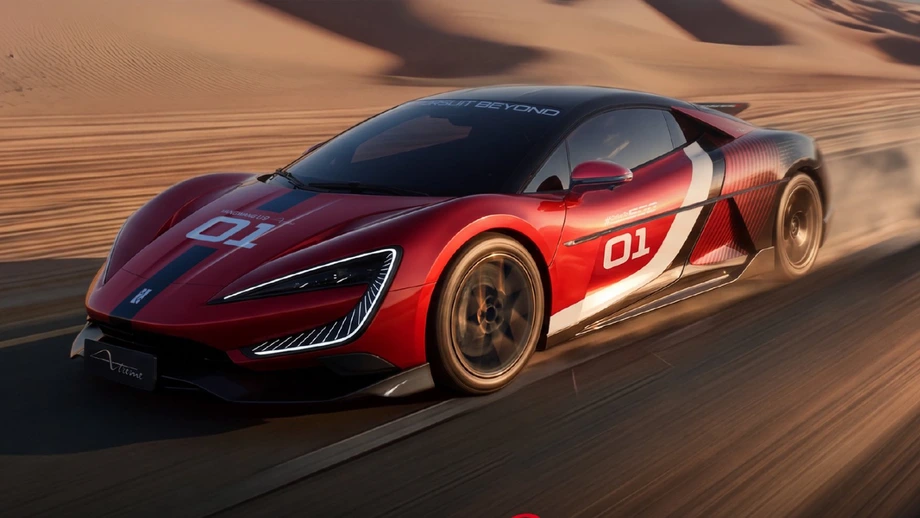
A 500 km/h barrier falls in Abu Dhabi
BYD's Yangwang U9 Xtreme has reached 503.17 km/h on a closed section of highway in Abu Dhabi, taking the electric supercar beyond a threshold no production car had previously crossed. German racing driver Marc Basseng achieved the speed on 1 November on the E11 in the emirate's Al Dhafra region.
Contents
Yangwang announced the result as a world production car speed record. The FIA recognised the speed on 6 November, while Guinness World Records recorded the achievement in two categories for runs made in a single direction. That measurement method matters when comparing the result with records based on an average of runs in opposite directions.
The new peak exceeds the U9 Xtreme's September 2025 result of 496.22 km/h at Germany's ATP Papenburg proving ground by 6.95 km/h, an increase of about 1.4%. At 503.17 km/h, the car travels approximately 140 metres every second.
The attempt used a 10 km section of Sheikh Khalifa Bin Zayed International Road, including a straight measuring seven kilometres. Although the route is a public highway, the section was closed for the speed attempt.
Yangwang's achievement also puts a Chinese electric supercar at the centre of a contest long associated with specialist performance brands. The U9 Xtreme's earlier German result had already exceeded the approximately 490 km/h achieved by the Bugatti Chiron Super Sport 300+.
What changed between the first runs and the record?
Basseng's first two runs on 31 October produced a best speed of 490 km/h. That left the car below its existing German benchmark and short of the team's 500 km/h target.
Yangwang's engineers then adjusted the aerodynamics, suspension settings and tyre pressures. Basseng made two more passes on 1 November, reaching 503.17 km/h on the final run. The improvement over the opening day's best was 13.17 km/h.
Abu Dhabi presented a different environment from the German proving ground. High ambient temperatures, crosswinds and desert dust were reported during the challenge. Heat increases the demands on the battery, motors and cooling systems, while wind can affect both straight line speed and stability.
Hu Xiaoqing, general manager of the Yangwang Sales Division, announced the challenge. The engineering programme has involved Yangwang's own development team, whose members have an average age below 30, with testing of the U9 and U9 Xtreme continuing since 2024.
The progression from testing to the latest record spans several stages:
- January 2024: The original U9 reached 309 km/h during testing in China.
- October 2024: The U9 reached 391.94 km/h at Papenburg in Germany.
- August 2025: A U9 engineering test car reached 472.41 km/h at the German facility.
- September 2025: The U9 Xtreme reached 496.22 km/h at Papenburg. Its global debut and the opening of orders followed on 20 September.
- April 2026: The production version was unveiled at the Beijing Auto Show.
- 31 October and 1 November: Abu Dhabi testing progressed from 490 km/h to the record peak of 503.17 km/h.
- 6 November: FIA recognition of the Abu Dhabi speed was announced.
How was the speed verified?
Guinness verified the speed using the car's onboard speedometer and a calibrated VBOX data logger, an instrument used to measure vehicle movement and speed. An FIA representative reviewed the data and supplied written confirmation for the Guinness verification.
The Guinness records use the highest speed reached during a pass in one direction. A different method, used for some other production car records, averages speeds from runs in opposite directions. Running both ways helps balance the effects of wind and road slope.
The SSC Tuatara, for example, recorded an independently verified average of 455.3 km/h in Florida in 2021. Its two runs produced speeds of 450.1 km/h and 460.4 km/h. The Yangwang figure describes its peak in one direction; the Tuatara figure describes the average of two opposing runs.
Readers comparing the fastest cars therefore need both the speed and the testing method. Yangwang's 503.17 km/h achievement is the first production car result above 500 km/h under the single direction format recognised for this attempt.
Four motors and a 1,200 volt platform
The U9 Xtreme produces a combined peak output of 2,220 kilowatts from four independently controlled electric motors. Each motor can deliver 555 kW and spin at up to 30,000 revolutions per minute.
Yangwang expresses the combined output as more than 3,000 PS, a metric measure of horsepower. The same 2,220 kW is approximately 2,977 horsepower under another commonly used horsepower standard. The different numbers reflect different units for the same power output.
The company gives a ratio of power to weight of 1,217 PS per tonne. This measure describes how much power is available for each tonne of vehicle mass, helping explain why engineers work on weight as well as motor output.
A 1,200 volt electrical platform supplies the motors. Higher voltage allows a given amount of electrical power to be delivered with less current. Managing current matters because electrical resistance produces heat, which becomes a major concern when a car is drawing enormous power.
The car's Blade Battery supports a 30C discharge rate. In battery terminology, that describes an extremely rapid release of stored energy: at a constant 30C rate, a battery would theoretically discharge its rated capacity in about two minutes. Here, the figure concerns delivering power to the motors, rather than the time needed to recharge.
Yangwang has also revised the car's thermal management system. Cooling must deal with heat from the battery, motors and associated electronics so the vehicle can maintain its performance during demanding runs.
Keeping the tyres and body under control
Yangwang developed the U9 Xtreme's tyres with Giti Tire for speeds above 500 km/h. They use aramid fibre reinforcement and technology intended to suppress standing waves, a dangerous pattern of tyre deformation that can develop at very high speeds.
A tyre repeatedly bends as it rolls through the area touching the road. At extreme speed, that deformation can persist around the tyre rather than settling quickly. Controlling it is essential because excessive deformation generates heat and puts the tyre structure under stress.
The custom tyres use a semi slick design, with fewer tread grooves than ordinary road tyres. Their development is a central part of the speed programme, alongside the car's enhanced titanium alloy and carbon ceramic braking system.
Yangwang's e4 drive system controls the four motors separately. Its torque vectoring system reportedly adjusts power distribution up to 100 times per second. In simple terms, the car can change how much turning force each wheel receives to help manage grip and direction.
The DiSus-X fully active body control system manages the car's body movement through its suspension. The adjustments made between the Abu Dhabi runs show how suspension settings, tyre pressures and airflow work together when engineers seek both speed and stability.
The body includes a carbon front splitter, a rear diffuser, a bonnet with two airflow channels and a rear wing mounted on swan neck supports. These parts guide air around the vehicle and help control the forces acting on it. Aerodynamic settings require a balance: pressing the car harder against the road can support grip, while extra air resistance can reduce maximum speed.
Yangwang also uses aviation grade structural components made through 3D printing. The manufacturing approach allows complex shapes that can help engineers meet demanding structural and weight requirements.
A record driver and a different kind of lap
Basseng brought substantial racing experience to the Abu Dhabi attempt. He won the 2012 FIA GT1 drivers' championship alongside Markus Winkelhock and also won the Nürburgring 24 Hours that year. He had already driven the U9 Xtreme to its 496.22 km/h German benchmark.
After the Papenburg run, Basseng described to BYD how the electric drivetrain affected his concentration behind the wheel:
Thanks to the electric motor, the car is quiet, there are no load changes, and that allows me to focus even more on the track,
The U9 Xtreme has also recorded a lap of 6 minutes 59.157 seconds around the Nürburgring Nordschleife, driven by Moritz Kranz. The detailed event chronology dates that lap to 22 August 2025, although September 2025 is also given for the achievement.
Kranz completed the 20.832 km course 0.843 seconds below seven minutes. The car became the first electric super sports car to cross that threshold in the Nürburgring's official classification.
A circuit lap tests a different collection of abilities from a maximum speed run. The Nordschleife result combines acceleration with braking, cornering, grip and the ability to manage power around a long course. Together, the two results show the range of tasks Yangwang has pursued with the Xtreme programme.
Thirty cars, with a price above 20 million yuan
Yangwang has limited U9 Xtreme production to 30 cars worldwide, allocating 28 outside China and two to the domestic market. The allocation sold out during the Beijing Auto Show period.
The production version shown in April 2026 carried a price above 20 million yuan per car, approximately $2.98 million at the conversion cited with the launch. It was the most expensive car sold at that show. A delivery schedule has not been specified.
The standard Yangwang U9 went on sale in China in February 2024 and starts at 1.8 million yuan. The Xtreme therefore costs more than 11 times the standard model's starting price, using the stated yuan figures.
The standard U9 has four motors rated at 240 kW each, for a combined 960 kW. The Xtreme's 2,220 kW is more than twice that output. Its changes also extend to the tyres, brakes, cooling, electrical architecture and aerodynamics needed for the record programme.
For buyers, the result concerns an exceptionally small and expensive production run. For Yangwang, it gives its flagship a verified speed achievement supported by a broader engineering programme, from the original U9's 2024 tests to a Nürburgring lap and the latest Abu Dhabi passes.
Key Points
- The Yangwang U9 Xtreme reached 503.17 km/h on a closed highway section in Abu Dhabi, driven by Marc Basseng.
- The result exceeded its previous 496.22 km/h benchmark by 6.95 km/h.
- FIA recognition was announced on 6 November. Guinness verified records based on peak speed in a single direction.
- Four electric motors deliver a combined 2,220 kW through a 1,200 volt platform.
- Custom Giti tyres, active suspension, revised aerodynamics and cooling support the car's extreme performance.
- The U9 Xtreme also completed a Nürburgring Nordschleife lap in 6:59.157.
- Production is limited to 30 cars, priced above 20 million yuan each, with the allocation sold out.