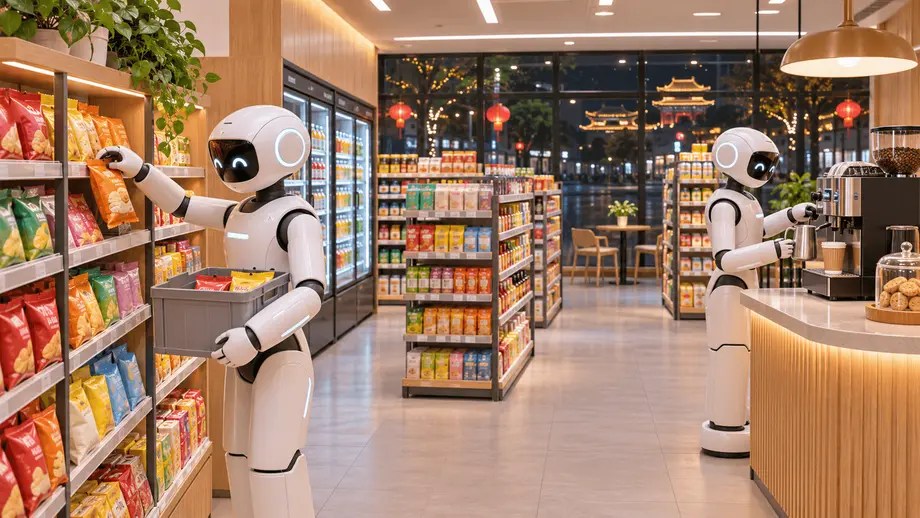
A Full Day at the Counter, With Four Robots Passing
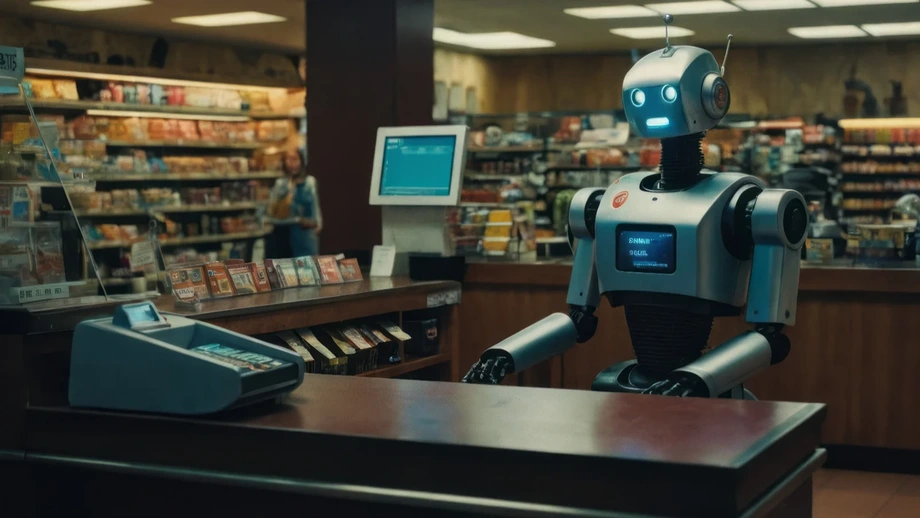
Six AgiBot G2 humanoid robots completed 1,730 tasks during a 24-hour trial at an operating convenience store in Shanghai's Xuhui district, serving customers through lunch, evening, overnight and breakfast periods. Four of the six passed the event's probation review, which assessed task completion, response speed, handling of unexpected situations and customer feedback.
Contents
- A Full Day at the Counter, With Four Robots Passing
- How the Six Robots Shared the Work
- Customers and Testers Changed the Conditions
- Why a Bun or a Freezer Door Is Difficult
- The Software Connecting Decisions and Movement
- What the Review Measured and What Is Still Missing
- From Product Releases to an Overnight Shift
- What the Trial Means for Store Work
- Key Points
The challenge ran from 10:00 on November 2 to 10:00 on November 3. Each robot had a fixed assignment, ranging from greeting customers and fetching goods to making coffee and cleaning tables. AgiBot said the livestream attracted more than 2 million viewers online.
The busiest assignment by the company's final count was customer reception, with 683 interactions. The robots also completed 369 item fetches and deliveries, 147 coffees, 126 breakfast orders, 277 restocking and shelf checks, and 128 table cleanings.
The trial brought several difficult problems together in one place: understanding what a customer wants, finding the correct product, handling objects gently and moving around people. Invited testers deliberately rearranged goods and blocked routes, while ordinary trading continued around the machines.
AgiBot described the run as operating without a human in the loop, meaning no human demonstrations or manual adjustments at the store. The published results nevertheless leave an important part of the performance picture unfinished: the company released completed task counts and success rates from the deployment before the livestream, but has not published success rates for the 24-hour trial or human takeover numbers.
How the Six Robots Shared the Work
One robot greeted customers at the entrance. Two handled picking, restocking and shelf patrols. A fourth made coffee, a fifth worked at the checkout counter and handled hot food, and the sixth cleaned tables.
Fixed assignments gave the machines different workloads. A greeting requires a different sequence of actions from making a drink or packing food. Even within one assignment, a robot could face changing requests, misplaced goods or an aisle occupied by a customer.
Customer receptions and item fetches together accounted for 1,052 of the 1,730 completed tasks, or about 61 percent. That gives a sense of where much of the activity occurred, although the counts give equal weight to tasks that may take very different amounts of time and effort.
The full tally was:
- Customer receptions: 683.
- Item fetches and deliveries: 369.
- Coffee preparation: 147.
- Breakfast service: 126.
- Restocking and shelf checks: 277.
- Table cleaning: 128.
Across the six robots, the total works out to about 72 completed tasks per hour for the team. Actual demand varied as the shop moved through busy periods and quieter overnight hours.
Customers and Testers Changed the Conditions
Invited testers challenged the robots with situations that required more than remembering where products usually sit. They mixed regular and sugar-free cola, then asked specifically for the sugar-free version. They also scrambled a full shelf of chewing gum.
The robots were reported to have combined the spoken drink request with visual checks to identify the right cola. For the chewing gum, they counted items visually while restoring the shelf, rather than depending on positions indicated by price tags.
Both tests targeted a common retail problem: the shop in front of a worker may differ from the expected layout. A customer may put a product back in the wrong place, and similar packaging can make two different products look almost identical.
Testers also stood in aisles and dropped boxes in the robots' paths. The machines were reported to have stopped and chosen new routes around obstacles. In an operating shop, movement and service are connected: reaching a shelf safely is part of completing the customer's request.
Why a Bun or a Freezer Door Is Difficult
Ren Guanghui, vice president of AgiBot's embodied research center, described convenience stores as demanding environments because they contain many types of goods, varied customer requests and tools that robots must use. A factory task can take place in a more fixed setting, with a narrower range of objects and movements.
Packing a bun illustrates the difficulty. The robot has to use tongs, grasp the food and open a paper bag. Each step changes the position of the objects and the space available for the next movement. A successful grasp alone is only one part of finishing the order.
Opening a freezer created another series of problems during development. The robot needed to understand which way the door opened and how much force to apply. It then had to coordinate both arms, holding the door with one while using the other to retrieve an item.
Ren explained that sensors on the head and wrists, together with force sensors on the arms, help the robot judge its movements. Force sensing lets a machine detect how hard it is pushing or pulling, helping it avoid a harsh collision or damage to the door.
Some of the hardest tasks involved goods that bend, shift or break easily. Hanging bags of candy on hooks and picking up soft cake without crushing it remained difficult, and the robots sometimes failed. Those examples show why a store trial needs to examine the quality of handling as well as the number of jobs completed.
The Software Connecting Decisions and Movement
All six robots were coordinated by Genie Master, AgiBot's embodied agent framework. The company says its Embodied Execution Protocol connects task decisions, physical movement and feedback from the result.
In simple terms, embodied intelligence is artificial intelligence that acts through a physical machine. A store robot has to turn a request into movements, then use its sensors to check what happened. Asking for a drink sets a goal; finding, grasping and delivering the correct container requires a chain of physical actions.
AgiBot says its system reviews successful and failed runs each day, stores useful experience in long-term memory and turns corrected attempts into training data. That training data consists of examples the system can use to improve later behavior.
Ren said the ordering system initially encountered failed orders, status updates that did not register and conflicts over robot positions. Problems with workflow coordination were reviewed the same day, with changes taking effect the next day without changing the model itself.
The robots also practiced during quiet hours. Ren said they would go to the shelves during idle periods at night to practice harder tasks. This made the shop both a workplace and a setting for further practice, with tasks continuing outside the busiest customer periods.
The company's description connects several parts of robot development that are often presented separately: choosing an action, carrying it out and learning from the outcome. The convenience store put those parts into a single deployment, where a mistake in one step could affect the rest of an order.
What the Review Measured and What Is Still Missing
Four robots passed the probation review after assessment of task completion, response speed, handling of exceptions and customer feedback. Two did not pass. The published outcome leaves their individual results and reasons for failing unspecified, alongside the missing success figures for the 24-hour trial and human takeover figures.
During the convenience store deployment before the livestream, the G2 robots running GO-3 Preview improved their complete workflow success rate from 28.6 percent on the first day to a stable 85.7 percent by the fifth day. Their single-task success rate was 17.7 percentage points higher than with conventional supervised fine-tuning, or SFT. These figures describe the deployment before the livestream, not the 24-hour trial itself.
Ren said the company would track a broader set of measures: task success rate, success on the first attempt, response time, total time from request to completion, acceptable deliveries per unit of time, human takeover frequency, recovery time and system availability.
Those measures answer different practical questions. First-attempt success records whether a robot gets a job right immediately. Recovery time measures how long it takes to resume useful work after a problem. System availability describes how much of the intended operating period the equipment is ready for use.
A store operator needs that detail because a completed delivery may follow a quick, smooth action or several retries. Likewise, a robot that responds promptly but spends a long time finishing an order creates a different customer experience from one that completes the whole sequence quickly.
AgiBot's final task count records the volume of completed activity. The fuller performance measures would let a shop assess how consistently the machines could serve customers, how much support they need and how well they recover when something goes wrong.
From Product Releases to an Overnight Shift
The convenience store challenge closed AgiBot's AI WAVE release series, which began on October 22. The series brought the company's datasets, simulation platform, models and robot hardware together in a live deployment.
The main milestones were:
- October 22: AgiBot began its AI WAVE release series.
- November 2, 10:00: The six robots started the convenience store challenge in Shanghai's Xuhui district.
- November 2 to November 3: The team worked through lunch and evening peaks, overnight duty and the morning peak.
- November 3, 10:00: The trial ended, with AgiBot reporting 1,730 completed tasks and four robots passing the review.
Ren identified overnight duty as one practical area the company is exploring. Shops that stay open around the clock need staff during hours that disrupt normal sleep patterns, while some repetitive duties require long periods of attention.
AgiBot is also exploring autonomous battery swapping to support extended operation. That would allow a robot to exchange a depleted battery and return to work. The approach is part of the company's stated plans for sustaining long periods of service.
What the Trial Means for Store Work
The Shanghai deployment placed robots in several connected service roles while customers continued shopping. Its strongest practical detail is the range of work attempted: speaking with customers, distinguishing products, handling food, using equipment, navigating aisles and cleaning shared surfaces.
The difficult moments were equally concrete. A soft cake needs a gentle grip. A freezer door needs controlled force and coordinated arms. A misplaced product needs a fresh visual check. Each is a small action for an experienced worker, yet each requires several robot capabilities to work together.
For a retailer considering similar equipment, the central questions are reliability throughout a shift, service quality during busy periods and the amount of human support required. AgiBot has published a substantial activity count and a mixed probation result. Its proposed performance measures would provide the next level of detail needed to judge routine store use.
Key Points
- Six AgiBot G2 humanoids worked from November 2 to November 3 in an operating convenience store in Shanghai's Xuhui district.
- AgiBot reported 1,730 completed tasks, including 683 customer receptions, 369 item fetches and deliveries, and 147 coffees.
- Four robots passed the event's probation review; two did not.
- Testers rearranged products and blocked aisles, testing identification, shelf work and navigation.
- Delicate handling, including lifting soft cake and hanging candy bags, remained difficult.
- AgiBot described the run as having no human demonstrations or manual adjustments at the store. Before the livestream, complete workflow success rose from 28.6 percent on day one to 85.7 percent by day five, and single-task success was 17.7 percentage points higher than with conventional supervised fine-tuning. Success rates for the 24-hour trial and human takeover figures remain unpublished.
- The company is exploring overnight work and autonomous battery swapping for longer periods of operation.