A close view of a spacecraft China rarely shows
A commercial satellite photograph taken on May 28, 2024, and released in a US intelligence assessment on October 26, 2026, offers an unusually detailed view of China's secretive reusable spaceplane. The image shows a winged vehicle with its cargo bay doors open and a structure with solar panels extending behind it, bringing new attention to experiments involving nearby objects in orbit.
Contents
- A close view of a spacecraft China rarely shows
- What the photograph reveals
- Why the name Shenlong needs care
- Four missions, with much longer stays in orbit
- Close encounters are the central clue
- How the American X-37B compares
- Why satellite handling attracts military attention
- A wider warning about space security
- Key Points
The photograph was captured by WorldView-3, operated by the company now called Vantor, previously Maxar. The observation was made from about 90 kilometres away, with a reported resolution of roughly 4.5 centimetres per pixel. That level of detail allows viewers to distinguish features that were difficult to identify in earlier public images.
The US Defense Intelligence Agency included the photograph in its assessment, Challenges to Security in Space: Congestion, Competition, and Cooperation 2026. Its release connects a rare close view of the Chinese vehicle with a longer record of tracked manoeuvres, satellite releases and possible recoveries.
Vantor describes a separate satellite attached to the rear of the spacecraft. Another description identifies the structure as a service module carrying solar arrays. The identity of the attached equipment, its relationship to the spaceplane and the work underway when the photograph was taken remain undisclosed.
China describes its programme as a way to test reusable spacecraft technology and develop more convenient, less expensive transport for the peaceful use of space. The DIA places the vehicle within a broader assessment of technologies that could also support military operations.
What the photograph reveals
The vehicle has triangular delta wings, two tail fins, a dark underside associated with protection during atmospheric reentry, and an open central payload bay. Its wings appear wider and more distinctly triangular than those of the American X-37B, the closest operational comparison.
Solar arrays extend on either side of the structure at the rear. These panels turn sunlight into electricity, providing power while a spacecraft operates away from Earth. An open payload bay can expose experiments or equipment carried inside the vehicle.
WorldView-3 normally photographs Earth. For this observation, its camera viewed another object in space, a practice known as non-Earth imaging. The technique allows satellites built to observe the ground to inspect spacecraft when their orbital paths and viewing conditions permit.
A lower resolution version of the image had already appeared publicly. Colonel John Patrick, then commander of US Space Forces Korea, displayed it at a space forum in South Korea in 2024. The newly released version makes the vehicle's shape and external equipment easier to examine.
Why the name Shenlong needs care
Shenlong, often translated as Divine Dragon, is the name commonly used outside China for the experimental spaceplane. Chinese state media generally use Chongfu Shiyong Shiyan Hangtian Qi, abbreviated CSSHQ, meaning reusable experimental spacecraft.
The DIA identifies Shenlong and Tengyun as China's principal spaceplane models. Tengyun is a separate concept proposed by China Aerospace Science and Industry Corporation in 2016, involving a carrier aircraft and an orbital vehicle in a system with two stages.
The assessment also distinguishes these programmes from Haolong-1, a proposed cargo spaceplane intended to supply China's space station. The photographed vehicle is widely described as Shenlong, although the report leaves its precise model designation unspecified.
China's experimental vehicle launches aboard a Long March 2F rocket and returns to land on a runway. Public knowledge of the programme is much thinner than the record of its American counterpart, including uncertainty over how many Chinese vehicles exist. Four flights have been tracked, but the size of the fleet is unknown.
Four missions, with much longer stays in orbit
China's first flight lasted about two days. The next two lasted 276 and 268 days, turning a brief initial demonstration into missions lasting roughly nine months. The WorldView-3 photograph was taken during the third flight.
The programme's main milestones show how its activity has developed:
- September 4, 2020: The first experimental reusable spacecraft launched and returned after about two days.
- August 2022: The second mission began. It lasted 276 days and included tracked encounters with a companion object.
- December 14, 2023: The third mission launched. It returned on September 6, 2024, after 268 days.
- May 28, 2024: WorldView-3 photographed the spacecraft during that third mission.
- February 7, 2026: The fourth mission launched.
- June to September 2026: Tracking observations indicated further releases and possible recoveries of a smaller object.
- October 26, 2026: The DIA published the detailed image in its space security assessment.
The two completed extended missions totalled 544 days in orbit. Their lengths were similar, with the second lasting eight days longer than the third. The fourth mission was still described as operating in orbit when the October assessment appeared.
Long flights give operators time to test equipment through repeated changes in sunlight, temperature and orbital position. Returning the vehicle also lets engineers examine hardware after months in space, rather than relying entirely on measurements transmitted to Earth.
Close encounters are the central clue
The strongest evidence about the spaceplane's activities comes from its movements near other objects. During the second mission, the DIA assessed that the vehicle travelled alongside a companion satellite while maintaining a relatively steady distance.
The Defense Intelligence Agency described the November 2022 encounter in its report:
In November 2022, this spaceplane appeared to manoeuvre with a companion satellite and conduct station-keeping at around 1 kilometre separation,
Station keeping means making small adjustments to hold a position relative to another object. In orbit, two spacecraft can be moving around Earth at very high speed while remaining almost motionless relative to each other.
The DIA said the objects may have approached within 100 metres and may have rendezvoused before the smaller satellite was released again. A rendezvous is a controlled approach between spacecraft. Physical attachment requires a further step, such as docking or capture.
The third mission also released and interacted with an object. During the fourth flight, space tracking company LeoLabs detected a new object near the spacecraft in June 2026. Astrophysicist Jonathan McDowell's analysis of public orbital tracking data indicated that the vehicle released a small satellite in June and recaptured it in July, then repeated the process in August and September.
McDowell's interpretation points to repeated practice rather than a single encounter. The capture mechanism remains unknown; a robotic arm is one possible explanation. The combination of the photograph and tracked movements makes handling equipment in orbit a central part of understanding the programme.
How the American X-37B compares
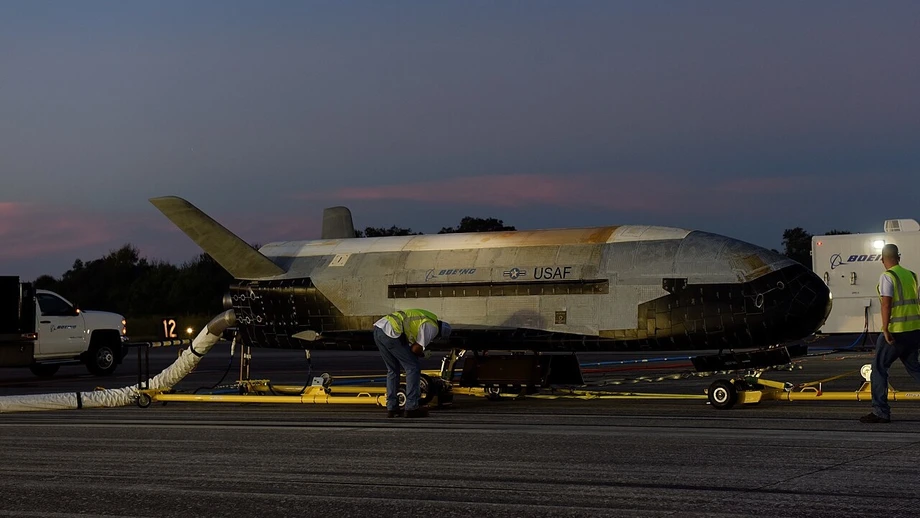
The US Space Force operates the Boeing X-37B, another uncrewed vehicle that launches on a rocket, spends extended periods in orbit and returns to a runway. Its first flight began in April 2010.
The X-37B had completed seven missions before its eighth launch in August 2025, accumulating more than 4,200 days in space. Its longest completed flight lasted 908 days, more than three times the 276 days of China's longest completed mission described here.
The seventh American mission ended at Vandenberg Space Force Base in California on March 7, 2025. It demonstrated aerobraking, which uses carefully controlled passes through the upper atmosphere to change an orbit while saving propellant.
The eighth mission launched aboard a SpaceX Falcon 9 on August 21, 2025, in the United States, corresponding to August 22 in China. Its disclosed experiments included laser communications and a quantum inertial sensor intended to support navigation where GPS is unavailable or disrupted. An inertial sensor measures motion so a vehicle can estimate how its position changes.
Colonel Brian Chatman, then installation commander for Space Launch Delta 45, explained the value of bringing experiments back after the eighth launch:
Having a returnable space platform allows us to learn faster,
Both programmes use a reusable, winged spacecraft, but their public descriptions provide different levels of detail. The United States identifies some experiments while keeping others classified. China has released much less information about individual payloads and operations.
Why satellite handling attracts military attention
A spacecraft able to approach, inspect, move or retrieve another object could repair satellites, remove abandoned equipment or return experiments to Earth. Similar equipment could also interfere with satellites used by another country. The intended target and the operator's actions determine how those capabilities are used.
The DIA points to other Chinese missions as examples of physical manipulation in orbit. In January 2022, Shijian-21 moved a defunct BeiDou navigation satellite into a higher disposal orbit above the geostationary region. Such disposal orbits help move old equipment away from heavily used operating positions.
Shijian-17, which carries a robotic arm, is another example cited by the agency. An arm can provide a way to grasp or move equipment, making it relevant to both servicing work and military planning.
China's 2007 destruction of an ageing weather satellite with an anti-satellite missile illustrates a different approach. That test created thousands of pieces of debris, many of which remain in orbit. Debris can endanger other spacecraft regardless of which country owns them.
For satellite operators, controlled approaches and destructive attacks present different practical risks. Close encounters require careful tracking and manoeuvring, while fragments from a destroyed satellite can spread into orbits used by many unrelated missions.
A wider warning about space security
The DIA assessment says China has tripled its satellite fleet since 2018. It also describes Chinese capabilities involving missiles, cyber operations, lasers and spacecraft able to approach other objects in orbit.
The agency's forecast extends beyond the spaceplane. It warns that China may deploy systems using directed energy, such as lasers, both in space and on the ground. Directed energy concentrates electromagnetic energy on a target, potentially interfering with or damaging sensitive satellite equipment.
The Defense Intelligence Agency set out its forecast in the report:
By the late 2020s, China may field space-based directed energy systems and higher-powered ground-based directed energy systems capable of threatening satellites in higher orbits.
The assessment also addresses Russia, Iran and North Korea, growing orbital debris and closer connections between commercial space services and military operations. Its warning about Russia includes an alleged programme to develop a satellite designed to carry a nuclear weapon, despite the 1967 Outer Space Treaty's prohibition on placing nuclear weapons in Earth orbit.
Communications, navigation, weather forecasting and military operations all depend on satellites. More vehicles, more debris and more military activity make the same orbital regions harder to manage. The newly detailed Chinese spaceplane image provides a concrete view of one programme within that wider competition, while its repeated encounters with smaller objects show why tracking what spacecraft do is as important as identifying their shape.
Key Points
- The DIA released a detailed image of China's reusable spaceplane on October 26, 2026; WorldView-3 took the photograph on May 28, 2024.
- The image shows delta wings, open cargo bay doors and equipment with solar arrays behind the vehicle.
- China's second and third missions lasted 276 and 268 days. Its fourth launched on February 7, 2026.
- The DIA described a close encounter in 2022, while tracking analysis indicated repeated releases and recaptures during 2026.
- China describes the programme as testing reusable transport technology for peaceful space use.
- The spacecraft's payloads, attached equipment and precise mission objectives remain undisclosed.