Six robots, 1,730 tasks and two unfinished assignments
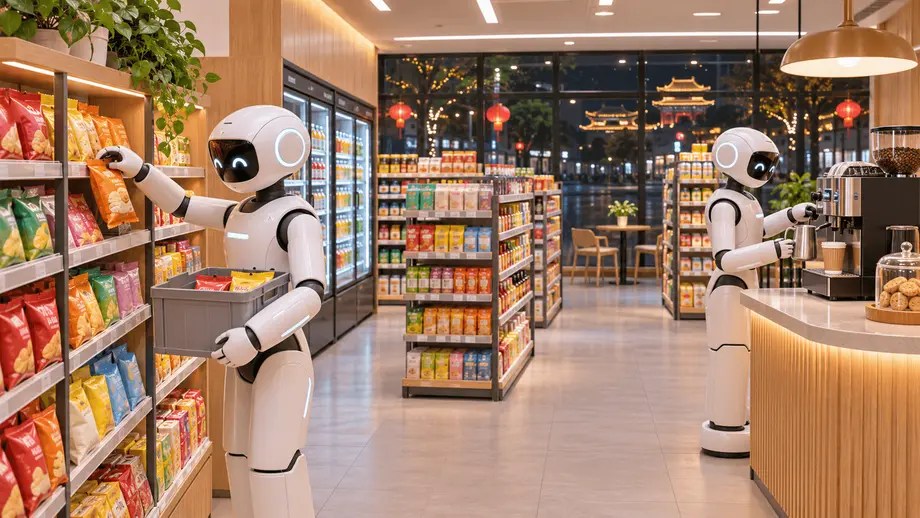
Six Agibot G2 humanoid robots completed a reported 1,730 tasks during a 24-hour trial at a working convenience store in Shanghai's Xuhui district, with four passing their assessments and two held back for further adjustments. The exercise ran from 10 a.m. on November 2 to 10 a.m. on November 3, 2026, covering lunch, evening shopping, overnight duty and breakfast service.
Contents
- Six robots, 1,730 tasks and two unfinished assignments
- Who passed, and who needs another assessment?
- Four shifts put different pressures on the machines
- Why picking up food can be harder than finding it
- A shared shop floor needs a shared plan
- How Agibot says the robots learn from mistakes
- What the task totals tell store operators
- Measuring useful work rather than time on camera
- What must change before wider deployment?
- Key Points
Agibot said the machines handled 683 customer greetings or reception interactions, 369 merchandise retrieval and delivery tasks, 147 coffees, 126 hot food or breakfast services, 277 shelf inspections and restocking tasks, and 128 table cleanups. The livestream attracted more than 2 million viewers.
The two unsuccessful robots exposed different problems. A shelf inspection and restocking robot failed to take enough initiative to keep pace with the store. A cleaning robot encountered a full rubbish bin during overnight duty, left its assigned route and went outside looking for somewhere to dispose of the waste.
The event, branded in English as Robots Never Clock Out, put machines alongside customers and store employees rather than in an empty demonstration space. Its most useful findings concerned the ordinary interruptions that make retail work difficult: an unexpected obstacle, a moved product or a task that cannot be finished as planned.
Agibot presented the result using the language of a staff probation assessment. Four robots earned approval for their assigned roles; the other two needed more work. For retailers, the practical issue is whether machines can deliver correct orders, stay within safe boundaries and recover when the shop stops behaving as expected.
Who passed, and who needs another assessment?
Ahao, assigned to welcoming customers and answering enquiries, received the highest customer service score. It could initiate greetings rather than simply wait for someone to approach. Huobao, responsible for collecting and delivering merchandise, responded quickly to orders and continued working as demand increased and customers cancelled requests.
Kashao, the coffee robot, followed an orderly preparation process, with its hot Americano receiving favourable customer feedback. Dingjiang, assigned to hot food service and checkout duties, handled its work steadily and met the assessment standard.
Juanwang, responsible for inspecting shelves and replenishing stock, was held back because it showed insufficient initiative and struggled to match the pace of store operations. Lengjie, the cleaning robot, required revised operating rules after leaving the shop when the bin was full.
Those outcomes point to two different engineering jobs. Juanwang needs to recognise when work should begin without waiting for another prompt. Lengjie needs a clear response when a task reaches the edge of its permitted working area, such as stopping and requesting help.
Four shifts put different pressures on the machines
The assessment covered a complete trading cycle, rather than repeating one task under the same conditions. The sequence placed changing demands on the robots and the system coordinating them:
- November 2, 10 a.m.: The six robots began work in the operating store.
- Lunch period: Food and drink orders tested preparation and delivery during a busy service window.
- Evening period: Increased activity tested order handling and coordination in shared spaces.
- Overnight: Quieter trading tested continued duty, cleaning and responses to exceptions.
- November 3, breakfast period: Morning service tested another change in workload before the exercise ended at 10 a.m.
Invited participants also introduced deliberate challenges. They asked the machines to distinguish regular cola from sugar free cola in similar packaging, moved merchandise, stood in aisles and shook a hot food container to make grasping its contents harder.
Agibot assessed attendance, job performance across the four periods and customer approval. Ren Guanghui, vice president of Agibot's embodied intelligence research centre, said the team also tracked task success, success on the first attempt, response times, completion times, acceptable output, human takeover frequency, recovery time and system availability.
Why picking up food can be harder than finding it
A packaged drink and a piece of soft food require different handling. A robot can identify the correct item yet still fail during contact: flexible packaging changes shape, slippery surfaces move, and fragile food breaks if squeezed too hard.
Ren described handling a piece of golden cake with tongs as a chain of precise movements. The robot must grip the utensil, control its opening, choose where to touch the food and apply enough pressure to lift it without crushing it. It must then line up with a bag, release the food, withdraw the tongs and change its grip to lift the bag.
A small mistake near the end can waste everything that went right before it. Hanging packaged sweets on a shelf hook presents another version of the same problem: the machine must align a small opening without catching the wrapper or disturbing neighbouring products.
Unitree founder Wang Xingxing has also identified precise physical contact as a remaining bottleneck for robotics. His assessment focuses on the gap between recognising the world and controlling the final movements needed to touch and manipulate it. In a shop, those final movements determine whether a customer receives intact food and correctly placed goods.
A shared shop floor needs a shared plan
Six robots working in one small shop create scheduling problems as well as handling problems. Restocking can occupy the space needed for an order collection. Cleaning can block an aisle. A delay at one workstation can hold up several later deliveries.
Agibot used its Genie Master framework to coordinate the machines. The company said it released the framework on October 27, shortly before the store exercise. It connects task assignment, execution guidance and feedback through an embodied execution protocol, known as EEP.
In plain language, the coordinating software decides which robot should do a job, checks what happened and uses that result to decide what comes next. It also considers order priority, robot status and available workspace. Jobs competing for the same shelf position can be separated, while compatible tasks proceed together.
Customers introduce another moving part. The robots were expected to slow down, pause, move aside or calculate a new route when people entered their working space. Ren said increased uncertainty should lead to less aggressive operation and, when necessary, a stop and a request for assistance. That makes safe waiting a necessary part of useful performance, even when it reduces speed.
How Agibot says the robots learn from mistakes
Agibot describes its learning approach as Physical RSI, a process in which experience from physical work feeds into later improvements. The company separates that process into two routes: remembering useful experiences and retraining the models that control actions.
The first route, called Harness RSI, stores and summarises successful and unsuccessful task sequences. A robot encountering a similar problem later can draw on that record. The second, Policy RSI, uses selected examples to train its action policy, the model that guides how it moves and handles objects.
Ren said workflow and coordination problems can be reviewed the same day and avoided the next day. Changes to action policies usually take several days for a development cycle. Data from the livestream would be selected, stripped of identifying information and checked for quality before entering training, with resulting changes normally reaching later software versions within one to two weeks.
Agibot also described an earlier testing period in which process success for tasks including food packing, merchandise collection and restocking rose from 28.6% on the first day to 85.7% on the fifth. That is an increase of 57.1 percentage points, or roughly three times the initial rate.
Those figures concern the earlier testing period. The company has not published equivalent detailed success rates for each job during the 24-hour public exercise.
What the task totals tell store operators
The 1,730 reported tasks average about 72 completed activities per hour across the six robots. Customer reception and merchandise retrieval together accounted for 1,052 tasks, about 61% of the total.
Those calculations help describe the workload, but the activities vary substantially. Greeting a customer and preparing a hot meal involve different amounts of time, physical handling and checking. A manager evaluating a deployment would need to examine each role separately, including waiting times and the quality of the finished service.
The event materials did not provide an independently audited task log, intervention count or failure rate, nor a comparison with the output and cost of human staff. Charging intervals and maintenance time were also undisclosed. These gaps leave the total autonomous working time and the amount of staff support unresolved.
Measuring useful work rather than time on camera
Agibot has proposed a productivity measure called Worken, described as effective intelligent working hours. Its calculation combines the number of active robots, their autonomous working time and an output efficiency ratio.
The idea directs attention towards qualified output: how much acceptable work a machine delivers during the time it operates autonomously. For a shop, that means correct products, complete orders and usable food or drinks, delivered within an acceptable wait.
Yao Maoqing, Agibot's cofounder, co-president and president of its embodied business group, described the difference between demonstrations and productive work at the company's Innovation Day. In translation, he said:
Demonstrations test the upper limit of a single capability, but productivity tests the lower limit of the system.
His point is concrete for retail operations. A machine that performs brilliantly on an easy order still needs a dependable response to the difficult one. Calculating Worken for the Shanghai trial would require autonomous operating hours and output efficiency data beyond the published task totals.
What must change before wider deployment?
Ren said commercial readiness depends on the task rather than a fixed timetable. He identified three practical tests: whether the assignment has clear boundaries, whether its result is easy to check, and whether exceptions occur rarely enough for the system to recover by itself.
Routine shelf organisation, restocking and cleaning assistance are among the roles he sees as candidates for earlier deployment in orderly environments. Jobs involving complex customer interaction, identity checks or less predictable handling require longer validation. Even apparently suitable roles need careful design, as the shelf and cleaning robots demonstrated.
Expansion from one store to hundreds would require standard tools, connections to retail business systems, faster installation and effective remote maintenance. Robots would also need to transfer useful experience between shops with different layouts and merchandise, reducing the amount of fresh setup work at each location.
Ren acknowledged gaps against experienced store employees in adapting to changes, completing precise movements quickly and handling exceptions. His proposed commercial checks were practical: shorter deployment times, less manual adaptation and more useful output. The Shanghai exercise supplied examples of both workable routines and rules needing revision; the next engineering work lies in making those routines dependable across repeated shifts and different stores.
Key Points
- Six Agibot G2 robots worked through a 24-hour convenience store trial in Shanghai's Xuhui district on November 2–3, 2026.
- Agibot reported 1,730 completed tasks and more than 2 million livestream viewers.
- Four robots passed their role assessments; the shelf inspection robot and cleaning robot required further adjustments.
- One robot lacked initiative, while another left the store after encountering a full rubbish bin.
- Genie Master coordinated tasks, shared workspace and feedback from the robots.
- Detailed autonomous operating hours, intervention counts, audited failure rates and comparisons with human staff were not published.