Inspection focuses on troop positions and a damaged bridge
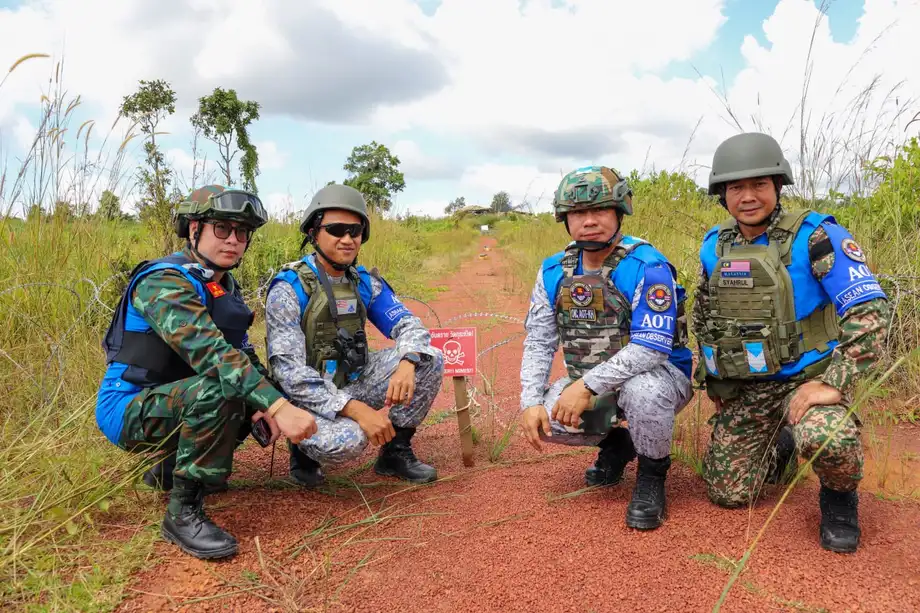
ASEAN observers visited O Phlouk Damrei in Cambodia's Pursat province on November 5, 2026, to examine ceasefire compliance at a location Cambodia's Ministry of National Defence says remains unlawfully occupied by Thai forces. The inspection brought renewed attention to military positions and damage to civilian infrastructure more than 10 months after the December 27, 2025 ceasefire agreement.
Contents
- Inspection focuses on troop positions and a damaged bridge
- What observers examined in Pursat
- A civilian bridge remains part of the dispute
- Which agreements Cambodia wants implemented
- How the peace effort reached this point
- Why Cambodia is citing old boundary records
- What a stronger observer role would mean
- Border communities still face restrictions
- Diplomacy continues on a separate maritime track
- Key Points
Defence Ministry spokesperson Maly Socheata said the ASEAN Observer Team in Cambodia, known as AOT-KH, was examining compliance with all measures in the December joint statement. Cambodian authorities also described a Thai observation post near the CH1 Checkpoint as having apparently moved forward about 20 metres, with fortification work continuing nearby.
The observers visited Stung Me Teuk Bridge in Thmor Da commune, Veal Veng district. Cambodia's ministry says Thai air force fighter jets bombed the bridge on December 13, 2025, leaving it completely impassable.
The inspection connects three practical concerns: where soldiers are positioned, whether military activity complies with the agreements, and whether damaged infrastructure remains usable for civilians. Cambodia is asking for a stronger monitoring role while maintaining that military force cannot change the international boundary.
What observers examined in Pursat
O Phlouk Damrei was the focus of Cambodia's allegation that Thai troops continue to occupy its territory. The defence ministry described the location in these terms:
has been attacked and is under the unlawful occupation of Thai military forces
The description sets out Cambodia's position on sovereignty, meaning which country has authority over the land. The observers' task, as described by Maly Socheata, concerns implementation of the ceasefire measures agreed by the two governments.
Near CH1 Checkpoint in Thmor Da commune, observers reportedly noted that a Thai observation post appeared to have moved forward by about 20 metres. They also noted continuing work on fortifications, which are defensive positions such as trenches or protected posts.
The direction and location of a military post matter because even a relatively short movement can change how opposing troops face each other. The November 5 account gives an approximate distance, making this a specific issue for monitoring rather than a general complaint about tensions.
No published findings settling responsibility, Thai response to these particular allegations, or timetable for a further inspection was given. The current public account of the visit comes through Cambodia's description of the mission and the reported observations.
A civilian bridge remains part of the dispute
Stung Me Teuk Bridge gives the inspection a direct connection to civilian movement. Cambodia's defence ministry says the bridge was rendered completely impassable by the December 13 attack.
The ministry identified the bridge as civilian infrastructure and described its location relative to the frontier:
Stung Me Teuk Bridge was civilian infrastructure, and is located several dozen kilometres from the Cambodia-Thailand border,
The visit was also described as examining damage from fighting in November, while the ministry gave December 13, 2025, as the specific date of the bridge attack. That date places the alleged bombing two weeks before the December 27 ceasefire statement.
An impassable bridge interrupts the route it carries. For people who depend on that route, restoration of normal movement requires repair or an alternative crossing as well as an end to fighting. The inspection therefore covers both military conduct and the physical damage left behind.
Which agreements Cambodia wants implemented
Cambodia's ministry urged Thailand to honour the joint statement adopted at the third special meeting of the Cambodia-Thailand General Border Committee on December 27, 2025. The committee, usually called the GBC, provides a channel for the countries to address border security matters.
The ministry also reaffirmed its commitment to the October 26, 2025 Joint Declaration on the Peace Agreement between Cambodia and Thailand, alongside other relevant agreements. Cambodia presents the November inspection as part of implementing those existing commitments.
The two dates mark different stages of the peace effort. The October declaration sought to strengthen arrangements after earlier fighting, while the December statement followed another outbreak of violence. Monitoring now concerns whether those commitments are being carried out on the ground.
Cambodia's government and defence ministry said they remained committed to implementing the ceasefire and peace agreements fully and faithfully. Their accompanying request to Thailand was to honour the same arrangements, including the measures covered by the observers' inspection.
How the peace effort reached this point
The November visit follows a sequence of agreements, renewed fighting and diplomatic intervention stretching across 2025 and 2026. The principal dates show why observers are still examining compliance long after the latest truce was reached:
- July 28, 2025: Cambodia and Thailand agreed to an unconditional ceasefire after five days of fighting.
- October 26, 2025: The countries adopted a joint peace declaration intended to strengthen the peace process.
- December 13, 2025: Cambodia's defence ministry says Thai fighter jets bombed Stung Me Teuk Bridge.
- December 27, 2025: A special GBC meeting produced the joint statement now cited as the basis for compliance monitoring.
- October 31, 2026: Thai Prime Minister Anutin Charnvirakul said all seven border checkpoints and crossings would remain closed.
- November 5, 2026: ASEAN observers inspected sites in Pursat, including the damaged bridge and military positions.
Diplomatic support widened after the December ceasefire. During the Yunnan peace talks, China offered help with landmine removal, humanitarian relief and support for the ASEAN Observer Team. Those discussions reflected the need to turn an agreement to stop shooting into conditions that could sustain calm.
Why Cambodia is citing old boundary records
Cambodia's defence ministry linked the inspection to its position that the international border established by the Indochina-Siam Boundary Commission must be protected. It cited Franco-Siamese conventions and treaties, commission maps and boundary demarcation records, and other bilateral documents.
Those documents concern where the boundary runs. Demarcation is the process of identifying or marking that boundary on the ground. A military position, by contrast, shows where troops are located at a particular time. Cambodia says it will not recognise changes to the border resulting from the use of force.
The ministry also invoked uti possidetis juris, a legal principle concerning the preservation of inherited borders. In simple terms, Cambodia is arguing that the boundary inherited through earlier legal arrangements should remain the basis for deciding territory.
Maps, treaties and demarcation records are central to that argument because they provide the historical and legal references Cambodia wants used. The ministry's position connects immediate concerns about troop movements with the longer dispute over the border itself.
What a stronger observer role would mean
Cambodia's defence ministry called for strengthening the ASEAN Observer Team's mandate. A mandate is the agreed authority that defines what a mission can do, such as the places it may visit and the matters it may examine.
The ministry said a stronger role would support transparency, accountability and mutual trust. It also welcomed further assistance from friendly countries willing to contribute to monitoring.
The inspection illustrates the practical work behind that request: visiting a disputed location, examining the position of a military post and inspecting damage to a bridge. Recording such details can give the governments concrete matters to address through their existing agreements.
Cambodia is seeking more support for that process while continuing to frame compliance around the October and December commitments. The request keeps attention on implementation, including activities at particular sites, rather than another declaration alone.
Border communities still face restrictions
Thailand's continuing closure of all seven checkpoints and crossings adds a wider constraint on travel and trade. On October 31, Prime Minister Anutin, who also serves as interior minister, tied reopening to territorial disputes, scam networks and the safety of Thai citizens.
The continued border closure covers both people and goods and has been in place since June 2025. Anutin gave no reopening date. His stated conditions show that Thailand is treating access to the frontier as part of a broader security and diplomatic agenda.
Cambodia's earlier recovery figures also show the scale of the civilian challenge. At the start of January 2026, the Interior Ministry put the number of people still displaced in Cambodia at 512,263. In that January displacement assessment, preparations for resettlement had been completed in 172 villages, while another 84 remained inaccessible and required clearance and assessment.
Those figures describe the situation in January. The November inspection supplies a more recent, specific example of the damage still under examination: a bridge the defence ministry describes as completely impassable.
Diplomacy continues on a separate maritime track
Cambodia and Thailand are also pursuing talks over their maritime boundary in the Gulf of Thailand. Following discussions in The Hague from October 14 to 18, they agreed on measures intended to build mutual trust.
The next maritime boundary talks are scheduled for November 24 to 27 in Kuala Lumpur. That process addresses competing claims at sea, while the Pursat inspection concerns ceasefire compliance and conditions along the land frontier.
Both tracks require the governments to carry out commitments while maintaining their territorial positions. In Pursat, the immediate issues are concrete: the location of a military post, continuing fortification work, access to disputed ground and damage to civilian infrastructure.
Key Points
- ASEAN observers visited Pursat province on November 5, 2026, to examine compliance with the December 27, 2025 ceasefire measures.
- Cambodia says Thai forces unlawfully occupy O Phlouk Damrei and rejects border changes resulting from force.
- A Thai observation post near CH1 Checkpoint reportedly appeared to have moved forward about 20 metres, with fortification work continuing.
- Cambodia's defence ministry says Thai fighter jets destroyed Stung Me Teuk Bridge on December 13, 2025, leaving it impassable.
- Cambodia wants a stronger ASEAN monitoring mandate and further international assistance.
- Thailand's seven border crossings remain closed, while separate maritime talks are scheduled for November 24 to 27.