Five years of diplomacy, still no clear strategy
Thai Foreign Minister Sihasak Phuangketkeow has called for a permanent crisis coordination team and stronger regional leadership to revive ASEAN's Myanmar peace plan, saying the framework adopted in April 2021 still lacks a clear strategy for implementation.
Contents
- Five years of diplomacy, still no clear strategy
- What the five points actually require
- Why changing the envoy matters
- What Lazaro's October mission achieved
- Who gets a seat at the table?
- Thailand's two tracks and China's role
- A permanent troika and faster crisis decisions
- How the diplomatic effort reached this point
- Cambodia tensions test the same regional machinery
- Key Points
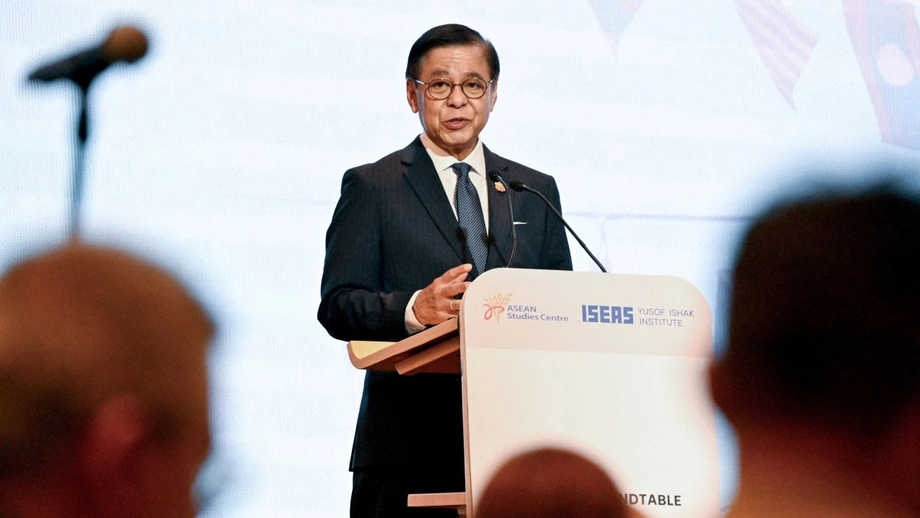
Speaking at the 41st ASEAN Roundtable in Singapore on November 5, 2026, Sihasak challenged a familiar diplomatic routine: governments reaffirm the Five-Point Consensus, hand responsibility to a special envoy whose appointment changes annually, and move to the next meeting.
His criticism came six days after Philippine Foreign Secretary Ma. Theresa Lazaro completed a humanitarian mission to Myanmar on October 30. Her visit delivered assistance and secured talks with Myanmar's foreign minister, but ended without a meeting with detained former civilian leader Aung San Suu Kyi.
Sihasak, who is also Thailand's deputy prime minister, said ASEAN needs to give its envoy practical direction rather than responsibility alone. He argued that keeping Myanmar isolated would damage the region and increase the risk of competition among outside powers.
At the roundtable, organised by the ISEAS – Yusof Ishak Institute, he connected Myanmar's unresolved conflict to a wider problem: whether ASEAN can respond quickly enough when its members face a crisis.
His proposals would change how the regional organisation works, including how its rotating chair calls urgent meetings and how successive chairs cooperate. Academic assessments published in 2022 and 2025 had already identified similar weaknesses, showing how long the gap between ASEAN's goals and its methods has persisted.
What the five points actually require
ASEAN adopted the Five-Point Consensus at its leaders' meeting in Jakarta in April 2021, two months after the military overthrew Aung San Suu Kyi's civilian government. The coup plunged Myanmar into a conflict involving the military, resistance forces and ethnic armed organisations.
The Centre on Asia and Globalisation at the National University of Singapore sets out the framework in its Five-Point Consensus assessment. Its commitments are:
- An immediate end to violence, with all parties exercising restraint.
- Constructive dialogue among all parties to seek a peaceful solution.
- A special envoy appointed by the ASEAN chair to help mediate that dialogue, with assistance from the ASEAN secretary general.
- Humanitarian assistance through the ASEAN Coordinating Centre for Humanitarian Assistance, known as the AHA Centre.
- A visit to Myanmar by the envoy and a delegation to meet all parties concerned.
The plan combines three jobs: stopping violence, opening political talks and getting help to people in need. An envoy is meant to connect those tasks, rather than become ASEAN's entire response.
ASEAN excluded Myanmar's political leadership from summits and foreign ministers' meetings in late 2021 after the military failed to implement key commitments. Five years after the agreement, the argument is increasingly about how to carry it out and who must participate.
Why changing the envoy matters
Lazaro's appointment ends when Singapore takes over the ASEAN chairmanship in 2027 and appoints the next envoy. That annual turnover is central to Sihasak's complaint: each envoy inherits a difficult negotiation without a sufficiently clear collective strategy.
The National University of Singapore assessment, written by Evan A. Laksmana, then a senior research fellow at the Centre on Asia and Globalisation, described limited progress under the first envoys. Brunei's Second Foreign Minister Erywan Yusof held the first appointment. Cambodia's Foreign Minister Prak Sokhonn visited Myanmar in March 2022, following Prime Minister Hun Sen's visit that January, but neither visit produced substantial progress.
ISP-Myanmar proposed a different arrangement in its October 2025 policy brief, published in English on October 23 after a Burmese version on October 22. It recommended giving the envoy a fixed mandate lasting several years, rather than changing the appointment with each chairmanship.
A longer appointment would let the same office maintain relationships, remember earlier commitments and follow negotiations through successive stages. ISP-Myanmar also called for benchmarks, meaning specific steps against which governments could assess progress.
Sihasak's proposals and the institute's recommendations address related problems through different mechanisms. He wants stronger coordination among ASEAN chairs; the institute also wants continuity within the envoy's office.
What Lazaro's October mission achieved
Lazaro's visit illustrates both the practical work an envoy can undertake and the political disagreements surrounding it. Her mission included aid distribution in Taunggyi, in a region of Shan State controlled by the military, and talks with Myanmar Foreign Minister Tin Maung Swe in Naypyidaw.
The Philippine Department of Foreign Affairs said the discussions covered humanitarian needs, communities that are difficult to reach and implementation of the Five-Point Consensus. Lazaro also visited a school and monastery in Pyinmana Township that received Philippine assistance after the March 2025 earthquake, before consulting ASEAN embassies in Yangon.
Myanmar's Foreign Ministry described the Naypyidaw meeting in terms of restoring the country's role and rights within ASEAN. It presented cooperation as taking place under Myanmar's own priorities and roadmaps. The military backed administration has explicitly rejected the Five-Point Consensus while seeking closer regional relations.
Those positions leave ASEAN and Myanmar's leadership pursuing different political objectives through the same diplomatic encounters. ASEAN seeks implementation of its agreed framework; Myanmar's administration seeks restored regional standing while retaining control over its domestic course.
Lazaro did not meet Aung San Suu Kyi. The Philippines had requested access after her transfer to house arrest in April 2026 and again in August, but Myanmar's administration refused both requests.
Who gets a seat at the table?
Sihasak said ASEAN should involve relevant people in Myanmar who have the authority to make decisions. He presented participation at an appropriate level as a way to make diplomatic engagement more useful.
The Thai foreign minister explained his proposal during the Singapore discussion:
We have to deal with people who can make decisions, and if they can attend ASEAN meetings at an appropriate level, I think that's going to help this policy engagement.
Malaysia's experience as ASEAN chair in 2025 shows that arranging inclusive discussions involves more than sending invitations. According to ISP-Myanmar, Prime Minister Anwar Ibrahim met military leader Min Aung Hlaing in person in Thailand in April 2025 and spoke virtually with Mahn Winn Khaing Thann, prime minister of the opposition National Unity Government.
The Malaysian chairmanship also organised Stakeholder Engagement Meetings in May, August and October 2025. Online consultations allowed participation by people unable to attend, and the envoy's delegation visited Thailand in June.
Disagreements between the Joint Coordination Body, which included key resistance groups, and the envoy's office over invitation formats and other matters led some ethnic armed organisations to withhold senior representation. ISP-Myanmar said this weakened participation and momentum.
Myanmar's ethnic armed organisations are essential participants because the consensus calls for dialogue among all parties. A process that cannot attract decision makers from those groups has less ability to turn discussions into commitments on the ground.
Thailand's two tracks and China's role
Thailand is advocating engagement while continuing to support an internal peace process. Sihasak described two parallel tracks: dealing directly with everyday problems along the shared border, and encouraging inclusive dialogue inside Myanmar.
The Thai foreign minister explained the pressure created by geography:
"We share a common border; we have problems every day; we have to engage and deal with these problems. And at the same time, we're not abandoning the situation inside Myanmar," he said.
Thailand's approach includes encouraging communication among ethnic armed groups and other relevant parties. Sihasak said Myanmar's people must ultimately resolve their country's problems, rather than have a solution decided for them by outside powers.
He also said he had asked Chinese Foreign Minister Wang Yi to encourage inclusive dialogue when they met at a Lancang-Mekong Cooperation meeting earlier that week.
ISP-Myanmar's October 2025 brief similarly recommended coordinating with Myanmar's neighbours. It proposed a core group of at least three ASEAN foreign ministers working with China, India and Thailand on practical implementation of the consensus.
The institute warned that a weakening common framework would leave individual countries pursuing separate relationships with Myanmar's authorities and resistance forces according to their own interests. Sihasak's concern about geopolitical competition reflects the same problem: neighbouring governments have influence, but their priorities may pull diplomacy in different directions.
A permanent troika and faster crisis decisions
Sihasak proposed making ASEAN's troika a standing arrangement. The mechanism brings together the immediate past, current and incoming chairs, providing a bridge across annual changes in leadership.
He argued that this would give chairs with less capacity or confidence stronger support when action is needed. ISP-Myanmar went further in its policy brief, recommending an expanded troika that includes neighbours outside ASEAN.
The two proposals would produce different structures. A permanent ASEAN troika would strengthen continuity within the organisation. Bringing in outside neighbours would add governments with direct interests in Myanmar, while also making coordination more complex.
Sihasak also wants the rotating chair to be able to convene urgent consultations and present practical response options. He cited the European Union's ability to bring ministers together quickly, contrasting that with ASEAN responses that can take a week or more.
Consensus means seeking agreement among member governments. Sihasak said that principle should remain fundamental, but argued that applying it rigidly to every matter can obstruct action.
He set out the balance he wants ASEAN to strike:
We must find ways to preserve the spirit of consensus while allowing room for flexibility. Otherwise our decision-making process risks becoming a constraint than an instrument of collective action and progress.
No timetable was announced for adopting these reforms. The next institutional transition identified is Singapore's assumption of the chairmanship in 2027, when responsibility for appointing the Myanmar envoy changes again.
How the diplomatic effort reached this point
Myanmar's crisis has passed through several ASEAN chairmanships while the same peace framework has remained in place. The chronology shows repeated diplomatic activity alongside persistent difficulty securing implementation.
- February 2021: The military overthrows Aung San Suu Kyi's civilian government.
- April 2021: ASEAN leaders adopt the Five-Point Consensus in Jakarta.
- Late 2021: ASEAN excludes Myanmar's political leadership from summits and foreign ministers' meetings.
- January and March 2022: Hun Sen and then special envoy Prak Sokhonn visit Myanmar, with little progress described in the National University of Singapore assessment.
- May, August and October 2025: Malaysia organises stakeholder meetings aimed at developing an action plan for dialogue.
- October 23, 2025: ISP-Myanmar publishes its English policy brief recommending a longer envoy mandate and stronger political coordination.
- October 30, 2026: Lazaro completes her humanitarian mission.
- November 5, 2026: Sihasak calls in Singapore for a clearer strategy and institutional changes.
- 2027: Singapore takes over the ASEAN chairmanship and appoints the next envoy.
The early assessment and the later policy brief reach a common practical concern: meetings and appointments need to be connected to an organised process that can sustain negotiations and track commitments.
Cambodia tensions test the same regional machinery
Sihasak also addressed Thailand's disputes with Cambodia, another challenge for an organisation that must keep working while its members disagree. The countries have frequently clashed over land and maritime disputes since July 2025.
He acknowledged that their border is not fully demarcated, meaning parts of its precise course have not been agreed and marked. He also suggested the dispute involved personal relationships, while saying frankly that he did not know its source.
In June 2026, Cambodia initiated compulsory conciliation under the United Nations Convention on the Law of the Sea. Conciliation is a formal process intended to help countries work towards agreement on a dispute.
Thailand generally prefers to resolve differences bilaterally, Sihasak said, meaning directly between the two governments. He added that a process now exists for addressing their disagreements and that both countries have been careful to keep those disputes from disrupting their participation in ASEAN and other international forums.
For Myanmar, the immediate policy choice remains how to combine contact with meaningful political dialogue. Sihasak wants ASEAN to engage more effectively; the academic proposals add longer appointments, benchmarks and sustained coordination. Together, they identify specific organisational changes that governments could consider rather than another reaffirmation of the same five points.
Key Points
- Sihasak said on November 5, 2026, that ASEAN's Myanmar peace plan still lacks a clear implementation strategy.
- He proposed a permanent troika of successive ASEAN chairs and faster consultations during crises.
- Thailand is combining practical border engagement with support for inclusive dialogue inside Myanmar.
- Lazaro completed an aid mission on October 30 but did not meet Aung San Suu Kyi.
- ISP-Myanmar recommends an envoy mandate lasting several years, progress benchmarks and closer coordination with neighbouring countries.
- Singapore takes over the ASEAN chairmanship in 2027 and will appoint the next Myanmar envoy.