Phuket talks move the agreement closer to completion
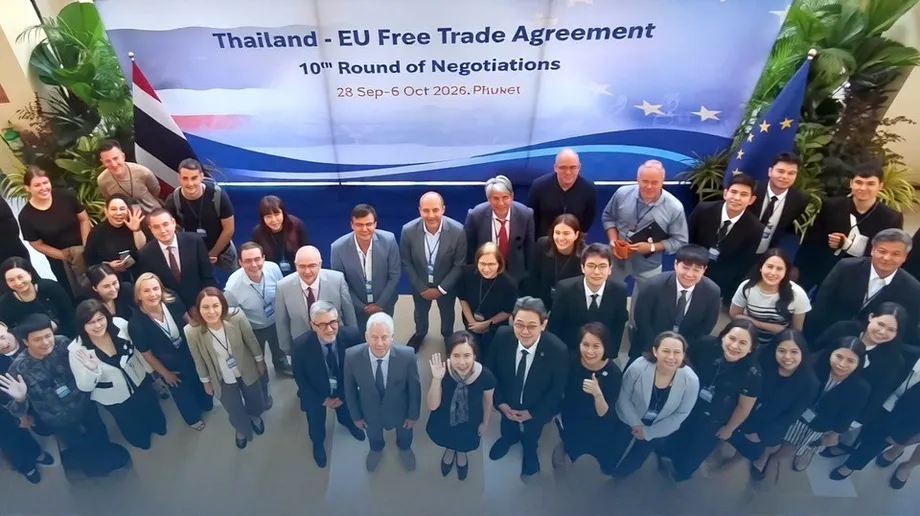
The European Union and Thailand have provisionally closed most chapters of their proposed free trade agreement after a tenth negotiating round in Phuket, shifting the remaining work toward market access and sensitive policy decisions. Both sides aim to conclude negotiations by the end of 2026, but the extent of the market opening has yet to be settled.
Contents
- Phuket talks move the agreement closer to completion
- What provisional closure actually means
- Which issues advanced in Phuket?
- Market access becomes the central negotiation
- How the ninth round prepared the ground
- A negotiating timeline stretching back to 2013
- The trade relationship behind the negotiations
- Thailand weighs opportunities against adjustment costs
- What will be published before signature?
- Key Points
The latest progress includes agreement in principle on sanitary and phytosanitary measures, services and investment, and initial provisions. Government procurement, energy and raw materials, and rules of origin were also provisionally agreed, except for market access issues. These qualifications matter: agreement on the rules governing trade does not establish every commercial concession that businesses would receive.
Reports differ on the duration of the Phuket round. One account describing the European Commission's findings places the talks between September 28 and October 2. Thai accounts give September 28 to October 6, 2026, with Thai Trade Representative Weerapong Prapha describing discussions lasting nearly 10 days. The reason for the different end dates is not established.
The European Commission's agreement documents page lists the tenth round report under October 2026. The page itself does not reproduce the report's detailed findings. It states that the negotiations seek new market access, increased trade and investment, and sustainable development.
What provisional closure actually means
Provisional closure marks progress in negotiating a chapter, not the completion or entry into force of the entire agreement. The distinction is especially important where negotiators have settled a chapter's general provisions while leaving market access commitments unresolved.
For companies, the remaining commitments may determine which products receive lower tariffs, which services can be supplied, and which public contracts become accessible. Until those details are settled, a largely agreed legal framework cannot be treated as a complete set of new trading rights.
The announced next step reflects that shift. Negotiations are expected to continue in dedicated formats rather than full negotiating rounds, concentrating on market access and outstanding issues. No dates for those discussions have been announced in the accounts of the latest round.
Nor has a complete chapter count been published in the information describing the outcome. Thai officials said roughly two thirds of the agreement had been agreed by the ninth round. The tenth addressed the remaining third, but the statement that most chapters are now provisionally closed does not establish that every unresolved provision has been settled.
Which issues advanced in Phuket?
Sanitary and phytosanitary measures were among the areas where an agreement in principle was reached. Often shortened to SPS, these measures concern food safety and the protection of animal and plant health. Their treatment in a trade agreement matters because agricultural and food products must satisfy the importing market's requirements, even when tariffs are reduced.
Thai descriptions of the talks highlighted agricultural product quality checks among the provisions where common ground was found. That progress follows the ninth round, when differences on SPS measures were still reported.
Services and investment also reached agreement in principle, alongside initial provisions, which establish introductory elements of an agreement. This does not mean that all service sectors or investment activities will be opened without restrictions. Thai officials separately identified access for services and investment as part of the remaining negotiations.
Energy and raw materials, procurement and rules of origin carry a similar qualification. Rules of origin determine whether a product qualifies as originating in a partner economy and can receive preferential tariff treatment. The final requirements can matter greatly to manufacturers that use imported components.
Intellectual property was among the complex subjects discussed in Phuket. However, the descriptions of the outcome do not establish that the entire intellectual property chapter was closed, or specify which provisions remain unresolved.
Market access becomes the central negotiation
Deputy Prime Minister and Commerce Minister Suphajee Suthumpun said the remaining issues mainly concern market access and policy matters. She described the negotiations as entering their final and crucial stage, with both sides seeking a balanced and mutually acceptable outcome.
Suphajee explained the purpose of the exchanges of offers, while stressing the need to account for sensitive parts of the economy:
"The aim is to open markets and create concrete economic, trade and investment opportunities for both sides while considering sensitive products and business sectors," Mrs Suphajee said.
Market access extends beyond tariffs on goods. The remaining discussions cover services, investment, government procurement and regulations connected with doing business. In procurement, for example, the commercial value of an agreement depends on which purchasing bodies and contracts are covered, not simply on whether a general chapter has been agreed.
For goods, negotiators must determine the treatment of individual products. Possible arrangements discussed in accounts of the negotiations include immediate tariff reductions, reductions introduced gradually, quotas and special treatment for sensitive products. These are negotiating choices, not announced outcomes for particular Thai or European products.
Weerapong said the final phase would focus on deciding how far each side would open its markets. The unfinished work is therefore central to the agreement's economic value, even though much of its text has advanced.
How the ninth round prepared the ground
The ninth negotiating round, held in Brussels from June 22 to 26, had already provisionally closed chapters on competition and subsidies, state owned enterprises and dispute settlement, together with the automotive annex dealing with technical barriers to trade.
Technical barriers to trade concern requirements such as product standards and conformity assessments, the processes used to show that goods meet applicable rules. An automotive annex can address these issues for vehicles, but provisional agreement on that annex does not by itself establish tariff treatment or remove every condition on vehicle sales.
The Brussels round also advanced work on services and investment, intellectual property, geographical indications, government procurement, rules of origin and tariff liberalization. Geographical indications are names identifying products whose qualities or reputation are linked to a particular place.
At that stage, differences remained on SPS measures, certain rules of origin for specific products, and energy and raw materials. Progress in Phuket on those same subjects shows where the tenth round moved beyond the earlier position, although market access reservations still apply to some areas.
Thai accounts place agreement on approximately two thirds of the pact at the end of the ninth round. That estimate describes the progress of the negotiations, not a share of bilateral trade already covered by agreed tariff cuts.
A negotiating timeline stretching back to 2013
The Phuket discussions are part of a process that began more than a decade ago. Negotiations started in 2013, were suspended after Thailand's 2014 military coup, and resumed in 2023. The Commission's published round index records a sequence of ten rounds from September 2023 through October 2026.
- 2013: Thailand and the EU began negotiations on a free trade agreement.
- 2014: Talks were suspended after the military coup in Thailand.
- September 2023: The first round in the resumed negotiations took place.
- January, June and November 2024: The second, third and fourth rounds followed.
- March to April, June and October 2025: The fifth, sixth and seventh rounds were recorded.
- February 2026: The eighth round took place.
- June 22 to 26, 2026: The ninth round was held in Brussels.
- September to October 2026: The tenth round took place in Phuket, with reports differing on its closing date.
- End of 2026: Both sides aim to conclude negotiations.
The sequence helps distinguish the present target from the agreement's eventual legal operation. Concluding negotiations by December would not mean that the pact automatically takes effect then. Publication, signature and ratification remain separate steps.
The trade relationship behind the negotiations
The EU was Thailand's fourth largest trading partner in 2025, after China, the United States and Japan. Bilateral trade was reported at US$45 billion, an increase of 3.44% from 2024. That existing exchange provides the commercial base on which the proposed agreement would build.
Thai exports to the EU reached $26.5 billion, up 9.27%, while imports from the EU were $18.6 billion, down 3.86%. Thailand's reported trade surplus was $7.86 billion. Export growth and falling imports therefore moved in opposite directions during the year.
The published figures use different levels of rounding. Exports of $26.5 billion plus imports of $18.6 billion total $45.1 billion, compared with the headline figure of $45 billion. Subtracting the rounded import value from exports gives $7.9 billion, close to the reported $7.86 billion surplus.
Using those rounded values, exports accounted for about 59% of the combined flows. This calculation describes the existing balance of trade; it is not a forecast of the agreement's effects.
Thailand's main exports included computers, peripherals and components; gems and jewellery; air conditioners and parts; rubber products; and electrical transformers and parts. Major imports from the EU included machinery and parts, medical and pharmaceutical products, chemicals, electrical machinery and parts, and scientific and medical instruments.
Thailand weighs opportunities against adjustment costs
Suphajee said authorities must assess how ready relevant sectors are and evaluate potential effects, particularly in sensitive areas. The agreement involves the responsibilities and regulations of several ministries and agencies, making the remaining policy decisions broader than tariff bargaining alone.
Weerapong described preparations during the three months before the latest round that included research and consultations with government agencies, large businesses, medium and small businesses, civil society and academic participants. He said Thailand would consider the degree of opening for individual products and services carefully.
Those consultations connect directly to the unresolved negotiation. Businesses seeking greater access to Europe may favour broader concessions, while sectors facing more import competition may need adjustment time or different conditions. The eventual schedules will show how negotiators balance those interests.
No agreed list of sensitive products, tariff reduction timetable or sector specific market opening commitments has been disclosed in the descriptions of the Phuket outcome. Claims that a particular industry has secured a defined new benefit would therefore go beyond what has been announced.
What will be published before signature?
The Commission has published EU textual proposals in three batches: September 2023, January 2024 and July 2024. They span goods, services, investment, procurement, intellectual property, digital trade, competition, sustainable development, customs, regulatory matters and other subjects.
These documents are negotiating proposals, not the final agreed treaty. The Commission explicitly says they represent the EU's initial proposed legal texts and that it may edit, supplement or remove provisions. The July 2024 publication concerned the motor vehicles annex.
The distinction prevents a common misreading of the public record. A provision appearing in an EU proposal cannot be assumed to have been accepted by Thailand, and a provision absent from an early proposal cannot be assumed to be absent from the final agreement.
The Commission says the complete agreement text will be made public after negotiations conclude, well before signature and ratification. That publication should provide the basis for assessing the final commitments rather than relying on chapter closure announcements.
The next substantive milestone is agreement on the outstanding market access and policy issues. The end of 2026 remains a negotiating target, not a confirmed signing date or implementation deadline. No exact timetable for signature, ratification or entry into force has been announced in the accounts of this round.
Key Points
- Most chapters were provisionally closed after the tenth negotiating round in Phuket.
- Agreement in principle covered SPS measures, services and investment, and initial provisions.
- Procurement, energy and raw materials, and rules of origin still carry market access qualifications.
- Reports place the talks' end on either October 2 or October 6, 2026.
- The remaining negotiations will focus on market access and outstanding policy issues in dedicated formats.
- Both sides aim to conclude negotiations by the end of 2026.
- Bilateral trade was reported at $45 billion in 2025, with a Thai surplus of $7.86 billion.
- The final text will be published after negotiations conclude, before signature and ratification.