Five days of talks follow the collapse of a 2001 framework
Cambodia and Thailand are scheduled to hold their second maritime conciliation meeting from October 14 to 18, 2026, at the Peace Palace in The Hague, moving into further legal and technical discussions over overlapping claims covering approximately 10,000 square miles in the Gulf of Thailand. The talks follow Thailand's termination of a bilateral negotiating framework in May and Cambodia's decision to seek conciliation under the United Nations Convention on the Law of the Sea (UNCLOS).
Contents
- Five days of talks follow the collapse of a 2001 framework
- Who is representing the two governments?
- How the dispute reached conciliation
- Different accounts of the old negotiations
- Boundary first, or resources before a final line?
- What compulsory conciliation can achieve
- Five conciliators and a confidential process
- The Gulf's resources and the limits of vessel data
- Koh Kood and the separate land conflict
- A precedent, not a promised outcome
- Key Points
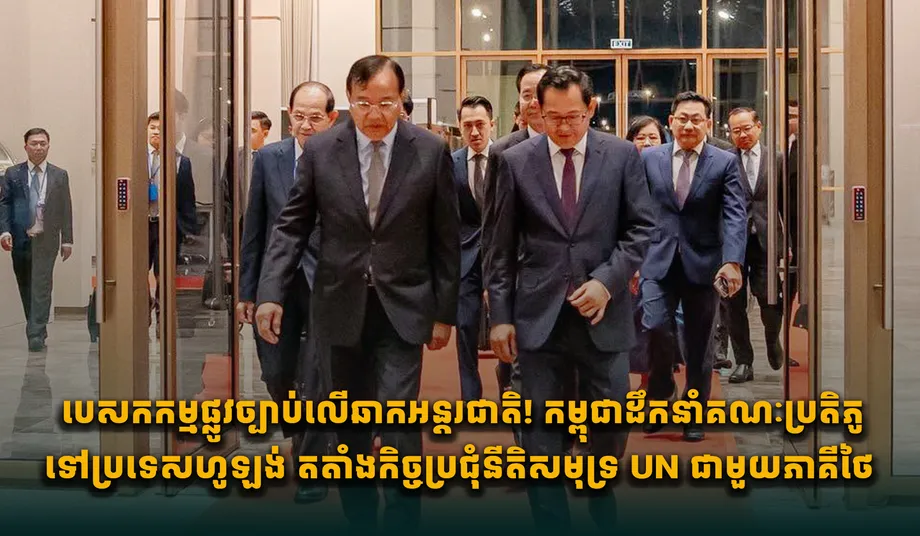
Cambodia's Deputy Prime Minister and Minister of Foreign Affairs and International Cooperation, Prak Sokhonn, departed on the evening of October 11 with a delegation of legal experts. The government news agency Agence Kampuchea Presse confirmed his departure and role as Cambodia's Agent in its October 11 announcement. As Agent, he represents the Royal Government of Cambodia before the commission.
The meeting follows an opening session in Singapore from September 14 to 16, with the two countries' foreign ministers delivering opening statements on September 15. Neither country's maritime claim has been accepted or rejected by the commission, and no settlement has been announced.
The central difference is already apparent. Cambodia wants either a treaty establishing a single maritime boundary or an interim agreement for joint development and equitable resource sharing. Thailand puts boundary delimitation first, with other matters considered afterwards. Delimitation means agreeing where one country's maritime rights end and the other's begin.
Despite the venue, these are not proceedings before the International Court of Justice (ICJ). The Peace Palace houses both the ICJ and the Permanent Court of Arbitration (PCA), but this dispute is before a separate UNCLOS conciliation commission. The PCA serves as its registry, supporting the administration of the proceedings.
Who is representing the two governments?
Prak Sokhonn is accompanied by Cambodia's Deputy Agent, Lam Chea, minister in charge of the State Secretariat of Border Affairs, and officials specialising in legal affairs. Their task is to develop Cambodia's positions on the boundary and on possible arrangements for offshore resources.
Thailand's delegation will be led by Deputy Prime Minister and Foreign Minister Sihasak Phuangketkeow, who serves as its Agent. Deputy Prime Minister Pakorn Nilprapunt will act as an adviser, while Songchai Chaipatiyut, director general of the Department of Treaties and Legal Affairs, is Thailand's Deputy Agent.
The Thai team also includes specialists from the Royal Thai Navy's Hydrographic Department and Naval Operations Department, together with the Department of Mineral Fuels under the Ministry of Energy. That composition reflects the technical work involved: comparing claim lines, examining their geographic positions and considering the resources within the disputed area.
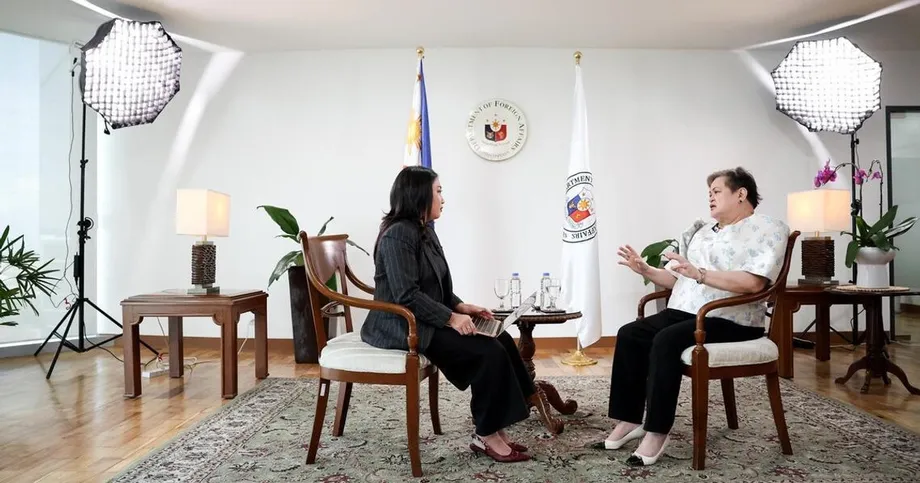
Following the Singapore meeting, Sihasak described the preparation required for the next stage:
"We will have to examine all of that. From now on, we have homework to do," he said.
How the dispute reached conciliation
The immediate trigger was the termination of MOU 44, the memorandum of understanding signed in 2001 to guide negotiations on maritime boundaries and joint development of hydrocarbon resources. It treated those subjects as an "indivisible package", rather than as separate negotiations.
The Center for Strategic and International Studies' Asia Maritime Transparency Initiative sets out the sequence in its September 30 analysis. Cambodia ratified UNCLOS earlier in 2026, creating a new legal setting for negotiations. Thailand then ended the memorandum, arguing that it had produced no meaningful progress over 25 years.
- May 5, 2026: Thailand terminated MOU 44.
- May 26: Cambodia withdrew the part of its UNCLOS declaration excluding maritime delimitation from binding dispute procedures.
- June 2: Cambodia filed its notification initiating conciliation.
- June 19: Thailand submitted its response and accepted the proceedings.
- August 14: The four appointed conciliators selected Katrina Cooper as chair.
- September 14 to 16: The first meeting took place in Singapore, with opening statements on September 15.
- October 14 to 18: The second meeting is scheduled in The Hague.
The governments disagree about what ending the memorandum meant. Cambodia says it removed the existing bilateral framework and prompted recourse to conciliation. Thailand says it intended to reset negotiations on a common legal basis, not stop them.
Different accounts of the old negotiations
The record of talks under MOU 44 is described differently. The Asia Maritime Transparency Initiative's analysis counts five rounds without agreement on either delimitation or joint development. Sihasak's account of Thailand's opening statement refers to only two rounds of official negotiations over 25 years.
The difference may concern which meetings are counted, but no explanation reconciling those figures has been announced. Both accounts agree on the essential result: the memorandum did not produce an agreed maritime boundary or a joint development arrangement.
Sihasak also said Thailand had proposed direct boundary negotiations, followed by joint recourse to conciliation if no agreement could be reached within six months. On that basis, he rejected Cambodia's position that termination of the memorandum left it with no alternative.
This disagreement matters to the diplomatic account of how proceedings began. It does not itself determine where the boundary should lie or which settlement options the commission will recommend.
Boundary first, or resources before a final line?
Cambodia has presented three possible outcomes. Its preferred objective is a treaty establishing a single maritime boundary for all purposes, in accordance with international law. Alternatively, it is prepared to agree on joint development and equitable resource sharing while awaiting a final boundary settlement.
If neither agreement is achievable, Cambodia wants recommendations from the commission that could become a basis for later negotiations. This makes its approach broader than settling the boundary alone: it leaves room for a resource agreement before the line is finalised.
Thailand's position places delimitation at the centre of the proceedings. Sihasak, Thailand's Foreign Minister and Agent, explained the sequence he favours after the Singapore meeting:
"The Thai position is that maritime delimitation should come first, with other matters considered afterwards," he said.
The difference is about both subject matter and timing. Joint development can allow countries to cooperate over resources while leaving their competing boundary claims unresolved. Thailand's stated approach would address the boundary before moving to those arrangements.
Cambodia's published opening position referred to equitable sharing, not a specified 50:50 division. No resource allocation formula has been agreed, and fairness should not be confused with an announced equal split.
What compulsory conciliation can achieve
UNCLOS provides rules governing countries' rights and responsibilities at sea, together with procedures for resolving disputes. Cambodia and Thailand have entered a process that is compulsory in its procedural basis but does not impose a binding settlement through the commission's recommendations.
According to the Asia Maritime Transparency Initiative's explanation, Article 298 allows states to exclude certain disputes, including maritime delimitation, from binding arbitration procedures. Thailand made such a declaration in 2011 and retains that exclusion. Cambodia initially made a similar declaration when it ratified UNCLOS, then withdrew the relevant part on May 26.
For qualifying delimitation disputes, the convention still provides compulsory conciliation under Annex V, Section 2. The commission helps the parties examine their differences and seek agreement. Its role is distinct from that of a court delivering a binding judgment.
The commission must report within 12 months of its constitution. Its report records any agreement reached or, if there is none, its conclusions on relevant questions and recommendations for an amicable settlement. The countries are then required to negotiate an agreement based on the report. If those negotiations fail, moving to binding dispute settlement requires mutual consent.
That distinction sets realistic expectations for The Hague meeting. The session can advance negotiations, narrow disagreements or prepare the ground for recommendations. It is not an announced deadline for a final boundary, and the commission cannot simply impose a resource sharing treaty.
Five conciliators and a confidential process
Australian diplomat Katrina Cooper chairs the commission. Cambodia appointed Danish Ambassador Peter Taksøe-Jensen and French international law specialist Jean-Marc Thouvenin. Thailand appointed Rüdiger Wolfrum of Germany and Albert Hoffmann of South Africa, both former presidents of the International Tribunal for the Law of the Sea.
The five members are conciliators, not national delegations negotiating on behalf of their appointing governments. Under the procedure described by the Asia Maritime Transparency Initiative, each country selects two members, who then select the chair. The commission sets its procedure by majority vote unless otherwise agreed.
At the Singapore meeting, the countries adopted the Terms of Appointment and Rules of Procedure, presented their positions and held more detailed discussions with the commission. Proceedings are confidential by default, which limits what can be established publicly about proposals exchanged during the sessions.
The commission had scheduled six further meetings after the opening round, beginning with October 14 to 18 in The Hague. Dates for the later sessions have not been specified in the public accounts. The 12 month reporting requirement should also be distinguished from a promise that a treaty will be signed within that period.
The Gulf's resources and the limits of vessel data
The overlapping claims area includes potential offshore oil and natural gas resources. Thailand has historically awarded concessions within it to companies including Chevron, PTTEP and BG Asia, a Shell subsidiary. Those concessions are part of the commercial history of the dispute, not evidence that either country's boundary position has been settled.
The area's boundaries draw in part on Cambodia's 1972 continental shelf claim and Thailand's 1973 claim. The origin of its southern boundary was not specified in MOU 44. The Asia Maritime Transparency Initiative describes an apparent connection to a theoretical equidistance line between Vietnam's Tho Chu Islands and Cambodia's Poulo Wai, while noting that use of that line has also been disputed.
Fishing activity provides another measure of how the sea is used despite the unresolved boundary. Starboard Maritime Intelligence data cited in the analysis recorded a monthly average of 57 Thai fishing vessels in the claims area between September 2025 and September 2026.
No Cambodian fishing vessels were observed in that dataset, but the analysis cautions that most Cambodian fishers lack automatic identification system equipment. AIS transmits vessel identity and location, so its absence from a tracking dataset cannot establish that Cambodian boats were absent from the sea.
Other vessel detections reviewed through Global Fishing Watch showed some activity without corresponding AIS signals, mostly clustered along navigation routes. The countries have not agreed on restrictions for vessel operations within the claims area. These observations describe maritime activity; they do not establish fishing rights or ownership of resources.
Koh Kood and the separate land conflict
Thailand says the proceedings concern maritime delimitation in the Gulf of Thailand, not sovereignty over land territory, including Koh Kood, also called Koh Kut. The island lies within the broader claims area and is internationally recognised as part of Thailand. Thai officials have repeatedly said MOU 44 did not affect that sovereignty.
Thailand also rejects Cambodia's 1972 continental shelf claim line, maintaining that it lacks a legal basis. That is Thailand's position, not a conclusion reached by the commission. The scope of proceedings and the competing legal arguments remain matters for the process to address.
The maritime talks take place against strained relations following the 2025 land border fighting. A December ceasefire paused major armed conflict, while the displacement following the ceasefire showed the continuing civilian cost in early January.
Those events explain the difficult diplomatic setting, but the maritime proceedings are separate from land boundary disputes. Allegations about rocket attacks, landmines and ceasefire violations raised in Thailand's opening account are not findings by the conciliation commission.
A precedent, not a promised outcome
The Cambodia and Thailand proceedings are described by the Asia Maritime Transparency Initiative as only the second compulsory conciliation under UNCLOS since the convention entered into force in 1994. The first was initiated by Timor-Leste against Australia in April 2016.
Australia initially challenged the commission's competence, but the commission unanimously found that it could hear the dispute. Negotiations ultimately produced a Maritime Boundary Treaty signed on March 6, 2018, which entered into force on August 30, 2019. It established permanent boundaries and a special regime for the Greater Sunrise gas field, including joint development and revenue sharing.
That example shows that conciliation can lead to a negotiated treaty addressing both boundaries and resources. It does not prescribe the result in the Gulf of Thailand. In the Timor Sea case, conciliation helped negotiate the termination and replacement of an existing resource arrangement. Here, termination of the negotiating framework came first and prompted the proceedings.
The immediate test in The Hague is whether detailed legal and technical discussions can bring the governments closer on the scope and sequence of a settlement. No boundary, joint development plan, revenue division or commission recommendation has yet been announced.
Key Points
- The second Cambodia and Thailand UNCLOS conciliation meeting is scheduled for October 14 to 18, 2026, at the Peace Palace in The Hague.
- Prak Sokhonn represents Cambodia as Agent; Sihasak Phuangketkeow represents Thailand.
- The dispute concerns approximately 10,000 square miles of overlapping maritime claims in the Gulf of Thailand.
- Cambodia seeks a single boundary treaty or interim joint development and equitable resource sharing. Thailand wants delimitation addressed first.
- Thailand terminated MOU 44 on May 5; Cambodia initiated conciliation on June 2.
- The commission's recommendations are not binding. A later binding dispute procedure would require mutual consent.
- No final settlement or resource sharing formula has been announced.