A 24 Point National Lead, With Sharp Regional Differences
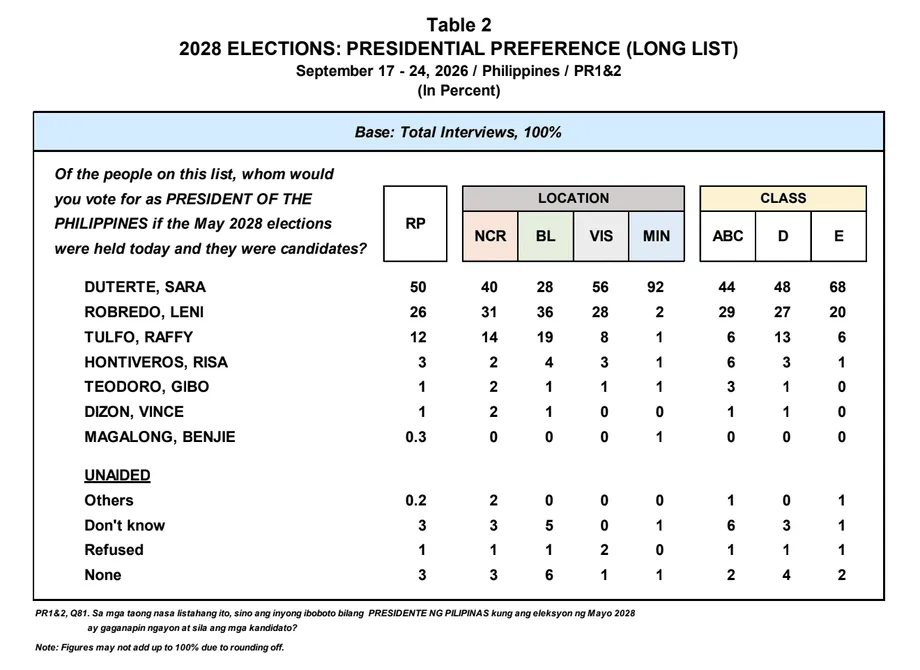
Vice President Sara Duterte received 50 percent of presidential preferences in Pulse Asia's September 2026 Ulat ng Bayan survey, putting her 24 percentage points ahead of Naga City Mayor Maria Leonor G. Robredo as respondents considered a hypothetical May 2028 election. Senator Raffy Tulfo placed third with 12 percent, behind Robredo's 26 percent.
Contents
- A 24 Point National Lead, With Sharp Regional Differences
- How Presidential Preferences Changed Since May
- Mindanao and the Rest of Luzon Point in Different Directions
- What the Three Candidate Contest Shows
- Duterte Leads Four Other Presidential Scenarios
- Go Leads Vice Presidential Preferences
- Poe Tops Senate Preferences as Election Interest Reaches 89%
- What the Survey Establishes and What Is Still Unknown
- Key Points
The survey interviewed 2,400 adults nationwide in person from September 17 to 24. Duterte also led all five alternative presidential contests tested, receiving between 52 percent and 60 percent depending on the candidates listed.
Her national advantage concealed large regional differences. Duterte received 92 percent in Mindanao in the broad presidential preference question, while Robredo led in the rest of Luzon, excluding Metro Manila, by 36 percent to 28 percent. In a separate contest limited to Duterte and Robredo, the two tied at 46 percent in Metro Manila.
The findings extended beyond the presidency. Senator Christopher Go led vice presidential preferences with 31 percent, while former Senator Grace Poe topped the reported Senate preferences with 50.2 percent. Interest in the May 2028 elections reached 89 percent of Filipino adults.
These are preferences expressed during the survey period, not an election result or a confirmed list of candidates. The different presidential scenarios are especially important: the 50 percent figure comes from the broader candidate list, while the 52 percent figure comes from a contest featuring Duterte, Robredo and Raffy Tulfo.
How Presidential Preferences Changed Since May
Duterte's September result was close to her standing in Pulse Asia's May 2026 survey. Her support moved from 49 percent to 50 percent, Robredo remained at 26 percent, and Raffy Tulfo moved from 14 percent to 12 percent.
That amounts to a one percentage point increase for Duterte and a two point decrease for Tulfo. The figures establish the size of the reported changes, but without the surveys' margins of error they do not establish whether those movements represent a meaningful shift in public opinion.
In the broader September candidate list, Senator Risa Hontiveros received 3 percent. Defense Secretary Gilberto Teodoro Jr. and Public Works and Highways Secretary Vince Dizon each received 1 percent, while Baguio City Mayor Benjamin Magalong received 0.3 percent.
Another 3 percent were undecided, 3 percent said they would not support any of the possible presidential candidates, and 1 percent declined to identify a preference. Those are separate responses: uncertainty about a choice is different from rejecting the candidates listed or withholding an answer.
The relevant dates place the findings in context:
- May 2026: Duterte received 49 percent, Robredo 26 percent and Raffy Tulfo 14 percent in the earlier presidential preference survey.
- September 17 to 24, 2026: Pulse Asia interviewed 2,400 adults for the latest Ulat ng Bayan survey.
- May 2028: The election considered in the hypothetical presidential and vice presidential questions is scheduled to take place.
Mindanao and the Rest of Luzon Point in Different Directions
Duterte's strongest support in the broad presidential question came from Mindanao, at 92 percent. She also received 56 percent in the Visayas and 40 percent in Metro Manila. Across socioeconomic classes, her support ranged from 44 percent to 68 percent.
Robredo's lead in the rest of Luzon was eight percentage points, with 36 percent against Duterte's 28 percent. That result makes the regional picture more complicated than the national ranking alone suggests: Duterte led nationwide, but did not lead in every geographic area.
The regional contrast persisted when the candidate list narrowed. In the contest featuring Duterte, Robredo and Raffy Tulfo, Robredo received 39 percent in the rest of Luzon against Duterte's 31 percent, again an eight point advantage. In Metro Manila, Duterte received 42 percent and Robredo 39 percent, a much smaller numerical gap than the national result.
National and regional percentages answer different questions. Duterte's 92 percent in Mindanao describes preferences among respondents there; it does not mean Mindanao supplied 92 percent of her national support. Calculating each region's contribution to the national result would require the survey's regional weights.
What the Three Candidate Contest Shows
In Set A, which tested Duterte against Robredo and Raffy Tulfo, Duterte received 52 percent, Robredo 30 percent and Tulfo 14 percent. Duterte's lead over Robredo was 22 percentage points, compared with 24 points in the broader presidential question.
All three received higher percentages in this narrower contest than in the broad list: Duterte rose from 50 percent to 52 percent, Robredo from 26 percent to 30 percent, and Tulfo from 12 percent to 14 percent. These differences show how the options presented can affect the distribution of preferences. They do not reveal which individual respondents changed their answers.
Additional breakdowns for this scenario put Duterte at 55 percent in the Visayas and 94 percent in Mindanao. She received 50 percent among Class D respondents and 70 percent among Class E respondents. Among Class ABC respondents, Duterte received 47 percent and Robredo 37 percent.
The class labels are the survey's socioeconomic groupings. Their results should be read separately from geographic results because they describe different ways of grouping respondents.
Reports use both 50 percent and 52 percent when describing Duterte's lead. The detailed results distinguish the broad presidential question from Set A. One account places the three candidate figures alongside lower ranking candidates and response categories from the broad list, so those figures should not be combined into a single result.
Duterte Leads Four Other Presidential Scenarios
Set B placed Duterte against Senator Erwin Tulfo and Hontiveros. Duterte received 57 percent, Erwin Tulfo 17 percent and Hontiveros 14 percent. In Set C, Duterte again received 57 percent, followed by Erwin Tulfo at 18 percent and Senator Paolo Benigno Aquino IV at 16 percent.
Duterte led across geographic areas and socioeconomic classes in both scenarios. Erwin Tulfo and Raffy Tulfo are different candidates in these questions, so their percentages cannot be treated as results for the same person.
In the contest limited to Duterte and Robredo, Duterte received 54 percent and Robredo 40 percent, a 14 point gap. Robredo's percentage was higher than in the broader candidate lists, although Duterte retained the national lead. The survey does not establish how supporters of excluded candidates would behave in an actual election.
That contest also produced some of the closest subgroup results. Duterte and Robredo tied at 46 percent in Metro Manila. Among Class ABC respondents, Duterte received 48 percent and Robredo 44 percent. Robredo led in the rest of Luzon, while Duterte received majority support in the Visayas, Mindanao, and Classes D and E.
Against Hontiveros alone, Duterte received 60 percent and Hontiveros 23 percent. Duterte led in every geographic and socioeconomic subgroup. The remaining respondents were undecided or said they would not support either candidate.
Go Leads Vice Presidential Preferences
Senator Christopher Go led the vice presidential question with 31 percent, followed by Senator Robin Padilla at 19 percent and Aquino at 17 percent. Former Senator Grace Poe received 14 percent, Senator Erwin Tulfo 10 percent and Senator Francis Pangilinan 3 percent.
A candidate identified as Torre received 0.3 percent. Other volunteered names accounted for 0.5 percent. Two percent were undecided, another 2 percent would not support any candidate, and 1 percent declined to answer.
Go's strongest regional result was in Mindanao, where he received 55 percent, followed by the Visayas at 37 percent. In Metro Manila, he received 26 percent against Aquino's 20 percent. Aquino led in the rest of Luzon, with 26 percent to Go's 18 percent.
The socioeconomic breakdown also differed from the national ranking. Go received 37 percent among Class ABC respondents and 31 percent among Class D respondents, while Padilla led among Class E respondents with 40 percent. Go's national lead therefore did not extend to every subgroup.
Poe Tops Senate Preferences as Election Interest Reaches 89%
Poe led the reported Senate preferences with 50.2 percent, followed by Senator Alan Peter Cayetano at 46.5 percent, Padilla at 45.9 percent and Raffy Tulfo at 44.4 percent. Cayetano, Padilla and Tulfo were described as sharing second through fourth places.
The reported top seven also included Davao City Mayor Sebastian Duterte at 37.2 percent, former Senator Manny Pacquiao at 36.5 percent and Senator Loren Legarda at 33.0 percent. These Senate results are separate from preferences for president or vice president and should not be added to those contests.
Interest in the coming election was widespread: 89 percent of adults said they were interested. Interest ranged from 85 percent to 97 percent across geographic areas and from 87 percent to 89 percent across socioeconomic classes.
Those figures measure stated interest, not a promise to vote or a turnout forecast. They nevertheless show that attention to the May 2028 electoral exercise was already high during the September survey period.
What the Survey Establishes and What Is Still Unknown
Pulse Asia Research said it conducts Ulat ng Bayan surveys independently, without any party singularly commissioning the research effort. The interviews provide a snapshot of preferences among adults at a particular time, using several possible candidate lists.
The findings establish Duterte's national lead across all five alternative presidential scenarios, Robredo's strength in the rest of Luzon, and Go's lead in the vice presidential question. They do not confirm who will run, which candidates will campaign together, or how preferences will develop before May 2028.
The methodology details reported here identify the sample size, interview method and fieldwork dates, but do not give margins of error, regional sample sizes or weighting details. Those missing details limit conclusions about small gaps and changes between surveys, particularly within subgroups.
No date is given for the next survey release. The next election date identified is May 2028, leaving a substantial interval between these reported preferences and the vote they describe.
Key Points
- Duterte received 50 percent in the broad presidential question, ahead of Robredo at 26 percent and Raffy Tulfo at 12 percent.
- Pulse Asia interviewed 2,400 adults nationwide from September 17 to 24, 2026.
- Duterte led five alternative presidential contests, with support ranging from 52 percent to 60 percent.
- Robredo led in the rest of Luzon and tied with Duterte in Metro Manila in their contest against each other.
- Go led vice presidential preferences with 31 percent; Poe topped reported Senate preferences with 50.2 percent.
- Eighty nine percent of adults expressed interest in the May 2028 elections.