Five days in The Hague bring an agreement on trust
Cambodia and Thailand agreed on measures to build mutual trust during maritime boundary talks from October 14 to 18, 2026, at the Peace Palace in The Hague. Their next meeting is scheduled for November 24 to 27 in Kuala Lumpur, where a conciliation commission will continue efforts to resolve overlapping claims in the Gulf of Thailand.
Contents
- Five days in The Hague bring an agreement on trust
- What have the governments agreed to do?
- Thailand insists on settling the boundary first
- What the legal and technical discussions covered
- A commission that recommends rather than rules
- How the talks reached Kuala Lumpur
- Why the disputed waters matter
- Fishermen and border tensions show the human stakes
- November brings a test of implementation
- Key Points
The immediate challenge is implementation. The commission said earlier commitments between the two countries remained incompletely implemented and urged both governments to carry out those arrangements alongside the new measures. Cambodia's Ministry of Foreign Affairs and International Cooperation described the steps as necessary for constructive negotiations.
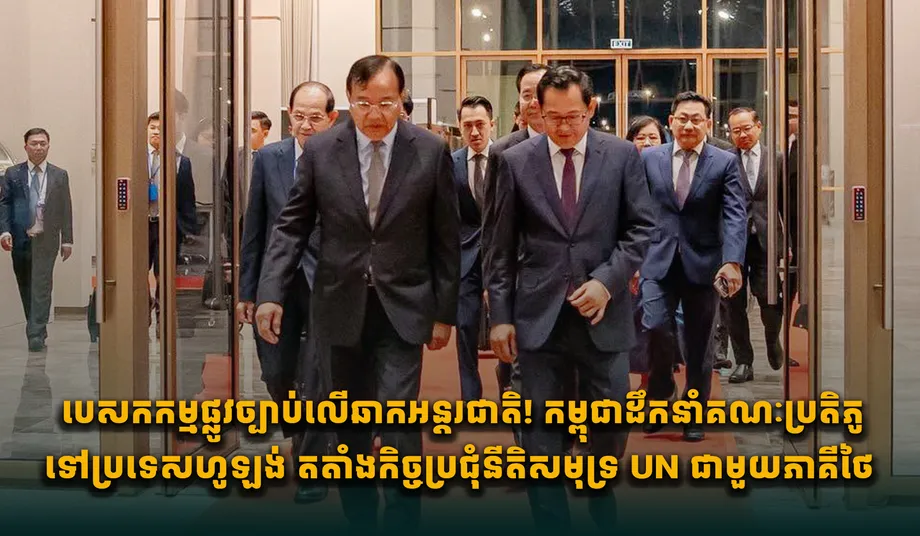
Cambodian Deputy Prime Minister and Foreign Minister Prak Sokhonn led his country's delegation. Thailand's delegation was headed by Deputy Prime Minister and Foreign Minister Sihasak Phuangketkeow. Both sides presented evidence and explained the legal principles behind their competing maritime claims during the five days of discussions.
The agreement comes after years of stalled negotiations over waters believed to contain substantial natural gas and other hydrocarbon resources. Cambodia began compulsory conciliation under the United Nations Convention on the Law of the Sea, known as UNCLOS, in June, following Thailand's termination of a negotiating framework signed in 2001.
Bangkok and Phnom Penh both support continued dialogue, but their public accounts place different priorities on the new measures. Cambodia highlighted each government's right to defend its legitimate interests and correct false information. Thailand stressed restraint in public accusations, the prevention of confrontations and a negotiating agenda focused exclusively on the maritime boundary.
What have the governments agreed to do?
Cambodia's foreign ministry made public one specific clause from the agreement: both countries retain the right to issue statements defending their rights or correcting false information. The ministry described that provision in its statement on the meeting:
Among the agreed measures, both parties recognize their right to make statements to protect their legitimate rights or to correct factual misinformation and disinformation.
Sihasak described discussions about refraining from statements or accusations in international forums that could damage the conciliation process or increase tensions. He also referred to avoiding actions that might trigger confrontations between the countries.
Both positions concern how governments respond when disputes become public. Cambodia wants room to answer claims it considers inaccurate. Thailand wants public exchanges to avoid making negotiations harder. Putting those principles into practice will require each government to manage its own statements while accepting that the other may respond.
The full package of agreed measures has not been published. Cambodia's ministry said the commission would issue an official statement on the meeting's outcome in due course, without giving a release date. The commission also did not publicly identify which earlier commitments remained unfinished or assign responsibility for those gaps.
Thailand insists on settling the boundary first
Sihasak said the commission's work should be confined to deciding where the two countries' maritime rights meet. Speaking as Thailand's foreign minister after the meeting, he set out Bangkok's position:
The key point for Thailand is that this process must focus exclusively on maritime boundary delimitation. Other matters fall outside the scope of the commission's mandate.
Delimitation means agreeing on a line separating the maritime areas belonging to each country. That line affects which government can exercise rights over the waters or seabed on either side.
Sihasak later described the absence of discussions about joint development and resource sharing as a positive sign. Thailand wants the boundary settled before considering those subjects. He also said both countries had reaffirmed their continental shelf claims and argued that Thailand's position was closest to current international law.
Cambodia has sought a broader choice of possible outcomes. At the first commission meeting in September, Prak Sokhonn said his country wanted a treaty establishing what he called "a single, all-purpose maritime boundary." Cambodia has also supported an interim arrangement for joint development and equitable sharing of resources, as outlined before the second conciliation meeting.
Thailand's Government Public Relations Department said in June that a joint development framework was premature before the boundary was clarified. The practical disagreement is therefore about the order of decisions: whether cooperation over resources can proceed while the boundary remains unsettled, or whether the line must come first.
What the legal and technical discussions covered
The Hague meeting concentrated on the evidence and legal arguments supporting each country's claims. According to Sihasak, the commission asked both governments to explain their positions on continental shelf and territorial sea boundaries.
A territorial sea is a belt of water beside a country's coast where that country exercises sovereignty, subject to international rules such as passage rights for foreign ships. The continental shelf concerns rights over the seabed and the resources beneath it. Those seabed rights are especially relevant where oil or gas may be present.
The two concepts matter because a maritime dispute can involve several kinds of rights across the same stretch of sea. Cambodia's request for a single boundary aims to settle the division through one agreed line, while the technical discussions examine the legal basis for the competing claims.
Sihasak said the commission would study the positions presented and could ask for clarification or suggest measures at later meetings. Thailand's foreign ministry had previewed the session on October 9 by saying Bangkok would provide the relevant technical facts. The October discussions gave both delegations an opportunity to put those arguments before the commission.
A commission that recommends rather than rules
The conciliation commission is chaired by Katrina Cooper of Australia. The Permanent Court of Arbitration, or PCA, serves as its registry, providing administrative support for the proceedings.
Conciliation differs from a court case. The commission helps the governments examine their differences and develop a settlement they can accept. It can make recommendations, while the decision to reach an agreement rests with Cambodia and Thailand.
Sihasak said the process would not produce a legally binding judgment. Explaining its purpose as Thailand's foreign minister, he said:
It aims instead to help both sides find a mutually acceptable solution based on international law.
Thailand's foreign ministry has described the process as taking about 12 months. Sihasak said Bangkok remained open to proposals that protected its national interests and sovereignty. Cambodia thanked both the commission and the PCA for helping the parties hold discussions and agree on measures to build confidence.
The PCA has pointed to the conciliation between Timor-Leste and Australia as an example of this approach. That process ended in a treaty signed on March 6, 2018. For Cambodia and Thailand, a final settlement would likewise require the governments to turn negotiations into an agreement they accept.
How the talks reached Kuala Lumpur
The current process follows the collapse of a bilateral arrangement that had linked boundary negotiations with possible cooperation over offshore resources. The 2001 memorandum of understanding was intended to guide both tasks, but talks had stalled for years.
Thailand terminated that framework in May 2026. Cambodia initiated UNCLOS conciliation in June, moving the dispute into a structured process supported by the commission and the PCA. The main steps are:
- 2001: Cambodia and Thailand signed a memorandum covering maritime boundary negotiations and joint development of hydrocarbon resources.
- May 2026: Thailand terminated the memorandum.
- June 2026: Cambodia initiated compulsory conciliation under UNCLOS.
- September 14 to 16: The commission held its first meeting with the parties in Singapore.
- October 9: Cambodia described the process as progress toward a peaceful resolution, while Thailand outlined its preparation for technical discussions.
- October 14 to 18: The second meeting took place at the Peace Palace in The Hague.
- November 24 to 27: The third meeting is scheduled for Kuala Lumpur, Malaysia.
The three announced meeting periods amount to 12 days of formal sessions: three in Singapore, five in The Hague and four planned in Kuala Lumpur. The commission's examination also involves evidence, legal submissions and any further explanations it requests from the governments.
Why the disputed waters matter
The overlapping claims cover approximately 10,000 square miles in the Gulf of Thailand, according to the account preceding the October meeting. The area is believed to contain substantial quantities of natural gas and other hydrocarbons, giving the dispute an economic dimension alongside the question of sovereignty.
A boundary agreement would determine where each country could exercise resource rights. A joint development arrangement would take a different route, allowing cooperation over resources under agreed rules while leaving the final boundary for later settlement.
Cambodia's interest in an interim arrangement and Thailand's insistence on delimitation first create different routes toward the same practical issue: how either country can pursue offshore resources in waters claimed by both.
The October meeting remained focused on the legal and technical arguments, Sihasak said. Negotiations over resource sharing would require further political agreement about whether and when that subject enters the process.
Fishermen and border tensions show the human stakes
Two Cambodian fishermen released by Thailand in September had been detained since February. The Thai navy said their vessel had entered Thai territory. Cambodia maintained that the arrest took place approximately 7.2 nautical miles from Koh Yor in Koh Kong province and violated Cambodian sovereignty and international law.
For people working at sea, competing claims can translate into the risk of detention and months away from home. Measures that reduce confrontations therefore have an immediate purpose beyond the diplomatic language used in meeting statements.
Relations also remain strained by two rounds of deadly fighting along the land border in 2025. After the December ceasefire talks, regional diplomacy focused on maintaining calm and rebuilding trust between governments that continued to accuse each other of breaking commitments.
The maritime negotiations now place similar demands on both sides: carry out agreed measures, keep communication open and address incidents before they cause a wider confrontation. Sihasak said confidence measures need not always take the form of formal agreements, but both countries must put them into practice together.
November brings a test of implementation
The Kuala Lumpur meeting from November 24 to 27 gives the commission another opportunity to examine the competing claims and seek explanations. It also gives the governments a period in which to demonstrate that the trust measures agreed in The Hague are being used.
Sihasak cited Thailand's participation in efforts to combat scam operations in Cambodia as an example of cooperation that could build confidence. He said Thailand would continue participating in conciliation and supported dialogue grounded in international law.
Cambodia, in its October 9 statement, described the goal as a peaceful maritime settlement benefiting people in both countries and supporting regional peace and cooperation. Its account of the latest meeting placed particular weight on fully implementing both old and new commitments.
The next stage has two concrete tasks: continue the detailed work on the boundary and reduce the public disputes and confrontations that can disrupt it. The commission has asked for implementation; the two governments now have to carry that work beyond the meeting room.
Key Points
- Cambodia and Thailand agreed on measures to build mutual trust during talks in The Hague from October 14 to 18, 2026.
- The commission urged both countries to implement earlier commitments that remained unfinished.
- Cambodia highlighted the right to defend legitimate interests and correct false information. Thailand called for restraint in accusations and actions that could cause confrontations.
- Thailand wants maritime delimitation settled before discussions about joint development or resource sharing.
- The commission can recommend a settlement, while agreement rests with the two governments.
- The next meeting is scheduled for November 24 to 27 in Kuala Lumpur.