An AI assistant that keeps working after the chat ends
Ant Group says its LingGuang artificial intelligence assistant has passed 20 million users, while a new version managed more than 1.16 million ongoing matters and carried out more than 3.6 million task executions in its first week. The figures accompany a shift in what the company wants its assistant to do: remember an obligation, watch for changes and follow up over time.
Contents
- An AI assistant that keeps working after the chat ends
- What the first week's numbers show
- Finding subscriptions and watching travel prices
- School notices and family obligations
- How LingGuang works across conversations
- Forty connections broaden its reach
- Permissions become part of the task
- From instant apps to continuing responsibility
- Key Points
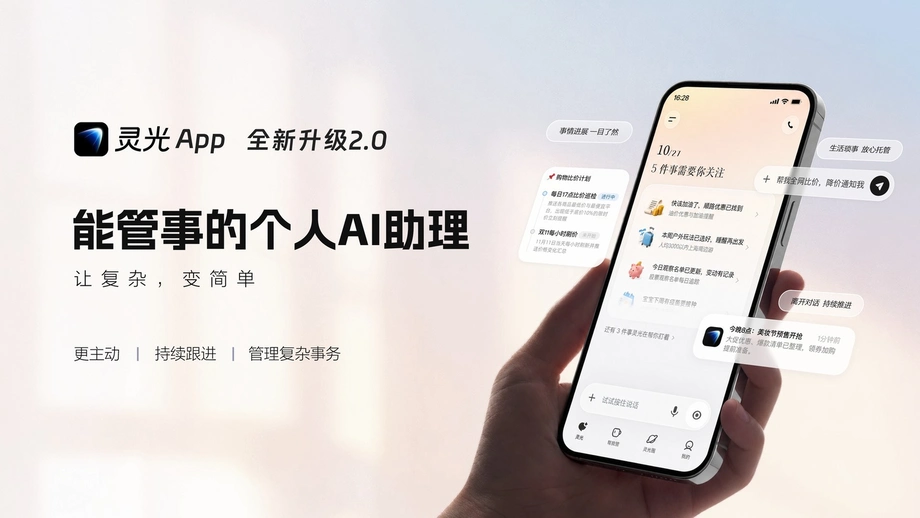
Announced in Hangzhou on October 27, 2026, LingGuang 2.0 introduced a feature called Bang Wo Guan, meaning Help Me Manage. With a user's permission, it can continue handling an assigned matter after the person leaves the conversation, then send a reminder when something needs attention.
The examples are practical: finding a forgotten subscription in Alipay spending records, monitoring flight and hotel prices after booking, or collecting a teacher's notices from a DingTalk class group. By November 3, LingGuang had connected to 40 external tools and services, extending its reach across payments, travel, messages and other everyday activities.
For users, the change is from asking an AI to do something once to asking it to keep looking after something. A travel query can become a continuing price watch. A review of spending can become an effort to find recurring charges that deserve another look.
What the first week's numbers show
Ant's figures separate the matters under management from the individual tasks executed. One ongoing matter, such as watching a hotel booking, can require several actions as the assistant checks information and follows up. That helps explain why the company recorded 3.6 million task executions alongside 1.16 million matters.
The user total describes the size of LingGuang's audience. Ant has not specified how many of those users are active each day, how many enabled the new management feature, or the share of tasks completed successfully. Those details would help readers assess how widely the new capability is being used and how reliably it works.
LingGuang's expansion follows an earlier burst of interest in its ability to create small applications from ordinary language. The latest figures track a different kind of activity: repeated work on a user's behalf, spread across time and potentially across several services.
Finding subscriptions and watching travel prices
Alipay spending records give LingGuang a concrete starting point for managing household costs. After receiving permission, the assistant can review transactions, identify subscriptions that renew automatically and suggest ways to save money.
A recurring payment can be easy to overlook when it appears among many purchases. LingGuang's proposed role is to bring those charges back to the user's attention and help them decide whether a service still deserves a place in the budget. The decision may depend on information the payment record alone cannot supply, such as whether another family member uses the subscription.
Flights and hotels offer another reason for an assistant to keep working after the original request. LingGuang can monitor prices after a booking and notify the user when it finds a lower price. The useful moment comes later, when information has changed, rather than when the booking is first made.
A price alert still leaves a practical decision for the traveller. Cancellation conditions, refund rules and the availability of a replacement booking determine whether switching would actually save money. The advertised function is to identify the opportunity and bring it to the user's attention.
School notices and family obligations
DingTalk class groups illustrate how LingGuang's new functions extend beyond spending. With authorization, the assistant can follow teachers' notices, organize important information, extract things that need doing and carry out related work such as formatting documents.
Parents often need a short list of obligations rather than another long conversation to read. Turning messages into organized tasks changes the output from a summary into something a family can act on, while keeping the underlying school communication as the starting point.
Ant also describes uses involving pet care, children's vaccinations, family anniversaries and vehicle inspections. These matters have a shared requirement: remembering a date or a piece of context long enough to act when it becomes relevant.
The management feature is intended to retain that context and arrange follow up within the permission granted by the user. Instead of starting another conversation and explaining the same situation again, a person can return to an existing matter that the assistant has continued to track.
How LingGuang works across conversations
LingGuang 2.0 combines memory across conversations, scheduling for tasks that run over long periods, connections to outside tools and dedicated cloud computing resources. Each component handles a different part of the job.
Memory preserves the background to a matter. Scheduling determines when the assistant should check again or take another step. Tool connections allow it to obtain information or perform an action in another service. A dedicated cloud host, a computer running remotely, supports work that continues after the user leaves the chat.
A language model supplies the ability to interpret a request and reason about possible steps. Continuing a task also requires software that keeps track of its status, notices new information and triggers the next action. That is why the upgrade involves more than producing better answers in a chat window.
LingGuang also supports MCP and CLI tools in an open computing environment. MCP, short for Model Context Protocol, provides a standard way for AI systems to connect with tools and information. A CLI, or command line interface, lets software carry out operations through text commands. Both can expand the actions available to an assistant beyond its built in functions.
Forty connections broaden its reach
By November 3, LingGuang's 40 external connectors covered services including Alipay, DingTalk, Feishu, WeChat Reading, Hello's mobility services, email and McDonald's. Ant also describes support for Mijia services, bringing smart home functions into the range of potential activities.
A connector is the software link that lets one system work with another. For LingGuang, those links are central to its promise of reducing the need to move repeatedly between applications. The assistant needs access to relevant information before it can organize a matter, monitor a change or execute a related task.
The services cover different parts of daily life. Alipay supplies payment information and services; workplace and messaging platforms contain notices and documents; travel services provide information relevant to journeys. Linking those activities gives the assistant a broader view of an assigned matter than a conversation alone would provide.
Users may gain convenience from that reach, while also having more decisions to make about access. Permission to read financial records, follow a class group or interact with a home service involves different information and different consequences. The scope of each authorization becomes part of the product's everyday usefulness.
Permissions become part of the task
LingGuang 2.0 connects to Ant's APASS account and security infrastructure. The system is designed to manage identity verification, checks on intended actions and privacy protection across AI agents, devices, applications and services.
Ant describes a mechanism that stores authorization keys separately from the AI agent. These keys act like digital credentials: they allow a system to access an approved service. Keeping them under separate management allows the assistant to perform authorized tasks without directly handling the keys itself.
Users can view, adjust or withdraw permissions. That control matters for an assistant expected to operate after the conversation ends, because authorization can remain relevant for hours, days or longer rather than for a single exchange.
The examples show why access needs to match the job. Reviewing spending requires financial information; organizing class notices requires messages; controlling a connected device involves an action in the home. LingGuang's stated approach puts authorization and security checks into the execution process, alongside the tools that perform the work.
From instant apps to continuing responsibility
LingGuang originally attracted attention for creating Flash Apps, small applications generated from a user's description. Its launch in November 2025 presented an assistant that could build tools such as planners and trackers in about 30 seconds, alongside visual responses and other formats.
The product then experienced a surge in early downloads, passing one million within four days and two million by its sixth day. Heavy demand briefly interrupted the Flash App feature while Ant added server capacity.
The main milestones now span almost a year:
- November 18, 2025: Ant launched the LingGuang app.
- Within six days: Downloads exceeded two million.
- October 27, 2026: Ant announced LingGuang 2.0 and its continuing management feature in Hangzhou.
- By November 3, 2026: Ant reported more than 1.16 million matters managed, more than 3.6 million task executions and 40 external connectors. The user base had passed 20 million.
The two stages address different needs. Flash Apps help a person turn an idea into a usable tool. Continuing management aims to take some of the remembering, checking and following up out of that person's hands. LingGuang's latest upgrade puts those repeated actions at the centre of its pitch as a personal assistant.
Key Points
- Ant says LingGuang has passed 20 million users.
- LingGuang 2.0 managed more than 1.16 million matters and executed more than 3.6 million tasks in its first week.
- The upgrade can continue authorized work after a user leaves the conversation.
- Examples include subscription reviews, travel price monitoring and organizing school notices.
- Forty external connectors were available by November 3, 2026.
- Ant says users can review, change and revoke permissions through its account and security arrangements.