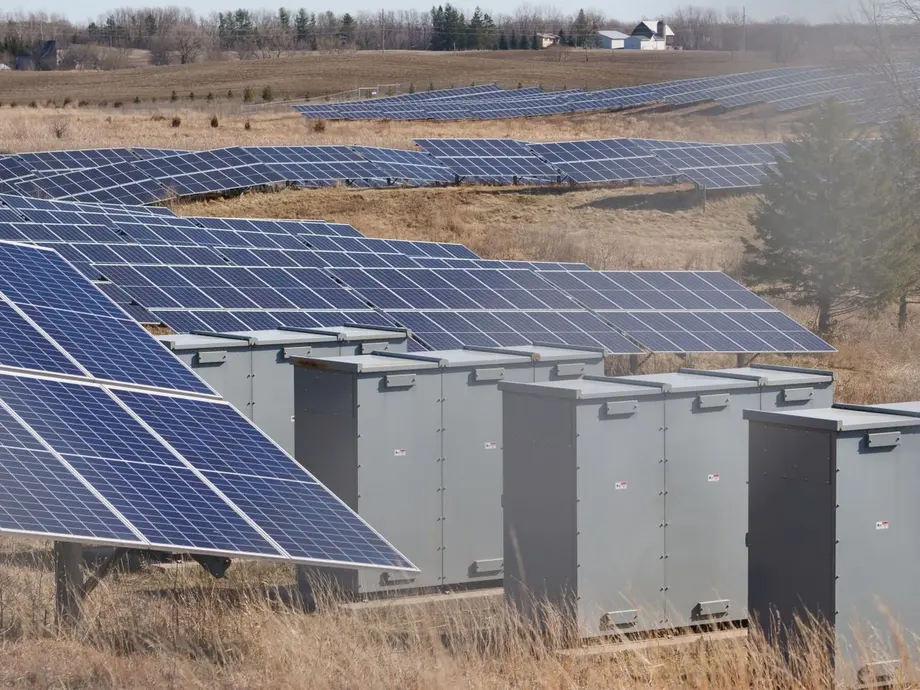
A bigger storage fleet must also earn its keep
China aims to reach 300 gigawatts (GW) of new energy storage by 2030, with an average discharge duration of about three hours, under a plan that puts electricity market income, reliable supply and operational safety alongside construction. From the National Energy Administration's September 2026 total of 167 GW, reaching the target would require another 133 GW, an increase of roughly 80%.
Contents
- A bigger storage fleet must also earn its keep
- What 300 GW and three hours mean
- How fast has the fleet grown?
- Where the new capacity will go
- Three ways storage could earn revenue
- Actual use matters as much as construction
- Lithium batteries lead, with more technologies planned
- More applications, with tighter investment discipline
- China's target anchors a wider global expansion
- Key Points
The National Development and Reform Commission and National Energy Administration published the Implementation Plan for New Energy Storage during the 15th Five-Year Plan Period on November 13, 2026. The notice, numbered NDRC Energy [2026] 1565, is dated October 29. Its 16 tasks cover six areas, from applications and technology to market rules, industry management and international cooperation.
The central change is how storage earns its place in the electricity system. Instead of primarily adding batteries to renewable energy projects to satisfy construction requirements, China wants facilities that respond to actual demand, help prevent supply shortages and receive payment for the services they deliver.
Storage takes in energy when it is available and releases it when needed. That becomes more valuable as solar and wind supply a larger share of generating capacity, because sunshine and wind do not follow household or factory schedules. China's combined wind and solar capacity exceeded 2.01 terawatts at the end of September, accounting for about 48.7% of installed generating capacity.
The plan concentrates on balancing supply and demand within each day. For consumers, its practical purpose is to move more renewable electricity into the hours when people need it and give grid operators another resource during periods of tight supply.
What 300 GW and three hours mean
China's new energy storage category includes batteries, compressed air and other emerging technologies, while excluding conventional pumped hydro. Pumped hydro stores energy by moving water uphill, then releasing it through turbines to generate electricity.
Gigawatts measure how much power storage can deliver at a moment. Gigawatt hours (GWh) measure how much energy it holds. A system rated at 1 GW with 3 GWh of usable energy can, in simplified terms, deliver its rated output for three hours.
Applying the plan's average duration of about three hours to 300 GW gives an indicative energy capacity of approximately 900 GWh. The National Energy Administration reported 435 GWh operating at the end of September 2026, so the implied energy capacity would be slightly more than double that level.
Liu Shi, chief scientist and deputy general manager of the National Innovation Center for New Energy Storage, explained that three hours is a national average objective. Individual projects should have capacities and durations suited to their tasks and operating conditions. A facility handling brief grid disturbances has different needs from one supplying electricity through an evening demand peak.
How fast has the fleet grown?
China ended the 13th Five-Year Plan period in 2020 with about 3 GW of new energy storage. By the end of 2025, the fleet had reached approximately 136 GW and 351 GWh, more than 40 times the earlier power capacity.
The National Energy Administration's October 30 release put operational capacity at 167 GW and 435 GWh at the end of September, up 63% from a year earlier. Chen Haisheng, director of the Chinese Academy of Sciences' Institute of Engineering Thermophysics and chairman of the China Energy Storage Alliance, cited an alliance total of 168 GW for June 2026; the two organisations' figures place the fleet at slightly different levels.
The main milestones are:
- End of 2020: about 3 GW of new energy storage installed.
- End of 2025: approximately 136 GW and 351 GWh operating.
- End of September 2026: the National Energy Administration recorded 167 GW and 435 GWh.
- October 29, 2026: the two agencies dated the implementation notice.
- November 13, 2026: the implementation plan was published.
- 2030: the target year for 300 GW and an average duration of about three hours.
Where the new capacity will go
The plan envisages about 140 GW of independent storage connected to the grid that can help meet peak demand by 2030. Such facilities operate as electricity system resources rather than serving only one wind farm, solar installation or customer. That target represents roughly 47% of the national 300 GW objective.
Renewable energy bases are expected to have another 50 GW to 60 GW of storage. The plan names desert development areas in Gansu, Xinjiang and Inner Mongolia, as well as clean energy bases in Qinghai and northeastern China. Storage would help these large generating centres make better use of transmission lines carrying electricity to other provinces.
Projects combining hydropower, wind and solar would add storage according to their operating needs. Offshore wind developments could place it at substations, collection points and locations where power cables reach land, helping manage the electricity delivered from multiple turbines.
A planning assessment also estimates approximately 110 GW of additional demand during the five year period for storage serving needs within individual provinces, taking that category above 240 GW by 2030. This geographical measure includes different project types, including independent facilities connected to the grid, so the plan's categories overlap.
Xu Dongjie, deputy chief engineer at the Electric Power Planning and Engineering Institute, described 300 GW as a prudently calculated baseline tied to system requirements. His explanation connects the target to another concern in the plan: giving investors confidence while preventing a rush of unnecessary construction.
Three ways storage could earn revenue
Electricity trading is the most familiar income source. A storage operator charges when electricity is cheaper and sells when prices are higher. Its earnings depend on the price gap, the energy lost during charging and discharging, and its operating costs.
The implementation plan supports equal access to contracts covering longer periods and to spot markets, where electricity is traded close to delivery. Renewable energy bases with storage could trade as a combined operation across provincial boundaries. Where local rules allow, storage attached to a generating project could also enter the market as an independent operator.
Capacity payments provide a second income source. They recognise the value of having dependable power available when the system needs it. The plan calls for a capacity price mechanism for eligible independent facilities connected to the grid, supported by project list management, and for reliable capacity compensation as spot markets develop.
Ancillary services provide a third route. These are tasks that keep the electricity system stable, such as correcting frequency deviations, holding emergency reserves and responding quickly when supply or demand changes. The plan also calls for exploring markets for ramping and rotational inertia, services that help the grid handle rapid changes and disturbances.
Li Zhen, deputy secretary general of the China Energy Storage Alliance, identified capacity payments, electricity trading and ancillary services as the three parts of a sustainable revenue structure. He also pointed to uneven progress among local markets, where trading income alone can still fall short of a reasonable investment return. The plan gives policy directions rather than a single nationwide payment rate or uniform implementation date.
Actual use matters as much as construction
The National Energy Administration reported an average storage duration of 2.61 hours at the end of September, about 0.27 hours longer than a year earlier. Equivalent utilisation reached around 915 hours during the first nine months of 2026, an increase of approximately 10 hours. This measure expresses activity relative to rated capacity, helping track how much work the growing fleet performs.
Western Inner Mongolia offers a concrete example of storage supporting supply. The regional grid operator reported 20.23 GW and 70.47 GWh operating in October. During emergency dispatch, storage supplied as much as 12.25 GW, equivalent to 33% of electricity demand at that time.
The implementation plan ties operation more closely to market conditions. Where spot markets run continuously, storage should operate according to market clearing results, which determine accepted trades and prices. Elsewhere, dispatch should account for economic returns and system requirements. During emergencies threatening grid safety, facilities under dispatch control must accept coordinated instructions.
Independent facilities already represented 51.2% of cumulative installations in 2025. Projects rated at least 100 megawatts accounted for 72%, while systems able to discharge for at least four hours represented 27.6%. Those figures show that large facilities and longer discharge periods already have a substantial place in the market.
Lithium batteries lead, with more technologies planned
Lithium ion batteries represented about 96% of installed new energy storage capacity in the National Energy Administration's figures. Li Zhen put their share of additions during the first half of 2026 at 94.1%. The plan supports further improvements in lithium batteries while promoting sodium ion batteries and other technologies for different operating needs.
CNESA DataLink's incomplete industry count identified 34 companies developing 45 sodium battery cell production bases across 20 provincial regions by July 2026. Planned annual production capacity totalled 293.7 GWh, with 25.2 GWh already operating. Only about 8.6% of the announced manufacturing capacity was therefore in operation, leaving most of the proposed expansion under construction or in planning.
Compressed air systems store energy by compressing air and later releasing it to generate power. Flow batteries store energy in liquids held in tanks. Both are among the technologies the plan seeks to move towards wider commercial use, alongside flywheels, which store energy in a spinning rotor.
Zhang Zhentao, a senior engineer at the Chinese Academy of Sciences' Technical Institute of Physics and Chemistry, described liquid air storage development in Qinghai and compressed carbon dioxide demonstration projects in Xinjiang and Hebei. The plan also includes gravity storage, molten salt heat storage and research into hydrogen and solid state batteries.
Grid forming technology receives particular attention. It allows storage equipment to help establish and maintain the grid's electrical conditions, rather than simply following signals from other generators. The agencies call for testing its reliability and developing technical standards before wider deployment.
More applications, with tighter investment discipline
Data centres, industrial parks and virtual power plants are among the applications the plan wants to expand. A virtual power plant coordinates separate resources, such as batteries, small generators and flexible electricity demand, so they can respond together to grid needs.
The plan encourages shared backup storage for computing facilities in national computing hubs, including Inner Mongolia, Gansu, Ningxia and Guizhou. It also supports storage for direct supplies of renewable electricity to customers, charging infrastructure and experiments in allowing electric vehicles to exchange power with the grid.
Existing energy infrastructure could find new uses. The agencies support building storage at retired thermal power sites using their land and electrical connections, exploring storage alongside coal generators, and assessing whether batteries can delay or replace some transmission and substation investment.
Private companies would receive support to invest and collaborate with universities and research institutes. Eligible projects could use policy financing tools, manufacturing loans, local government special bonds and green finance. At the same time, the plan calls for stronger product testing, safety oversight throughout a project's life, recycling research and orderly factory expansion.
Investment expectations are already strong. Forecasts compiled from at least five institutions project that 23 storage related listed companies could increase net profit by more than 20% in both 2026 and 2027. Those expectations sit alongside the industry's practical challenge: turning additional factories and completed facilities into dependable services and lasting income.
China's target anchors a wider global expansion
Energy research institution Ember's global storage target analysis, published October 15, puts China's combined 2030 objective at 460 GW: 300 GW of new energy storage plus 160 GW of pumped hydro. It says China reached its previous 2025 goal of 30 GW two years early.
Ember examined 98 countries and the European Union, using targets current to August 31, 2026. Their combined storage targets totalled 822 GW, up 190% since the COP29 climate conference, compared with the conference pledge of 1,500 GW by 2030. China's 460 GW and the EU's 200 GW together account for just over 80% of that national and regional target total.
Katye Altieri, an electricity transition analyst at Ember, described how concentrated the increase has been:
Almost all of the increase in global storage ambition since COP29 comes down to two economies: China and the EU.
Global storage additions reached 118 GW in 2025, including 108 GW of batteries, according to Ember. China contributed 54% of those additions. Its manufacturing scale and experience operating large facilities therefore matter beyond its domestic electricity system.
The Chinese plan supports overseas projects, international research and cooperation on technical standards through mechanisms including APEC, the BRICS group and the Shanghai Cooperation Organisation. It also asks companies to track foreign market access and environmental rules. At home and abroad, the next stage depends on matching equipment to local electricity needs and paying for the useful work it performs.
Key Points
- China targets 300 GW of new energy storage by 2030, with an average discharge duration of about three hours.
- The National Energy Administration recorded 167 GW and 435 GWh operating at the end of September 2026.
- The plan envisages about 140 GW of independent storage capable of supporting peak supply and 50 GW to 60 GW at renewable energy bases.
- Electricity trading, capacity payments and ancillary services are intended to broaden project income.
- Lithium batteries remain dominant, while sodium batteries, compressed air, flow batteries and other technologies receive policy support.
- Stronger safety oversight and controls on unnecessary expansion accompany support for private investment and new applications.
- Ember puts China's combined storage and pumped hydro target at 460 GW, the largest among the markets it assessed.