A $300,000 aircraft moves toward limited use
XPeng is targeting passenger trips in China as early as summer 2027 with a two seat electric aircraft priced at about $300,000, as its flying vehicle business works through aviation certification. Recreational flying in approved locations and emergency services are expected to come before any wider use over cities.
Contents
- A $300,000 aircraft moves toward limited use
- What buyers would actually receive
- Why certification remains central
- How the delivery timetable has changed
- Short flights in approved places
- Testing and automatic flight
- Orders and a factory built for scale
- Overseas ambitions start with regional partners
- Why the first routes may stay outside cities
- Key Points
Michael Du, vice president and chief financial officer of XPeng, said limited deliveries to Chinese partners were expected within months, followed by a broader rollout. Deli Zhao, chief executive of the flying vehicle business, placed recreational and emergency service use in the second half of 2027. Neither executive gave an exact date for the start of customer flights.
The timetable has moved since the project entered formal certification. XPeng initially planned production deliveries for the fourth quarter of 2025, then targeted 2026. Those earlier company announcements help explain why the latest commercial forecast needs to be understood alongside the remaining regulatory work.
Speaking at the Web Summit technology event in Lisbon, Du described the aircraft as a product approaching commercial use rather than an isolated demonstration.
It's no longer science fiction or just a single demo aircraft.
It's really a commercial model.
The proposed experience is more specific than the phrase flying car suggests: customers would drive a large vehicle carrying a detachable aircraft to a suitable location, deploy it and fly within permitted areas. The aircraft and its road carrier are separate machines, each subject to its own approval process.
What buyers would actually receive
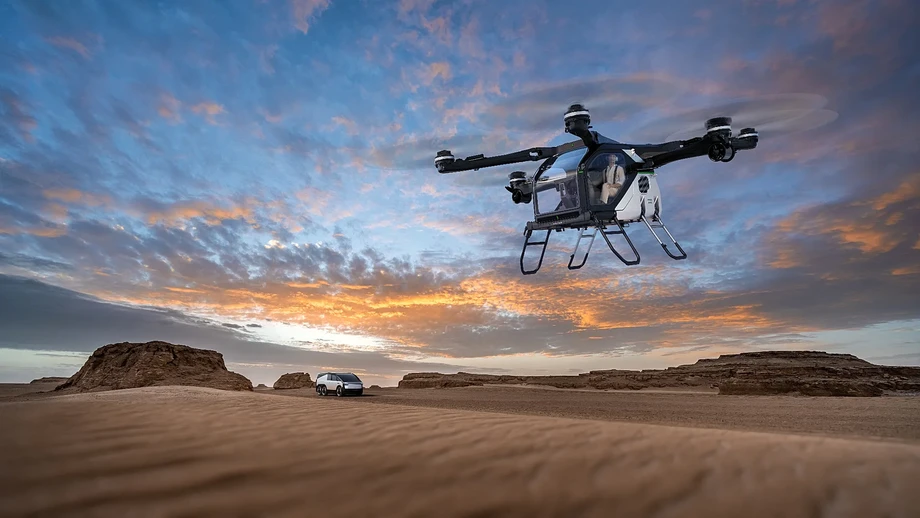
The Land Aircraft Carrier combines an aircraft known as the X3-F with a vehicle that transports and recharges it. The flying component has two seats, six propellers powered by batteries and a cockpit roughly the size of a small car. It takes off and lands vertically, rather than accelerating along a runway.
XPeng's March 2024 announcement describes the X3-F as a piloted electric aircraft with manual and automatic flight modes and a panoramic cockpit offering a 270 degree view. A joystick provides manual control, while automatic functions allow flight to a programmed destination.
The road vehicle has seating for four or five people, six wheels, drive to all six wheels and rear wheel steering. Its range extender power system can recharge the aircraft several times, according to the company. The aircraft folds into the rear compartment for travel on roads and unfolds for flight.
Zhao said the approximately $300,000 price includes the carrier vehicle. That makes the package different from a car that simply lifts off from a traffic jam: its road and air journeys require a change between two separate vehicles.
The carrier has a claimed driving range exceeding 1,000 kilometers under China's CLTC testing cycle. That figure measures the ground vehicle, while the aircraft has a reported flight range of 30 kilometers. For a buyer planning a journey, the two numbers describe very different capabilities.
Why certification remains central
The Civil Aviation Administration of China has issued a type inspection authorization, according to the latest account of the project, and its test pilots have completed the required test items. XPeng says the aircraft has permission for limited use and is pursuing final type certification.
China's certification process examines several different parts of an aircraft program. XPeng's official explanation identifies three main approvals: a type certificate for the design, a production certificate for the manufacturing system, and an airworthiness certificate for each individual aircraft.
- A type certificate approves the aircraft design against applicable safety and environmental requirements.
- A production certificate confirms that the manufacturer has a quality system capable of consistently building aircraft to the approved design.
- An airworthiness certificate confirms that an individual aircraft meets the approved design and is in a condition for safe operation.
The type certificate process operates under China's Regulations for Certification of Civil Aviation Products and Parts, known as CCAR-21. In simple terms, regulators examine the design, the factory and each completed aircraft at different stages.
XPeng's May 2025 announcement said the Central and Southern Regional Administration of the CAAC had accepted the X3-F production certificate application on May 9, 2025. At that point, examination of the aircraft design had reached the compliance verification stage, when the company must demonstrate that it meets the applicable requirements.
How the delivery timetable has changed
XPeng's published milestones show a project advancing through regulatory and manufacturing stages while its delivery targets move later. The March 2024 announcement anticipated reservations opening in the fourth quarter of that year and production deliveries beginning in the fourth quarter of 2025.
By May 2025, the company was aiming for production deliveries in 2026. The latest executive comments put wider recreational and emergency service use in 2027, with smaller deliveries to partners expected earlier.
- March 21, 2024: The X3-F type certificate application was accepted, according to the company's later account. XPeng published its initial announcement on March 25.
- May 9, 2025: The regulator accepted the production certificate application. XPeng said it was working toward deliveries in 2026.
- November 2025: Trial production reportedly began at the Guangzhou factory.
- Summer or the second half of 2027: Executives expect the start of broader recreational and emergency service use in China.
Delivering aircraft to selected partners and starting passenger operations involve different practical steps. Partners may need aircraft for preparation and deployment before customers begin taking trips. For prospective users, the relevant milestones are therefore both delivery and permission to operate at a particular location.
Short flights in approved places
The initial operating plan is restricted to approved park areas in China and emergency services reaching places that are difficult to access. Zhao identified recreational users, including people interested in flying and other outdoor activities, as an early market.
The aircraft has a reported range of 30 kilometers and can cruise at an altitude of up to 1 kilometer. Those limits point toward local excursions and short missions. A 30 kilometer flight range is far shorter than the carrier vehicle's claimed driving range of more than 1,000 kilometers, so most distance on a long outing would still be covered on roads.
Zhao said the company intends to double flight range through batteries with greater energy density. Energy density describes how much energy a battery stores for its weight. Raising it could allow longer flights without adding the same proportion of battery mass, a major consideration for any aircraft.
The published battery targets use inconsistent units, so a reliable numerical specification for that upgrade is unavailable. The stated ambition is to extend flight range from 30 to about 60 kilometers.
For emergency services, the proposed benefit is access to an otherwise difficult location. A two seat cabin and short flight range would shape which missions operators could undertake, making the aircraft's payload, permitted routes and operating conditions important parts of deployment planning.
Testing and automatic flight
XPeng says it has tested the aircraft at sea level and high altitude, in hot and cold conditions, and in wind and rain. Du presented that testing as part of the company's case that the product is ready to move beyond demonstrations.
The March 2024 company announcement describes a distributed electric propulsion system designed to meet safety requirements for a single point of failure. Distributed propulsion means using multiple propulsion units rather than relying on one central engine. Redundancy means providing backup capability so that the loss of one component can be managed.
Du said electrification could change aircraft development in ways similar to its effect on cars, citing power distribution, backup systems and quieter operation. Those are company expectations about the technology, while the certification process examines whether the particular design satisfies aviation requirements.
Zhao, a trained pilot, claimed he could teach someone to fly the vehicle in five minutes. XPeng also describes automatic flight functions, including route planning and assistance with takeoff and landing. Customers would still operate within the permissions and conditions set for the aircraft and its approved flying areas.
Orders and a factory built for scale
XPeng has received more than 7,000 preorders worldwide, according to Du. Most are from China, with others from the Middle East. He said potential customers include private flyers, air tourism businesses, emergency rescue services and other public service operators.
The Guangzhou factory is intended to turn that interest into production. In May 2025, XPeng said construction was 70 percent complete and that the assembly, painting, connection and composite materials workshops had reached structural completion. It planned to finish the factory in the fourth quarter of 2025.
Trial production reportedly began in November 2025 at the facility, which covers about 120,000 square meters. Its planned annual capacity is 10,000 aircraft modules, with an initial production target of 5,000.
The reported preorder count exceeds that initial production target by more than 2,000 aircraft. Fulfilling the stated interest would require production beyond the initial target, while actual deliveries would depend on certification, manufacturing progress and customers completing their purchases. XPeng has not disclosed the terms of the reservations or a schedule for fulfilling them.
Overseas ambitions start with regional partners
The Middle East and Southeast Asia are the clearest early markets outside China, according to Du. Zhao said the company had signed agreements with the United Arab Emirates and countries in Southeast Asia to explore uses for the aircraft.
Europe is also attractive to XPeng. Du said the Lisbon event offered a chance to introduce the product to European consumers, regulators and potential partners. He identified an affordable product, suitable infrastructure and places to fly as requirements for entering that market.
Du said XPeng would welcome more open markets and would consider the United States if regulations allowed. He estimated that China, the United States and Europe together account for about half of the global aircraft market, arguing that other regions also offer room for growth.
Each overseas launch would require work with local regulators and operating partners. The company's stated agreements are an early commercial step; its immediate rollout plan remains focused on China.
Why the first routes may stay outside cities
Du sees an advantage in routes across islands and sparsely populated regions, where aircraft can connect locations without a road or railway running continuously between them. Takeoff and landing sites would still be needed, along with permission to operate.
Explaining that argument, the XPeng executive contrasted flight with the construction required for ground transport.
You don't actually need to build infrastructure inch by inch from the starting point to the end.
China's broader push for a low altitude economy includes drones, cargo aircraft and vehicles carrying passengers. Zhao said his business was among about 20 companies in China developing flying vehicles. XPeng's proposed starting point fits a gradual approach: selected locations and specific jobs before more complicated urban operations.
Du described a possible industry sequence beginning outside cities, with cargo and some passenger transport, before expansion into urban areas. For XPeng, the next practical steps are completing certification, producing aircraft consistently and helping partners establish permitted operations.
The 2027 proposal is therefore a limited first service rather than unrestricted personal flight across China. Its earliest customers would gain a new way to make short trips in designated areas, while emergency operators would gain another possible tool for reaching difficult terrain.
Key Points
- XPeng executives expect initial recreational and emergency service use in China in summer or the second half of 2027.
- The approximately $300,000 package combines a two seat electric aircraft with a separate vehicle that carries and recharges it.
- The aircraft has a reported flight range of 30 kilometers, with initial use restricted to approved areas and emergency operations.
- Final type certification remains in progress, alongside the separate requirements for production and individual aircraft approval.
- Earlier company delivery targets were the fourth quarter of 2025 and then 2026.
- XPeng reports more than 7,000 preorders and plans a factory capable of producing 10,000 aircraft modules annually.
- The Middle East and Southeast Asia are priority overseas markets, with Europe also under consideration.