Nearly 152,100 cancer deaths recorded in five years
Vietnam recorded about 152,100 deaths attributed to cancer between 2021 and 2025, with the annual total rising from 19,425 to 46,767. Lung and liver cancers carried the largest shares of the toll, while deaths attributed to stomach and colorectal cancers also became more prominent.
Contents
- Nearly 152,100 cancer deaths recorded in five years
- How the annual toll climbed
- Lung and liver cancers dominate the toll
- Digestive cancers take a growing share
- Men bear most deaths, while women's needs also grow
- People aged 60 to 69 form the largest group
- Why registration quality matters
- Why international estimates are much higher
- Prevention and care need to advance together
- Key Points
The figures come from the National Statistics Office's mortality trends report, which examines death registration records across the country for 2021 through 2025. Together, lung, liver, stomach and colorectal cancers accounted for 50.6% of recorded cancer deaths during that period.
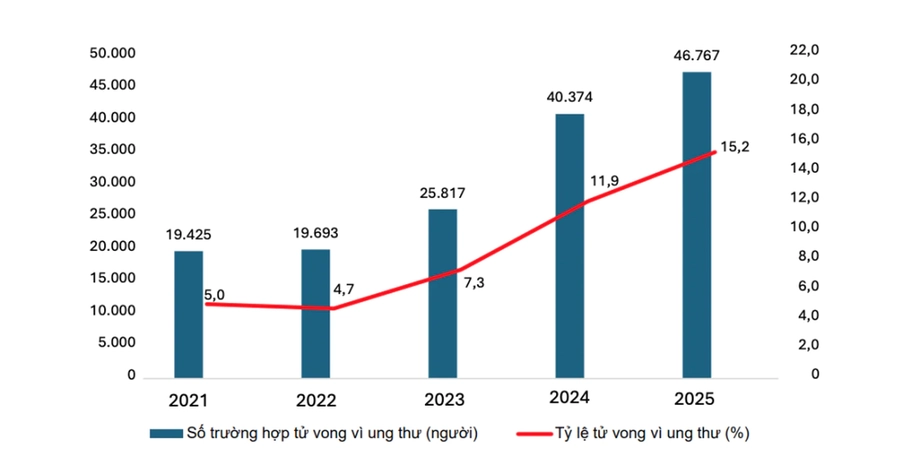
Cancer represented about 8.4% of deaths attributed to disease across the five years. Its annual share rose from roughly 5% in 2021 to 7.3% in 2023 and 15.2% in 2025. By the final year, around one in every seven deaths registered as caused by disease was attributed to cancer.
Vietnam's statistics agency also identifies improvements in recording, identifying and coding causes of death as a possible contributor to the increase. The figures therefore describe a growing recorded burden alongside changes in how completely the registration system captures it.
For health services, the findings point to two connected priorities: preventing and treating the cancers responsible for the most deaths, and improving the information used to decide where care is needed. Men accounted for about two thirds of recorded cancer deaths, and people aged 60 to 69 formed the largest age group.
How the annual toll climbed
Recorded cancer deaths rose every year, with the largest numerical increase occurring between 2023 and 2024. The annual figures trace the change:
- 2021: 19,425 recorded cancer deaths.
- 2022: 19,693 deaths.
- 2023: 25,817 deaths.
- 2024: 40,374 deaths.
- 2025: 46,767 deaths.
The increase between the first and final years was 27,342 deaths, or approximately 141%. Put simply, the system recorded about 2.4 cancer deaths in 2025 for every one recorded in 2021.
Cancer also took a larger share of deaths attributed to disease, rising by about 10.2 percentage points between 2021 and 2025. That change matters because it shows cancer becoming more prominent within the recorded disease burden, alongside the increase in the number of deaths.
The publication organises its results around the year of death registration events. Registration timing and the quality of cause information therefore form part of the explanation for the annual pattern. The contribution of better recording to the increase has not been quantified.
Lung and liver cancers dominate the toll
Lung cancer ranked first, accounting for an average of 22% of recorded cancer deaths during 2021 through 2025. Its share rose from 18% in 2021 to 24.9% in 2025, when it represented almost one quarter of the cancer toll.
Liver cancer ranked second, with an average share of 17.4%. Its proportion increased from 15.9% to 18.7% over the same period. The reported average shares for lung and liver cancers add up to 39.4%, placing these two diseases at the centre of Vietnam's recorded cancer mortality burden.
Tobacco use and air pollution are important risks for lung cancer. For liver cancer, the findings sit alongside Vietnam's continuing burden of hepatitis B, hepatitis C and chronic liver disease. Long lasting hepatitis infection can damage the liver over many years and increase the likelihood of cancer.
The two leading cancers require different prevention efforts. Reducing tobacco exposure addresses a major lung cancer risk, while hepatitis B vaccination and care for people with chronic hepatitis address important routes to liver cancer. Both also require access to diagnosis and treatment when disease develops.
Digestive cancers take a growing share
Stomach cancer's share of recorded cancer deaths rose from 4.7% in 2021 to 6.4% in 2025. Colorectal cancer, which affects the colon or rectum, increased from 3.5% to 6.6%, moving slightly above stomach cancer by the end of the period.
Together, these two cancers accounted for 13% of recorded cancer deaths in 2025, compared with 8.2% in 2021. Their combined share increased by 4.8 percentage points, showing why attention also needs to extend beyond lung and liver disease.
Diet, physical activity and family history are relevant to prevention and assessment of digestive cancers. A research review of cancer in Vietnam identified an association between family history and colorectal cancer diagnosed before age 50 in a study in Ho Chi Minh City.
Stomach cancer also has an important link to Helicobacter pylori, a bacterium that can live in the stomach. Treating the infection is one prevention measure identified in cancer control guidance. Decisions about testing, treatment and cancer screening depend on a person's circumstances and the services available.
Men bear most deaths, while women's needs also grow
Men accounted for approximately two out of every three recorded cancer deaths, a proportion that remained relatively steady throughout the five years. Lung, liver, stomach and colorectal cancers together represented 55.5% of male cancer deaths, compared with 50.6% of cancer deaths across both sexes.
The concentration among men gives prevention services a concrete group to reach. Earlier research documented high tobacco exposure among Vietnamese men: smoking prevalence fell from 56.1% in 2002 to 45.3% in 2015, but remained widespread at the end of that historical period.
Women faced a different mix of cancers. Cancers affecting the female reproductive system accounted for 13.6% of recorded female cancer deaths across 2021 through 2025. Their annual toll rose from 571 deaths in 2021 to 2,357 in 2025, while their share of female cancer deaths increased from 9% to 16%.
That category contains several diseases with different prevention and treatment needs. Cervical cancer, for example, has a strong connection to human papillomavirus, or HPV. Vaccination and screening are central tools for addressing that particular cancer, alongside timely care for women with abnormal findings.
People aged 60 to 69 form the largest group
People aged 60 to 69 accounted for 32.9% of recorded cancer deaths, close to one third of the total. The share rose sharply from age 40 and declined among people older than 80.
These figures describe how deaths were distributed across age groups. Measuring an individual's risk at each age requires another step: comparing deaths with the number of people living in that age group. For service planning, the concentration still identifies substantial demand among adults approaching or living through retirement.
Recorded cancer deaths also increased among people younger than 20. The published account gives no count or size of that increase. Children and adolescents therefore appear in the trend, while the largest recorded burden remains among middle aged and older adults.
Families caring for older patients may need help with transport, appointments, treatment costs and daily care. Cancer services must also accommodate patients with other illnesses, a practical concern when a large proportion of deaths occurs in older age groups.
Why registration quality matters
Do Thi Ngoc, deputy head of the National Statistics Office under the Ministry of Finance, presented the wider mortality findings at a workshop organised with the United Nations Population Fund and Vital Strategies. Disease accounted for 64.5% of all recorded deaths.
Among deaths attributed to disease, only 28% had a specific disease cause identified; 72% lacked that level of detail. The electronic civil registration system also recorded approximately 285,200 deaths with an undetermined cause during 2021 through 2025, equivalent to 10.2% of all registered deaths.
These categories describe different gaps. A record may identify disease as the broad reason for death while leaving the particular illness unspecified. Another record may leave the cause undetermined altogether. Both gaps make it harder to allocate services according to the illnesses affecting communities.
The national report uses Vietnam's list of 81 community causes of death to organise the records. Coding means assigning a recorded cause to a standard category so that information from different places can be counted consistently. The agency calls for stronger recording, certification, coding and information sharing between civil registration authorities and health services.
Registration itself is becoming more complete. The accompanying national civil registration report put death registration coverage at 91.4% in 2025, although only 63.9% of registered deaths were registered on time. Recorded stroke deaths also rose, from about 16,000 in 2021 to 33,100 in 2025, placing the cancer trend within a wider challenge of tracking major diseases accurately.
Why international estimates are much higher
Vietnam's death registration totals sit alongside international cancer estimates produced using cancer registry information and statistical models. A model uses available observations to estimate the wider burden, including where direct information is incomplete. Registered deaths and modelled estimates therefore answer different counting questions.
A review of cancer control, published in 2019, cited International Agency for Research on Cancer estimates of 114,871 cancer deaths in Vietnam in 2018. Liver cancer led that estimate with 25,404 deaths, followed by lung cancer with 20,710. The review also described weaknesses in national cancer registry information.
Figures reported as the agency's GLOBOCAN 2024 estimates put Vietnam's annual burden at 177,404 new cancer cases and 111,015 deaths. Within those estimates, lung cancer ranked first for mortality with 21,340 deaths, or 19.2%, followed by liver cancer with 13,664, or 12.3%.
For 2024, the civil registration series records 40,374 cancer deaths, compared with 111,015 in the reported GLOBOCAN estimates. The registration series counts deaths entered and classified in the administrative system; the international estimate aims to describe the broader population burden. Keeping those methods visible helps explain why readers encounter very different totals for Vietnam.
The historical review traced an increase in estimated cancer deaths from 37,700 in 1990 to 114,871 in 2018. Those earlier estimates add a longer perspective to the problem, while the registration report provides a more recent view of what Vietnam's civil records capture.
Prevention and care need to advance together
Vietnam's cancer control needs extend from reducing exposure to harmful substances and infections to helping people obtain diagnosis and treatment. The leading cancers make tobacco control, hepatitis prevention and management, and attention to digestive cancers practical priorities.
The 2019 review, drawing on evidence gathered through 2018, described gaps in organised screening, treatment capacity and financing. It reported that only 20% to 30% of cancer cases in the evidence it examined were diagnosed at an early stage, when disease is still relatively limited.
Earlier research collected in that review also documented heavy financial strain. An ASEAN study found that 68% of participating Vietnamese households affected by cancer experienced financial catastrophe within a year. Another analysis found that treatment costs pushed 37.4% of affected households into serious poverty. Those historical findings show why access involves affordability as well as hospital capacity.
Vietnam is developing its civil registration and vital statistics action programme for 2026 through 2030. More precise cause information can help authorities identify where prevention, diagnostic services and treatment resources are most needed, then track whether those efforts reach the people facing the greatest burden.
The immediate picture is concrete: lung and liver cancers dominate registered cancer deaths, digestive cancers take a growing share, and men account for most fatalities. Improving care and improving the records used to plan it are connected tasks.
Key Points
- Vietnam recorded approximately 152,100 cancer deaths during 2021 through 2025.
- The annual recorded toll rose from 19,425 to 46,767, an increase of about 141%.
- Lung, liver, stomach and colorectal cancers accounted for 50.6% of recorded cancer deaths.
- Men accounted for about two thirds of deaths; people aged 60 to 69 represented 32.9%.
- Better recording may explain part of the rise, while incomplete cause information remains a major challenge.
- International cancer estimates use different methods and give much higher totals than civil registration records.