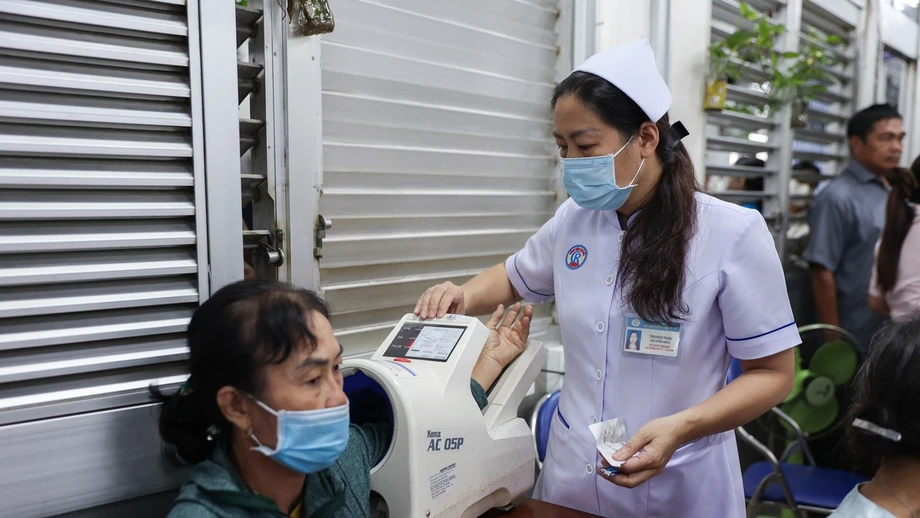
Millions face uncontrolled blood pressure as treatment advances
Vietnam has an estimated 16.9 million people aged 30 to 79 with high blood pressure, yet only 15% have it under control. The Vietnam National Heart Association now aims to raise that share to at least 50% by 2030, while hospitals expand procedures that can repair damaged hearts without opening the chest.
Contents
- Millions face uncontrolled blood pressure as treatment advances
- What the death figures show
- Why the 2030 blood pressure target matters
- Younger patients can carry damage for years
- Two patients show the cost of delaying care
- An ageing population brings more valve disease
- Catheters expand the options beyond open surgery
- Choosing a procedure means planning beyond today
- A national meeting turns attention to standards
- Key Points
The figures, drawn from the World Health Organization's 2025 Vietnam Hypertension Profile and presented at the national cardiology congress on October 3, 2026, expose a large gap between detecting disease and keeping patients healthy. About 51% of people with hypertension have been diagnosed, and 32% receive treatment.
Applied to the estimated 16.9 million patients, those rounded percentages suggest about 8.3 million remain undiagnosed and roughly 14.4 million lack adequate blood pressure control. Reaching 50% control would mean about 8.45 million people meeting their target, compared with approximately 2.54 million at present, if the patient population stayed the same.
Cardiovascular disease causes about 200,000 deaths annually in Vietnam, according to figures presented by cardiology leaders. Doctors are also treating younger adults whose hypertension, diabetes or damaged heart valves have progressed to heart failure.
Vietnam's response therefore has two connected tasks: prevent years of damage through regular community care, and make increasingly sophisticated hospital treatment accessible when disease becomes severe. Progress in one area depends on progress in the other. A repaired valve still needs follow-up, while a blood pressure diagnosis needs sustained treatment to reduce the chance of a future emergency.
What the death figures show
The WHO's Vietnam cardiovascular disease overview records more than 170,000 deaths in 2016, accounting for 31% of all deaths. Cardiologists have cited approximately 200,000 deaths and a 31% share for 2023; the Ministry of Health has also put the annual share at about 33%. The estimates place cardiovascular disease among Vietnam's largest causes of death.
Cardiovascular disease covers disorders of the heart and blood vessels, including heart attacks, strokes, heart failure and congenital heart conditions. Coronary arteries supply blood to the heart muscle. When that supply is blocked, part of the muscle can be damaged in a heart attack.
The WHO, the United Nations health agency, describes the need to identify people at risk and keep them in care:
People with cardiovascular disease or who are at high cardiovascular risk (due to the presence of one or more risk factors, such as hypertension, diabetes, hyperlipidaemia or already established disease) need early detection and management using counselling and medicines, as appropriate.
Worldwide, WHO estimates cited at the congress put cardiovascular deaths at 19.8 million in 2022, about 32% of all deaths. Approximately 85% involved heart attacks and strokes, and more than three quarters occurred in countries with low or middle incomes.
Why the 2030 blood pressure target matters
The Vietnam National Heart Association launched its 50/30 Charter on October 3 during the national cardiology congress in Da Nang. Its goal is to bring blood pressure under control for at least half of patients by 2030, up from about 15%.
Professor Pham Manh Hung, the association's president and head of the cardiology institute at Hospital 19-8, has described an approach extending from early diagnosis to treatment and continuing care in the community. For patients, that means a reliable place to have blood pressure checked, obtain appropriate medicines and return for monitoring.
Blood pressure measures the force of blood against artery walls. Persistently high pressure makes the heart work harder and damages blood vessels. The two numbers in a reading describe pressure when the heart contracts and when it relaxes; mmHg is the unit used to measure it.
Recommendations discussed at the congress included a treatment target below 130/80 mmHg, particularly for people with cardiovascular disease, diabetes or chronic kidney disease. Patients need their clinician to set an appropriate target and review treatment over time.
Hung cited evidence that lowering blood pressure by 5 mmHg can reduce the risk of stroke and heart failure by 13% each, coronary heart disease by 8%, and cardiovascular death by 5%. These are reductions in risk, rather than percentage point changes in the number of people who become ill.
Dr Ha Anh Duc, director of the Ministry of Health's Department of Medical Examination and Treatment, called for stronger primary care and continuous management between hospitals and community services. WHO's work in Vietnam similarly prioritises tobacco control, salt reduction, and hypertension and diabetes management at commune health stations.
Younger patients can carry damage for years
Vietnamese specialists describe cardiovascular patients in their 20s and 30s as increasingly familiar in specialist clinics. Hypertension, abnormal blood fats, diabetes, smoking, excess weight and inactivity can begin damaging the heart and circulation before someone notices symptoms.
Studies across eight provinces recorded hypertension in about 16.8% of participants in 2001 and 2002, rising to approximately 25% in a study of similar scale about eight years later. That is an increase of 8.2 percentage points. WHO's separate STEPS survey in 2015 found hypertension in 18.9% of adults aged 18 to 69, with only 13.6% of patients managed at a health facility; its age range and methods were different.
Figures presented in discussion of childhood health describe an average annual increase of 7.9% in the prevalence of overweight and obesity among people aged five to 19 between 2010 and 2025. Excess weight can contribute to high blood pressure, diabetes and other conditions that increase cardiovascular risk.
Heart failure is one possible result of prolonged damage. Associate Professor Pham Nguyen Vinh, vice president of the Vietnam National Heart Association and director of the cardiovascular centre at Tam Anh General Hospital in Ho Chi Minh City, explains it as a condition in which the heart cannot pump or receive enough blood to meet the body's needs.
At a national heart failure meeting in late 2025, specialists estimated that Vietnam had about 1.6 million people with the condition. A national epidemiological count is still lacking. At Cho Ray Hospital, director Pham Thanh Viet has described annual growth of about 15% in outpatient heart failure patients, adding pressure to continuing care services.
Global Burden of Disease figures cited in discussions of younger patients put the number of people aged 15 to 49 living with heart failure above seven million in 2021. The reported increase between 1990 and 2021 was 76.76%, with a projection exceeding eight million by 2035.
Two patients show the cost of delaying care
A man identified by the changed name Huy, aged 39, had been diagnosed with hypertension about a decade earlier. After initially taking medicine, he stopped treatment and follow-up when he felt well. He later learned he had heart failure and type 2 diabetes but again delayed care.
By the time he sought treatment for breathlessness and swollen legs, his ejection fraction was 14%. Ejection fraction measures the proportion of blood pushed out of the heart's main pumping chamber with each beat; the clinical account gave a normal value above 50%. Treatment improved his symptoms and raised the measurement to 21%, leaving his pumping function severely reduced.
Another patient, identified by the changed name Trung, aged 42, delayed recommended surgery for severe narrowing of the aortic valve for three years. He eventually developed chest pain and fatigue that prevented him from walking more than 500 metres. His heart had been working against the narrowed valve, and he developed heart failure and an irregular rhythm.
After surgery, his heart function improved to about 50%, although episodes of atrial fibrillation continued and required prescribed anticoagulant medicine to reduce stroke risk. Both cases show why feeling able to work or carry out daily activities can coexist with a heart condition that needs treatment.
An ageing population brings more valve disease
Vietnam is projected to have about 18 million people aged 60 or older by 2030, nearly four million more than in 2024. Ageing increases the likelihood of calcium buildup and degeneration in heart valves, while other illnesses can make treatment more complicated.
Heart valves act like gates, keeping blood moving in the right direction. A narrowed valve restricts flow. A leaking valve allows blood to move backwards. Either problem can force the heart to work harder and eventually contribute to heart failure.
The Vietnamese government's cardiac treatment update, published on November 7, 2026, cites specialist estimates that nearly 500,000 people older than 60 have some degree of aortic valve disease. Between 100,000 and 200,000 may have moderate or severe narrowing. These are specialist estimates, with a nationwide survey needed to establish the burden more precisely.
International studies cited by Vietnamese cardiologists found moderate or severe valve disease in 13.3% of people aged 75 or older. Severe aortic narrowing affected an estimated 3.4% of people older than 75, while moderate or severe mitral valve leakage affected 2.3% of those aged 65 or older. Vietnam needs its own patient data to plan services for its population.
Catheters expand the options beyond open surgery
Vietnam now has more than 140 interventional cardiology centres performing approximately 70,000 coronary artery procedures annually. Rapidly reopening a blocked coronary artery during a heart attack can limit damage to the heart muscle and improve survival.
Structural heart treatment addresses a different set of problems, involving valves, walls separating the chambers and other parts of the heart. Around 30 Vietnamese centres perform these procedures at varying levels. About 20 carry out transcatheter aortic valve implantation or replacement, known as TAVI or TAVR, with nearly 250 procedures annually.
During TAVI, doctors deliver a replacement valve through a catheter, often introduced through an artery in the thigh. Suitable patients can avoid opening the chest and may recover sooner. Alain Cribier and colleagues first performed the procedure in a person in 2002. A publication in 2025 recorded nearly three million recipients across more than 80 countries, with approximately 300,000 procedures annually worldwide.
Vietnamese hospitals are also developing catheter procedures to repair mitral and tricuspid valves. Devices that bring valve edges together can reduce backward blood flow in selected patients. Other procedures close abnormal openings, treat leaks around replacement valves or address deterioration in biological replacement valves.
The government's update describes 2025 recommendations from the European Society of Cardiology and the European Association for Cardio-Thoracic Surgery supporting TAVI for suitable patients aged 70 or older with severe narrowing of an aortic valve that has three leaflets. Here, three leaflets describes the aortic valve's structure, rather than the separate tricuspid valve on the heart's right side.
Choosing a procedure means planning beyond today
Age, the shape of the heart and blood vessels, other illnesses and the expected durability of a replacement valve all influence treatment decisions. A younger person may need further procedures over a lifetime, making the first choice especially consequential.
Three dimensional ultrasound and computed tomography help doctors examine anatomy, choose device sizes and plan how to reach the damaged structure. Artificial intelligence is also being used to support analysis and planning. The clinical team must bring that information together with the patient's condition and longer term needs.
A multidisciplinary heart team can include interventional cardiologists, imaging specialists, cardiac surgeons, anaesthesia and intensive care doctors, and nurses. Their work continues after a procedure through monitoring, medicines and checks for complications.
High device costs, patients' ability to pay, late diagnosis and uneven expertise between hospitals remain barriers in Vietnam. Expanding services therefore requires trained teams and dependable follow-up alongside equipment. For families, the practical issue is whether suitable treatment is reachable, affordable and supported after discharge.
A national meeting turns attention to standards
The 12th Vietnam Interventional Cardiology Conference, VICC 2026, was organised in Hai Phong on November 7 and 8 by the Vietnam Interventional Cardiology Society. Its programme brought together nearly 1,500 delegates, 83 scientific sessions and 328 presentations, with about 210 experts participating as speakers, chairs or discussants, including seven international experts.
Six live procedure sessions connected centres in Vietnam, Singapore and Taiwan. Two focused on TAVI, while the wider programme covered complex coronary interventions, structural heart disease and practical training.
The meeting introduced the 2026 consensus of the Vietnam National Heart Association and the Vietnam Interventional Cardiology Society on standardising cardiac catheterisation and interventional cardiology units. Priorities discussed included technical procedures, training, competency assessment, teamwork, complication management and tracking treatment results.
Training activities involved young doctors, nurses and technicians, including practice in ultrasound, circulation support and emergency care. Hung has also called for Vietnamese registries and research across multiple centres, so hospitals can learn from local anatomy, patient characteristics and treatment outcomes.
The main milestones connect decades of technical progress with the next public health deadline:
- 1996: The starting point used to mark Vietnam's development of interventional cardiology.
- 2002: Alain Cribier and colleagues performed the first TAVI procedure in a person.
- Late 2025: Vietnamese heart failure specialists estimated about 1.6 million patients nationally.
- October 3, 2026: The Vietnam National Heart Association launched its 50/30 blood pressure charter.
- November 7 and 8, 2026: VICC in Hai Phong presented advances and the consensus on standardising interventional units.
- 2030: The association aims for at least 50% blood pressure control, as Vietnam's population aged 60 or older approaches 18 million.
Key Points
- About 16.9 million Vietnamese adults aged 30 to 79 have hypertension; approximately 15% have it controlled.
- The 50/30 Charter targets blood pressure control for at least half of patients by 2030.
- Cardiology leaders cite approximately 200,000 cardiovascular deaths annually in Vietnam.
- Younger patients can develop severe heart failure after years of untreated hypertension or valve disease.
- About 20 centres perform TAVI, with nearly 250 procedures annually, while an ageing population increases demand.
- Community care, affordability, trained teams and continued monitoring are central to turning treatment advances into better health.