A closer look at a drone built to enter defended airspace
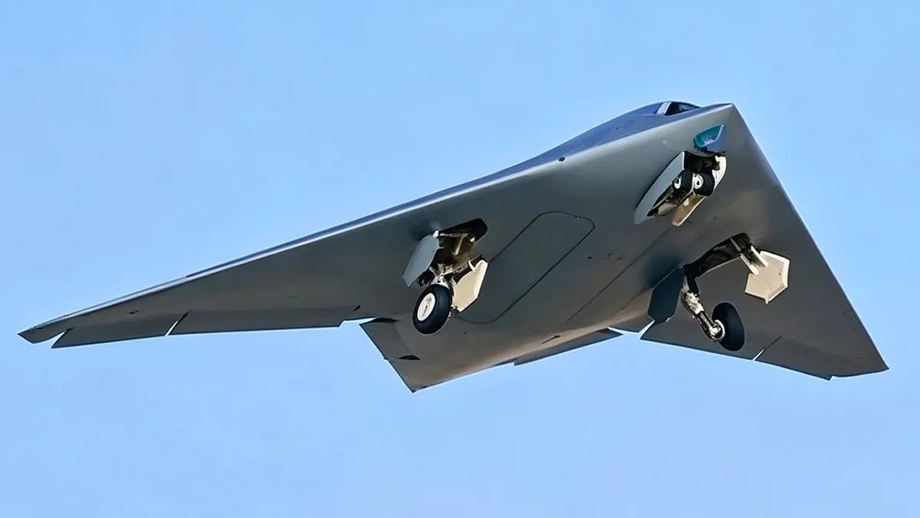
China has released detailed footage of its GJ-11 stealth combat drone, exposing two internal weapons bays, a shielded engine exhaust and a sensor window beneath the nose. The November 9, 2026 release also carried a claim that the aircraft had completed its first attack using a live weapon, hitting its target after cloud cover forced its operators to make another pass.
Contents
- A closer look at a drone built to enter defended airspace
- One weapon release after a second pass
- What the two weapons bays reveal
- How the aircraft tries to reduce detection
- A nose sensor and a more complete takeoff sequence
- How the GJ-11 could work with crewed fighters
- Training crews and moving the control station
- From public debut to aircraft in Tibet
- A naval relative aboard Sichuan
- Key Points
The footage appeared two days before the 77th anniversary of the founding of the People's Liberation Army Air Force (PLAAF). It follows satellite imagery showing three GJ-11 aircraft at Shigatse Air Base in Tibet in 2025 and earlier footage of the drone flying alongside Chinese crewed combat aircraft.
The aircraft, widely known as Sharp Sword and also called Xuanlong, is intended for reconnaissance, precision strikes and suppression of enemy air defenses. The last mission means finding and disrupting the radars and missile systems that threaten other aircraft, potentially allowing a larger formation to operate with less exposure.
China's latest presentation brings those roles together: a drone carrying weapons inside its body, receiving direction from people and potentially working ahead of J-20 stealth fighters and J-16 aircraft. Its operational fleet size, unit readiness, detailed sensor capabilities and integrated weapons remain undisclosed.
The most revealing part of the announcement may be the account of the strike itself. Operators described a practical problem, finding a target through cloud, and a decision to circle again before firing. Their account places human judgment at the center of a program often discussed in terms of autonomous warfare.
One weapon release after a second pass
PLAAF drone operators Shi Xiaoran and Fu Ting took part in the mission with other members of their crew. Both belonged to the air force's first group of female drone operators trained through its own program.
According to the account released by Chinese authorities, cloud obscured the target during the initial approach. Shi thought the aircraft might have to return with its weapon still aboard. The crew made another circuit, located the target and launched successfully.
Shi Xiaoran, a PLAAF drone operator, described the moment when the crew regained sight of its objective:
finally found the target
The reported sequence was a hit with the first weapon released, following a second pass to acquire the target. The date, location, target and munition were not disclosed, and the publicly released sequence omitted the weapon release.
Cloud cover matters because an optical targeting system needs a usable view of an object, while infrared equipment detects heat and can also face limits in poor atmospheric conditions. The GJ-11 footage shows a window consistent with such equipment beneath the nose. The strike account leaves the sensor and guidance method used unspecified.
A second circuit also takes time. For an aircraft operating near hostile defenses, locating a target promptly can be as important as the accuracy of the weapon. The crew's account shows how weather and decisions about when to fire remain central even when the aircraft has no pilot aboard.
What the two weapons bays reveal
Two separate weapons bays occupy the underside of the GJ-11, between its main landing gear. Each has doors with serrated edges, a feature used on stealth aircraft to manage radar reflections.
Carrying weapons inside the aircraft helps preserve its smooth external shape. Missiles, bombs and their mounting equipment can produce additional radar reflections when attached beneath wings. Internal carriage also avoids some of the drag created by external stores.
An Aviation Industry Corporation of China display at Airshow China in 2021 had already shown a model with two bays holding several precision guided bombs. The new footage offers a closer view of the actual aircraft's doors and their position within the body.
Published estimates suggest each bay might accommodate a weapon in the 1,000 pound class, possibly one in the 2,000 pound class. Those estimates concern the apparent space available; China has not released a confirmed loading arrangement or operational weapons list.
The practical choice could involve several smaller weapons or fewer larger ones, depending on their dimensions and the aircraft's carrying limits. Smaller weapons could allow attacks on more individual targets, while larger weapons could be selected for targets requiring greater destructive force.
Chinese accounts identify suppression of enemy air defenses as an intended mission. Weapons for that task could include precision guided munitions directed at known positions or weapons designed to home in on radar emissions. The public announcement identifies the mission without naming the GJ-11's equipment for carrying it out.
How the aircraft tries to reduce detection
The GJ-11 uses a tailless flying wing layout, blending its body and wings rather than having a conventional fuselage with upright tail surfaces. Its shape reduces the number of prominent surfaces that can return strong radar signals toward a receiver.
A flattened exhaust sits along the upper rear portion of the aircraft, partly shielded by the surrounding structure. The air intake is also on top. These arrangements are intended to limit views of engine components and reduce the aircraft's radar and infrared signatures, particularly from below.
Infrared sensors look for heat, including hot engine exhaust. Shielding an exhaust can make that heat harder to detect from certain directions. Radar detection depends on reflected radio waves, so shaping the aircraft and managing its edges address a different part of the same problem.
Chinese military affairs commentator Song Zhongping said the GJ-11 uses material that absorbs radar energy and that its exhaust nozzle received special treatment to improve stealth. Published descriptions have also associated the aircraft with a WS-13 turbofan, although the engine configuration has not been officially detailed.
Stealth performance depends on more than the outline of an aircraft. Its coating, construction, maintenance, viewing angle and the type of radar looking for it all affect detection. The new imagery shows the design choices China is displaying, while measured detection ranges and thermal performance remain undisclosed.
A nose sensor and a more complete takeoff sequence
A trapezoidal glazed fairing beneath the nose appears consistent with an electro-optical and infrared sensor installation. Similar looking systems on combat aircraft can help crews identify targets, track objects and direct precision weapons.
The installation has prompted comparisons with the targeting systems on China's J-20 and J-35 fighters. Its possible functions include providing imagery, tracking heat sources and using a laser to support weapon guidance. The precise functions fitted to the GJ-11 have not been announced.
The relatively compact forward section also leaves uncertainty about the size and capability of any onboard radar. Connections that exchange targeting information with other aircraft could give the drone access to observations made elsewhere in a formation. That would allow a target found by one aircraft to be attacked by another.
The new takeoff sequence shows the landing gear retracting after liftoff. In the November 2025 anniversary footage, the aircraft appeared with its gear still extended. The latest views also show a substantial nose landing gear assembly with two wheels.
Some aircraft in the footage carry a projecting nose boom used to collect air data during testing. Small diamond shaped features are visible on upper surfaces as well, but their function is unknown. Some hangar sequences appear to reuse earlier imagery, so the release combines views from different stages rather than presenting one continuous flight.
How the GJ-11 could work with crewed fighters
Chinese descriptions place the GJ-11 within a formation rather than treating it simply as an independent strike drone. The latest coverage includes mission planning involving J-16 and J-20 fighters, while November 2025 footage showed the drone flying with a J-20 and a J-16D electronic warfare aircraft.
A J-16D is designed for electronic warfare, including interfering with hostile radar and communications. Pairing that role with a stealth fighter and an armed drone would let different aircraft share the jobs of finding threats, disrupting them and attacking selected targets.
The PLAAF presentation describes drones scouting air defenses, acting as decoys and releasing guided weapons under direction from crewed aircraft. A decoy can draw attention or encourage an opponent to switch on a radar, revealing a position that other aircraft may then locate.
The two seat J-20S has frequently been discussed as a possible airborne command platform for drones, with a second crew member helping manage the wider formation. Chinese footage from 2022 suggested such a role, while the 2025 formation included a J-20 with a single seat.
The latest account shows people directly involved in controlling the mission and deciding when to release a weapon. Details of the communications links, division of tasks and degree of independent decision making assigned to the drone remain undisclosed.
For crews, sharing tasks across several aircraft could mean one platform searches while another carries weapons or stays farther from a threat. For an opponent, several connected aircraft create more objects and activities to track at once. Reliable communications become a central requirement for that approach.
Training crews and moving the control station
Shi and Fu reportedly took about five months to progress from newcomers to trained drone operators. Shi logged more than 100 hours on a simulator developed by the unit, practicing aircraft control, emergency procedures and weapon employment.
Shi Xiaoran, describing the demands of the job, placed the focus on experience:
None of this has anything to do with gender, only with proficiency and hours of operation
Shi also described drone sorties as typically lasting more than six hours. Her comments concerned the demands of drone operations generally; no official GJ-11 endurance figure accompanied the announcement.
Long missions require operators to maintain attention even during uneventful periods, then respond quickly when weather, a target or an equipment problem changes the situation. Simulator practice allows crews to rehearse rare emergencies and complex weapon sequences without flying the aircraft each time.
Chinese authorities also said the integrated control station and its operators can be loaded onto a military transport aircraft. That gives the unit a way to move the people and equipment needed to direct missions between bases. Aircraft maintenance, weapons supplies and dependable communications would still be needed at the destination.
From public debut to aircraft in Tibet
The GJ-11's development has become visible through parade appearances, test activity, satellite imagery and formation flights. Published accounts place service entry no later than late 2025, although the size of the force has not been announced.
The main public milestones span several years:
- 2018: Sightings of GJ-11 prototypes became more frequent.
- October 2019: The aircraft made a major public appearance during China's national anniversary military parade.
- 2021: An Airshow China model displayed the two internal weapons bays and multiple bombs.
- 2022: Chinese footage suggested a possible control role for J-20 aircraft with two seats.
- August to September 2025: Three GJ-11 aircraft were observed at Shigatse; satellite imagery was published in October.
- November 2025: Footage showed the GJ-11 flying with J-20 and J-16D aircraft, alongside announcements of service entry.
- November 9, 2026: China released the closer views and the account of a successful live weapon attack.
Shigatse Air Base sits at an estimated elevation of 3,782 meters in Tibet, near India's frontier. The presence of three aircraft there placed the design at a demanding, high altitude airfield beyond its better known development locations.
GJ-11 activity has also been observed at Malan in Xinjiang, including imagery from 2024 and accounts of frequent flights. Aviation researcher Andreas Rupprecht has assessed visible aircraft numbers as consistent with examples from an initial production run at a low rate.
The distinction between the dates of the Shigatse sightings and the later publication of imagery helps explain references to both an August to September presence and an October deployment disclosure. The duration and purpose of the stay have not been announced.
A naval relative aboard Sichuan
China's latest air force presentation follows an October 30, 2026 announcement that the related GJ-21 completed a takeoff and an arrested landing aboard Sichuan, the first Type 076 amphibious assault ship.
The wording attributed to the Chinese military said the GJ-21 "recently made its first successful take-off and landing on 076 amphibious assault ship, the 'Sichuan'." That wording does not specify an arrested landing, although the People's Liberation Army Navy was also reported as saying the drone completed its first takeoffs and arrested recoveries aboard the ship.
Sichuan has an electromagnetic catapult, which accelerates an aircraft along the flight deck for launch. An arrested landing uses equipment that catches the returning aircraft and brings it to a stop within a short distance.
Chinese descriptions identify the GJ-21 as a naval stealth drone intended for reconnaissance and strike missions. Public imagery of the announced flights at sea was unavailable in the accounts of the milestone.
The GJ-11's substantial landing gear has prompted suggestions that components might be shared with the naval aircraft. Published assessments also envisage GJ-21 operations from larger carriers such as Fujian. The confirmed public claim concerns the demonstration aboard Sichuan.
A ship based version would give China another direction from which to conduct reconnaissance and launch strikes, alongside aircraft flying from land bases. Together, the Shigatse sightings and the Sichuan announcement show the geographic breadth of China's ambitions for this aircraft family: operations from high altitude inland bases and, through a related design, from the sea.
Key Points
- China released detailed GJ-11 footage on November 9, 2026, ahead of the PLAAF's 77th anniversary.
- The footage shows two internal weapons bays, a shielded exhaust, a nose sensor window and retracting landing gear.
- Operators Shi Xiaoran and Fu Ting participated in a reported strike that hit with the first weapon released after a second pass to find the target.
- China identifies reconnaissance, precision strikes and suppression of air defenses among the drone's intended missions.
- Three GJ-11 aircraft were observed at Shigatse in 2025, and earlier footage showed cooperation with crewed fighters.
- China has also announced a GJ-21 takeoff and landing aboard Sichuan; the Navy was reported as specifying arrested recoveries, although the quoted military wording does not.
- Fleet size, detailed weapons integration, operational readiness and the extent of autonomous control remain undisclosed.