Parliament Passes Controversial Legislation Amid Outcry
India’s Parliament passed the Transgender Persons (Protection of Rights) Amendment Bill, 2026, on March 25, sparking immediate protests across multiple cities and fierce criticism from opposition parties, human rights organizations, and the transgender community itself. The legislation, which seeks to amend the 2019 Transgender Persons Act, now awaits the President’s assent to become law. While the government maintains the changes will streamline welfare benefits and prevent exploitation, critics argue the bill strips away fundamental rights established by the Supreme Court in 2014 and threatens to erase thousands of legally recognized transgender persons from official records.
- Parliament Passes Controversial Legislation Amid Outcry
- Reversing a Decade of Progress
- Medical Scrutiny Replaces Self Determination
- Narrowing Who Counts as Transgender
- The Architecture of Erasure
- Protests Erupt Across the Nation
- Criminalizing Community Support
- Government Defends Narrow Approach
- Global Pattern of Rights Contraction
- Key Points
Reversing a Decade of Progress
The current controversy represents a dramatic shift from the legal framework established just over a decade ago. In April 2014, the Supreme Court of India delivered a landmark judgment in National Legal Services Authority v. Union of India, commonly known as the NALSA judgment. The two judge bench recognized transgender persons as a “third gender” and affirmed that the right to self identification of gender falls under Article 21 of the Constitution, which guarantees personal liberty.
Justice K.S. Radhakrishnan, writing for the court, explicitly rejected what he termed the “Biological Test” for determining gender. The judgment stated that “gender identity is integral to the dignity of an individual” and declared that “any insistence for sex reassignment surgery for declaring one’s gender is immoral and illegal.” The court directed both central and state governments to grant legal recognition of self identified gender without requiring medical procedures.
Parliament responded with the Transgender Persons (Protection of Rights) Act in 2019. While activists criticized various provisions of that law as well, it nevertheless encoded the core principle that gender identity is self perceived and decoupled legal recognition from surgical requirements. The 2026 Amendment Bill now seeks to reverse these constitutional protections.
Medical Scrutiny Replaces Self Determination
The most significant change proposed by the new bill involves the process for obtaining legal recognition. Under the 2019 law, district magistrates issued certificates of identity based on self declaration. The 2026 bill removes this right to “self perceived gender identity” entirely and replaces it with a mandatory two stage medical evaluation process.
First, applicants must obtain certification from a medical board headed by a Chief Medical Officer or Deputy Chief Medical Officer. These boards will evaluate whether individuals meet specific biological criteria including chromosomal patterns, gonadal development, hormonal production, or primary sexual characteristics. After this medical clearance, district magistrates retain discretionary power to seek additional evaluations from “other medical experts” before issuing certificates.
Activists describe this as an institutionalization of humiliation. Grace Banu, a prominent transgender rights activist, addressed a public hearing in Delhi with raw emotion.
Strangers probing our bodies, demanding proof of who we are, our privacy shattered, our dignity crushed. Who gave anyone the right to decide my gender for me?
Narrowing Who Counts as Transgender
The amendment dramatically narrows the legal definition of “transgender person.” While the 2019 Act included broad categories covering trans men, trans women, genderqueer individuals, and intersex persons, the new bill limits recognition to specific named sociocultural identities including kinner, hijra, aravani, jogta, and eunuch, plus persons with specified “congenital variations” in sex characteristics.
This definition explicitly excludes “persons with different sexual orientations and self perceived sexual identities.” For thousands of trans men and trans women who do not belong to traditional hijra or kinner communities, this creates a legal vacuum. Rituparna Neog, a member of the National Council for Transgender Persons who resigned in protest, noted that regional identities from the northeast such as Nupi Maanba and Nupi Maanbi from Manipur are absent from the list.
Does this mean that in the northeast, we are not found in the sociocultural framework? Does it mean the entire north east’s trans people will be wiped out?
The bill also dissolves the separate legal category for intersex persons, folding them into a medicalized framework of “congenital variations” that implies conditions requiring correction. Intersex activist Daniella Mendonca challenged this framing.
Congenital variation means something that can be corrected. But what if I don’t want to be corrected? Are you stopping me from doing that?
The Architecture of Erasure
Perhaps the most constitutionally alarming provision appears in a brief seven word clause. The bill states that the category of transgender person “shall not include, nor shall ever have been so included” persons with self perceived identities. This retrospective language attempts to reach backward in time and delegitimize the legal identities of thousands who obtained recognition under the 2019 law.
The government has issued more than 32,000 transgender certificates since 2019. The bill contains no transitional provisions explaining what happens to these existing certificates. It simply declares that those people were never who they said they were.
Additionally, the bill requires every medical institution performing gender affirming surgery to “furnish the details of such person to the concerned District Magistrate.” This creates a mandatory reporting system that critics argue violates the informational privacy protections established by the Supreme Court in the 2017 Puttaswamy judgment. The Supreme Court held that privacy includes the right to prevent information about oneself from being disseminated without consent.
Protests Erupt Across the Nation
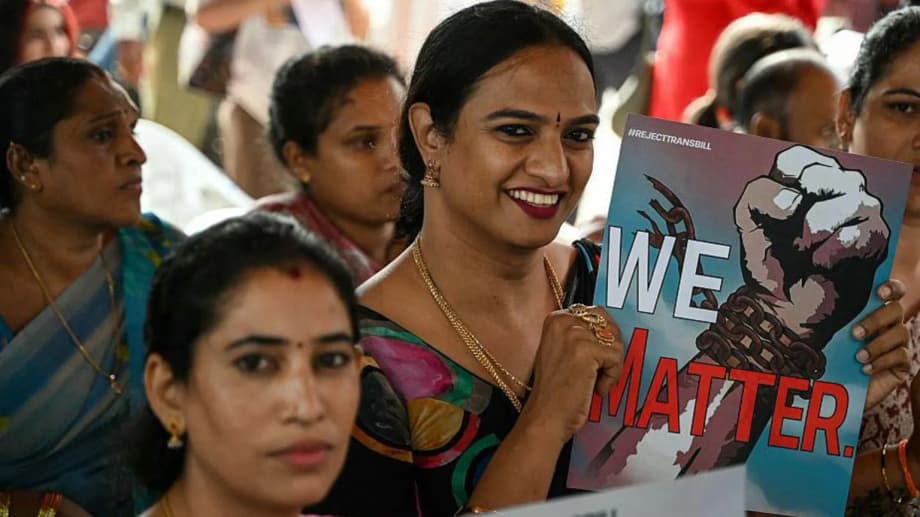
Within hours of the bill’s introduction on March 13, coordinated protests began emerging in cities across India. Demonstrations occurred in Delhi, Mumbai, Chennai, Bengaluru, Hyderabad, Kolkata, Pune, Goa, and Bhubaneswar, among other locations. Student organizations, civil society groups, and LGBTQ collectives organized press conferences, street demonstrations, and petition drives.
Two members of the statutory National Council for Transgender Persons resigned immediately after the bill passed. Kalki Subramaniam, the southern region representative, wrote in her resignation letter to Social Justice Minister Virendra Kumar:
As a statutory representative, my primary mandate is to advise the government on legislation affecting our lives. The decision to move this Bill forward without any formal consultation with myself or other community representatives undermines the very purpose for which this Council was established.
Rituparna Neog, representing the northeast, submitted a similar resignation. “From NCTP, some of us tried to reach out to you as the voice of the community and we felt that we were not heard,” she wrote.
Opposition political parties joined the outcry. Congress leader Rahul Gandhi called the bill a “brazen attack” on transgender rights. RJD MP Manoj Kumar Jha stated the bill should be “thrown into the dustbin.” Congress MP Renuka Chowdhury posed a pointed question during parliamentary debate: “If no one asks us, men and women, to prove our gender before a medical board, then who are we to question the identity of trans people?”
Criminalizing Community Support
The bill introduces new criminal offenses carrying sentences of up to life imprisonment, built on the premise that transgender identity is often coerced rather than self determined. Provisions criminalize “compelling” children to “outwardly present a transgender identity” and create severe penalties for anyone accused of forcing others into transgender identity through “mutilation, emasculation, castration, amputation, or any surgical, chemical, or hormonal procedure.”
While the government frames these provisions as protections against exploitation, activists argue they criminalize the very support structures that sustain transgender communities. Many transgender individuals are abandoned by biological families and find survival through chosen families, community organizers, and traditional hijra jamaats. Under the new law, anyone assisting a young person exploring their gender identity could face prosecution.
Kanmani, an advocate for trans and intersex persons, warned about the consequences.
You are empowering every parent, every family that wants to put a trans person through violence, to also put the people supporting them through violence. Every NGO, every Hijra Aravani jamaat is going to face this threat.
The framing echoes the colonial era Criminal Tribes Act of 1871, which criminalized entire communities including eunuchs and presumed them to be kidnappers. The Supreme Court in the 2014 NALSA judgment specifically called this “brutal legislation with a vicious and savage mindset.”
Government Defends Narrow Approach
Social Justice Minister Virendra Kumar has defended the amendments, arguing that the existing definition of “transgender” was too vague and open to misuse. He maintains that the changes are necessary to ensure welfare benefits reach only those who genuinely need protection and face “extreme and oppressive” discrimination due to biological conditions.
The bill’s Statement of Objects and Reasons reads: “The protection and benefits that are provided under the Act are vast in nature. Care has to be taken that such identification cannot be extended on the basis of any acquirable characteristics or personal choice or claimed self perceived identity of an individual.”
Government officials reportedly told protesting community members during a meeting on March 22 that their suggestions could not be considered because they fell outside the bill’s ambit. Senior ministry officials allegedly told National Council members there was “no need to consult you all” regarding the legislation.
Global Pattern of Rights Contraction
The Indian legislation emerges within a broader international context of transgender rights erosion. The Transgender Europe Association’s 2025 Trans Rights Index recorded the first year in its thirteen year history where more rights were taken away globally than were gained. Hungary has amended its constitution to recognize only two genders. The United Kingdom’s Supreme Court ruled in 2025 that for equality law purposes, sex means biological sex. In the United States, the Trans Legislation Tracker recorded 740 anti trans bills under consideration across 42 states in 2026 alone.
Critics note that the Indian bill shares ideological grammar with these global trends: substituting state and medical verification for self determination, invoking protection against exploitation to justify surveillance, and asserting that trans identity is acquired rather than intrinsic.
Key Points
- Parliament passed the Transgender Persons (Protection of Rights) Amendment Bill, 2026 on March 25; it awaits Presidential assent
- The bill removes the right to self identified gender established by the Supreme Court in the 2014 NALSA judgment
- Medical boards must now certify transgender identity based on biological criteria including chromosomes and genitalia
- The definition narrows to specific traditional identities (hijra, kinner, aravani, jogta) and excludes many trans men, trans women, and non binary persons
- A retrospective clause threatens to invalidate over 32,000 existing transgender certificates issued since 2019
- Two members of the National Council for Transgender Persons resigned in protest, citing lack of consultation
- Nationwide protests occurred in Delhi, Mumbai, Chennai, Bengaluru, Hyderabad, and other cities
- Opposition parties including Congress, RJD, DMK, and TMC demanded the bill be withdrawn or sent to committee
- New criminal provisions could target community support networks and chosen families
- Activists plan legal challenges citing violations of constitutional rights to privacy, dignity, and equality